Showing posts with label Battle of Gettysburg. Show all posts

Friday, March 05, 2021

Notable and Forthcoming: Meade at Gettysburg, A Study In Command

Meade At Gettysburg: A Study in Command, Kent Masterson Brown, Esquire, University of North Carolina Press, 488 pp., 70 illustrations, 13 maps, bibliographic notes, index, June 2021, $ 35.00.

Although he took command of the Army of the Potomac only three days before the first shots were fired at Gettysburg, Union general George G. Meade guided his forces to victory in the Civil War's most pivotal battle. Commentators often dismiss Meade when discussing the great leaders of the Civil War. 
 
But in this long-anticipated book, Kent Masterson Brown draws on an expansive archive to reappraise Meade's leadership during the Battle of Gettysburg. Using Meade's published and unpublished papers alongside diaries, letters, and memoirs of fellow officers and enlisted men, Brown highlights how Meade's rapid advance of the army to Gettysburg on July 1, his tactical control and coordination of the army in the desperate fighting on July 2, and his determination to hold his positions on July 3 insured victory. 
 
Brown argues that supply deficiencies, brought about by the army's unexpected need to advance to Gettysburg, were crippling. In spite of that, Meade pursued Lee's retreating army rapidly, and his decision not to blindly attack Lee's formidable defenses near Williamsport on July 13 was entirely correct in spite of subsequent harsh criticism.
 
Combining compelling narrative with incisive analysis, this finely rendered work of military history deepens our understanding of the Army of the Potomac as well as the machinations of the Gettysburg Campaign, restoring Meade to his rightful place in the Gettysburg.
 
Kent Masterson Brown an award-winning writer, filmmaker, and attorney residing in Lexington, Kentucky. His previous books include Retreat from Gettysburg: Lee, Logistics, and the Pennsylvania Campaign


Friday, March 13, 2020

New and Noteworthy: Lee Is Trapped And Must Be Taken

"Lee is Trapped, and Must be Taken": Eleven Fateful Days after Gettysburg: July 4 - 14, 1863, Thomas Ryan, Savas Beatie Publishing, 342 pages, 33 illustrations, index, bibliography, $32.00, 2019. 

 A remarkable accomplishment of scholarship. Using scores of enlisted men's letters and reflections, commissioned officers' reports, newspaper, and civilian recollections Ryan and Schaus offer a fast-paced, day-by-day account of the decisions and the happenstances of the Army of Northern Virginia's flight from Gettysburg Battlefield as the Army of the Potomac attempts to catch the fast-moving Rebels. 'Lee Is Trapped and Must Be Taken' is now must-reading alongside Brown's 'Retreat From Gettysburg', and Wittenberg's/Petruzzi's/Nugent's 'One Continuous Fight'.

 Front cover

Tuesday, January 14, 2020

New and Noteworthy: Gettysburg: The Living and The Dead as Viewed by a Poet and a Photographer

GettysburgGettysburg: The Living and the Dead, Kent Gramm with photography by Chris Heisey, Souhtern Illinois University Press, 225 pp, profusely illustrated, 2019, hardcover, $29.95.

Reviewed by Matthew A. Borders, (National Park Service, American Battlefield Protection Program; review published by H0Civil War, January 2020.
 
I knew that this work, Gettysburg: The Living and the Dead, would be a challenge from the beginning. An artistic work, the book looks at the largest battle ever fought in the Western Hemisphere through a myriad of lenses, peoples, times, and writings. This is not, nor does it purport to be, another military history of the Battle of Gettysburg. That being said, it is set up in a manner that would familiar to anyone who has read military histories of the battle. Gettysburg has four distinct chapters, covering the first day of fighting with twenty separate entries, the second day with thirty-five entries and the third day with fourteen entries. It ends, as many histories of the battle do, with a chapter on the aftermath, which contains nineteen individual entries.

Each entry, be it a poem or short story, is accompanied by an image. This structure struck me not only as a familiar choice, but also possibly a deliberate one to help the reader. As most are already familiar with the three traumatic days of the battle, this structure seems designed to place the reader into the right mind-set of each day and its aftermath.

That may be the reason why I found the first chapter so jarring. Set up as it is, even with a snippet of the famous 1889 Joshua Lawrence Chamberlain speech just before the table of contents to set the stage, the first chapter has little to do with the Battle of Gettysburg as the opening poems are broad enough to describe almost any conflict. This is not a bad thing, and in fact can bring the past and present closer together as it reveals shared passions, fears, and sorrows. As the chapter continues, however, Gramm also reveals much of himself. There are numerous references to the Vietnam War in this chapter (entry 8: Blood Trail, entry 9: 'Stang, entry 18: Stayin' Alive) and sprinkled throughout the book. The war is seen as a mistake and or something to be protested by the author.
Some of his stories go so far as to use the memory of historical figures from the Battle of Gettysburg as inspiration for these protests. There are several very well-written short stories in this chapter taken from the soldier's perspective and even one apparently real letter from a migrant worker in 1927 who worked in the orchards around Gettysburg. In all, this is a very scattered chapter that feels lacking in focus.

Much like the second day of the Battle of Gettysburg itself, which saw the longest period of fighting, stretching well into the night on some parts of the field, the second chapter is the longest. It is also where I feel the book finds its focus. Of the thirty-five entries, again mostly poems and short stories, the majority focus on the Battle of Gettysburg or its participants. It is also where we start to see a large helping of one of the subthemes of Gettysburg, the supernatural. This had been hinted at since the beginning of the book, but over a third of the entries of this chapter have to deal with ghosts or spirits tied to or trapped on the battlefield, for any number of reasons. Some are trying to communicate with the living to dissuade us from repeating the follies of history, some are still fighting the battle, and some are searching for fallen loved ones. This a theme that is hard to escape in Gettysburg, as the town itself is awash in ghost tours of dubious quality and historic accuracy.

The best aspect of Gettysburg: The Living and the Dead is the bravery of the author to tell his stories and poems through a broad range of voices. Both Union and Confederate soldiers are portrayed, sometimes with sympathy towards their enemies, often with the passions and hatreds of the war on full display. We hear the voices of women—those caring for the wounded, watching over the dead, pining for the lost, or educating the current generation. Veterans both old and new are written about, as are former rangers, battlefield guides, museum curators, and even a reenactor in one story. I will admit I was surprised to see the author use an African American dialect in two of his entries, a bold decision and a commendable effort to include the whole story of the region. The story that spoke to me the most, however, and which in today's climate of intolerance struck me deeply, comes nearly at the end of the work, entry 85: North and South (pp. 207-09). Two fathers, one from Wisconsin and one from North Carolina, tour the battlefield together, discussing fatherhood, loss, and the war. Both are products of their regional bias, neither having really dealt with anyone from the other side of the Mason-Dixon Line. This story ends with two men having a better understanding of the other and a promise to memorialize a loss from a much more recent conflict. I sincerely hope that this story, presented from the perspective of a writer, is the fulfillment of that promise.

It would be a mistake to review Gettysburg: The Living And The Dead without touching on the beautiful photography of Chris Heisey. The images are as diverse as the stories and poems themselves, and sometimes suffer from the same out-of-place feeling that some of the writings have. Every poem or story has at least one image attached to it. Most of these are dramatic shots of the battlefield landscape or the monuments on it. Entry 31: War Means Fighting (pp. 79) is one such example of an oddity, as it has a praying mantis on page 78 to accompany the story. Surprisingly, almost a quarter of the images are wintry shots of the battlefield or monuments, and there are numerous autumnal landscape shots. Considering the sweltering July conditions in which the battle was fought, the snow-and-ice-covered images are beautiful, if unexpected.

While I had some concerns reading this work, I am glad I did. Our cultural landscapes, even our most studied, such as Gettysburg National Military Park, have meant and continue to mean different things to different people. While I may not understand all of the author and the photographer's perspectives and choices for Gettysburg: The Living and the Dead, it is obvious that they care deeply for this historic landscape, the history that happened here, and its visitors.

Citation: Matthew A. Borders. Review of Gramm, Kent; Heisey, Chris, Gettysburg: The Living and the Dead. H-CivWar, H-Net Reviews. January, 2020. URL: http://www.h-net.org/reviews/showrev.php?id=54316

Wednesday, January 02, 2019

New and Noteworthy: Marching, Plundering and Payback with Ewell's Corps in Maryland and Pennsylvania


At The Forefront of Lee's Invasion: Retribution, Plunder, and Clashing Cultures on Richard Ewell's Road To Gettysburg, Robert J. Wynstra, Kent State University Press, 2018, 352 pp., 39 illustrations, 5 maps, bibliographic notes, bibliography, index, $49.50.

Civil War Librarian: Students of the Gettysburg Campaign are well served by Robert Wynstra's At The Forefront of Lee's Invasion. He fully integrates the Confederate cavalry's reconnaissance efforts with the progress of Ewell's corps' march from June 10 to July 1.The positive and negative attributes of the corps' division and brigade commanders as well as cavalry commander Albert Jenkins' are fairly presented. Diaries, letters and recollections by infantrymen, cavalrymen and their commanders are on every page. Wynstra's offers splendid, rarely seen photographs collected by county historical societies. Also, dominating the story are the civilian accounts of their encounter with Ewell's troops.  The author discusses Lee's directives regarding the difference between fair seizures of private property, plundering, and theft, Ewell's understanding of the directives, and the troops constant hunger along with the replacement of worn out uniforms and brogans. Also, included are the issues of collecting African Americans for their return to slavery and white civilians resistance to that collecting.  The Pennsylvania emergency militia's localized and haphazard encounters with the invasion are not neglected by the author. Wynstra's At The Forefront of Lee's Invasion is a splendid effort and achieves a bit of suspense in regard to the Confederates' approach to Gettysburg. If, before the battle, another week had been available  . . . .


From the Publisher: After clearing Virginia’s Shenandoah Valley of Federal troops, Gen. Robert E. Lee’s bold invasion into the North reached the Maryland shore of the Potomac River on June 15, 1863. A week later, the Confederate infantry crossed into lower Pennsylvania, where they had their first sustained interactions with the civilian population in a solidly pro-Union state. Most of the initial encounters with the people in the lush Cumberland Valley and the neighboring parts of the state involved the men from the Army of Northern Virginia’s famed Second Corps, commanded by Lt. Gen. Richard S. Ewell, who led the way as Lee’s veteran soldiers advanced north toward their eventual showdown with the Union army at the crossroads town of Gettysburg.

The move to the North lasted for nearly a month and encompassed the major battle at Winchester, Virginia, with more than 5,000 casualties; five skirmishes with more than 100 men killed, wounded, and captured in each; and several other minor actions. Civilian property losses in the North amounted to several million dollars. The interactions along the way further laid bare the enormous cultural gulf that separated the two sides in the war. As Robert Wynstra explains, Ewell and his top commanders constantly struggled to control the desire among the troops to seek retribution for what they perceived as Federal outrages in the South and to stop the plundering, working to maintain strict discipline in the army and uphold Southern honor.

Despite the yearly flood of books on Gettysburg, the Confederate advance has been largely ignored. Most books devote only a few pages or a single short chapter to that aspect of the campaign. In this new study, Wynstra draws on an array of primary sources, including rare soldiers’ letters and eyewitness accounts published in local newspapers, manuscripts and diaries in small historical societies, and a trove of postwar damage claims from the invasion to fill in this vital gap in the historiography of the campaign.

Thursday, May 24, 2018

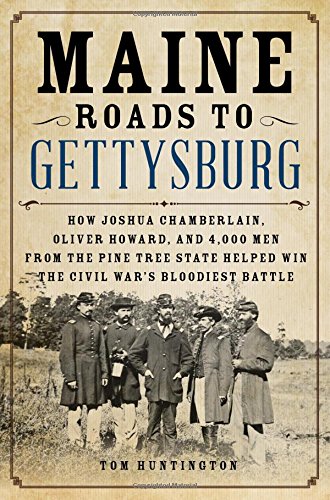
New and Noteworthy: Maine Roads To Gettysburg

 Maine Roads to Gettysburg: How Joshua Chamberlain, Oliver Howard, and 4,000 Men from the Pine Tree State Helped Win the Civil War's Bloodiest Battle, Tom Huntington, Stackpole Press, 432 pages, 2018, $32.95
From the Publisher:  Joshua Lawrence Chamberlain and his 20th Maine regiment made a legendary stand on Little Round Top during the Battle of Gettysburg in July 1863. But Maine's role in the battle includes much more than that. Soldiers from the Pine Tree State contributed mightily during the three days of fighting. 
Pious general Oliver Otis Howard secured the high ground of Cemetery Ridge for the Union on the first day. Adelbert Ames--the stern taskmaster who had transformed the 20th Maine into a fighting regiment--commanded a brigade and then a division at Gettysburg. 
The 17th Maine fought ably in the confused and bloody action in the Wheatfield; a sea captain turned artilleryman named Freeman McGilvery cobbled together a defensive line that proved decisive on July 2; and the 19th Maine helped stop Pickett's Charge during the battle's climax.
  
Maine soldiers had fought and died for two bloody years even before they reached Gettysburg. They had fallen on battlefields in Virginia and Maryland. They had died in front of Richmond, in the Shenandoah Valley, on the bloody fields of Antietam, in the Slaughter Pen at Fredericksburg, and in the tangled Wilderness around Chancellorsville. And the survivors kept fighting, even as they followed Robert E. Lee's Army of Northern Virginia into Pennsylvania.  Maine Roads to Gettysburg tells their stories.

Tom Huntington is the author of Searching for George Gordon Meade: The Forgotten Victor of Gettysburg, as well as Guide to Gettysburg Battlefield Monuments, Pennsylvania Civil War Trails, and Ben Franklin’s Philadelphia. He is also the former editor of American History and Historic Traveler magazines, and his writing has appeared in many publications, including Smithsonian, Air & Space, American Heritage, British Heritage, and Yankee. He was born and bred in Augusta, Maine, but now lives in Camp Hill, Pennsylvania, not far from Gettysburg.

Friday, October 27, 2017

Forthcoming---A Vast Sea of Misery: The Classic To Be Reissued

A Vast Sea of Misery: A History and Guide To the Union and Confederate Hospitals at Gettysburg, June 1-November 20, 1863, Gregory Coco,  Savas Beatie Publishing, Paperback, 224pages, profusely illustrated, maps, appendices, index, bibliographic endnotes,   $19.95 On Sale: January 15, 2018

Nearly 26,000 men were wounded in the three-day battle of Gettysburg (July 1-3, 1863). It didn't matter if the soldier wore blue or gray or was an officer or enlisted man, for bullets, shell fragments, bayonets, and swords made no class or sectional distinction. Almost 21,000 of the wounded were left behind by the two armies in and around the small town of 2,400 civilians. 

Most ended up being treated in makeshift medical facilities overwhelmed by the flood of injured. Many of these and their valiant efforts are covered in Greg Coco's A Vast Sea of Misery: A History and Guide to the Union and Confederate Field Hospitals at Gettysburg, July 1-November 20, 1863.

The battle to save the wounded was nearly as terrible as the battle that placed them in such a perilous position. Once the fighting ended, the maimed and suffering warriors could be found in churches, public buildings, private homes, farmhouses, barns, and outbuildings. 

Thousands more, unreachable or unable to be moved remained in the open, subject to the uncertain whims of the July elements. As one surgeon unhappily recalled, "No written nor expressed language could ever picture the field of Gettysburg! Blood! blood! And tattered flesh! Shattered bones and mangled forms almost without the semblance of human beings!"

Based upon years of firsthand research, Coco's A Vast Sea of Misery introduces readers to 160 of those frightful places called field hospitals. It is a sad journey you will never forget, and you won't feel quite the same about Gettysburg once you finish reading.

CWL: The first published in 1988 by Thomas Publications [Gettysburg, Pennsylvania], A Vast Sea of Misery is 30 years old.  Coco's work on this and related fields began something new. Firm in in his  scholarship and relying upon soldiers' recollections and letters,  Coco then integrated farmers' damage claims to both the Federal and Pennsylvania governments into the Battle of Gettysburg narrative.   A Vast Sea of Misery also opened up the study of the borough and its civilians, religion and the volunteerism which occurred after the battle. CWL has two copies, one hardback and paperback; the former near mint the latter thoroughly marked with notes. Savas Beatie is congratulated for keeping  A Vast Sea of Misery in print.

Wednesday, March 22, 2017

News---Wesley Culp's Original Photographic Portrait Located, Moved To Gettysburg Museum

The Gettysburg Museum of History is located at 219 Baltimore Street in Gettysburg and houses over 4,000 artifacts.  The  exhibits include the American Civil War, World War I and II, JFK and other presidents, Elvis, Marilyn Monroe and many more.  Truly there is something for everyone in this museum and store.


In  this post on the Gettysburg Daily weblog, Erik Dorr explains how the photographic portraits of Wesley Culp, Second Virginia, Company B and Thomas Culp, 87th Pennsylvania came into his possession. He is convinced that this his the original 1861-1862 portrait of Wesley Culp who was killed on July 2 or 3, 1863 on the culps Hill sector of the battlefield. He describes how the only portrait you have ever seen is a reproduction of a reproduction originally created by the National Park Service.

There eight slides in this post by the Gettysburg Daily weblog. The second, fifth and seventh slides are videos in which Erik Dorr explains how he the museum acquired the two Culp photographic portraits and the related parole document issued July 29th 1863 by the Department of the Susquehanna, headquartered in Gettysburg

Gettysburg Daily:     Gettysburg Daily weblog link to Gettysburg Museum of History videos of Erik and the photographic portraits.  The videos were created by the Gettysburg Daily.

Gettysburg Museum of History web homepage:  Gettysburg Museum of History website

Tuesday, December 06, 2016

News: Demise of the Last Wax Museum in Gettysburg; Presidents and First Ladies to be Auctioned


Gettysburg; Hall of Presidents Closes, Wax Figures To Be Auctioned, story by Chris Kaltenbach, The Baltimore Son, December 5, 2016.

Forty-three U.S. presidents will be looking for homes next month, as Gettysburg’s Hall of Presidents and First Ladies, which closed in late November, will be auctioning off the wax figures that have been entertaining tourists for more than half-a-century.The figures, along with other museum contents, will be put up for auction Jan. 14.

A fixture on Gettyburg’s Baltimore Street since 1957, the museum displayed figures of all 43 men who have served as president. It also included figures of each first lady, dressed in facsimile inaugural gowns. The museum fell victim to a decline in attendance that not even interest in the recent presidential election could stem, its owner said.

"It was kind of its time," said Max T. Felty, president of Gettysburg Tours Inc. "We were hoping that, with the Gettysburg [2013] sesquicentennial, we'd see the attendance go up. But it really didn't increase much." According to the museum’s website, the figures’ heads are made of a liquid vinyl plastic (with eyes purchased from an optical supply company), while the torsos are made of Fiberglass and Styrofoam. The “fully articulating arms” are made of wood.

Gettysburg Tours Inc. also operates the Jennie Wade House and Museum, in a building that was home to the only civilian killed during the Civil War’s Battle of Gettysburg.  Attendance at the Jennie Wade House remains steady, Felty says, and its future is secure for now. "She's not going anywhere," he says. "That's a very good attraction."

The company also owned the town’s Soldier's National Museum, which closed in November 2014.
The Hall of Presidents auction is set for 10 a.m. Jan. 14 at the 1863 Inn of Gettysburg, 516 Baltimore St. Previews are set for noon-5 p.m. Jan. 8 and 4 p.m.-8 p.m. Jan. 12 at the museum, 789 Baltimore St.

text and image source: Baltimore Sun

Friday, July 15, 2016

New and Noteworthy--At Gettysburg Was Barksdale's Charge The Real High Water Mark of the Confederacy?

Barksdale’s Charge: The True High Tide of the Confederacy at Gettysburg, July 2, 1863, Phillip Thomas Tucker, Casemate Publishi8ng, 2013. Pp. 313.
  
Review by Ciarán Dean-Jones For Michigan War Studies Review, July 1, 2016.
Portions of Dean-Jones review:
....In Barksdale’s Charge, Phillip Tucker (PhD, St. Louis Univ.), a former historian for the US Air Force, reexamines the Battle of Gettysburg (1–3 July 1863). Southern mythology has traditionally given Gen. George Pickett’s Charge (3 July) pride of place in its remembrance of the pivotal battle of the Civil War. Tucker offers a different view:
In truth, Gettysburg was decided not on the famous third day of the battle, but on the previous after-noon…. [T]he charge of General William Barksdale and his 1,600-man Mississippi Brigade … came closer to toppling the Army of the Potomac than any other Rebel offensive effort of the war…. [I]n one of the great inequities of American history, Barksdale’s Charge has long remained in the shadow of “Pickett’s Charge,” thanks largely to the dominance of the Virginia School of history. (1, 3)
....
 Tucker indicts Longstreet and Lee for not supporting Barksdale’s troops. “Longstreet, who had never wanted to launch the tactical offensive this afternoon, was not only more pessimistic but out-right defeatist. He ordered no troops to follow up behind Barksdale” (176). Lee’s overconfidence in his corps commanders compounded the problem, since he “failed to closely supervise and manage the offensive effort, especially in supporting Barksdale’s dramatic breakthrough…. Lee possessed no strategic reserve to follow-up [sic] on Barksdale’s success, or any other that might be achieved that day” (176). By contrast, Meade and his artillery chief Henry Hunt made good use of their reserves during the Second Corps’ retreat up Cemetery Ridge. “Unfortunately for the Mississippi Brigade, the Army of the Potomac … benefited from the availability of a powerful artillery reserve, unlike Lee’s Army, which had made the fatal error of abolishing its artillery reserve corps just before invading the North” (213).
....  
Barksdale’s Charge tells a tale of immense valor at the brigade level frustrated by the ill-coordinated tactical decisions of division and corps commanders: “while the army’s commander and his top lieutenant had been badly outgeneraled on July 2, the Mississippi Brigade had not been out-fought by any unit on either side” (244). Hood wrote after the war, “Thus it was that the 21st Mississippi Regiment bore the Stars and Bars to the very farthest point reached in the enemy’s line on the bloody field of Gettysburg” (243). Meade wrote in his after-battle report that “Sickles’ unauthorized advance to the Peach Orchard was ‘an error which nearly proved fatal in the battle’” (259). Phillip Tucker has demonstrated in detail the truth of these judgments.
The entire book review is at:   Michigan War Studies Review, July 1, 2016

Monday, June 15, 2015

New and Noteworthy---Spies, Scouts and Secrets in the Gettysburg Campaign

Spies, Scouts, and Secrets in the Gettysburg Campaign: How the Critical Role of Intelligence Impacted  the Outcome of Lee's Invasion of the North, June-July, 1863 Thomas J. Ryan, Savas Beatie LLC,  482 pp.,  70 b/w illustrations, 23 maps, bibliographic notes, bibliography, index, $32.95.

Spies, Scouts, and Secrets in the Gettysburg Campaign is very likely the first study that compares and contrasts the Confederates' and Federals' work of gathering, using, and misusing strategic and tactical intelligence during the Gettysburg Campaign. Ryan, former U.S. Army and U.S. Department of Defense intelligence analyst, presents an informed and compelling narrative that at times becomes suspenseful though, of course, the reader knows the outcome.

Having published six related articles between 2002 and 2005 in Gettysburg Magazine, the only magazine ever to focus on a single campaign and battle,  Ryan has expanded and deepened his research in the Official Records of the Civil War, primary sources, secondary sources and online sources.In the Forward, Stephen Sears notes that Lee explained the loss at Gettysburg "was occasioned by a combination of circumstances." One of which, Lee stated, was that 'it was commenced in the absence or correct intelligence."  Additionally, Sears notes that Meade, if asked, may have stated that "the battle was won because of the timeliness and accuracy of intelligence."  

Predecessor to Spies, Scouts, and Secrets in the Gettysburg Campaign is Edwin C. Fishel's 1996 The Secret War for the Union: The Untold Story of Military Intelligence  in the Civil War. It is an extensive rendering of the evolution of Federal intelligence operations during the war.  Until Spies, Scouts, and Secrets in the Gettysburg Campaign a comprehensive documentation of Confederate intelligence efforts during the Gettysburg Campaign was nearly non-existent.

Ryan offers a nearly hour-by-hour and day-by-day focus on both the Federal and Confederate generals'  efforts to find and describe the movements of the opposing army. Joseph Hooker may be remembered for four positive changes he made to the Army of the Potomac during the spring 1863. He reorganized and centralized the cavalry corps; he added corps badges to the army's units; he vastly improved the system of furloughs; he created the Bureau of Military Intelligence. This unit had its own scouts and interrogated prisoners captured by both infantry and cavalry units. Contrabands and local citizens were systematically questioned. Analytical reports were prepared and placed on the desks of both Hooker and Meade. The Federal Signal Corps 'wigwag' stations reported to Federal headquarters and managed telegraphic communications

Conversely, there was not systematic effort by the Confederate commanders to gather, analyze and place military intelligence in front of the headquarters staff.  Longstreet had his own spies, as did Lee.  Ewell and Hill relied closely upon local residents who were sympathetic to the Confederacy and depended upon maps located in Maryland and Pennsylvania county court houses. Jed Hotchkiss, Thomas Jackson's cartographer was inherited by Ewell but also worked for Lee, during the fall of 1862 and the winter of 1863. Lee was his own intelligence analyst. The Confederate Signal Corps was limited to intra-corps communications and Lee, believing that telegraphic communication was not secure, relied upon couriers.

Ryan's work should not be the first book one reads on the Gettysburg Campaign.  Though the style is accessible to most, readers should have a good background in the strategic and tactical workings of the campaign.   Within each chapter, Ryan divides the text between five and ten brief segments. Frequently these segments introduce elements of intelligence gathering and analysis with which he has practiced in his professional career with the U.S. Army and the U.S. Department of Defense. 

Some readers may wish for Ryan to have paid a closer attention to Meade's orders after the Grand Assault of July 3. Neither Farnesworth's unsuccessful cavalry charge nor the successful assault of the Pennsylvania Reserves' on Longstreet's lines are addressed. One of the many strengths of Ryan'swork is that he follows the path of the intelligence through the hands of initial collectors, then Hooker, then Halleck, then Stanton, and then Lincoln.  Often, Hooker tells Stanton intelligence that he does not send to Halleck, his immediate commander. As usual, politics permeates the leadership of the Army of the Potomac. The final chapter offers a nice 12 page appraisal of 'The Intelligence Battle.'

Without a doubt,  Thomas J. Ryan's Spies, Scouts, and Secrets in the Gettysburg Campaign: How the Critical Role of Intelligence Impacted  the Outcome of Lee's Invasion of the North, June-July, 1863 most likely will be considered one of the best Civil War books published in 2015, will be nominated for several annual book awards, and be a winner. 


Thursday, January 09, 2014

Interview With Authors---Gettysburg: The Story of the Battle With Maps, Detweiler and Reisch [Part Three]


Interview with David Detweiler and David Reisch, of Gettysburg: The Story Of The Battle With Maps, Editors of Stackpole Press, [2013]

DD--David Detweiler, President and Chairman, Stackpole Publishing, author
DR—David Reisch, historian, researcher, cartographer, author
CWL—Civil War Librarian, Rea Andrew Redd, Director, Eberly Library, and adjunct instructor, U.S. history, Waynesburg University, Waynesburg, PA 15370; author of Gettysburg Campaign Study Guide, Volume One, [2012].

Part Three
CWL: 11  On page 60, the text reads “Longstreet peevishly rejoins, no. Lee told us to attack up the road, we attack up the road. Longstreet is torn. There’s no one way he feels.”   What tone are you setting for the reader?
DD:  Good question.  I was trying to mimetically not only overtly describe Longstreet’s dilemma but convey the mood of what I think at that moment was his frustration, loyalty, pessimism, anger, stubbornness, loyalty (again) and fatalism, each at war with the other(s).

CWL: 12. The review in Library Journal stated: “A dispassionate recitation will suddenly veer into purple prose (e.g., “Near the darkling swale of Plum Run, Barksdale is discovered….”), complete with mixed metaphors (e.g., “Like a mighty breaker exhausting to froth, the Confederate sweep eastward has run out of steam”).”  As authors, how do you approach statements like these?
DD:  I am responsible for the outbreaks of purple prose, from more than which you will find in the book David Reisch saved me.   I don’t apologize, but I do, certainly, admit that what I write sometimes (I trust not often) goes too far, becomes contrived or, worse, cute or, worst of all, opaque in a sophomoric attempt to be colorful.   Yet, you can’t write well if you edit yourself while you’re writing, so, what I hope I can learn to do (better) is to flag and temper or eradicate the purple prose when it rears up.  But who’s counting?  I am (!)  Of perhaps four dozen written review/responses, from here and there, to the book, about half a dozen expressly make it clear they do not like the writing.  Not quite double that go out of their way to praise the writing.  And the great majority (I with unobjective egoism calculate), in praising the book highly, generally and without caveat are in effect approving of the writing.  But!  The purple prose criticism is not only valid but, much as I hate to admit it, accurate.
DR:  De gustibus non est disputandum. [In matters of taste, there can be no disputes.]

CWL: 13.  Stackpole Publishing has been around since before World War 2. Tell us a little about the history of Stackpole Books and Edward Stackpole.
DD:  We – my family – have been publishing for 120-plus years – newspaper, the odd book in the early twentieth century.  In the mid-1930s my grandfather Edward Stackpole and his brother formalized the tiny book publishing vein as “Stackpole Sons.”   He, my granddad, his father before him, a bit, my dad, and I all worked in the field (of publishing).  My grandfather Edward Stackpole, a friend, I’m fortunate to be able to say, was a general, was awarded everything, and I mean everything, short of the Medal of Honor for his service in World War I, published, wrote, was heavy into community affairs, a charming man, what they sometimes call a mensch.

CWL: 14. Stackpole Publishing offers Don Troiani’s books.  Is it an exacting business to publish art books?
DD:  Very exacting to publish art books, which we don’t strictly speaking do . . . Jack Davis suggested we see if Don Troiani (head and shoulders, in my opinion, the best Civil War painter and one of the very few best “war” painters anywhere ever), would let us do a book, with text (Jack and the late Brian Pohanka), of his magnificent paintings.  He did, we did, and the huge success continues.  We’re proud to have more than one Don Troiani book on our list.  He is the very best and, naturally, though I believe he’s pleased overall with what we’ve been able to do together, momentary issues such as the exact blue of a particular sky have, once or twice, led to what the diplomats call a frank and open exchange.   We are, again, immensely fortunate he chose us.
DR:  Exacting – and very much worth it.  Don’s paintings involve not only days upon days at the canvas, but also countless hours devoted to researching the historical details, acquiring period uniforms and equipment, and enlisting individuals to pose.  He takes the time to get every detail right, from the shade of blue of a Union jacket to the position of a metal ring on a musket, and we’re happy to take the time to make sure Don’s artistic talent and historical meticulousness come through in the printed books.  The results, we hope, speak for themselves.

CWL: 15. Stackpole Publishing offers Ralph Peter’s fiction written under the pseudonym of Owen Parry.  How did this come about?
DD:  Ralph is a friend, and a friend of the house, and, as with Don Troiani, we’re hugely proud to have books of Ralph’s on our list.  Principally, as we are, principally, a nonfiction publisher, we have done collections of Ralph’s well-known non-fiction writing, commentary, on geo-military-political affairs and history.   These books have been a source of pride for us not to mention lucrative.  We also have a few re-issues of Ralph’s best-selling Civil War novels (nom de plume Parry).  We haven’t had a book of his in a while as he’s doing more Civil War novels, one of which to me – Cain at Gettysburg – is on the short list of the best Civil War fiction.

CWL: 16 What will Stackpole Publishing release within the next two years regarding the American Civil War?
DD:  Classified I’m afraid.   Thanks so much for the forum and the good questions, it was fun.

CWL:  Thank upu  for Gettysburg: The Story of the Battle With Maps and for this interview.

Interview With Authors---Gettysburg: The Story of the Battle With Maps, Detweiler and Reisch [Part One]


Interview with David Detweiler and David Reisch, of Gettysburg: The Story Of The Battle With Maps, Editors of Stackpole Press, [2013]

DD--David Detweiler, President and Chairman, Stackpole Publishing, author
DR—David Reisch, historian, researcher, cartographer, author

CWL—Civil War Librarian, Rea Andrew Redd, Director, Eberly Library, and adjunct instructor, U.S. history, Waynesburg University, Waynesburg, PA 15370; author of Gettysburg Campaign Study Guide, Volume One, [2012]. 

CWL: 1. Tell us a bit about yourself regarding and how you came to be editors for Stackpole Press?
DD:  STACKPOLE is a family-owned small business and I the fourth generation.  We do excellent books, I think.  Have been running it for 38 years;  if survival’s success, am succeeding.
DR:  It was my good fortune that Stackpole was hiring just as I left college with a degree in history and a love for the written word.  I’m still here more than ten years later.

CWL: 2. As editors, what tasks to you regularly do?
DD:  I am an editor at heart, despite title, and an editor finds superb authors and helps them develop a book better even than they could have imagined.
DR:  Editors, especially at a smaller publisher like Stackpole, perform a variety of tasks, from the acquisition and development of new books to the copyediting and proofreading of those books, as well as marketing and promotion work.  Turns out we can also be called upon, happily, to be historians as well.

CWL: 3. What got you interested in the study of history and the Civil War period?  Are other periods of history as important to you as the American Civil War?
DD:  My granddad, a citizen soldier, was gripped by and wrote about the Civil War.  I picked at a ravel, a couple of years ago:  Gettysburg, and have happily drowned in the infinite fascination of the infinite subject matter.  (More on mixed metaphors later.)
DR:  My interest in history began, when I was a boy of eight or nine, with an interest in the Civil War, which in turn began with books, such as the old classic kids’ novel Rifles for Watie.  Soon I moved on to Civil War Times magazine and adult history books.  Among the first of those I ever read was General Stackpole’s They Met at Gettysburg.  I was hooked, on Gettysburg, on the Civil War, on history.  It didn’t hurt that I grew up half an hour from the battlefield, had parents who encouraged my interests, and had some wonderful and inventive history teachers, not only in college, but also in middle and high school.  I often venture into other areas of history, World War II especially, but without fail I come back to the American Civil War.  Fortunately for publishers, not to mention historians, there seems always to be something new to learn, new to say, about this inspiring, appalling war of better angels and killer angels.

CWL: 4. Within the recent past, several Gettysburg Campaign atlases have been published. Why another atlas on Gettysburg?
DD:  I conceived of a treatment of the Battle of Gettysburg which would map, every other page, the progress of the battle without changing the grid, the size, the dimensions, the area, of the map.  Books previously – excellent ones – without fail took advantage of space to, when half the battlefield contains no event, leave it visually out.  Our GETTYSBURG shows the flow of the battle by keeping the stage – the base map – constant.  Other books zoom in, focus on an important area, fine.  But our original treatment shows something that a “moving camera” cannot:  the flow, the progress, of the facets of the battle as interrelated in time and space constant, over the 3 days.  Years ago when they made a film of the ballet Romeo and Juliet (Prokofiev’s I think), it drove me crazy when the movie camera moved – with Nureyev as he leaps -- or Fonteyn as she pirouettes along.  Ballet’s to been seen danced, its flow, on the unmoving base map of the stage.

CWL: 5. What makes your study stand out?  What does it contribute to the literature that has not already been contributed by others?
DR:  We’re lucky to have some very good maps of the battle.  But as useful as those other maps are, the picture they give can sometimes be disjointed or at least incomplete.  It’s essential to zoom in on, say, the Wheatfield in order to understand that bloodily tangled area of the battlefield.  But our book zooms out to show not only what was happening in the Wheatfield, but also what was happening elsewhere on the field at the same time – the fighting taking place in other sectors, the movement of reinforcements, and so on – so that the importance of the Wheatfield becomes clear (e.g., why it was the scene of such desperate fighting, what the Confederates could have done if they decisively seized it, how Union reinforcements of the Wheatfield sector weakened other parts of Meade’s line) and so that the tactical decisions of Lee, Meade, and their lieutenants can be more easily understood.  We’ve aimed to depict – shifting now from dance to music – not movements or isolated bars of melody, not cellos or trumpets alone, but the entire grand symphony that was the Battle of Gettysburg.