Showing posts with label Peterburg Virginia. Show all posts

Wednesday, January 04, 2012

News---Will The USCT Be Honored With A Monument at Petersburg NMP's Crater? Isn't There Already One There?

Gingrich Seeks Monument For Black Union soldiers At Battlefield, Brian J. Couturier, Progress-Index, December 29, 2011.

Leading Republican presidential candidate Newt Gingrich is behind an effort to have African-American Union soldiers recognized for their role in the Civil War Battle of the Crater. Gingrich, along with co-author William R. Forstchen, wrote The Battle of the Crater: A Novel that was released in November and recounts the role that United States Colored Troops played during the Siege of Petersburg in 1864. In the acknowledgments and afterward of the book, the authors call for a monument to be placed in Petersburg National Battlefield at the site of the Battle of the Crater in recognition of "forgotten" African-American soldiers "who, on a terrible day in July 1864, did indeed offer up the 'last full measure of devotion.'"

The idea of a monument for United States Colored Troops has the initial support of National Park Service officials who oversee the battlefield. "We are definitely open to putting something near the Crater to let people know about the role of United States Colored Troops," said Petersburg National Battlefield Superintendent Lewis Rogers. "Today as we approach the 150th anniversary of the battle, there is still no formal recognition of the role played by these soldiers in that fight," Gingrich and Forstchen wrote.

About a year ago, battlefield officials were in discussions with representatives of Gingrich to discuss how to place a monument at the Battle of the Crater site, Rogers said. One of the main contacts on the effort was Kathy Lubbers, who is Gingrich's literary agent and his daughter. "They were pushing us hard for five to six months," Rogers said.

However, the effort has stalled since Gingrich, who could not be reached for comment, announced his presidential bid. Gingrich and Forstchen wrote that Petersburg National Battlefield officials "are delighted to work with us to fulfill a long-held dream of ours to see a monument placed on the site of the Crater in memory of the thousands of USCTs who fought on that field. As far as we can have been able to find out, not a single battlefield monument to any USCT regiment exists on ground they fought for. We hope to rectify this long-overdue honor and acknowledgment." While there is no monument for a specific USCT regiment, there is a monument at Petersburg National Battlefield that recognizes United States Colored Troops on ground they fought on. The monument was placed on the Petersburg battlefield in the summer of 1993 and is inscribed: "In memory of the valorous service of regiments and companies of the U.S. Colored Troops, Army of the James and Army of the Potomac, Siege of Petersburg 1864-65."

Nearby there are informational signs that describe fighting by African-American troops on June 15, 1864, where they "recorded their first major success of the war in Virginia." During two hours of fighting, African-American troops routed Confederate defenders and captured dozens of Confederates and six cannons on the Dimmock Line. The current proposal is to move the existing USCT monument to the Battle of the Crater site and reface it to refer to specific units that fought in that battle. The monument could then be rededicated. The battlefield's current management plan recommends no further monuments at the park. "We don't want a forest of monuments," Rogers said.

Also, the National Park Service is also considering a trail near the Battle of the Crater site that would have waysides or informational placards that would teach visitors about the battle and the role of African-Americans in that particular fight and in the overall war. Park officials say they have also been approached by the African-American Civil War Memorial and Museum in Washington, D.C., about the effort for a monument.

However, the National Park Service would have to find money for such an effort and that could be a challenge in the current political climate with Congress cutting the federal budget. The effort has particular meaning for Rogers. "The USCTs are one of the lesser know things known in the Civil War," he said. "I'm an African-American and I didn't have much of an interest in the Civil War because I didn't know of the contributions of African-Americans."

Rogers said many African-Americans are not aware of the major contributions of African-American soldiers during the Civil War and typically think of the period as it relates to slavery. During the war, a total of nearly 187,000 African-Americans served in the Union army. Of those, the greatest concentration of U.S. Colored Troops was at Petersburg. During the Petersburg Campaign, USCTs would participate in six major engagements and earn 15 of the 16 total Medals of Honor awarded to African-American http://www.blogger.com/img/blank.gifsoldiers in the Civil War. More than 4,000 United States Colored Troops fought in the Battle of the Crater on July 30, 1864, and represents one of the largest concentrations of African-American soldiers on any battlefield during the war. As a result of the battle, 1,327 soldiers were killed, wounded, missing or captured in the fighting.

The Battle of the Crater stemmed from a Union effort to dig a tunnel packed with gunpowder under Confederate fortifications and blow a hole in the defensive lines around Petersburg. United States Colored Troops were trained to be the first units to charge the Confederate works after the blast, but a last-minute order placed untrained white Union soldiers in the front of the attack. As a result, the attack bogged down and many Union soldiers charged into the crater rather than going around it. The ensuing battle was a bloody defeat for the
Union.

http://www.blogger.com/img/blank.gif
Text and Top Image Source
: Progress-Index, December 29, 2011.

CWL
: There is a USCT monument at Petersburg. Here is the Petersburg NMP virtual cache site of the memorial.

Tuesday, April 20, 2010

CWL on No Quarter: The Battle of the Crater, 1864

No Quarter: The Battle of the Crater, 1864 , Richard Slotkin, Random House, 2009, 410 pp., maps, index, notes, bibliography, $28.00.

Richard Slotkin's account of the July 30 1864 battle is remarkably wide in its context and deep in it details. Strategy, tactics, and personalities are used to frame this kaleidoscopic portrait of brutality. The Battle of the Crater was a terrifically bloody and brutal fight on a nauseatingly hot day at Petersburg Virginia. After two and a half months of the Overland Campaign, the siege of Petersburg began. Within six weeks of the start of the siege the 511 foot tunnel with a double cassion of eight tons of gun powder was under the Confederate line at Elliot's Salient. The tunnel was dug, built and loaded by the Irish miners in the 48th Pennsylvania Infantry preparation by the troops of the Federal Ninth Corps, the Federals exploded a 511 foot long tunnel that travels from the Federal picket line to beneath a Rebel salient.

Slotkin states the purpose of writing No Quarter: The Battle of the Crater 1864 "is to give the reader a clear and accurate account of the strategic setting and the battle action as it developed by hour by hours, and to show how the culture and politics of the place and time shaped the way the soldiers fought and the meanings they saw in their experience of war". Slotin does precisely that. Keeping a steady and suspenseful narrative pace, crisply setting the personalities into the story, and revealing the mindset of the characters regarding race, war exhaustion, the 1864 Rebel and Union elections, and desertion. For the most part this is a soldiers' story but Slotkin judicially handles politics, politicians and political attitudes to reveal the culture in which the soldiers fought and sacrificed.

The author has captured episodes that are memorable. In the 1st Michigan Sharpshooters were trained scouts and crack shots from the Chippewa, Ottawa as well as other tribes. They appear several times briefly throughout the book. Slotkin offers a final glimpse of them in the Crater. They are huddled with their shirts over the heads and plaintively chanting their tribe's death songs.

The possibility and perception of atrocities against blacks is addressed by Slotkin. The Crater was fought in the shadow of the awareness of the 1864 tragedies at Fort Pillow, Poison Springs and Saltville. The 25th North Carolina's war record is covered including their first encounter against black Federal soldiers, freedmen and white Southern collaborators during the 1864 Plymouth, North Carolina campaign. The North Carolina's had a different response towards each group. The violent response varied toward each group with the black the degree of violence meted out. The regiment's second encounter with black Federals is at the Crater. Going into battle the USCT brigades were told that as the Confederates gave no quarter to black troops
they would give no quarter during this battle. The unspoken words by the USCT captains was the no quarter would be given to the Southerners during this day of battle. The blood gets deep in the Crater and in the entrenchments beyond it.

Slotkin describes the tedium of trench warfare and the unexpected brutality of death by mortar round, by sharpshooter or by dysentery. Colonel Pleasant of the 48th Pennsylvania, architect of the tunnel, Brigadier General Ferraro, commander of the USCT Division, Major General Burnside, commander of the Ninth Corps, and Major General Meade, commander of the Army of the Potomac among the many Federals are well described and fully presented. Major General Mahone, Brigadier Generals Ransom, Weisger and Sanders, General Lee have succinct and well craft portraits.

Within the chapter 'Preparation for Battle' the reader is able to locate 15 decisions that caused the attack to fail at the Crater. The tactical objective was to seize Cemetery Hill and cut control the Jerusalem Plank Road. Slotkin is not forceful in describing these harbingers of failure but he allows the reader to think through the conditions and choice made and not made. The author is well practiced in the art of narration and as a story No Quarter: The Battle of the Crater 1864 is extremely well paced and even suspenseful. Slotkin drive carries the story past the battle to the truce and into the Court of Inquiry. Readers of traditional battle studies will find issues not generally encountered. Provocative issues are addressed by Slotkin. Soldiers' opinions on race and politics, their hearth and homes, and slavery and freedom.

A few quibbles: CWL likes maps. There are four that cover the Overland Campaign, the siege and the battle. More maps would have been helpful, especially those showing the maze and labyrinth of Rebel earthworks behind Elliott's Salient. Also, a brief discussion of newspaper illustrations and photographs depicting the battle would have been enjoyable. Coverage of The Crater in historical memory would have been welcomed also. Slotkin does offer material on the post-battle newspaper coverage and the court of inquiry (August 6-September 9, 1864). An order of battle for the Federal Ninth Corps and those Rebel troops brigades would have been convenient.

Text by CWL.
Middle and Bottom Images: The entrance to the mine. Photography by Civil War Librarian.

Monday, January 25, 2010

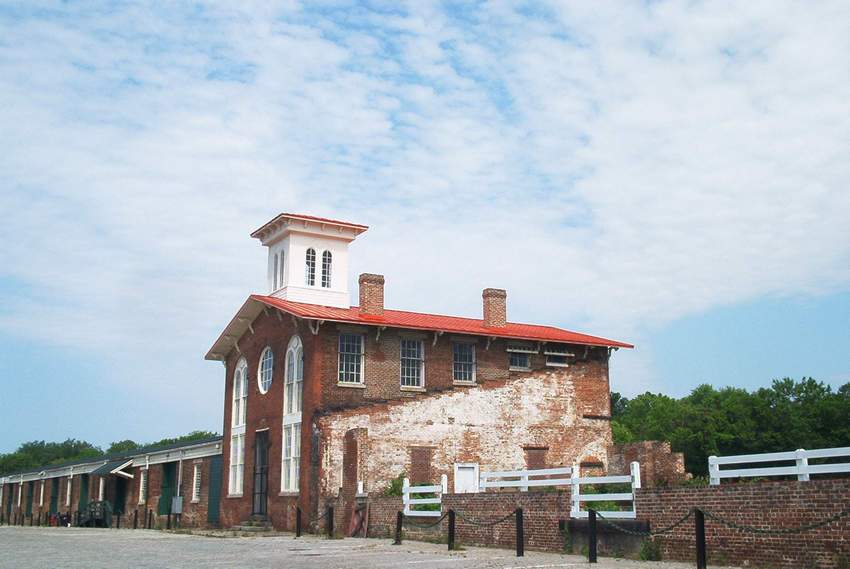
News---Peterburg NPS Eyes 1854 Station As Visitors Center

South Side Depot Could Become Visitor Contact Station For NPS, F.M. Wiggins, January 24, 2010.

One of the city's most historic building's could become the property of the National Park Service if a plan to expand the park's boundaries is completed. This week the public will get a chance to comment on the proposed plans. South Side Depot, which was one of the most important buildings during the nine-month long siege of the city during the Civil War, could potentially become a visitor contact station for the National Park Service.

Originally built around 1854, the building served the Southside Railroad that connected City Point in Hopewell to Lynchburg. During the siege of the city, the Confederates used the station to receive supplies. Though the depot was a frequent target of Union shelling, it is only documented as having been struck twice. At a January 5 City Council meeting, Petersburg National Battlefield Park Superintendent Bob Kirby told officials that circumstances within the Park Service made it more feasible for the federal government to take possession of the building.

The 2005 General Management Plan for the Petersburg National Battlefield included the establishment of a visitor contact station in Old Towne Petersburg at the South Side Depot. It also called for the city to retain ownership of the building. Kirby said that the political climate within the National Park Service has changed dramatically. He described how several years ago, during the development of the General Management Plan, he was told that the train station was "just another old building" by National Park Service representatives at the regional office in Philadelphia. "Now without amending the General Management Plan we were able to proceed with an environmental assessment and will develop an idea of what the general public opinion is on how to proceed," Kirby said.

He said that the building is an emblematic institution of the importance of transportation - especially rail - during the Civil War. On Wednesday, the public will have a chance to speak up about the plans to include the 2.94 acre depot site in the boundaries of the Petersburg National Battlefield. Under the proposed plan, the city would transfer ownership of the building to the park to be used as a visitor contact station in the city.

If the park is able to expand the boundaries to include the building, Kirby said that repairs necessary to open it could cost up to $8 million. Maintenance and operations costs for the building would be included in the park's annual budget at no additional cost. But Bill Patton of the Petersburg Foundation - who has twice owned the station - said that the local non-profit has agreed to partner with the city and the National Park Service should the plan move forward.

"We would primarily be handling the money," Patton said. Patton is excited about the potential of reuse for the building. He said that he personally paid to have it restored for use in 1990. However, the August 1993 tornado that ripped through Petersburg caused more damage to the building than nine months of siege warfare. The east cargo terminal was leveled, the cupola on the roof of the central building was removed and roofing was nearly destroyed. Following the tornado, the building was sold in the late 1990s to a group that had promised to raise funds, restore the building and turn it into a museum.

Patton said that plan fell through and he had to take the group - The War Between The States, Inc. - to court. The lawsuit ended with a settlement that returned the building to the possession of the Patton family. Patton then eventually sold the building to the city for $640,000. Now he'll be working with the Petersburg Foundation to act as a fiscal agent and fundraising organization. "We'll be raising money, seeking federal and state grants to have the building restored," Patton said.

Patton said that he hopes that along with the money, the foundation will be able to hire contractors to preserve and restore the building - with the exception of the east cargo terminal. Federal restrictions prohibit the reconstruction of any building that has been destroyed. Patton said instead a roof may be constructed over the felled remains of the building, which may be restored to some extent for some other use - perhaps as an amphitheater or outdoor interpretive space.

The public will get two opportunities on Wednesday to comment on the proposal. National Park Service staff will host an two open house sessions where interested members of the community can ask questions, learn more about project and submit comments. The first session will be from 2 to 4 p.m. and the second session will be held from 6 to 8 p.m. at the nearby Union Station at 103 River St.

Kirby said that the public comment period actually opened Jan. 13 and will continue through Feb. 19. The next step after the comment period, according to Kirby, could be completed by the end of April if everything goes well. "If there's no substantive objection to the use of the structure, we will have a Finding Of No Significant Impact or FONSI," Kirby said. If the FONSI is signed off by the regional director of the National Park Service, things will then take a legislative turn.

"We will then be at the stage of drafting a bill," Kirby said. "But the bill will need a sponsor." Kirby said that could come from the region's congressman - U.S. Rep. J. Randy Forbes - and that means that expanding the park boundary may not happen until the next legislative session. Kirby said that because this is a relatively "small project" with relatively little expected cost - approximately $600,000 to acquire the building and property - the project could move forward fairly quickly.

Text and Top Image Source: Petersburg Progress Index

Middle Image Source: Petersburg Data

Bottom Image Source: Flickr

Sunday, July 12, 2009

New and Notable: Trench Work and Warfare at Petersburg

In the Trenches at Petersburg: Field Fortifications and Confederate Defeat, Earl J. Hess, University of North Carolina Press, 480 pp., maps, illustrations, index, $35.00

The Petersburg campaign began June 15, 1864, with Union attempts to break an improvised line of Confederate field fortifications. By the time the campaign ended on April 2, 1865, two opposing lines of sophisticated and complex earthworks stretched for thirty-five miles, covering not only Petersburg but also the southeastern approaches to Richmond. This book, the third volume in Earl Hess's trilogy on the war in the eastern theater, recounts the strategic and tactical operations in Virginia during the last ten months of the Civil War, when field fortifications dominated military planning and the landscape of battle.

Hess extracts evidence from maps and earthworks systems, historic photographs of the entrenchments, extensive research in published and archival accounts by men engaged in the campaign, official engineering reports, modern sound imaging to detect mine galleries, and firsthand examination of the remnants of fortifications on the Petersburg battlefield today. The book covers all aspects of the campaign, especially military engineering, including mining and countermining, the fashioning of wire entanglements, the laying of torpedo fields, and the construction of underground shelters to protect the men who manned the works. It also humanizes the experience of the soldiers working in the fortifications, revealing their attitudes toward attacking and defending earthworks and the human cost of trench warfare in the waning days of the war.

Tracy Power, author of Lee's Miserables: Life in the Army of Northern Virginia from the Wilderness to Appomattox:
"The last volume of Earl J. Hess's trilogy on field fortifications in the East completes a figurative breakthrough as impressive as Grant's literal breakthrough at Petersburg. It and its companion volumes, displaying a masterful blend of narrative, description, and analysis, are among the most significant Civil War studies of this or any time."

A. Wilson Greene, Pamplin Historical Park, author of The Final Battles of the Petersburg Campaign "Earl Hess has written the finest study of the Petersburg Campaign in more than a century. By relating the development of the army's field engineering to the course of the combat action, and through the use of previously untapped sources, Hess brilliantly unravels the complexity of the Petersburg story. This is simply one of the finest Civil War studies of our generation."

Earl J. Hess is associate professor and chair in the Department of History at Lincoln Memorial University. Previous books in his series on field fortifications are Field Armies and Fortifications in the Civil War: The Eastern Campaigns, 1861-1864 and Trench Warfare under Grant and Lee: Field Fortifications in the Overland Campaign.

Text and Image Source: University of North Carolina Press

Tuesday, January 01, 2008

CWL---'Breaking The Backbone of The Rebellion' Returns To Print


The Final Battles of the Petersburg Campaign: Breaking the Backbone of the Rebellion, A. Wilson Greene, University of Tennessee, $45.00 (hardcover).

The first edition, published by Savas PC in 2000, contained 25 original maps 36 photos and illustrations. Current available copies of the Savas Publishing's 2000 hardcover edition begin at $65, when they are offered for sale. The University of Tennessee's edition should arrive in the first sixty days of 2008 (hopefully with a sharper looking cover than the 2000 edition.)

Green presents an in-depth look at the six battles March 1865 battles at Petersburg that rooted Lee's army out of it's burrow. The climax was the breakthrough by the Union Sixth Corps on April 2, just six miles southwest of Petersburg. This Federal victory forced Lee to evacuate Petersburg and Richmond that night, and to surrender his army just one week later.

A. Wilson Greene is executive director of Pamplin Historical Park, which preserves these portion of these battlefields and he is also the author of both Whatever You Resolve to Be, a collection of essays on Stonewall Jackson Civil War and Petersburg: Confederate City in the Crucible of War. Greene has also authored National Geographic Guide to the Civil War National Battlefield Parks(1995).

Tuesday, June 05, 2007

Other Voices: To Live and Die in Dixie: Civilians In Petersburg, Virginia


H-NET BOOK REVIEW
Published by H-CivWar@h-net.msu.edu (June 2007)

A Wilson Greene. Civil War Petersburg: Confederate City in the Crucible of War. Charlottesville: University of Virginia Press, 2006. xi + 363 pp. Illustrations, bibliography, notes, index. $34.95 (cloth)

Reviewed for H-CivWar by Robert N. Thompson, Independent Scholar

As A. Wilson Greene points out in his preface to Civil War Petersburg, there has been an increasing amount of scholarship in recent years dedicated to examining the lives of noncombatants during the Civil War. One genre of this scholarship might be termed the "community study," in which the economic, social, political, and military impact of the war on a specific city or town is studied. This study, in turn, allows the modern reader to gain a feel for not only how the people viewed and reacted to great events of the time, but also how the war affected their every day lives,particularly when war came calling at their doorsteps.

Greene, the Executive Director of the Pamplin Historical Park and National Museum of the Civil War Soldier, just outside Petersburg, has a natural interest in the city's role in the war and, as his research makes clear, he makes good use of some wonderful source material in developing his study. His heavy reliances on primary sources, especially letters and diaries taken from the collected papers of individuals and families who lived in the city during the war, allows these citizens to speak to us across time, conveying their feelings and impressions literally as they were captured at particular moments in time. This, in turn, gives us the most accurate image possible of what their lives were like.

However, Greene is careful not to rely solely on these sources, lest he convey only the image of the city provided by those few who documented their lives. He also uses editorial comments and reports from the local newspapers, as well as statistical data to tell his story. From all these sources, we see Petersburg as a thriving pre-war commercial center whose strategic position astride the railway leading to Richmond would eventually make it subject to the longest siege of the war.

While Greene provides extensive detail on virtually every aspect of live in the city as the war progressed, two aspects stand out as particularly enlightening: the war's impact on the African American population and the effects of financial inflation.The first is particularly interesting because Petersburg had one of the South's largest free African American populations. In fact, as Green points out, in 1860, 36 percent of Petersburg's African American's were free, and, some 26 percent of Petersburg's total free population was African American--the highest percentage of any city in the South (p. 8). Further, the majority of these free African Americans were women and they owned half the property held by the city's black population. Some free African Americans managed to become quite affluent. In fact, one of the more interesting points in Greene's book is that some of the free African American women who worked as prostitutes or became concubines to white men were so affluent that they actually owned their own slaves.

As the war progressed, the African American population's situation worsened. Initially, both free black men and slaves volunteered to support the Confederacy by joining the cause as laborers to build defensive works and fortifications. While they appeared enthusiastic, Greene states this enthusiasm was demonstrated primarily out of necessity, and did not reflect any true zeal for the Southern cause. The workers were paid, however, and the city actually provided some welfare and sustenance, however meager, for the families left behind in the Petersburg. However, as the war continued, the African American population was hit especially hard by increased racial tensions, which led to increased arrests and harsh punishment for African Americans accused of even the most petty of crimes. Further, along with the
poor white population, they were devastated by the effects of rampant economic inflation.

Greene points out that, as was probably the case in much of the South, nothing did more damage to the city's economy than inflation, which was primarily fueled by a lack of commodities. He demonstrates this by citing some of the differences in prices between the winter of 1863 and the spring of 1864. During the winter months, butter rose from $4.00 a pound to $15.00, while the price for an egg increased by 1,500 percent in only seven months. Other staples saw similar inflation, with flour increasing from $75.00 to $300.00 dollars per barrel; beef rising from 30 cents to $4.00 per pound; and meal elevating from $12.00 to $40.00 dollars per bushel.

Greene also documents the steady decline of the city's commercial and industrial base. As supplies of cotton and tobacco diminished, the mills and tobacco warehouses began to close. Further, a lack of spare parts for machinery also severely limited the capabilities of those factories and mills that did operate. Eventually, many of the tobacco warehouses were converted to hospitals for wounded soldiers, but this loss in economic infrastructure further worsened life for both whites and African-Americans,who depended on these mills, factories, and warehouses for employment.

Finally, with the siege of the city beginning in the summer of 1864, life in the city would markedly change. The regular bombardment by Federal artillery ended many of the few remaining social activities of the city, and disrupted the very patterns of daily life. The siege, which would last for ten months,left an indelible impact, which can still be seen today.

While this book is not the sort that many Civil War enthusiasts will flock to, it is an excellent scholarly study, and one that provides valuable insights into urban Southern life during the war. The fact that the subject city also became a key strategic point in the war provides for additional interest and the opportunity for further insight. In total, the book sets a new standard for its genre and one we hope others will strive to meet.

Copyright (c) 2007 by H-Net, all rights reserved. H-Net permits
the redistribution and reprinting of this work for nonprofit,
educational purposes, with full and accurate attribution to the
author, web location, date of publication, originating list, and
H-Net: Humanities & Social Sciences Online. For other uses
contact the Reviews editorial staff: hbooks@mail.h-net.msu.edu.

Friday, December 08, 2006

New and Noteworthy: The Civilians' Civil War in Petersburg, VA


Civil War Petersburg: Confederate City in the Crucible of War, A. Wilson Greene,
Hardcover, 384 pages, University of Virginia Press (Winter, 2007), ISBN: 0813925703

In the past ten years, the urban and civilian aspect of the American Civil War has started to be addressed. Gettysburg, Atlanta, New York City, Charleston, Washington, D.C., Richmond, Pittsburgh, and Knoxville have been received attention. Greene, historian working at Pamplin Park, Virginia and author of essays considering the character and memory Stonewall Jackson, addresses the urban wartime history of Peterburg, Virginia

Few wartime cities in Virginia held more importance than Petersburg. It's written history has lacked both an adequate military and civilian home front work. The noted Civil War historian A. Wilson Greene now provides an expertly researched and eloquently written study of the Virginia city that was second only to Richmond in size and strategic significance. Industrial, commercial, and extremely prosperous, Petersburg was home to a large African American community, including the state's highest percentage of free blacks.

On the eve of the Civil War, the city elected a conservative, pro-Union approach to the sectional crisis. Little more than a month before Virginia's secession did Petersburg finally express pro-Confederate sentiments, at which point the city threw itself wholeheartedly into the effort, with large numbers of both white and black men serving. Over the next four years, Petersburg's citizens watched their once-beautiful city become first a conduit for transient soldiers from the Deep South, then an armed camp, and finally the focus of one of the Civil War's most physically and environmentally damaging campaigns.

At war's end, Petersburg's antebellum prosperity evaporated under pressures from inflation, chronic shortages, and the extensive damage done by Union artillery shells. Greene's book tracks both Petersburg's civilian experience and the city's place in Confederate military strategy and civilian administration. Employing unpublished sources, the book weaves a uniquely personal story of thousands of citizen-free blacks, slaves and their holders, factory owners, merchants-all of whom shared a singular experience in Civil War Virginia.

(Source: in part, Book Description, Amazon.com)