Showing posts with label 1862. Show all posts

Tuesday, August 21, 2012

150 Anniversary: The Battle of Cedar Mountain, Virginia


The Battle of Cedar Mountain [Cedar Run], took place on August 9, 1862, in Culpeper County, Virginia. Union forces under Major General Nathaniel P. Banks attacked Rebel forces under Maj. Gen. Thomas J.  Jackson near Cedar Mountain as the Confederates marched northward toward Culpeper Court House.  Jackson's force was to deter the Federal seizure of the junction of railroads at Gordonsville.  Fought late in the day  Banks' troops nearly drove the Confederates from the field. Reinforced, the Confederates counterattacked and broke the Union lines. 
On June 26, Major General John Pope received command of the newly created Army of Virginia which were three corps that had been independent until that point.   On the western flank, under Major General Franz Sigel, was positioned at Sperryville located in the Blue Ridge Mountains.  On the eastern flank, under under Major General Irvin McDowell, was located, across from Fredericksburg,  at Falmouth on the Rappahannock River.  The center, under Major General Nathaniel P. Banks, was situated in the northern part of Culpeper County.  A brigade of Banks's corps, Brigadier General Samuel W. Crawford's brigade and Brigadier General John P. Hatch's cavalry, were stationed about 20 miles beyond the Union line, at Culpeper Court House.


General Robert E. Lee responded to Pope's dispositions by dispatching Major General T. J. Jackson with 14,000 men to Gordonsville on July 13 and  later reinforcing with another division of  10,000 men under Major General Ambrose  P.  Hill.  On the morning of August 9, Jackson's army crossed to the Rapidan River into Culpeper County with Major General Richard S. Ewell's division leading.  Brigadier General Charles S. Winder's division followed by Hill's division acting as a reserve.

At about 5pm, near the end of the initial artillery barrage by both Federals and Confederates, Confederate Brigadier General Charles S. Winder, who had been ill the entire day,  attempted to direct his troops and was struck by a shell. Winder's left arm and side were shredded. He died a few hours later.  The Stonewall Brigade had come up and was then swept aside by Crawford's troops.  As the artillery batteries were on the verge of being captured Jackson ordered them withdrawn.  Taliaferro and Early's troops were devastatingly hit by the Federal volleys and broke.


Jackson rode to that part of the field and came upon the Stonewall Brigade finally being brought up to reinforce the retreating line.  He attempted to brandish his sword but it had rusted in its scabbard. He unbuckled the sword from his belt, waved the scabbard over his head then grabbed a  flag from the retreating color guard. The Stonewall Brigade and portions of other regiments challenged by Jackson launched into the Federal troops.  As other Confederate regiments came forth and as there were no Federal troops in reserve, Jackson prevailed that day. Within three weeks, the battles of Brawner's Farm, Second Manassas and Chantilly would be fought. 

On the 150th anniversary of the battle a seminar was held at Germanna Community College and on the Cedar Mountain battlefield. Topics included the creation of the Federal Army of Virginia and its assigned task, the Stonewall Brigade, the 10th Maine Regiment, and the preservation of the battled.  National Park rangers extensively discussed the battle's action.  Their presentation was in a auditorium during the day and the battled during the evening. 

Text and Images by Civil War Librarian. The top image shows in the foreground the approximate site of the mortal wounding of Winder.  Approximately 100 to 200 yards to the rear of the wayside marker is the location of Jackson's rallying with scabbard and starry banner the troops.

Friday, August 17, 2012

New and Noteworthy---Yorktown's Civil War Siege: Drums Along the Warwick

Yorktown's Civil War Siege: Drums Along the Warwick, John V. Quarstein and J. Michael Moore, History Press, 192 pp., 77 b/w illustration,8 maps,  2 appendices, bibliographic notes, bibliography, index, $19.99.


From the Publisher:  On 4 April 1862, Major General George McClellan marched his 121,500-strong Army of the Potomac from Fort Monroe toward Richmond. Blocking his path were Major General John B. Magruder's Warwick-Yorktown Line fortifications and the Confederate ironclad CSS Virginia. Despite outnumbering Magruder almost four to one, McClellan was tricked by Magruder's bluff of strength and halted his advance. Yorktown, the scene of Washington's 1781 victory over Cornwallis, was once again besieged. It was the Civil War's first siege and lasted for twenty-nine terrible days. Just as McClellan was ready to bombard Yorktown, the Confederates slipped away--because of his delays, McClellan lost the opportunity to quickly capture Richmond and end the war. Historians John V. Quarstein and J. Michael Moore chronicle the Siege of Yorktown and explore its role in the 1862 Peninsula Campaign and the final battles surrounding Richmond.

Tuesday, May 22, 2012

Noteworthy---The 1862 Kentucky Campaign and The Battle of Perrysville

The Civil War At Perryville: Battling For The Bluegrass, Christopher L. Kolakowski, History Press, 2009, 189 pp., 38 illustrations, 17 maps, appendices, notes, bibliography, $21.99.


The Civil War At Perryville: Battling For The Bluegrass offers a straight forward account of the autumn 1862 Kentucky Campaign.  Readers unfamiliar with the campaign should prepare for Kolakowski's work by using Shelby Foote's the Civil War: A Narrative--Fort Sumter to Perryville [volume I] places the campaign in both a political and military context.  Also readers may also review online resources such as http://www.battleofperryville.com/ and The Civil War Trust's http://www.civilwar.org/battlefields/perryville.html?tab=facts. 


Kolakowski sketches the personalities of the commanders and terrain features of the campaign; his narrative is well organized and well paced.  Most readers will find The Civil War At Perryville a good introduction; others may wish to read a more comprehensive treatment such as Perryville: This Grand Havoc of Battle by Kenneth W. Noe.  Deficits of the book include the poor quality of several reproduced portraits.  The maps appear to be poor photocopies of previously photocopied topographic maps.  An Order of Battle for Kirby Smith's Confederate army is missing, though an Order of Battle for Buell's Federal army and Bragg's Confederate army are offered.   A chronology would have been helpful for understanding sequence of events for three armies. Also an index would have been made it possible for readers to follow a person or an unit through the campaign.

Friday, May 11, 2012

News---1862 Turning Point: Perrysville, Kentucky Adds 140 Acres, Another 122 Acres A Possibility


Perryville Battlefield Adds 140 Acres, Joanna King, The Advocate-Messenger, May 2, 2012.
 Much like winning a battle one field at a time, Perryville continues to capture more of the land that shaped the identity of a region and, ultimately, a nation. James R. Overstreet and Pat W. and Lora June Overstreet have transferred ownership of more than 140 acres on Hayes-May Road to the Civil War Preservation Trust for $725,000, according to a deed filed recently at the Boyle County Clerk’s Office.
Joni L. House, preservation specialist and program coordinator for Perryville Battlefield State Historical Site, said the acquisition represents an opportunity  to keep a piece of history intact that might otherwise be lost to development. “In Franklin, Tenn., the site of a historical battle was only preserved after the tract was purchased and the Pizza Hut that had been built on there torn down,” she said.
The Civil War Preservation Trust is a national non-profit supported by donors who believe like House does that such areas should be off limits to development and available for future generations. House was raised on battlegrounds by a father who was a history teacher. Her husband and son are re-enactors, and their home resembles those of the Civil War era. “Ihave a churn, and I even know how to use it,” she said. “My middle name is ‘Lee’ if that tells you anything,” she said, an apparent reference to Robert E. Lee, general of the Confederate army.
The latest property acquisition in Perryville picks up where the gravel road that intersects the battlefield ends. “It is the land that surrounds the Bottom House,” she said. According to House, H.P. Bottom went to bed one night the first week of October 1862 a wealthy man comfortable in his place in the world and woke up in a world that would never be the same with all he knew destroyed by a war in his own backyard. “I think we are still suffering on some levels from what happened here,” House said, speaking about the economic direction the town was headed before war set it back.
The beautiful rolling green hills became “hell on earth” littered with the dead and dying, she said. Preservation of the battlefield pays homage to the 2,500 who died. The Civil War Preservation Trust hopes to acquire even more land in the area. It is soliciting donations to purchase a 122-acre tract known as the “Slaughter Pen.” Other property for potential purchase includes a 60-70 acre tract. According to the trust website (www.civilwar.org/battlefields/perryville.html), every $1 donated multiplies to $3.28 because of available matching and other grants. Registration is also now open at www.perryvillebattlefield.org to participate in the 150th commemoration of the Battle of Perryville scheduled for Oct. 5-7 in which 100 percent of funds raised will go toward preservation efforts.


Text and Image Source: Advocate-Messenger

Tuesday, February 28, 2012

News---1862 Person of the Year On American History TV, CSPAN3.


AHTV Looks at "Person of the Year" for 1862, CSpan 3, Saturday February 25, 2012.

Each year, Time magazine selects a person who had the most influence on events during the previous twelve months. If the same question were posed in 1862, who would Time have selected as the Person of the Year?

Five historians will ponder that question and present their candidates for Person of the Year 1862 at a forum organized by Museum of the Confederacy and hosted by the Library of Virginia. American History TV will have LIVE coverage of the day-long event. Nominees are kept secret until the historians announce their candidates. At the end of the day the audience will vote on the nominees for Person of the Year 1862 and the winner will be announced.

Historians presenting nominations are:
James McPherson, Civil War Scholar & Princeton University History Professor Emeritus [nominated David Farragut]

David Blight, Director of Yale University’s Center for the Study of Slavery, Resistance & Abolition [nominated Frederick Douglass]

Robert Krick, Former Chief Historian at Fredericksburg & Spotsylvania National Military Park [nominated Thomas Jackson]

Brig. Gen. John Mountcastle (Ret.), Former U.S. Army Chief of Military History [nominated George B. MCClellan]

Emory Thomas, Civil War Scholar & University of Georgia History Professor Emeritus [nominated Robert E. Lee]

We’ll also open our phone lines and take tweets during the day so viewers can talk directly with the historians about their nominations, and propose their own candidates. This is the second forum of its kind by the Museum of the Confederacy & the Library of Virginia. Last year, the audience voted Abraham Lincoln as the winner of Person of the Year 1861. This year continues the 150th Anniversary of the Civil War, which lasted from 1861-1865.

Text Source with CWL edits: AHTV

CWL: Yes I am disappointed that Lincoln didn't get at least a nomination for the EP. The excuse of 'well Lincoln got a nod last year' is pretty weak. The Emancipation Proclamation changed the entire war and the issue with which it dealt was one of the main causes of the war

Can't argue with any of the nominations, though I think that the nomination of Jackson was light. But of course the event was sponsored by Virginians and the host mentioned VMI about ten times. If you invite one of the Kricks or Emory Thomas you know what they are coming with. I think McClellan's nomination by Mountcastle, a Virginian was a surprise but fair; Mountcastle, the presenter, is a U.S. Army brigadier general, so there you are.

I enjoyed and agreed with McPherson's nomination of Farragut. New Orleans was the largest city in terms of population, the largest port, and the location of the U.S. Mint. The loss was as significant as the loss of Richmond would have been.

Blight's nomination of Douglass was a fine effort and convincing but he made in the Q & A an egregious statement about the current Republican Party that was extraneous to conversation and cheapened his nomination of Douglass.

For myself, Grant is worthy of a nomination. Grant's work at the Forts Henry and Donelson, the Battle of Shiloh, and the campaign that ended at Chickasaw Bluffs probably changed the war more than Jackson's Valley Campaign and Second Manassas.

A Pennsylvania or New York sponsored event would come up with a different list of nominees. Invite presenters such and as Guelzo or Holzer and you would have foregone conclusions about a Lincoln nomination.

Tuesday, August 24, 2010

Intriguing Thesis---- The Mayor, The Cops, The Immigrants and The Quick Fall of the Big Easy in 1862

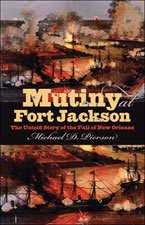
Mutiny at Fort Jackson: The Untold Story of the Fall of New Orleans, Michael D. Pierson, University of North Carolina Press, 2008. 264 pp. $30.00 (cloth), ISBN 978-0-8078-3228-8.

Reviewed by Judith Gentry (University of Louisiana at Lafayette)on H-CivWar (August, 2010)

Mutiny and Unionism in Civil War New Orleans

The title of this book is misleading, as very little of it is about the mutiny at Fort Jackson. It might better be titled A Study of Unionism and Other Disaffection in Confederate Military Units and among Civilians in or near New Orleans in 1862.

Michael D. Pierson has done an excellent job of describing and analyzing the small number of sources focused on the night of the mutiny, but the heart of the book is a discussion of the impact of the mutiny on Admiral David G. Farragut’s ability to rescue New Orleans from the Confederates; the extent of Unionist sentiment (or at least disaffection from the Confederacy) in New Orleans and southeastern Louisiana; the background and the social, economic, and political context that caused the mutineers and deserters and other New Orleanians to have little affection for the Confederacy; and the role of Benjamin Butler in protecting existing Unionists and building additional support for the Union in New Orleans.

Pierson reveals, as the book unfolds, a series of provocative thesis statements. For the ease of the readers of this review, I have arranged them in chronological order. The peculiar Louisiana version of the Know-Nothing Party, which emphasized anti-immigrant rhetoric and actions, controlled the New Orleans government from 1856 until May 1, 1862, when Butler established martial law. Once Louisiana seceded from the Union, the New Orleans mayor used his direct control of patronage, which traditionally had been used to win elections for the Know-Nothings through violence and intimidation of opponents by police officers and government workers rampaging through the streets in what was commonly called the “mob,” to support the Confederacy.

By 1858, such tactics had reduced voting by immigrants by 50 percent and caused most immigrants to keep a low profile on politics. In 1861 and into the spring of 1862, both the mob and the police were used to suppress dissent and encourage volunteering for military service. Poverty and joblessness also coerced volunteering by New Orleanians who had no love for the Confederacy. By September 1861, the government had help from the mob in coercing military-age men to participate in local units of the state militia. In the emergency of February and March 1862, as Farragut’s fleet entered the lower Mississippi River, several of the militia units were reorganized into units of the Confederate army and placed on ships that carried them to Fort Jackson or Fort St. Philip downriver from New Orleans. Others were sent to other forts nearer to New Orleans.

Although the police and mob were effective in keeping Unionists in New Orleans quiet, Pierson argues, Unionists existed. Some simply preferred the prewar U.S. life. Secession and war had closed down the economy of New Orleans and left the working class in extreme poverty. Other Unionists were immigrants who had never felt welcome in New Orleans and had endured Know-Nothing harassment. “Merchants and white wage workers, in addition to African Americans, came to support the Union in large numbers during the war.... New Orleans offered considerable aid and comfort to the United States” (pp. 49-50). The fact that much of this aid took place in 1861 and 1862 rather than later in the war made New Orleans unusual.

An important reason why the Confederates in New Orleans suppressed Unionism was that the existence of Unionists undercut the central moral justification for secession: that secession was necessary because the Northern states were oppressing all white Southerners and trying to take away the rights of all Southerners to enjoy the prosperity and freedom of the nation. The author argues that the importance of the mutiny at Fort Jackson has been underestimated.

This review is continued at H-Net Reviews

The second image is Fort Jackson as it appears today and the image's source is Civil War Librarian, June 2008.

Friday, June 13, 2008

Forthcoming---Confederate Mutiny Paved The Way For Farragut at New Orleans In April 1862

Mutiny at Fort Jackson; The Untold Story of the Fall of New Orleans. Michael D. Pierson, University of North Carolina Press,264 pp., 27 illustrations, notes, bibliography, index, Winter 2008-2009.

New Orleans was the largest city--and one of the richest--in the Confederacy, protected in part by Fort Jackson, which was just sixty-five miles down the Mississippi River. On April 27, 1862, Confederate soldiers at Fort Jackson rose up in mutiny against their commanding officers. New Orleans fell to Union forces soon thereafter. Although the Fort Jackson mutiny marked a critical turning point in the Union's campaign to regain control of this vital Confederate financial and industrial center, it has received surprisingly little attention from historians. Michael Pierson examines newly uncovered archival sources to determine why the soldiers rebelled at such a decisive moment.

The mutineers were soldiers primarily recruited from New Orleans's large German and Irish immigrant populations. Pierson shows that the new nation had done nothing to encourage poor white men to feel they had a place of honor in the southern republic. He argues that the mutineers actively sought to help the Union cause. In a major reassessment of the Union administration of New Orleans that followed, Pierson demonstrates that Benjamin "Beast" Butler enjoyed the support of many white Unionists in the city.

Pierson adds an urban working-class element to debates over the effects of white Unionists in Confederate states. With the personal stories of soldiers appearing throughout, Mutiny at Fort Jackson presents the Civil War from a new perspective, revealing the complexities of New Orleans society and the Confederate experience.

About the Author
Michael D. Pierson is associate professor of history at the University of Massachusetts, Lowell. He is author of Free Hearts and Free Homes: Gender and American Antislavery Politics (from the University of North Carolina Press).

Blurbs:
"Pierson shows that there is much more to the Fort Jackson mutiny than we have thought, and that it really matters historically. He not only analyzes the episode astutely and provides rich background material, but also tells a good story, replete with drama and even humor. This is a well-written, well-organized, and deeply researched study that has important implications for some of the major issues currently being debated among Civil War historians."
--Stephen V. Ash, author of When the Yankees Came: Conflict and Chaos in the Occupied South

"Mutiny at Fort Jackson makes a significant, original contribution to the field of Civil War history. Identifying the home front as crucial to understanding the course of the Civil War and its impact on American society, Pierson expands the burgeoning study of Southern Unionism with a sophisticated analysis of Unionism in New Orleans's ethnically diverse, urban wage economy. This book will interest Civil War enthusiasts as well as students and scholars."-Victoria Bynum, author of The Free State of Jones: Mississippi's Longest Civil War

Ghost town - Fort Jackson, LA. This old American military post was located on SH 23, and the west bank of the Mississippi River, 2.5 miles southeast of Triumph, about 70 miles southeast of New Orleans. It was built in 1822-1832, and occupied in 1861 by the Confederate Army. It is a large, star-shaped brick fort with a surrounding moat. It was built to protect New Orleans, but on April 18, 1862, Admiral Farragut and his fleet of 43 boats, battled the fort for over a week. New Orleans fell, the fort surrendered, and his forces occupied them. Since 1961, Fort Jackson has been a National Historic Monument. Closed since Katrina.

Text: http://uncpress.unc.edu/browse/book_detail?title_id=1549
Photograph and Caption: http://picasaweb.google.com/khokhloma/NewOrleans/photo#5137372912340959682