Showing posts with label Western Theatre. Show all posts

Monday, December 01, 2014

New And Noteworthy---Montana's Confederate Heritage

Confederates In Montana Territory: In The Shadow of Price's Army, Ken Robison, History Press, 192 pp.,49 illustrations, 4 maps, index, chapter bibliographies, $19.99. 

Montana was not an organized territory until the spring of 1864 and was over a thousand miles away from military operations in Kansas and New Mexico. During the first three years of the war the region that would become Montana was divided between the territories of Washington, Idaho and Dakota. During the war there were those Confederate soldiers that deserted or Confederate civilians who drifted into this region. In the southwest area one community wished to name itself Varina, in honor of Varina Davis, the wife of  the Confederate president. This was dismissed by a regional judge who was a native of Connecticut but did allow a substitute name, Virginia. In 1862, gold was discovered in the region and one strike was named Confederate Gulch. Such loyalty issues arose and caught the attention of Unionists in the region who brought it to the attention of the national government which remedied the situation by creating the Montana Territory.

Ken Robison, the author of Confederates In Montana Territory is a Montana native, historic preservationist, newspaper columnist, historian and retired captain of the U.S. navy's intelligence branch. He has authored four other books on Montana's early history and a frequent contributor to the Montana: The Magazine of Western History and other regional journals.

Confederates In Montana Territory: In The Shadow of Price's Army offers detailed and entertaining stories regarding Confederate veterans commanded by William Quantrill,  Bill Anderson, Nathan Bedford Forrest and John Mosby. Robison's focus includes particular cavalry regiments and the unique adventures that the Confederate veterans experienced during the war. The Moore brothers accompanied Jefferson Davis during his flight from Richmond, Virginia; others were veterans of the Confederate Marine Corps. Robison uniquely captures the lives of former slaves who migrated to Montana during and after the war. His work is a biography driven account of Confederate soldiers, civilians and contrabands living together on western frontier.   Confederates In Montana Territory: In The Shadow of Price's Army offers a clear and concise account which is a fine example of local and regional historical research done well.


Tuesday, August 02, 2011

Noteworthy---A Deep and Steady Thunder in Georgia

A Deep and Steady Thunder: The Battle of Chickamaugua, Steven E. Woodworth, McWhiney Foundation Press,134 pp., order of battle, bibliography, index, 1996 and 2006,$11.95.

Steven Woodworth does a fine job of explaining one of the Civil War's most tactically complex battles. The Battle of Chickamauga, which was fought September 18-20 1863 fought, northern Georgia's dark forests with few farm clearings, includes a multitude of intentional and unintentional flanking attacks ordered by confused commanders with limited tactical control. It was a battle fought largely by brigades, regimental and company commanders. Chickamauga, though as important as Gettysburg, has not generated the wealth of campaign and battle studies. Glenn Tucker's Chickamauga, published during the Civil War centennial and Peter Cozzen's 1992 This Terrible Sound are the only two notable campaign and battle studies.

Woodworth has nicely crafted a concise, clear narrative for readers who are approaching the battle for the first or second time. Containing 21 short biographical descriptions and 13 maps, A Deep Steady Thunder moves from general staff to regimental levels in a quick fashion. Woodworth is direct in his criticism of Confederate commanders resistance to Bragg's sound and appropriate plans and Rosercans exhaustion induced confusion that is reminiscent of Jackson's Seven Days on the Peninsula in 1862. Woodworth's description of Longstreet as being arrogant, self-promoting and envious of Bragg's position seems to be a bit over the top. Another book from the McWhiney Press offers a heavy handed demolition of Longstreet during the Chickamauga, Chattanooga and Knoxville campaigns of 1863.

The strength of Woodworth's effort is his handling of the command decisions which limited the Confederate's successes and brought about the Federals defeat. As divisions, brigades and regiments move back and forth through the wilderness and cornfields confusion sometimes reigns. Fortunately, Woodworth has sorted through a multitude of assaults, retreats, and counter-attacks to provide a clear and even suspenseful accounting of plans gone awry. Rosecran's movement of brigades that led to gaps in the Federal line on the 20th are clearly described. The important arrivals of Longstreet's Confederate corps and Granger's Federal reserve division are nicely described and their importance to the outcome of the battle is well developed by Woodworth.

Within the limits of 100 pages, Woodworth offers tight and thorough introduction to the Battle of Chickamauga; for those who are visiting for the first time the battlefield it is a fine place to start. For the armchair reader who is unfamiliar with the 'Gettysburg of the West' A Deep Steady Thunder offers good introduction.

Friday, June 13, 2008

Forthcoming---Confederate Mutiny Paved The Way For Farragut at New Orleans In April 1862

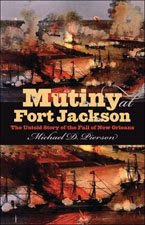
Mutiny at Fort Jackson; The Untold Story of the Fall of New Orleans. Michael D. Pierson, University of North Carolina Press,264 pp., 27 illustrations, notes, bibliography, index, Winter 2008-2009.

New Orleans was the largest city--and one of the richest--in the Confederacy, protected in part by Fort Jackson, which was just sixty-five miles down the Mississippi River. On April 27, 1862, Confederate soldiers at Fort Jackson rose up in mutiny against their commanding officers. New Orleans fell to Union forces soon thereafter. Although the Fort Jackson mutiny marked a critical turning point in the Union's campaign to regain control of this vital Confederate financial and industrial center, it has received surprisingly little attention from historians. Michael Pierson examines newly uncovered archival sources to determine why the soldiers rebelled at such a decisive moment.

The mutineers were soldiers primarily recruited from New Orleans's large German and Irish immigrant populations. Pierson shows that the new nation had done nothing to encourage poor white men to feel they had a place of honor in the southern republic. He argues that the mutineers actively sought to help the Union cause. In a major reassessment of the Union administration of New Orleans that followed, Pierson demonstrates that Benjamin "Beast" Butler enjoyed the support of many white Unionists in the city.

Pierson adds an urban working-class element to debates over the effects of white Unionists in Confederate states. With the personal stories of soldiers appearing throughout, Mutiny at Fort Jackson presents the Civil War from a new perspective, revealing the complexities of New Orleans society and the Confederate experience.

About the Author
Michael D. Pierson is associate professor of history at the University of Massachusetts, Lowell. He is author of Free Hearts and Free Homes: Gender and American Antislavery Politics (from the University of North Carolina Press).

Blurbs:
"Pierson shows that there is much more to the Fort Jackson mutiny than we have thought, and that it really matters historically. He not only analyzes the episode astutely and provides rich background material, but also tells a good story, replete with drama and even humor. This is a well-written, well-organized, and deeply researched study that has important implications for some of the major issues currently being debated among Civil War historians."
--Stephen V. Ash, author of When the Yankees Came: Conflict and Chaos in the Occupied South

"Mutiny at Fort Jackson makes a significant, original contribution to the field of Civil War history. Identifying the home front as crucial to understanding the course of the Civil War and its impact on American society, Pierson expands the burgeoning study of Southern Unionism with a sophisticated analysis of Unionism in New Orleans's ethnically diverse, urban wage economy. This book will interest Civil War enthusiasts as well as students and scholars."-Victoria Bynum, author of The Free State of Jones: Mississippi's Longest Civil War

Ghost town - Fort Jackson, LA. This old American military post was located on SH 23, and the west bank of the Mississippi River, 2.5 miles southeast of Triumph, about 70 miles southeast of New Orleans. It was built in 1822-1832, and occupied in 1861 by the Confederate Army. It is a large, star-shaped brick fort with a surrounding moat. It was built to protect New Orleans, but on April 18, 1862, Admiral Farragut and his fleet of 43 boats, battled the fort for over a week. New Orleans fell, the fort surrendered, and his forces occupied them. Since 1961, Fort Jackson has been a National Historic Monument. Closed since Katrina.

Text: http://uncpress.unc.edu/browse/book_detail?title_id=1549
Photograph and Caption: http://picasaweb.google.com/khokhloma/NewOrleans/photo#5137372912340959682

Monday, April 28, 2008

New---The North Won The War By Winning The West; Praeger Publishing Lauches New Series

Decision in the Heartland: The Civil War in the West, Steven E. Woodworth, 208 pages, Praeger/Greenwood Publishers,photos, bibliography, notes, $39.95.

The verdict is in: the Civil War was won in the "West"--that is, in the nation's heartland, between the Appalachian Mountains and the Mississippi River. Yet, a person who follows the literature on the war might still think that it was the conflict in Virginia that ultimately decided the outcome.

Each year sees the appearance of new books aimed at the popular market that simply assume that it was in the East, often at Gettysburg, that the decisive clashes of war the took place. For decades, serious historians of the Civil War have completed one careful study after another, nearly all tending to indicate the pivotal importance of what people during the war referred to as "the West."

In this fast paced overview, Woodworth presents his case for the decisiveness of the theater. Overwhelming evidence now indicates that it was battles like Fort Donelson, Shiloh, Chattanooga, and Atlanta that sealed the fate of the Confederacy-not the nearly legendary clashes at Bull Run or Chancellorsville or the mythical "high-water mark" at Gettysburg. The western campaigns cost the Confederacy vast territories, the manufacturing center of Nashville, the financial center of New Orleans, communications hubs such as Corinth, Chattanooga, and Atlanta, along with the agricultural produce of the breadbasket of the Confederacy.

They sapped the morale of Confederates and buoyed the spirits of Unionists, ultimately sealing the northern electorate's decision to return Lincoln to the presidency for a second term and thus to see the war through to final victory. Detailing the "Western" clashes that proved so significant, Woodworth contends that it was there alone that the Civil War could be--and was--decided.
Steve E. Woodworth is Professor of History at Texas Christian University in Fort Worth, Texas. He received his Ph.D. in history from Rice University in 1987 and has taught at colleges in Texas, Oklahoma, and Georgia. He has authored, co-authored, or compiled twenty-six books, including Nothing but Victory; While God is Marching On; and Jefferson Davis and His Generals.

Source: text supplied by the publisher

CWL: Decision in the Heartland: The Civil War in the West is the first in the series 'Reflections on the Civil War Era' from Praeger/Greenwood Publishing. Decision in the Heartland: The Civil War in the West arrived in January. True Sons of the Republic: European Immigrants in the Union Army by Martin W. Öfele was released in February and Weary of War: Life on the Confederate Home Front by Joe A. Mobley in March.

Monday, December 10, 2007

CWL----Combined Operations, Dysfunctional Personalities and Generals Who Know How To Fight


Unconditional Surrender: The Capture of Forts Henry and Donelson, Spencer C. Tucker, McWhiney Foundation Press, 2001, 136 pp, b/w photographs, maps, index, orders of battle, selected bibliography.

Tucker’s Unconditional Surrender is a short, solid and satisfying introduction to the war in Kentucky and Tennessee during the fall of 1861 and the beginning of 1862. Its refreshing to find a good map on the second page of a first chapter. A map of the Western Theatre with railroads, rivers and cities introduces the strategic considerations of Halleck, Johnston, Polk and Grant. At the end of the chapter another map with all the railroads, rivers and cities of the Confederacy are presented along with the Confederate Line of Defense in the Winter of 1861-1862. Each of the generals are sketched in sidebars the this chapter which sets the stage.

Emphasizing the riverine warfare , Tucker states that the ‘control of the west’s great rivers, the Mississippi, the Ohio, the Tennessee, and the Cumberland, was vital to both sides in the war.” This vitality becomes apparent as he describes the efforts of McClellan, Halleck, Grant, and Andrew Hull Foote to put together an inland fleet. New to the reader is Andrew Hull Foote, who is often mentioned in brief elsewhere. Both he and Don Carlos Buell are sketched by the author in sidebars. Foote’s career is truly remarkable: son of a U.S. senator, former student but not a graduate of the naval academy, convert to Christianity, executive officer of the Philadelphia Naval Asylum, commander of a ship that chased slave smugglers between Africa and the U.S., commander of a ship that landed marines in China and destroyed four forts in 1856. His industriousness in building a fleet that would capture Forts Henry and Donelson, Island No. 10, Nashville and Memphis in the first 5 months of 1862 is outstanding.

Tucker is careful in his descriptions of ‘timberclads’, and river-class iron gunboats and of the floating navy yards at which the ships were built and maintained. With carpenters and iron workers who had great experience in building steamships but little or no experience in building ironclads, Foote agitated locally, regionally and nationality those who had to contribute to the effort. McClellan, Fremont, Halleck, Buell and Gustavaus V. Fox (under-secretary of the navy) were lobbied for resources and funds by Foote.


Fort Henry on the east bank of the Tennessee and Fort Donelson on the west bank of the Cumberland were constructed on the Kentucky-Tennessee border by CSA general Lloyd Tilghman in the late fall and early winter of 1861. Fort Henry’s location was prone to flooding and after the arrival of troops under the command of Grant and the river fleet under Foote, it was evacuated and the CSA troops marched to Donelson. Grant drew his commanders together and all agreed that a quick advance on Donelson was appropriate.

The reader is struck with the resemblance of the Fort Donelson battlefield and the Shiloh battlefield, which would be fought in 60 days. On a ridge over looking a river, with flooded creeks and ravines on its flanks a once beaten army regards its foe. In February the CSA army is on the ridge, in April the USA army is on the ridge. Fortunately for Grant in both instances the CSA commanders exercise either to much tactical authority and too little strategic. The Confederate breakout of Donelson is successful until, Pillow and Floyd flinch and lose heart. The night after the breakout and retreat Pillow resigns the command of the fort to Floyd. Floyd promptly resigns the command and passes it on to Bruckner, who is wise enough to surrender the fort the next day as both Pillow and Floyd are floating in small boats and trying to escape capture. As in the battle Shiloh, it is Forrest who refuses inactivity and works an aggressive type of small unit warfare which both allows his troops to escape and twist the tail of the Union lion.

The consequences of Grant’s campaign includes the first great victory and his reputation as someone who knows how to fight and envied by Halleck. The CSA suffers a crisis of strategy. The retreat and concentration of Confederate forces and the Battle of Shiloh is a direct result of their loss of Forts Henry and Donelson. Indeed, Tucker points out that the 12,000 to 15,000 lost troops and the 40 pieces of lost artillery likely made a significant difference in the Battle of Shiloh in April.

Tucker and the McWhiney Foundation Press have produced a brief but rewarding discussion of the campaign, its commanders and its significance. The maps are clear, the biographical sidebars are informative and describe the personalities in command. This book is recommended for buffs and those unfamiliar with the war in the West. It is suitable for both high school and undergraduate academic libraries as well as public libraries.