Showing posts with label 2nd Manassas. Show all posts

Thursday, June 21, 2018

Manassas Amputation Pit Discovery: More News, Enfield Bullets Key to Dating

Image result for washington post manassas amputation


The Washington Post reports . . .


The park service says it’s the first time that a surgeon’s pit at a Civil War battlefield has been excavated and studied. The complete remains of two soldiers were found in the pit, along with 11 partial limbs.  Researchers believe the bodies were those of Union soldiers who died in the Second Battle of Bull Run, also known as the Second Battle of Manassas. The battle was fought in August 1862. 

Researchers are confident the remains belong to Union soldiers because buttons from a Union jacket were found in the pit. In addition, one of the soldiers had an Enfield bullet lodged in his thigh bone — those bullets were used almost exclusively by Confederate soldiers.

The Enfield bullets also provide a key clue that the pit is from the second Bull Run battle, not the first. Those bullets were not yet in use during the first Bull Run battle, which was the first major battle of the war. The location of the pit also fits with the battle lines from the second battle.


Washington Post Text Source: Washington Post 

The two soldiers — referred to as Burial 1, with the embedded bullet, and Burial 2 — were placed side by side in the pit. The severed limbs were carefully arranged next to them, like broken tree branches, according to a photograph from the dig. Burial 1 probably went in first, because Burial 2 was partially on top of him.

The hole was about a foot deep, and over the years farm plows had carried off the skull of one man and part of the skull of the other.  Anthropologists from the Smithsonian Institution have studied the injuries suffered by the two soldiers and examined the cut marks on the severed limbs made by the surgeons’ saws. There were nine severed legs and two arms in all.

Washington Post Text Source:  Washington Post 


News--Second Manassas Battlefield Field Hospital's Amputation Site Discovery

Second Manassas Battlefield Field Hospital's Amputation Site: Discovery, Excavation, Evaluation, Identification, Reburial

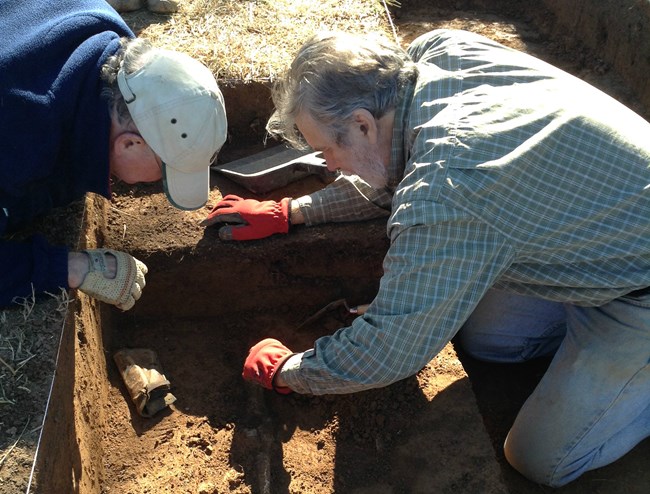
Archeologists crouch over a bone embedded in the dirtIn August 1862, two Union soldiers were gravely wounded at the Battled of Second Manassas. They were brought to a field hospital, though both died as a result of their injuries. Their bodies were laid to rest in a shallow burial pit, intermixed with amputated limbs from other soldiers wounded in the battle. Then they were lost to history. The National Park Service (NPS) first encountered the remains during a utility project in 2014. With help from the Smithsonian Institution the NPS was able to identify the remains as Union soldiers, and worked with the Army to give these soldiers an honorable final resting place.

In 2014, Manassas National Battlefield Park was working on a utility project. Although previous archeological testing of the area did not identify any significant finds, during the utility installation several small fragments of bone were unearthed and collected by the archeologist assigned to monitor the work.

At first, no one knew exactly what, or when, the bone fragments were from. To find out, the NPS sent the fragments to the the forensic anthropology lab at the Smithsonian Institution's National Museum of Natural History. Researchers there determined that the fragments were human, and that they dated to the Civil War. What's more, a piece of femur bone they were able to piece together had been sawed off, consistent with an amputation. All that information led to the conclusion that further excavation was needed. It was possible that something incredibly rare was on the site, and this was an invaluable opportunity to study and preserve the findings.
 
In 2015, archeologists from the NPS and the Smithsonian Institution removed the earth in a grid pattern, inch by inch, layer by layer. Using scientific techniques and measurements from a variety of tools, they carefully recorded the objects they found and their precise positions. Understanding the exact positions of bones in the ground helps scientists understand how the remains were placed and whether damage to bones happened before or after the person died.
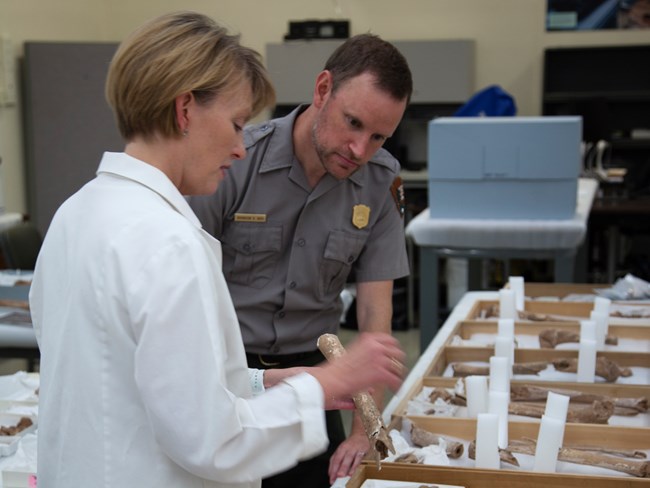
A female scientist and male park ranger examine a bone in a laboratory
Beneath the surface, they found two nearly-complete human skeletons, and several artifacts including buttons from a Union sack coat, a .577 Enfield bullet, three pieces of .31 caliber lead buckshot, and an assemblage of eleven arms and legs. The discovery was something incredibly rare: a battlefield surgeon's burial pit. In fact, this was the first time such a burial pit had ever been excavated and studied at a Civil War battlefield.   To learn more about who these bones belonged to, the NPS again turned to the lab at the Smithsonian to investigate.
 
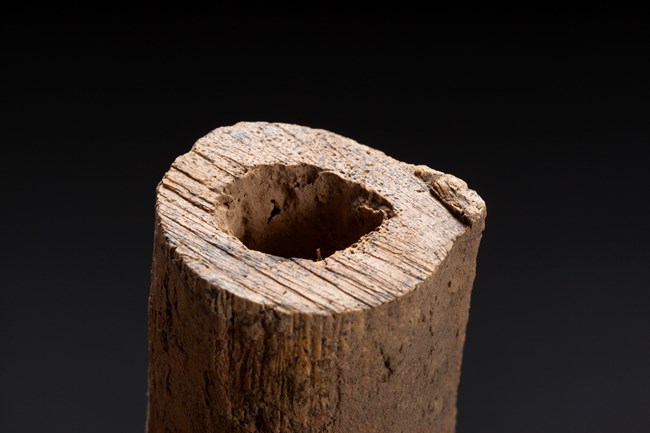
A sawed bone shows the lines left by the surgeon's saw on its end
Manassas National Battlefield Park Superintendent Brandon Bies inspects a bone fragment with Smithsonian scientist Kari Bruwelheide, 2018. Bies is a trained archeologist and participated in the excavation at Manassas.
NPS / Nathan King

Forensic anthropologists from the Smithsonian helped the NPS remove the bones from the site and moved them to a laboratory at the Smithsonian's National Museum of Natural History for further study.  By analyzing the chemistry of the bones, researchers determined where the soldiers were from. Carbon isotopes and oxygen isotopes indicated they ate food and drank water from northern latitudes. Combined with the artifacts including sack coat buttons found with them, they were identified as Union soldiers.

By analyzing the teeth, joints, and bone structure of the two skeletons, scientists determined the first was a man in his late 20's who died as a result of injuries from an Enfield bullet striking his upper leg. Surprisingly, the bullet was still lodged in the femur bone, likely because it slowed as it passed through the man's cartridge box.
 
This detail photo shows the marks left by a surgeon's bone saw when the limb was amputated.
Smithsonian Institution / Kate D. Sherwood
The second skeleton, estimated to be a man 30-34 years old, died as a result of a buck and ball shot to the upper arm, pelvis, and leg.  Both men were taken to the field hospital, but appear to have died without being operated on. Their injuries were too severe.

Research on the eleven limbs recovered from the surgeon's burial pit continues. By examining the cuts, it is possible to determine the skill of the surgeon and even his physical position relative to the patient. With help from historical records, researchers believe it may be possible to match the bones with a specific surgeon and maybe even the soldier they belonged to, a truly unique discovery.
 
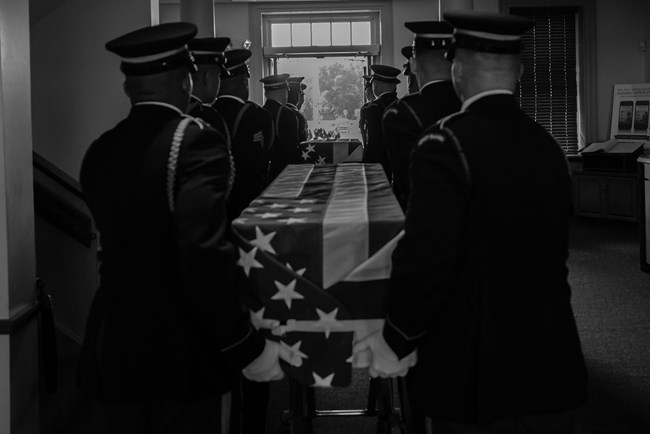
Army honor guard carries flag-draped boxes out of the Manassas Battlefield visitor center
The 3rd U.S. Infantry Regiment, "The Old Guard," carries the remains of the two soldiers out of the Manassas National Battlefield Park visitor center. The remains will be interred at Arlington National Cemetery.
NPS / Bryan Gorsira

After the remains were identified as soldiers, the Army expressed interest in giving the men a permanent resting place at Arlington National Cemetery.  On June 19, 2018, the NPS transferred the remains of the two soldiers to the Army. The Army will inter the remains at Arlington National Cemetery in two caskets made by park rangers from a fallen tree on the battlefield.

The Union soldiers engaged in the Second Battle of Manassas showed tremendous valor. On August 30, 1862, the day these soldiers were likely wounded, Federal troops were ordered to cross an open field, assailed by crushing artillery fire and withering infantry fire from an elevated, entrenched Confederate position. Like many others that day, these soldiers gave the last full measure doing their duty.

Discovering these soldiers' remains led to valuable research that has helped us better understand what happened during the Second Battle of Manassas and of Civil War medicine. Being laid to rest in Arlington National Cemetery will honor their memory and the sacrifice of so many service members throughout our nation's history.

Full Text Source: Manassas Battlefield Field Hospital Amputation Site

Friday, April 18, 2014

Forthcoming and Noteworthy---Manassas: A Battlefield Guide

Manassas: A Battlefield Guide, Ethan Rafuse, author; Erin Greb, cartographer;  University of Nebraska Press, 232 pp, 47 maps, 2 appendices, $21.95. [May 2014].

From the publisher:
This volume is the essential guide to the Manassas battlefields, site of two of the Civil War’s critical campaigns. Ethan S. Rafuse, a distinguished scholar of the Civil War, provides a clearly organized, thorough, and uniquely insightful account of both campaigns, along with expert analysis and precise directions for armchair traveler and battlefield visitor alike.

The July 1861 Battle of First Manassas and the August 1862 Battle of Second Manassas unequivocally influenced the course and outcome of the Civil War. The first battle dealt a decisive blow to hopes that the inexperienced armies of the North and the South could bring about a quick military resolution of the secession crisis. The second battle was the climactic engagement of a spectacular campaign that carried the war to the outskirts of Washington DC and marked the coming of age of Robert E. Lee’s Army of Northern Virginia.

Manassas: A Battlefield Guide presents readers with a clear, convenient guide to the sites in northern and central Virginia that shaped the course and outcome of these campaigns. Lucid, concise narratives give readers a better understanding of the events that took place on these battlefields and of the terrain, personalities, and decisions that shaped them.


Ethan S. Rafuse is a professor of history at the U.S. Army Command and General Staff College and has led staff rides and tours of historic battlefields for many military and civilian groups. He is also the author of several books, including Antietam, South Mountain, and Harpers Ferry: A Battlefield Guide (Nebraska, 2008) and McClellan’s War: The Failure of Moderation in the Struggle for the Union.

Blurbs: “This guidebook explores the campaigns of Manassas like no other. It will take you to obscure places long forgotten and accord them significance; it takes the familiar and illuminates them in ways not done before. Well written and dashed with analytical twists both thoughtful and helpful, Dr. Rafuse’s work is by far the best of its kind.”—John Hennessy, author of Return to Bull Run: The Campaign and Battle of Second Manassas

“No other work juxtaposes Lincoln’s writing and speeches with contemporary commentaries and criticism of him. Rawley’s careful selection of these documents and his judicious interweaving of his historical analysis and background come together to create a powerful dialogue with the reader as well.”—From the foreword by William G. Thomas

CWL:   Manassas: A Battlefield Guide is fifth volume in the This Hallowed Ground: Guides to Civil War Battlefields edited by Brooks D. Simpson, Mark Grimsley and Steven E. Woodworth.   Other volumes in the series include guides for 1] Antietam, South Mountain and Harpers Ferry, 2] Gettysburg, 3] Chickamauga and 4] Wilson's Creek, Pea Ridge and Prairie, Grove. CWL owns and frequently uses 1], 2] and 3].  These books are dashboard friendly for driving tours and readable at home. Both the maps and the narrative are clear, concise and cogent. 

Lower Image is of the author, Ethan Rafuse.

Thursday, September 03, 2009

On the 2nd Manassas Trail: Locating Kettle Run at the Battle of Bristoe Station

On the evening of August 26, after passing around Pope’s right flank via Thoroughfare Gap, Jackson’s wing of the army struck the Orange & Alexandria Railroad at Bristoe Station and before daybreak August 27 marched to capture and destroy the massive Union supply depot at Manassas Junction. This surprise movement forced Pope into an abrupt retreat from his defensive line along the Rappahannock River. On August 27, Jackson routed a Union brigade near Union Mills (Bull Run Bridge), inflicting several hundred casualties and mortally wounding Union Brig. Gen. G.W. Taylor. Ewell’s Division fought a brisk rearguard action against Hooker’s division at Kettle Run, resulting in about 600 casualties. Ewell held back Union forces until dark. During the night of August 27-28, Jackson marched his divisions north to the First Manassas battlefield, where he took position behind an unfinished railroad grade.

From Gerry Boehm, correspondent of Civil War Librarian:
This hot summer day in late August I joined the a small troop accompanying J. Michael Miller, our guide to Bristoe Station. We walked along a nearly dry creek bed, a feeder to Broad Run, south of Broad Run and north of Kettle Run. As pathfinders we sought out the Orange and Alexandria Railroad, hoping to see the battle flag of the 5th New Jersey beyond, but alas the regiment passed before we arrived. The 115th Pennsylvania, in the fog of war mistakingly shot into the 5th New Jersey's ranks. As we moved up aside the railroad toward Bristoe Station, I thought I could smell fresh Forno Brand coffee from New Orleans, either fresh off the campfire from this morning's breakfast or from the nearby homes of Bristoe Station. While on the excursion I walked beside the proud father of a VMI Cadet as we sought to locate where the 8th Louisiana had protected the Dement's Maryland (CSA) Artillery.

A poignant detail presented by Miller, our guide, was that General Hooker finally arrived at Bristoe Station to find an abandoned field hospital. Amoung the wounded was a dying German immigrant who moaned, "Oh! How hard it is to die, when I have been in this land only three months." As the son of German immigrant parents myself, these words suddenly brought me back to the present to pen my recollections of a most memorable battlefield tour. For those who missed the 2:00 PM tour or any of the other Prince William County tours of the Kettle Run Battlefield on Saturday, August 29th, in commemoration of the 147th Anniversary of the Battle of Kettle Run and Second Manassas, on behalf of the Civil War Librarian, I commend to you an excellent article by our brigade leader, Mr. J. Michael Miller, who penned an excellent and extensive article on this often overlooked affair, titled, "The Battles of Bristoe Station" in Volume 26, Issue 2 of the Blue and Gray Magazine. The killing fields of this battle had much to do with sealing General Pope's fate at Second Manassas and the sacrafices here must never be forgotten.

Introductory Text: Ohio State University
Pencil Sketch: Alfred Waud, Northern Virginia CC
Top Image (Boehm): Assault Path of 5th New Jersey
Middle Image (Boehm): Assault Path of the 115th Pennsylvania, 70th and 72nd New York
Bottom Image (Boehm): Line of 8th Louisiana at Kettle Run

Friday, August 01, 2008

News---Preservation: Restoration of Railroad Cut and Brawner Farm at the Second Manasas Battlefield

The National Park at Manasas announced that it has accomplished the restoration of the Railroad Cut. This part of the Second Manasas battlefield (August 28, 29, 30, 1862) is famed for Stonewall Jackson's stout defense against multiple, vigorous Federal attacks. Previously, the Brawner Farm buildings were rehabilitated; the farm was the site of the collision between the Iron Brigade and the Stonewall Brigade August 28.

For those somewhat familiar with the battlefield park, the Railroad Cut is about a half mile north of the Vistors Center, and the Brawner Farm is about two miles west. The Visitors Center is located on the First Manasas' Henry Hill site. To accommodate the Railroad Cut's rehabilitation the walking trails around the Railroad Cut had been closed for over a year.

Checking the Manasas NMP's 2008 calendar, there are no anniversary events planned; although CWL suspects that there will be walking tours scheduled. With the Pennsylvania Reserves reenactment units, CWL camped on Stuart's Hill for the past two years and did living history of the Brawner Farm. If readers plan to take the walking tours, then use tick repellent. Believe me, burning ticks off with a cigar is not a memory I cherish from the living history event. Though come to think of it, that was probably authentic; but, I did not get a 'period rush' from it.

Photograph: Manasas National Military Park

Friday, August 03, 2007

News: Digital Digging for 2nd Manassas Campaign


Aerial photographs from 1937, when superimposed on current aerial photographs have revealed a star shaped fort in an undeveloped field in Fairfax County, Virginia. Also, parts of the Chantilly/Ox Hill battlefield, can be studied even though it was bulldozed for a strip mall a few years ago.

Fought on September 1, 1862, CWL views it as day four of the Second Battle of Manassas. It is treated as such by John Hennessey in his well regarded study, Return to Bull Run. Divisions under the direction of Maj. Gen. Philip Kearny and Maj. Gen. Isaac Stevens thwarted troops under the direction of Maj. Gen. Thomas J. Jackson. About 1,300 Union and 800 CSA causalites were suffered in the farm fields and during an tremendous rain storm with huge bolts of lightning.

Jackson's troops were making a nearly successful turning movement of the Federal right. If achieved R. E. Lee may have a achieved the battle of annihilation for which he longed.

Here's the link for the Washington Post story:
http://www.washingtonpost.com/wp-
dyn/content/article/2007/08/01/AR2007080102407_pf.html

For more on the Second Manassas Campaign:
Return to Bull Run: The Campaign and Battle of Second Manassas, John J. Hennessy

For more on the Battle of Ox Hill/Chantilly:
Tempest at Ox Hill: The Battle of Chantilly, David A. Welker

He Hath Loosed the Fateful Lightning: The Battle of Ox Hill,September 1, 1862, Paul Taylor

Monday, July 30, 2007

CWL --- Brawner's Farm: Manassas Inaugural Event, August 25th, 26th


My understanding of 2nd Bull Run is that it is a four day battle:
August 28th, Brawner's Farm: Iron Brigade vs. Stonewall Brigade
August 29th, The Unfinished Railroad: Pope vs Jackson
August 30th, The Unfinished Railroad & Chinn's Ridge: Pope vs. Jackson &
Longstreet
September 1st, Chantilly/Ox Hill

In July 2002, as my daughter was being oriented to George Washington University in D.C., I drove down the road to Manassas National Battlefield Park. In the morning I hiked the plateau from the Stone Bridge to Henry Hill House. In the afternoon I walked the Iron Brigade's route to Brawner's Farm and climbed around the railroad bed's famous 'cut' where Jackson's men stoned Federal soldiers. Last year, I had the privilege to camp, as a reenactor, in the Manassas Battlefield Park. The Pennsylvania Reserves reenactment group encamped on Stuart's Hill and I with several other hardy souls marched to Chinn Ridge.

Of course, after reading several books on 1st and 2nd Manassas since the 1960s, my ideas changed whenever I walk the ground. The Iron Brigade had to march uphill to reach the Stonewall Brigade. Longstreet's Assault did not roll over a flat Virginia plateau, but went up and down dry gullies with thickets that broke up the ranks. I had mentally pictured Longstreet's Assault as being similar to the Pickett-Pettigrew-Trimble Assault at Gettysburg. No so in the least bit.

This August, I'll again march in the steps of the soldiers. As a Civil War infantryman and as a Signal Corps officer I'll be with my unit, encamped on Stuart's Hill but marching to Brawner's Farm. John Reid, NPS Ranger at Manassas National Military Park sent the following remarks to Pennsylvania Reserve event co-coordinator Joe Sodomin.

". . . the demonstrations [are] concentrated at Brawner Farm, and we are looking to really inaugurate the site with its renovated house and the grounds where the first combat of the second battle occurred with a grand finale to the summer. We are expecting 120 from the Stonewall Brigade and the 3rd U.S. and 3rd Maine (who will portray the 19th Indiana and the 2nd Wisconsin); with your 40 Pennsylvanians [Pennsylvania Reserve Division, a reenactment group,] we can really represent Brawner with both Black Hat and Doubleday's reinforcement to Gibbon (56th Pennsylvania). This is shaping to be the largest single event we have ever contemplated here, let alone presented! The troops will be like "sardines in a barrel" but we have enough room at Stuart's Hill and Brawner for camp bivouacs and demonstrations."