Showing posts with label Atlanta Georgia. Show all posts

Friday, April 26, 2019

News: Atlanta's Civil War Cyclorama---Artifact, Memorial, or Lesson Plan?

 Atlanta’s Civil War Monument, Minus the Pro-Confederate Bunkum: A new exhibition of a gigantic painting uses historical fact to dispel Lost Cause mythology.  By Daniel Judt, The Atlantic Magazine, March 17, 2019

Every city in the South, it seems, is trying to figure out what to do with its monuments. Richmond has kept its grand “Monument Avenue” lined with statues of Confederate luminaries. New Orleans took Robert E. Lee and Jefferson Davis down from their pedestals.   In the city of Atlanta, whose leading Civil War monument is the enormous Atlanta Cyclorama, the strategy is novel: Use history itself to strip a divisive object of its symbolic power.
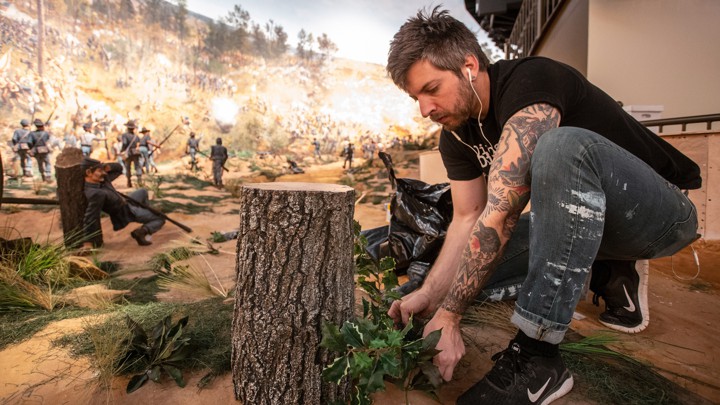
Cycloramas are panorama paintings designed for exhibition in rotundas. The viewer stands in the middle, cocooned by a canvas that becomes the world. The Atlanta Cyclorama shows the 1864 Battle of Atlanta, a crucial turning point in the Civil War that launched General William Tecumseh Sherman on his infamous march and sealed the South’s fate. Now the center of a major new exhibition at the Atlanta History Center, the Cyclorama measures 49 feet high by 382 feet long and weighs more than 9,000 pounds, making it one of the largest paintings in the United States.

 Ever since it premiered in 1886, the Cyclorama has itself been a battleground—a key theater in America’s 150-year fight over how to remember its Civil War. Some exhibitions have cast it as a Union victory; others as a Confederate one. At various moments, Union and Confederate veterans, white and black politicians, civil-rights leaders and segregationists have all tried to claim and control the Cyclorama. Some literally repainted it to promote their memory of the war. For much of the 20th century, the Lost Cause won out, and the Cyclorama served as Atlanta’s Confederate monument. It became part of an effort to uphold white supremacy under the guise of merely commemorating history.

The Cyclorama underscores why we care so much about monuments: not for the past they portray, but for the values they project into the present. “Southern white communities used monuments to preserve their version of the Civil War,” Sheffield Hale, the Atlanta History Center’s director, told me. “A statue of a Confederate general … is not about loss or grief. It is about power.”

When I spoke with Hale and his team of curators at the opening weekend late last month, they were very clear about the goal of the exhibition. They hope to end the Cyclorama’s career as a vessel for Civil War myths—to take away its power without erasing its history.

 They have succeeded. The new exhibition transforms the Cyclorama from, as Hale puts it, “attraction to artifact”—from monument to museum piece. It shifts the focus almost entirely from the history depicted in the painting to the history of the painting itself; from the battle that the Cyclorama depicts to the battle over that battle. And in doing so, it shows how we might resolve the long debate over Civil War monuments. Instead of letting the monuments tell our history, we can tell theirs.

Over its 133-year existence, the Cyclorama has proved uniquely pliable as a Civil War memento, perhaps because it was designed that way.
In their 19th-century heyday, cycloramas traveled from city to city, just as fairs or circuses did. They needed to appeal to a wide audience. When the Milwaukee-based American Panorama Company created the Atlanta Cyclorama, it instructed its team (all German immigrants who spoke no English) to paint an ambiguous juncture in the Battle of Atlanta: 4:45 p.m. on July 22, a moment when four Confederate brigades had just broken the Union line and taken control of Union artillery. Minutes later, Union reinforcements led by General John Logan would beat back the Confederates and end the threat. The Cyclorama depicts Logan on horseback, gallantly charging toward the battle. But he wasn’t there yet. The scene is tense, the outcome unresolved. The painters in Wisconsin crafted the Cyclorama to depict an impending Union victory. From another angle, though, the scene could also be interpreted as a Confederate opportunity. This was a moment when the war could have gone the other way.

The report continues at The Atlantic

Tuesday, December 22, 2015

News---Great Locomotive Chase's Texas Removed From Atlanta Museum For Restoration Purposes

 Press Release:  Atlanta History Center Prepares for Historic Restoration and Move of Atlanta’s Cyclorama Civil War Painting and Texas Locomotive

"Another part of the collection to move to the History Center’s new Cyclorama annex is the Western & Atlantic Texas locomotive. Atlanta was founded as the terminus of the Western & Atlantic Railroad, and only two engines are left in existence from that line. The locomotive Texas is one of them, and remains the best historical example of a Western & Atlantic locomotive of the era, prompting the History Center to dedicate $500,000 to the conservation efforts for the Texas locomotive, which was donated to the City of Atlanta in 1908 and has been exhibited with The Battle of Atlanta painting since 1927.

“As railroads are Atlanta’s reason for being, this steam engine is an icon of Atlanta’s founding and growth as the Gate City of the South – the commercial center of the Southeast,” said Sheffield Hale. “The Texas locomotive symbolizes Atlanta’s longtime relationship with railroads and the city’s importance as a hub for people, commerce, and ideas. No artifact can be more important for telling the story of Atlanta’s beginnings than this Western & Atlantic locomotive.”

Text Source: Atlanta Center For History 

 Backgound:
The Great Locomotive Chase or Andrews' Raid was a military raid that occurred April 12, 1862, in northern Georgia. Union Army volunteers led by civilian scout J. J. Andrews seized a locomotive and drove it northward toward Chattanooga while creating damage to the Western and Atlantic Railroad line between Atlanta and Chattanooga. Confederates pursued them and used the locomotive Texas in the chase. Andrews' raiders cut the telegraph wires; Confederates could not send warnings ahead to forces along Andrews' route.   Eventually captured the raiders and some were executed as spies.  Others had escaped.  The Medal of Honor was created to recognize the raiders efforts and sacrifices.   As a civilian, Andrews is not eligible for the medal.

Monday, February 04, 2013

New and Noteworthy---What the Yankees Did to Us: Sherman's Bombardment and Wrecking of Atlanta

What the Yankees Did to Us: Sherman's Bombardment and Wrecking of Atlanta, Stephen Davis Mercer University Press; 450 pages; $35

Like Chicago from Mrs. O’Leary’s cow, or San Francisco from the earthquake of 1906, Atlanta has earned distinction as one of the most burned cities in American history. During the Civil War, Atlanta was wrecked, but not by burning alone. Longtime Atlantan Stephen Davis tells the story of what the Yankees did to his city.

General William T. Sherman’s Union forces had invested the city by late July 1864. Northern artillerymen, on Sherman’s direct orders, began shelling the interior of Atlanta on 20 July, knowing that civilians still lived there and continued despite their knowledge that women and children were being killed and wounded. Countless buildings were damaged by Northern missiles and the fires they caused. Davis provides the most extensive account of the Federal shelling of Atlanta, relying on contemporary newspaper accounts more than any previous scholar. The Yankees took Atlanta in early September by cutting its last railroad, which caused Confederate forces to evacuate and allowed Sherman’s troops to march in the next day.

The Federal army’s two and a half-month occupation of the city is rarely covered in books on the Atlanta campaign. Davis makes a point that Sherman’s “wrecking” continued during the occupation when Northern soldiers stripped houses and tore other structures down for wood to build their shanties and huts. Before setting out on his “march to the sea,” Sherman directed his engineers to demolish the city’s railroad complex and what remained of its industrial plant. He cautioned them not to use fire until the day before the army was to set out on its march. Yet fires began the night of 11 November—deliberate arson committed against orders by Northern soldiers. Davis details the “burning” of Atlanta, and studies those accounts that attempt to estimate the extent of destruction in the city.  Davis pays particular attention to contemporary journalistic accounts and to the Union force's two and a half month occupation of the city.

Stephen Davis of Atlanta earned a PhD in American Studies, an MA from the University of North Carolina at Chapel Hill, and a BA from Emory University. His hobby since the fourth grade has been the Civil War, on which he has written more than one hundred articles. For over twenty years, he served as book review editor for Blue & Gray Magazine. His book, Atlanta Will Fall: Sherman, Joe Johnston and the Yankee Heavy Battalions, was published in 2001.

Text and Image Source: Mercer University Press

Wednesday, February 02, 2011

News---ISO Atlanta's Battlefields: "It's just a huge crime scene."

Archaeologist Mines Atlanta Landscape for Remains of the Clash Between Union and Confederate Armies, Cameron McWhirter, Wall Street Journal, January 31, 2011.

When Gen. William Tecumseh Sherman arrived here in June 1864, he wrote to his superiors, "The whole country is one vast fort." Gen. Sherman and his 100,000 men encountered 65,000 Confederates dug in along 12 miles of earthworks at Kennesaw Mountain. After fierce fighting, the rebels retreated to nearby Atlanta. Several more battles ensued before Union forces took the city, dealing a crippling blow to the South. Today, metro Atlanta—a land of expressways, subdivisions and shopping malls—has grown to about 5.7 million people, from about 10,000 in the 1860s. So it's easy to assume that evidence of the famous clash of armies has been obliterated except for that preserved in museums, parks and monuments.

That assumption is wrong, according to Garrett Silliman, a 36-year-old archaeologist for an environmental and land-use consulting firm. Mr. Silliman's employer, Edwards-Pitman Environmental Inc., has a contract with Cobb County and the Georgia Department of Transportation to identify battle sites to preserve—or at least excavate—before bulldozers plow them under. He is hoping that as the 150th anniversary of the Civil War arrives this year, governments will take a renewed interest in preservation.

Battlefield archaeology is meticulous work. It takes years of education and mastery of sensitive equipment, including global positioning systems, ground-penetrating radar, advanced metal detectors and extremely precise mapping software. "It's just a huge crime scene," said William Lees, president of the Society for Historical Archaeology and a professor at the University of Western Florida. "You are just trying to figure out what happened there by what was left behind."

If Mr. Silliman finds a clump of unspent bullets, he knows it was where men fumbled with ammunition shortly before an attack. If he finds shattered bits of bullets and belt buckles, he knows it is where soldiers encountered heavy fire. This forensic detail helps Mr. Silliman and other archaeologists develop a much clearer picture of parts of specific battles and also helps them understand overall military strategy at the time. "We can really create a good picture of what was happening even with a limited archaeological record," Mr. Silliman said.

On a cold January morning, Mr. Silliman set out in his Land Rover in search of forgotten battlefields hidden amid heavily developed suburbs. His first stop was a municipal water tank atop a low hill in the shadow of Kennesaw Mountain. In 2005, Mr. Silliman was surveying at the bottom of the hill when he fell in a hole. Cutting away kudzu with a machete, he discovered what he thought was an advanced trench line. Looking at maps and accounts of the fighting, he determined the unnamed hill was likely an advanced position of Alabama Confederates, captured by Union Midwesterners on June 15, 1864.

Five years after he fell in the hole, Mr. Silliman has come back—with funding, county permission and equipment—to see what is still here. Mr. Silliman, who with a trim rounded beard and knit cap looks like a cross between a hippie and a Civil War colonel, hoisted on his back a GPS device that looked like a futuristic trumpet and pointed skyward. He carried a notebook to sketch battle lines that he would later scan into his computer.

There were trenches made of piled mud and stone, running along the hill. The water tank destroyed trenches higher up the hill. A nearby utility line and a subdivision destroyed more down the hill. But the side of the hill, which is tough to build on, had been spared. The fortifications still stand a few feet high, despite years of erosion. "It's amazing how well preserved these things are, given everything that's happened," Mr. Silliman said as he tramped through the forest. Mr. Silliman stopped every few feet to log data to the satellite and sketch the line. He will probably come back in the spring with a metal detector to try to find bullets. Unlike collectors, who dig up items to trade or sell, Mr. Silliman uses detectors to figure out the battle's progress.

Many first-hand reports from the battles and later recollections were wrong. Officers confused by the fighting or eager to impress superiors wrote accounts of battles that often made themselves look better and the fighting fiercer than they actually were. It's like any crime scene. Witnesses can't be trusted, but physical evidence can.

Mr. Silliman's guess is that professionals have surveyed less than 10% of all the battle lines around Atlanta. Like many archaeologists, he considers his work on these forgotten battlefields to be more of a calling than a job. He has ancestors who fought for the Union, and says he wants to preserve what he can for future generations. "It's our Iliad," he said of the conflict.

First Image Caption: Garrett Silliman points toward a rifle pit he found this month while using a GPS system in the woods of Smyrna, Ga. The detritus of war—bullets, uniforms, cannon shot, swords and, of course, corpses—was strewn across the region in the aftermath. Trenches, both intricate defenses built over weeks by engineers and shallow pits frantically dug by infantry under fire, snaked for miles.

Second Image Caption: Garrett Silliman uploads the site's coordinates for comparison with old Civil War era maps. But the work's goal is simple: to reconstruct a battle.

Text and Image Source: Wall Street Journal, January 31, 2011.

CWL: There will be a time when CWL is the guy in the photograph.

Beth wrote:
"Fascinating story. Hopefully he'll be able to find much more, despite the depletion of the battlefields."

Friday, December 25, 2009

New in 2009---Right Book, Wrong Title: The Bonfire

The Bonfire: The Seige and Burning of Atlanta, Marc Wortman, Public Affairs Press, 431 pp., illustrations, index, notes, bibliography, photo credits, $28.95.

How does a non-fiction book end up with the wrong title? A title that leads to disappointment. Bait and switch marketing department at the publisher? A literary agent? The author? CWL will give this book a more accurate, more provocative title. Rebel Phoenix: The Birth, Burning, and Rebirth of Atlanta during the Antebellum and Civil War Era Eras. That is an accurate and compelling labeling of Wortman's work.

Of he 361 pages of text, Atlanta begins to burn in the last 10% of the book. The first 20% concerns frontier Georgia with the very young William T. Sherman showing up at the future site of the city of Atlanta. Yes, Sherman was there, studying the topography of northern Georgia in 1844. A fine story well developed and handled by Wortman. The author finds and presents accounts of massacres survival stories of settlers by Native Americans in early north and central Georgia. These stories Wortman develops well and appreciative of the Georgians later stance on Cherokee removal.

In the next 20% Southern railroad history is developed and a northern Georgia crossroad is planned and labeled 'Terminus' maps. Wortman's chapters here are worthy of reading by anyone interested in American or Southern urban history, the notion of industrial modernization in a slave holding agricultural society.

The next 20% is Civil War history propelled forward by some remarkable Atlanta residents: slaveholders, slaves and freemen, and non-slave holding middle class members. The lives of James Montgomery Calhoun (a Unionist and slaveholder), Festus and Isabella Flipper (slaves whose son enters West Point Military Academy), George Washington Lee (commander of the Confederate Provost Guard) and Bob Yancey (African-American barber, currency speculator and friend to Union prisoners) and many others are well handled by Wortman who offers these individuals as illustrations of how men, women and families accommodate themselves to urban life during wartime.

In the last portion of the book, Sherman and his army reaches Atlanta. During the Confederate retreat from the city, Hood burns the railroad stock. During the Union advance out of the city, Sherman burns much more. Wortman does not excel a telling military history. He should have had a fact checker for the number of commanders Lincoln went through in the Army of the Potomac, the spelling of William Rosecrans' name, and the sequence of events at Chickamaugua and Chattanooga. For those who are looking for a superior military history and social/urban history of the capture of Atlanta and its two destructions, they should consider Bond's War Like A Thunderbolt. Wortman's style uses lots of adjectives and sometimes has lengthly sentences. On the other hand, Bond's is more reportorial and similar to Bruce Catton's Army of the Potomac trilogy.

CWL had trouble 'getting into 'Bonfire' mainly because a huge urban fire should have been around the corner. Upon realizing that Bonfire is urban and social history of a Civil War city, it became enjoyable.

Wednesday, December 02, 2009

News---The Science of Civil War Atlanta's Archaeology

Science Digs Into Civil War Sites, Cameron McWhorter, US News and World Report Science and The Atlanta Journal-Constitution, November 29, 2009.

Just north of I-20 on Moreland Avenue in Atlanta sits an intersection on a low hill. There's a gas station and a liquor store and some other businesses, but not much else. Though you would never know it from the unremarkable view, thousands of men died here 145 years ago in one of the fiercest fights of the Civil War. Confederate Private Sam Watkins, wounded in the battle that July day in 1864, recalled bodies, horses, wagons and cannon "piled indiscriminately everywhere" and "streams of blood."
"'Twas a picture of carnage and death," he wrote. It was a day and a place he would never forget.

But Atlanta did forget. Since the war, the city has sprawled out in every direction with buildings, roads and traffic, paving over this battleground and others. Today most people assume any archaeological record of the clash of two enormous armies more than 160,000 men has been obliterated by modernity. Not so fast. A small but growing number of Georgia archaeologists and history buffs are starting to use high-tech gear, ground-penetrating radar, metal detectors, new software programs and detective-style techniques to detail with amazing precision what happened when U.S. Gen. William T. Sherman made good on his promise to "make Georgia howl."

Decades ago, archaeology was about spades, notebooks and educated guesses. You found a field where you thought something might have been, and you dug pits. Trying to piece together what happened on a battlefield for several hours of one day more than a century ago seemed preposterous. This was especially true in metro Atlanta, where bulldozers have been working overtime for decades. But now this loose group of experts call them Civil War CSI are on the case. They still use historical records and spades, but they also use a whole lot more.

Garrett Silliman, a 35-year-old archaeologist at an environmental consulting firm, has started giving talks to experts in the area and in other states on new approaches that are helping find new Civil War sites and new information in this megalopolis of drywall and asphalt. "A lot of this technology has been around for years, but now it's a lot cheaper and easier to use," he told The Atlanta Journal-Constitution. "For some of us, it's becoming standard operating procedure."

The technology includes:

GIS: geographic information systems technology detailed mapping software that can give a three-dimensional view of an area, and impose old Civil War maps on modern maps.

GPS: global positioning system, which uses satellite to pinpoint the location of a found object or entrenchment.

Ground-penetrating radar. Developed by the U.S. Army to find enemy tunnels during the Vietnam War, the technology used to require a truck and many people to operate it. Today, one person can carry it on his back. The radar can find disturbances many feet underground, revealing Civil War earthworks or battles. Soil and relic testing. Lab testing can give detailed reports on everything from the age of an item to traces of blood.

Metal detectors that are far more precise than the clunky ones popular with Civil War relic hunters. Several Georgians are embracing these new tools. William Drummond, a professor at Georgia Tech's College of Architecture, has spent years promoting GIS technology for use in identifying, analyzing and preserving battlefields.

Dan Elliott, an archaeologist who has been doing Revolutionary War research and some Civil War research in coastal and central Georgia, was trained to use ground-penetrating radar about eight years ago. At the time, only four people in the state knew how to use it — and almost no one was using it for archaeology. Today, more than 20 people in the state are trained and it is a common tool for archaeologists.
"Basically we're stealing ideas that medical technology had 20 years ago," he said. "It gives you Superman eyes to see under the ground." Lu Ann De Cunzo, president of the Society for Historical Archaeology and a professor at the University of Delaware, said these technological advances have given archaeologists an exactitude no one could have imagined only a few years ago. "We can really fine-tune what we are seeing," she said.

The precision this technology offers is startling. To demonstrate, Silliman picked up a small plastic bag on his desk. Inside was a bullet that he recently recovered from a site at Tanyard Creek in Buckhead. Through global positioning he knew the exact location where the bullet was found. Examining its markings, he was able to tell it was a British-made bullet fired from model 1853 Enfield rifle. Because it was slightly marked, he could tell it had been rammed into a gun that had been fouled, probably from being shot a lot that day. Because the lead bullet didn't have any impact marks, he could tell it had not hit a target, but probably just traveled through the air, then dropped to the ground. Military records showed fighting at that location. Using mapping software showing modern Atlanta overlaid with Civil War fortifications, he traced back 1,100 to 1,300 yards the distance an Enfield-fired bullet would travel — to Rebel earthworks.

Silliman held up the little gray missile and declared confidently it was fired between 2 and 4 p.m. on July 20, 1864, by a retreating Confederate soldier. The Rebel missed whatever he was trying to hit. A reporter asked Silliman if he was sure. Silliman smiled slightly. "Plus or minus 120 feet," he said.

Sitting in his small but ordered office in Smyrna, Silliman pulled up on his computer a topographic map of modern Atlanta. He then superimposed historical maps of Union and Confederate defenses, soldiers' camps and where battles took place. Red lines signified Confederate areas; blue showed Union areas. Purple showed areas that have been surveyed by archaeologists. Very little of metro Atlanta was purple. Silliman, who with his lanky build and goatee could pass for a Union corporal, hopes to see that change with new technology.

He said for years traditional archaeology has focused on small sites that were inhabited for long periods, such as Native American villages. The Civil War, he said, requires a different approach especially in Georgia. Silliman, who was raised in New Hampshire but earned his graduate degree at Georgia State University, is the resident Civil War expert at Edwards-Pitman, a subcontractor that does environmental and historical assessments for companies and government agencies that are planning to develop land. Most of his work is in metro Atlanta for the Georgia Department of Transportation or agencies looking to see if any area has historical significance. Silliman insists that huge swaths of metro Atlanta do. The whole area for about a month in 1864 was one gigantic war zone. "Essentially everything from here up to Chattanooga was battlefield," he said.

That includes the low hill near the Moreland exit, and hundreds of other places where the two armies fought around Atlanta. Under the earth, evidence of the fighting survives. Douglas Scott, an archaeology professor in Nebraska nationally known as one of the pioneers in battlefield archaeology, said this technological transformation of archaeology "really has exploded, pun intended, in the last three or four years."

He said battlefield archaeologists in Europe, the eastern United States and the West have started using these tools, and now the South is embracing them. He said historical accounts, just like eyewitness testimony in a criminal case, couldn't always be trusted. "There's a precision that goes with finding stuff on the ground," he said. "Think of historians as detectives; these tools help us find the forensic evidence."

Text Source: U S News and World Report Science

Image Sources:
First: Integrated Solutions for GIS
Second: Global Positioning device at Williamsburg, VA
Third: ground penetrating radar
Fourth: Metal Detecting on Historical Sites

Wednesday, August 12, 2009

New and Noteworthy: Bonfires in the Most Northern of Southern Cities

The Bonfire: The Siege and Burning of Atlanta, Marc Wortman, Public Affairs Press, 352 pages, $26.95, August 2009.

The capture of three great Southern cities were turning points in the American Civil War. The capture of New Orleans in April 1862, the most populated and prosperous city in the Confederacy put Europe on notice and plugged the Mississippi River's Gulf of Mexico and trans-Atlantic trade. The capture of Atlanta in September 1864 put the electorate on notice that the war was being won and that there was a light at the end of the tunnel. The capture of Richmond during the first days of April 1865 routed the Confederate civil government and put it flight.

Recently, Atlanta's Civil War history has received attention In particular, Secret Yankees has revealed that the Northerners that founded the city and lived there remained loyal to the Union and supplied a vast amount of intelligence on commissary stores and troop movements. Marc Wortman offers Bonfire: The Seige and Burning of Atlanta which provides the story of Atlanta from its founding in the 1830s to its burning in the fall of 1865. IN reviewing the index and the first several pages, Wortman's narrative appears to be character driven and accessibly written.

Noted historian, Debby Applegate reports that Wortman offers "extraordinary original research" and "vivid prose and old-fashioned suspense." Wortman is the author of The Millionaires’ Unit: The Aristocratic Flyboys Who Fought the Great War and Invented American Air Power, now in development as a feature film. An award-winning freelance writer, his work has appeared in numerous national magazines. He has taught literature and writing at Princeton University.

The destruction of Atlanta is one of the two epic moments in the film Gone with the Wind. A third epic moment occurred in 1970 when the film was released in major theatres and to my shock and dismay Nancy, my date, burst into tears at the scene where Scarlett is the most broken and then becomes the most resilient. Well, . . . it was an epic moment in my life.

Looking at the stack of soon to be read books on the floor next to my desk, Wortman's Bonfire is next; by the length its bibliography and the first several pages, it looks like one that I might wish to read a second time.

Thursday, October 30, 2008

News---Georgia Builds Civil War Heritage Museum at Resaca Battlefield For $3 Million

Georgia To Build Civil War Visitor CenterResaca Battlefield State Historic Site To Open In 2010, The Citizen, October 28, 2008.

In anticipation of the American Civil War’s sesquicentennial (2011-2015), the Georgia Department of Natural Resources (DNR) has broken ground on the future Resaca Battlefield State Historic Site in Gordon County. During an Oct. 27 ceremony, Civil War re-enactors fired musketry on the site for the first time in 144 years. Resaca Battlefield State Historic Site will serve as Georgia’s gateway to its numerous Civil War attractions.

Located just off I-75 near the Georgia/Tennessee border, its strategic location welcomes casual visitors as well as history buffs as they enter the state — helping generate tourist dollars for not only Gordon County, but all of Georgia. According to the 2000 Georgia Traffic Flow Map, nearly 56,000 vehicles pass the site daily. Visitors to Resaca Battlefield State Historic Site will learn about the battle of Resaca, then gather information for traveling on to Kennesaw Battlefield, Andersonville National Historic Site, Pickett’s Mill Battlefield State Historic Site, Fort McAllister Historic Park, Fort Pulaski National Monument and other locations.

“Because of its location near a major interstate, this new visitor center has the potential to bring many more tourists into Georgia, generating revenue for our communities,” said State Representative John Meadows. “I’d like to particularly thank Governor Sonny Perdue, DNR Commissioner Noel Holcomb and the Friends of Resaca Battlefield for their efforts on this project.” During the ceremony, the Friends of Resaca Battlefield presented a $10,000 donation to the DNR for building the visitor center. The donation was made possible in part by a grant from the Calhoun Gordon County Community Foundation, an affiliate member of the Community Foundation of Northwest Georgia.

“Today’s groundbreaking ceremony is a dream come true,” said Friends President Ken Padgett. “It represents more than a decade of work by our members, state legislators and many other agencies.” Resaca Battlefield State Historic Site will open in 2010 and will include interactive displays, artifacts, retail and a theater. The project is funded with $3 million in bond funds. Between 2000 and 2003, the Georgia Department of Natural Resources purchased 512.85 acres of the battlefield site and has a conservation easement on an additional 61.74 acres. The Department of the Interior has recognized this historic battlefield as one of 25 sites chosen by the Civil War Sites Advisory Commission for funding under the American Battlefield Protection Program. Currently, there is no public access to the site.

The visitor center was designed by BRPH of Marietta and will be LEED certified for environmental responsibility. Out of respect for those who fought and died at the site, the building was specifically designed to represent this particular battle. Situated near a wooded area, the low-profile building has minimal intrusion on the field. Numerous roof angles represent the war’s conflict, and the footprint follows actual lines of the battle.

The Battle of Resaca occurred May 13-15, 1864 and represents the first significant confrontation in Major General William T. Sherman’s Atlanta Campaign. Resaca was the only battle during this campaign where the full might of both armies faced each other in open battle. Here, Sherman hoped to destroy the Confederate Army of Tennessee led by General Joseph E. Johnston — yet there was no clear winner. When it was over, more than 5,500 men lost their lives, and many believe this was a low estimate. The three days of fighting produced nearly 10 percent of the combined casualties sustained during the Atlanta campaign.

Text Source: The Georgia Citizen.com
Top Picture: Robert C. Jones Copyright 2008 by Robert C. Jones (Robert C. Jones, POB 1775, Kennesaw, Georgia 30156)

Middle Picture: Friends of Resaca board members move uphill along the east ridge toward Confederate entrenchments. Image Source: Friends of Resaca Battlefield

Monday, August 27, 2007

CWL --- Stealing the General: Not Your Disney's Train Raid


Stealing the General: The Great Locomotive Chase and the First Medal of Honor, Russell S. Bonds, Westholme Press, 444 pages, maps, b/w photographs, notes, index, bibliography, $29.95, 2007.

Buster Keaton and Fess Parker. If you are over fifty, then you probably know who they are. Silent film comedian and Davy Crockett/Daniel Boone. The story of Union soldiers traveling south surreptitiously to high jack a locomotive and retreat north, all the while disabling rails and bridges was the stuff of legend before Hollywood was born. Buster Keaton's film, The General is a hallmark of silent film comedy; Fess Parker's film, The Great Locomotive Chase is the hallmark of the Cold War Disney entertainment machine.

Russell Bond's Stealing the General gives the reader the whole story: the idea, its implementation, its execution, and its failure. In April 1862, twenty Union soldiers crossed Confederate lines to steal a locomotive in an endeavor to aid in the capture of Chattanooga, Tennessee. Thinking that Steven Spielberg will have Liam Neeson portray Lincoln in the film version of Team of Rivals and that Harrison Ford possibly will star in Manhunt: The 12 Day Chase for Lincoln's Killer, then Bond's work may generate a third Civil War locomotive chase film.

Lawyer and historian, Russell Bonds offers a wonderfully gripping narrative account of the first Union invasion of Alabama, the theft and the chase, the capture of raiders, their executions and their escapes. By the end of the book, when the reader is thoroughly satisfied, the Medal of Honor is introduced and the story has a second ending, just like the movies. The author has a superlative writing style, and an authoritative control of the vast primary source material available from the participants.

Bonds also tells the stories of Confederate railroading, boom town Atlanta, and locomotive construction. In addition, not only do the personalities of the Union soldiers come to the fore but the personalities of those chasing them. To the satisfaction of this reader, Bonds provides a succinct review of the literature of the chase, both by the participants and by later writers.

Fortunately, members of the Book of the Month Club, the History Book Club, the Military Book Club and shoppers at Borders Books and Music and Amazon.com shoppers will have the opportunity to see the splendid cover art.