Showing posts with label Battle of Atlanta. Show all posts

Friday, April 26, 2019

News: Atlanta's Civil War Cyclorama---Artifact, Memorial, or Lesson Plan?

 Atlanta’s Civil War Monument, Minus the Pro-Confederate Bunkum: A new exhibition of a gigantic painting uses historical fact to dispel Lost Cause mythology.  By Daniel Judt, The Atlantic Magazine, March 17, 2019

Every city in the South, it seems, is trying to figure out what to do with its monuments. Richmond has kept its grand “Monument Avenue” lined with statues of Confederate luminaries. New Orleans took Robert E. Lee and Jefferson Davis down from their pedestals.   In the city of Atlanta, whose leading Civil War monument is the enormous Atlanta Cyclorama, the strategy is novel: Use history itself to strip a divisive object of its symbolic power.
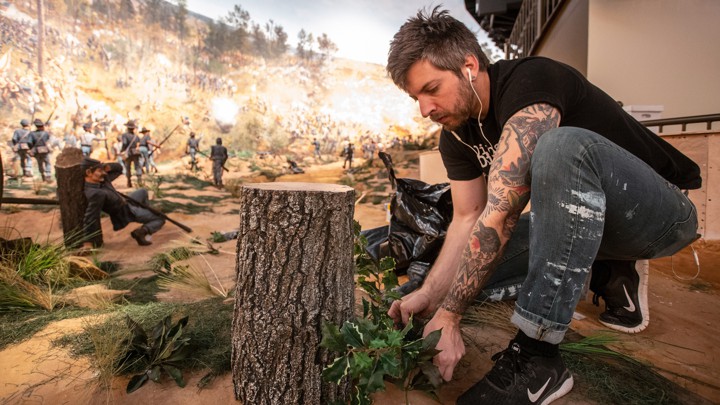
Cycloramas are panorama paintings designed for exhibition in rotundas. The viewer stands in the middle, cocooned by a canvas that becomes the world. The Atlanta Cyclorama shows the 1864 Battle of Atlanta, a crucial turning point in the Civil War that launched General William Tecumseh Sherman on his infamous march and sealed the South’s fate. Now the center of a major new exhibition at the Atlanta History Center, the Cyclorama measures 49 feet high by 382 feet long and weighs more than 9,000 pounds, making it one of the largest paintings in the United States.

 Ever since it premiered in 1886, the Cyclorama has itself been a battleground—a key theater in America’s 150-year fight over how to remember its Civil War. Some exhibitions have cast it as a Union victory; others as a Confederate one. At various moments, Union and Confederate veterans, white and black politicians, civil-rights leaders and segregationists have all tried to claim and control the Cyclorama. Some literally repainted it to promote their memory of the war. For much of the 20th century, the Lost Cause won out, and the Cyclorama served as Atlanta’s Confederate monument. It became part of an effort to uphold white supremacy under the guise of merely commemorating history.

The Cyclorama underscores why we care so much about monuments: not for the past they portray, but for the values they project into the present. “Southern white communities used monuments to preserve their version of the Civil War,” Sheffield Hale, the Atlanta History Center’s director, told me. “A statue of a Confederate general … is not about loss or grief. It is about power.”

When I spoke with Hale and his team of curators at the opening weekend late last month, they were very clear about the goal of the exhibition. They hope to end the Cyclorama’s career as a vessel for Civil War myths—to take away its power without erasing its history.

 They have succeeded. The new exhibition transforms the Cyclorama from, as Hale puts it, “attraction to artifact”—from monument to museum piece. It shifts the focus almost entirely from the history depicted in the painting to the history of the painting itself; from the battle that the Cyclorama depicts to the battle over that battle. And in doing so, it shows how we might resolve the long debate over Civil War monuments. Instead of letting the monuments tell our history, we can tell theirs.

Over its 133-year existence, the Cyclorama has proved uniquely pliable as a Civil War memento, perhaps because it was designed that way.
In their 19th-century heyday, cycloramas traveled from city to city, just as fairs or circuses did. They needed to appeal to a wide audience. When the Milwaukee-based American Panorama Company created the Atlanta Cyclorama, it instructed its team (all German immigrants who spoke no English) to paint an ambiguous juncture in the Battle of Atlanta: 4:45 p.m. on July 22, a moment when four Confederate brigades had just broken the Union line and taken control of Union artillery. Minutes later, Union reinforcements led by General John Logan would beat back the Confederates and end the threat. The Cyclorama depicts Logan on horseback, gallantly charging toward the battle. But he wasn’t there yet. The scene is tense, the outcome unresolved. The painters in Wisconsin crafted the Cyclorama to depict an impending Union victory. From another angle, though, the scene could also be interpreted as a Confederate opportunity. This was a moment when the war could have gone the other way.

The report continues at The Atlantic

Friday, December 25, 2009

New in 2009---Right Book, Wrong Title: The Bonfire

The Bonfire: The Seige and Burning of Atlanta, Marc Wortman, Public Affairs Press, 431 pp., illustrations, index, notes, bibliography, photo credits, $28.95.

How does a non-fiction book end up with the wrong title? A title that leads to disappointment. Bait and switch marketing department at the publisher? A literary agent? The author? CWL will give this book a more accurate, more provocative title. Rebel Phoenix: The Birth, Burning, and Rebirth of Atlanta during the Antebellum and Civil War Era Eras. That is an accurate and compelling labeling of Wortman's work.

Of he 361 pages of text, Atlanta begins to burn in the last 10% of the book. The first 20% concerns frontier Georgia with the very young William T. Sherman showing up at the future site of the city of Atlanta. Yes, Sherman was there, studying the topography of northern Georgia in 1844. A fine story well developed and handled by Wortman. The author finds and presents accounts of massacres survival stories of settlers by Native Americans in early north and central Georgia. These stories Wortman develops well and appreciative of the Georgians later stance on Cherokee removal.

In the next 20% Southern railroad history is developed and a northern Georgia crossroad is planned and labeled 'Terminus' maps. Wortman's chapters here are worthy of reading by anyone interested in American or Southern urban history, the notion of industrial modernization in a slave holding agricultural society.

The next 20% is Civil War history propelled forward by some remarkable Atlanta residents: slaveholders, slaves and freemen, and non-slave holding middle class members. The lives of James Montgomery Calhoun (a Unionist and slaveholder), Festus and Isabella Flipper (slaves whose son enters West Point Military Academy), George Washington Lee (commander of the Confederate Provost Guard) and Bob Yancey (African-American barber, currency speculator and friend to Union prisoners) and many others are well handled by Wortman who offers these individuals as illustrations of how men, women and families accommodate themselves to urban life during wartime.

In the last portion of the book, Sherman and his army reaches Atlanta. During the Confederate retreat from the city, Hood burns the railroad stock. During the Union advance out of the city, Sherman burns much more. Wortman does not excel a telling military history. He should have had a fact checker for the number of commanders Lincoln went through in the Army of the Potomac, the spelling of William Rosecrans' name, and the sequence of events at Chickamaugua and Chattanooga. For those who are looking for a superior military history and social/urban history of the capture of Atlanta and its two destructions, they should consider Bond's War Like A Thunderbolt. Wortman's style uses lots of adjectives and sometimes has lengthly sentences. On the other hand, Bond's is more reportorial and similar to Bruce Catton's Army of the Potomac trilogy.

CWL had trouble 'getting into 'Bonfire' mainly because a huge urban fire should have been around the corner. Upon realizing that Bonfire is urban and social history of a Civil War city, it became enjoyable.

Wednesday, December 02, 2009

News---The Science of Civil War Atlanta's Archaeology

Science Digs Into Civil War Sites, Cameron McWhorter, US News and World Report Science and The Atlanta Journal-Constitution, November 29, 2009.

Just north of I-20 on Moreland Avenue in Atlanta sits an intersection on a low hill. There's a gas station and a liquor store and some other businesses, but not much else. Though you would never know it from the unremarkable view, thousands of men died here 145 years ago in one of the fiercest fights of the Civil War. Confederate Private Sam Watkins, wounded in the battle that July day in 1864, recalled bodies, horses, wagons and cannon "piled indiscriminately everywhere" and "streams of blood."
"'Twas a picture of carnage and death," he wrote. It was a day and a place he would never forget.

But Atlanta did forget. Since the war, the city has sprawled out in every direction with buildings, roads and traffic, paving over this battleground and others. Today most people assume any archaeological record of the clash of two enormous armies more than 160,000 men has been obliterated by modernity. Not so fast. A small but growing number of Georgia archaeologists and history buffs are starting to use high-tech gear, ground-penetrating radar, metal detectors, new software programs and detective-style techniques to detail with amazing precision what happened when U.S. Gen. William T. Sherman made good on his promise to "make Georgia howl."

Decades ago, archaeology was about spades, notebooks and educated guesses. You found a field where you thought something might have been, and you dug pits. Trying to piece together what happened on a battlefield for several hours of one day more than a century ago seemed preposterous. This was especially true in metro Atlanta, where bulldozers have been working overtime for decades. But now this loose group of experts call them Civil War CSI are on the case. They still use historical records and spades, but they also use a whole lot more.

Garrett Silliman, a 35-year-old archaeologist at an environmental consulting firm, has started giving talks to experts in the area and in other states on new approaches that are helping find new Civil War sites and new information in this megalopolis of drywall and asphalt. "A lot of this technology has been around for years, but now it's a lot cheaper and easier to use," he told The Atlanta Journal-Constitution. "For some of us, it's becoming standard operating procedure."

The technology includes:

GIS: geographic information systems technology detailed mapping software that can give a three-dimensional view of an area, and impose old Civil War maps on modern maps.

GPS: global positioning system, which uses satellite to pinpoint the location of a found object or entrenchment.

Ground-penetrating radar. Developed by the U.S. Army to find enemy tunnels during the Vietnam War, the technology used to require a truck and many people to operate it. Today, one person can carry it on his back. The radar can find disturbances many feet underground, revealing Civil War earthworks or battles. Soil and relic testing. Lab testing can give detailed reports on everything from the age of an item to traces of blood.

Metal detectors that are far more precise than the clunky ones popular with Civil War relic hunters. Several Georgians are embracing these new tools. William Drummond, a professor at Georgia Tech's College of Architecture, has spent years promoting GIS technology for use in identifying, analyzing and preserving battlefields.

Dan Elliott, an archaeologist who has been doing Revolutionary War research and some Civil War research in coastal and central Georgia, was trained to use ground-penetrating radar about eight years ago. At the time, only four people in the state knew how to use it — and almost no one was using it for archaeology. Today, more than 20 people in the state are trained and it is a common tool for archaeologists.
"Basically we're stealing ideas that medical technology had 20 years ago," he said. "It gives you Superman eyes to see under the ground." Lu Ann De Cunzo, president of the Society for Historical Archaeology and a professor at the University of Delaware, said these technological advances have given archaeologists an exactitude no one could have imagined only a few years ago. "We can really fine-tune what we are seeing," she said.

The precision this technology offers is startling. To demonstrate, Silliman picked up a small plastic bag on his desk. Inside was a bullet that he recently recovered from a site at Tanyard Creek in Buckhead. Through global positioning he knew the exact location where the bullet was found. Examining its markings, he was able to tell it was a British-made bullet fired from model 1853 Enfield rifle. Because it was slightly marked, he could tell it had been rammed into a gun that had been fouled, probably from being shot a lot that day. Because the lead bullet didn't have any impact marks, he could tell it had not hit a target, but probably just traveled through the air, then dropped to the ground. Military records showed fighting at that location. Using mapping software showing modern Atlanta overlaid with Civil War fortifications, he traced back 1,100 to 1,300 yards the distance an Enfield-fired bullet would travel — to Rebel earthworks.

Silliman held up the little gray missile and declared confidently it was fired between 2 and 4 p.m. on July 20, 1864, by a retreating Confederate soldier. The Rebel missed whatever he was trying to hit. A reporter asked Silliman if he was sure. Silliman smiled slightly. "Plus or minus 120 feet," he said.

Sitting in his small but ordered office in Smyrna, Silliman pulled up on his computer a topographic map of modern Atlanta. He then superimposed historical maps of Union and Confederate defenses, soldiers' camps and where battles took place. Red lines signified Confederate areas; blue showed Union areas. Purple showed areas that have been surveyed by archaeologists. Very little of metro Atlanta was purple. Silliman, who with his lanky build and goatee could pass for a Union corporal, hopes to see that change with new technology.

He said for years traditional archaeology has focused on small sites that were inhabited for long periods, such as Native American villages. The Civil War, he said, requires a different approach especially in Georgia. Silliman, who was raised in New Hampshire but earned his graduate degree at Georgia State University, is the resident Civil War expert at Edwards-Pitman, a subcontractor that does environmental and historical assessments for companies and government agencies that are planning to develop land. Most of his work is in metro Atlanta for the Georgia Department of Transportation or agencies looking to see if any area has historical significance. Silliman insists that huge swaths of metro Atlanta do. The whole area for about a month in 1864 was one gigantic war zone. "Essentially everything from here up to Chattanooga was battlefield," he said.

That includes the low hill near the Moreland exit, and hundreds of other places where the two armies fought around Atlanta. Under the earth, evidence of the fighting survives. Douglas Scott, an archaeology professor in Nebraska nationally known as one of the pioneers in battlefield archaeology, said this technological transformation of archaeology "really has exploded, pun intended, in the last three or four years."

He said battlefield archaeologists in Europe, the eastern United States and the West have started using these tools, and now the South is embracing them. He said historical accounts, just like eyewitness testimony in a criminal case, couldn't always be trusted. "There's a precision that goes with finding stuff on the ground," he said. "Think of historians as detectives; these tools help us find the forensic evidence."

Text Source: U S News and World Report Science

Image Sources:
First: Integrated Solutions for GIS
Second: Global Positioning device at Williamsburg, VA
Third: ground penetrating radar
Fourth: Metal Detecting on Historical Sites

Tuesday, October 06, 2009

CWL---War Like A Thunderbolt: The Battle and Burning of Atlanta Among 2009's Best

War Like the Thunderbolt: The Battle and Burning of Atlanta , Russell S. Bonds, Westholme Publishing, 544 pages, 10 maps, 50+ photographs, end notes, index, bibliography. $29.95.

What initially drew me to this book was the author. In Stealing the General: The Great Locomotive Chase and the First Medal of Honor Russell Bonds captures The Andrews Raid of 1862 (better known as the Great Locomotive Chase) so well in detail and story that I hoped a second effort would soon arrive.

During the middle of my reading Thunderbolt, I asked myself 'when have I so thoroughly enjoyed a book on the American Civil War?' As enjoyable as Stealing the General is, War Like A Thunderbolt exceeds it. The freshness of the writing style, the pace of the story, and the handling of an entire campaign is as compelling Bruce Catton's hallmark Army of the Potomac trilogy. When I finished reading Catton's trilogy (each of the three times) I wanted to know more about the Army of the Potomac and its battles. Finishing Thunderbolt, I went to my shelves and found two other related books. Bonds' writing left me with a desire to know more about the battles at Atlanta, its soldiers, its impact on civilians, and even the logistics of moving armies across rivers, mountains, and through the cities of Georgia.

In the Preface Bonds presents the risk that Selznick took in obtaining the rights to Gone With The Wind, then producing and marketing the movie. The impact of tragedy and romance on the representations of the Atlanta campaign was profound. Considerations of Sherman, Johnson, Hood and their armies are often viewed with Gone with the Wind in mind of the popular audience and casual reader of Civil War history. Bonds challenges that Hollywood induced collective memory.

The civilians in the path of the armies are not neglected by Bonds: die hard Rebels, immigrant Northern business families, free and enslaved Blacks appear in the opening chapters, throughout the book and in the final chapter about the Phoenix City. Sherman's reputation is neither polished nor bruised; through Sherman's words Bonds' tells the commander's story of amazing generalship, intuitive leadership and a great deal of luck, earned and unearned. Some the earned luck that Sherman had included his 1844 tour of duty that place him among the mountains and rivers over which his army would march 20 years latter. Bonds pointedly describes Sherman's first visit to northern Georgia and how crucial it was for the formation of his 1864 strategy.

Neither Johnson nor Hood are stereotyped or diminished. Johnson does not act cowardly and Hood is not a laudanum addled commander. Each general has his perspective and talents and commands the army in accordance with them. The soldiers' voice is heard throughout every chapter; corps, divisions and brigades are surely in their place and there commanders and troops are placed as firmly before the reader as they are the enemy.

Three times I've returned to Catton's Mr. Lincoln's Army, Glory Road, and Stillness at Appomattox during my lifetime of reading Civil War history; I plan to do the same with War Like the Thunderbolt: The Battle and Burning of Atlanta and Stealing the General.