Showing posts with label Georgia. Show all posts

Tuesday, May 28, 2019

New and Noteworthy: The Strange Journeys of the Cotton Gin, The Confederate Constitution, The Confederate Gold, The Stone Mountain Memorial, The Boll Weevil and The KKK Among Other Pieces of Georgia History

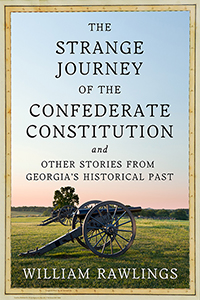
https://www.mupress.org/Assets/ProductImages/9780881466263.jpgThe Strange Journey of the Confederate Constitution and Other Stories from Georgia's Historical Past, William Rawlings, Mercer University Press, 288 pages, 2017, illustrations, maps, bibliographic notes, bibliography, appendix, index, $29.00.

William Rawlings offers a clear and concise collection of essays organized as themes in Georgia history: the cotton gin's actual history, land frauds in colonial and revolutionary era Georgia, the creation and post-war travels of the Confederate States' constitution, what exactly the Confederate gold was and how it was spent and not buried, the creation of the Stone Mountain Memorial [and what was supposed to be but is not on it], and the first, second and third Ku Klux Klans.Also murder trials, fraud trials, and a pastor who shoots a blue jay bird and a chicken.

Rawlings offers an extensive appendix entitled: Exploring Our Past: A Short Practical Guide to Historical Research for Writers which is suitable for aspiring writers, Advanced Placement History students, college graduates and journalists.  Overall, Rawling's The Strange Journey of the Confederate Constitution and Other Stories for Georgia's Historical Past is a superb example of well writing, interesting and insightful state and local history with applications to the nation's story.

From the Publisher: The Strange Journey of the Confederate Constitution and Other Stories f\rom Georgia's Historical Past  is a collection of seventeen articles and essays on topics in Georgia and Southern history. Individual chapters are arranged by era and cover subjects ranging from The Great Yazoo Fraud of the 1790s, to Jefferson Davis and the Confederate Treasure of the 1860s, to the Reign of Terror visited by the Ku Klux Klan in Macon of the 1920s. While academic, the book’s varying topics are aimed at readers with a general interest in the intriguing and often convoluted history of the South. Some articles focus on events, others on people (e.g. Gutzon Borglum or Eli Whitney), and still others on more controversial topics, such as the place of The Birth of a Nation and Gone With the Wind in modern society. The author’s writing style is one that promotes relaxed recreational reading, treating each topic as an unfolding story as the chapter progresses. As a bonus to those interested in research and writing about historical subjects, the Appendix contains advice in the form of “A Short Practical Guide to Historical Research for Writers.”

Tuesday, June 12, 2018

New and Noteworthy: The War Beyond My Window


The War Outside  My Window: The Civil War Diary of LeRoy Wiley Gresham, 1860-1865 Edited by Janet Elizabeth Croon, Savas Beatue Publishing, 480 pp, maps, images, medical forward, Dramatis Personae, $34.95

Residing in a family that owned two rural Georgia plantations but residing in Macon, Georgia, LeRoy W. Gresham, has left a remarkable document that reveals much about the daily life of a slave holding family.  Gresham is a resilient young adult who grievously suffers from known and unknown health conditions. While viewing a house that had recently burned down, a chimney collapsed and struck his leg. In his future are not canes, crutches or wheelchairs. He must be pulled around in a cart by his brother, cousins or a slave. Unknown to his doctor or his parents is that tuberculosis has entered his body and he is slowly degenerating.  He dies in 1865 at the age of 18.

The American Civil War is indeed outside of his window. In 1860 he gathers premonitions of the coming storm when he travels on a ship from Savannah to Philadelphia and New York City for the purpose of being examined by medical specialists. He notes the present of Japanese visitors walking the streets of Philadelphia. Back home, he views it by reading newspapers, conversing with relatives and visiting the troop trains that pass through Macon. Sherman’s march misses Macon but the refugees from the march don’t. 

If you are an environment historian, you should read the diary for the droughts and floods that interrupt the agriculture practices of the plantations and the fluctuating prices of food. If you are a social historian, you should read this for his description of his family’s extended relative connections, his education, the family’s parlor games and the diets of a plantation household that live in a city. If you are drawn to communications and journalism, you will find how fast news and newspapers travel between the United States and the Confederate States. He has his favorite Northern and Southern newspapers and he comes to an understanding of ‘fake news’ and how and why it exists.  If you are a medical historian, you will discover how doctors understand and treat Gresham’s coughs, back pains, headaches, nerve damage to his leg and hips.  Readers will come to learn that a belladonna plaster on the spine really, really itches. 

In Gresham’s diary there are fires which destroy homes; eleven homes and farm buildings are destroyed by fire during 1860-1861. Readers might ponder whether these fires occur when a fire place ember pops and lands on carpets and quilts or whether some slaves became arsonists. Funerals are a regular occurrence. Elders and infants die; adults get very sick very quickly and die.
Gresham is never not reading two or three books at the same time.  The works of Charles Dickens, Wilkie Collins, James Fennimore Cooper, William Prescott [the historian] are each on his bookshelves which hold history, travel or fiction books.  If relatives come to visit him, they usually bring a book or newspapers and then take some time to play chess with him.  Also on his book shelf are manuals of chess openings used by the experts.   He does have opinions about the New York City and Philadelphia newspaper editors.

When Gresham is outside he travels to the train station to talk to the troops or ventures to a target range where he practices his archery and rifle skills. With help he flies a kite. At night he studies the constellations.  During the daytime he works on math problems, Latin and essays. 

The annotated notes by Janet Elizabeth Coon are clear, concise and insightful. There are maps, sample pages of the diary, and a list of those relatives, neighbors and slaves mentioned in the diary. What readers will not find in the book is ‘presentism’ inserted by the author.  Race, gender, class issues are not offered in the context of today’s social and political environment. They are not absent from the diary though.  You may read the diary and find out what women do, slaves do, capitalists do as viewed through the eyes of a young adult male. 

There are between twelve and fifteen book awards related to the American Civil War. The War Outside My Window: The Civil War Diary of LeRoy Wiley Gresham, 1860-1865 will likely be nominated several times as a ‘book of the year’.  Other diaries of this caliber are by Mary Boykin Chesnut, Sarah Morgan, Sam Watkins and the Cormany Diaries.


Wednesday, January 23, 2013

News---Possible Confederate Blockade Runner Found On Desolate Island Near Georgia

Shifting Sand Yield Mystery Ship Wreck On Remote Georgia Island That Likely Dates To 1800s, Associated Press, Washington Post, January 21, 2013.
The odd skeleton of wooden beams barely poked above the sands, exposed just enough by wind and tides for a beachcomber to report the curious find. Fred Boyles, National Park Service superintendent on Georgia’s Cumberland Island, says the buried beams could have easily been overlooked as ordinary flotsam washed ashore on the beach. But archaeologists called to the remote Atlantic coastal island spent days last week unearthing an astonishing find: an old wooden shipwreck held together with wooden pegs, its backstory lost in time.

“Someone had the foresight to say that doesn’t just look like normal wood, and thank goodness they called us,” Boyles said of the island resident, who stumbled on the wreck around Christmas. “Frankly, had I been driving on the beach, I would’ve ridden right by.” This 80-foot-long fragment of history, with some of its wooden siding still intact, is believed to date to the mid-1800s based on its construction, said Michael Steiber, a National Park Service archaeologist trying to crack the mystery of the ship’s origin.

It might have been delivering supplies to Southern plantation owners who grew cotton, corn and rice on Cumberland Island for decades after the Revolutionary War, Steiber said. Or perhaps it was a Confederate blockade runner that sank during the Civil War. There is no shortage of potential suspects on Cumberland Island, a place steeped in history. The park service manages the island off the Southeast coast today as a federally protected wilderness. “This has been a high-traffic area ever since the Spanish and the British started colonizing,” Steiber said. “There are a lot of possibilities.”

The archaeologists made copious notes during their days of excavation on the site last week. They drew maps and collected wood samples for testing. Now they are turning to the historical records for clues. Early Spanish settlers operated missions on the island for roughly a century, from 1587 to 1684. The English arrived not long after Gen. James Edward Oglethorpe founded Georgia as the 13th British colony in 1733. In the 1800s, plantations thrived on Cumberland Island until the region’s economy collapsed after the Civil War. Yet identifying the wreck is proving elusive.

The story continues at Washington Post.
Image Source: Atlanta Journal Constitution