Showing posts with label Confederacy. Show all posts

Tuesday, May 28, 2019

New and Noteworthy: The Strange Journeys of the Cotton Gin, The Confederate Constitution, The Confederate Gold, The Stone Mountain Memorial, The Boll Weevil and The KKK Among Other Pieces of Georgia History

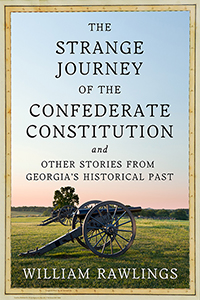
https://www.mupress.org/Assets/ProductImages/9780881466263.jpgThe Strange Journey of the Confederate Constitution and Other Stories from Georgia's Historical Past, William Rawlings, Mercer University Press, 288 pages, 2017, illustrations, maps, bibliographic notes, bibliography, appendix, index, $29.00.

William Rawlings offers a clear and concise collection of essays organized as themes in Georgia history: the cotton gin's actual history, land frauds in colonial and revolutionary era Georgia, the creation and post-war travels of the Confederate States' constitution, what exactly the Confederate gold was and how it was spent and not buried, the creation of the Stone Mountain Memorial [and what was supposed to be but is not on it], and the first, second and third Ku Klux Klans.Also murder trials, fraud trials, and a pastor who shoots a blue jay bird and a chicken.

Rawlings offers an extensive appendix entitled: Exploring Our Past: A Short Practical Guide to Historical Research for Writers which is suitable for aspiring writers, Advanced Placement History students, college graduates and journalists.  Overall, Rawling's The Strange Journey of the Confederate Constitution and Other Stories for Georgia's Historical Past is a superb example of well writing, interesting and insightful state and local history with applications to the nation's story.

From the Publisher: The Strange Journey of the Confederate Constitution and Other Stories f\rom Georgia's Historical Past  is a collection of seventeen articles and essays on topics in Georgia and Southern history. Individual chapters are arranged by era and cover subjects ranging from The Great Yazoo Fraud of the 1790s, to Jefferson Davis and the Confederate Treasure of the 1860s, to the Reign of Terror visited by the Ku Klux Klan in Macon of the 1920s. While academic, the book’s varying topics are aimed at readers with a general interest in the intriguing and often convoluted history of the South. Some articles focus on events, others on people (e.g. Gutzon Borglum or Eli Whitney), and still others on more controversial topics, such as the place of The Birth of a Nation and Gone With the Wind in modern society. The author’s writing style is one that promotes relaxed recreational reading, treating each topic as an unfolding story as the chapter progresses. As a bonus to those interested in research and writing about historical subjects, the Appendix contains advice in the form of “A Short Practical Guide to Historical Research for Writers.”

Tuesday, July 18, 2017

New and Noteworthy---Jefferson Davis, Confederate Nationalism and the Possibility of Arming Slaves

Jefferson Davis's Final Campaign: Confederate Nationalism and the Fight to Arm Slaves, Philip D. Dillard, Mercer University Press, 286 pages, eight photos, 8 maps, footnotes, bibliography, index, 2017, $35.


 Jefferson Davis's Final Campaign: Confederate Nationalism and the Fight to Arm Slaves focuses upon the Southern public's debate over the enlistment of free blacks and slaves into the military forces of the Confederacy. Virginia, Georgia and Texas newspapers are closely examined as well as Davis' statements and correspondence. Also the author relies on Davis' annual address of 1864 and his letters to to Confederate States officials.

The chief conclusion the author reaches is that the closer the Federal armies came to Southern communities the more prevalent and vocal came the call from those communities to consider the enlistment of African Americans. The proposition to arm the slaves came from those most threatened by Federal armies.

 Jefferson Davis's Final Campaign begins with  a survey of current work done on the topic of the enlistment of slaves. Dillard's research takes into consideration the various social classes in the Confederacy.  His narrative suggests the consideration of the question: what would an independent Confederate nation look like if it contained former slaves  who were veterans or if it contained slaves who were once armed but not emancipated.

Dillard discusses three phases which the debate of arming the slaves passed through: during the second half of 1863 (post Gettysburg and Vicksburg); the summer and autumn of 1864 with Sherman approaching Atlanta, Grant approaching Richmond and Thomas waiting at Nashville for Hood to arrive; Davis' annual address at the end of 1864 and the February 1865 Hampton Roads conference.

The author derives most of the support for his  arguments from newspaper editorials and letters to the editor from soldiers and civilians. Contrary to popular understandings of Davis effectiveness, Dillard finds that Davis successfully marshaled support for his views, though the support he received may have been too little and too late.  Jefferson Davis's Final Campaign: Confederate Nationalism and the Fight to Arm Slaves is a thought provoking study of the Confederate nation at the brink of its extinction and what possible life-saving remedies were acceptable to its leaders and citizens.

Friday, May 27, 2016

New And Noteworthy: When Did The Best Chance for Confederate Independence Occur?

The Confederacy at Flood Tide: The Political and Military Ascension, June to December 1862, Philip Leigh, Westholme Publishing, 288 pp., $28.00.
 

From The Publisher: 
The Fleeting Moment When the Confederate States of America Had the Best Opportunity to Achieve Independence and Why Their Efforts Failed.

The first six months of 1862 provided a string of Federal victories in the West at Mill Springs, Fort Donelson, Pea Ridge, and Shiloh. In May, New Orleans fell, and Union General George McClellan’s army was so close to the Confederate capital of Richmond, Virginia, that the troops could set their watches by the city’s church bells. But then the unexpected happened. 
In June, Robert E. Lee’s Army of Virginia pushed McClellan’s much larger army back to the James River. In Europe, Confederate diplomats sought international recognition for the Confederate States of America, which was made even more attractive now that a shortage of cotton made the powerful textile interests anxious to end the war. 
Further tipping the balance, in July, the Confederacy secretly ordered two of the latest ironclad ships from England’s famous Laird Shipyard—the same yard that built the commerce raider Alabama. These steam-powered ironclads would be far superior to anything in the Federal navy.

While the “high tide” of the Confederacy is often identifed as Pickett’s Charge during the Battle of Gettysburg in July 1863, the most opportune time for the Confederacy vanished seven months earlier, coinciding with President Abraham Lincoln’s Emancipation Proclamation in December 1862 and the failure of the secessionist states to be recognized as a sovereign nation. 
As Philip Leigh explains in his engrossing new book, The Confederacy at Flood Tide: The Political and Military Ascension, June to December 1862, on every battlefront and in the governmental halls of Europe, the Confederate effort reached its furthest extent during the second half of 1862. But with the president’s proclamation, the possibility of slave revolts and decline in the production of the very products that were sustaining the Southern economy became real; coupled with Europe’s decision to reject Confederate overtures and halt the sale of the ironclads, the opportunity for Confederate success ended. The Confederacy would recede, and the great battles of 1863 and 1864 only marked the Southerners’ tenacity and stubborn belief in a lost cause.

Friday, October 02, 2015

New and Noteworthy---Empty Sleeves: Amputation In The Civil War South

Empty Sleeves: Amputation In The Civil War South, Brian Craig Miller, University of Georgia Press, 280pp, 20 b/w illustrations, endnotes, bibliography, index, $29.95.

From The Publisher:    The Civil War acted like a battering ram on human beings, shattering both flesh and psyche of thousands of soldiers. Despite popular perception that doctors recklessly erred on the side of amputation, surgeons labored mightily to adjust to the medical quagmire of war.

 Brian Craig Miller shows in Empty Sleeves, the hospital emerged as the first arena where southerners faced the stark reality of what amputation would mean for men and women and their respective positions in southern society after the war. Thus, southern women, through nursing and benevolent care, prepared men for the challenges of returning home defeated and disabled.
 
Still, amputation was a stark fact for many soldiers. On their return, southern amputees remained dependent on their spouses, peers, and dilapidated state governments to reconstruct their shattered manhood and meet the challenges brought on by their newfound disabilities. It was in this context that Confederate patients based their medical care decisions on how comrades, families, and society would view the empty sleeve.

In this highly original and deeply researched work, Miller explores the ramifications of amputation on the Confederacy both during and after the Civil War and sheds light on how dependency and disability reshaped southern society.  Empty Sleeves: Amputation In The Civil War South reveals how amputation influenced definitions of manhood, allowing dependency to be recognized as part of southern masculinity

Brian Craig Miller is an Associate Professor and Associate Chair of History at Emporia State University and the forthcoming editor of the journal Civil War History. Miller is the author of  John Bell Hood and the Fight for Civil War Memory (Univ. of TN Press, 2010) and A Punishment on the Nation: An Iowa Soldier Endures the Civil War (Kent State, 2012). He is currently working on an exploration of Walt Disney and Civil War Memory. His work has been supported by numerous fellowships, including a Mellon Fellowship from the Huntington Library, two Mellon Fellowships from Virginia Historical Society, a Ballard Breaux Fellowship from the Filson in Louisville, and the Reynolds fellowship from the University of Alabama at Birmingham. Miller is an active member of several historical organizations, including the Southern Historical Association and the Society of Civil War Historians. When he is not writing, Miller enjoys running, as he is attempting to run a half marathon in all 50 states (and DC). He has completed 21 so far, most recently in Whitefish, Montana.

Sunday, October 05, 2014

New and Noteworthy----Embattled Rebel: Jefferson Davis Beseiged on Several Fronts


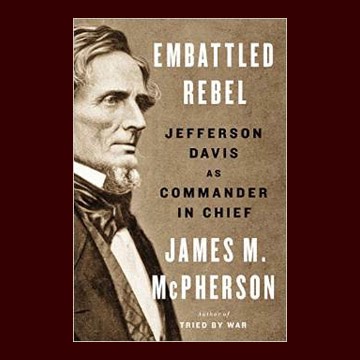
EmbattledRebel: Jefferson Davis as Commander In Chief, James M. McPherson, Penguin Press, 302pp., 24 black and white illustrations, 15 maps, bibliographic notes, index, 2014, $32.95.

As president of the Confederacy, did Jefferson Davis prove to be a decisive factor in bringing about its defeat? Did his work as commander-in-chief contribute the defeat of the Confederacy? Is historian David M. Potter correct in stating that if  the Union and the Confederacy had exchanged presidents, the Confederacy might have won its independence?  In Embattled Rebel James M. McPherson, an academic scholar with over a dozen books and numerous articles to his credit, avoids comparing Davis to Lincoln. McPherson describes and analyzes Davis’ conception and execution of his duties as commander in chief as he understood them.

McPherson notes that negative depictions of Davis’ personality have been offered by his contemporaries in both the Confederate government and military.  These depictions of Davis are adequately noted by William C. Davis in Jefferson Davis: The Man and His Hour and An Honorable Defeat: The Last Days of the Confederate Government. McPherson acknowledges that there is substance to the claims that Jefferson Davis was impatient with others with whom he disagreed and did not take personal criticisms well.  More often than not, Davis could be humorless, argumentative and cold to others. 

The author does note that some found Davis to be attentive and polite to others, as well as cordial and a good listener.  McPherson believes that the Confederate president’s ill-health health was the likely cause of apparently abusive conduct.  Symptoms of previous bouts with malaria, severe neuralgia, and corneal ulcers left him at times in pain, nauseous, and partially blind.  Often sick, Davis worked frequently from a sick bed at home. Bronchial infections, insomnia and boils increased discomfort and pain.

McPherson notes that it was in April and May 1863, while Lee was suffering from symptoms of heart disease and Jackson was dying, that Davis could not come to the  presidential office for reasons of sickness.  Along with his ill-health, the stress of having meager resources at hand to meet the challenges of the presidency added to Davis’ irritability, impatience and short temper. 

With these caveats, McPherson judges Davis on five activities: 1. national policies regarding war aims, 2. national strategies regarding of the mobilization of political, economic, diplomatic, and military resources, 3. military strategy to address the war aims, 4. operations and management of the armies and their movements, and 5. the military tactics of specific armies in specific battles. 

He finds that Davis’ shaping and articulation of national polices to be clear and forceful regarding nationhood and slavery. McPherson makes the case that Davis’ military efforts were conditioned by economic and European situations beyond his control. Regarding the operations of the armies and military tactics, McPherson describes the difficulties and behavioral conflict inherent in Davis’ command style and those of several army commanders, who like Davis could be apparently thin skinned regarding criticism and closed minded to suggestions. 

In Embattled Rebel: Jefferson Davis as Commander In Chief,  McPherson clearly understands  that at the core of Davis’ difficulties lies not only his ill-health but also his ‘offensive-defensive’ military strategy and the strategies’ conflicts with the rights of the states to control their own manpower and resources. For McPherson, Jefferson Davis should not be charged with losing the war but that Lincoln won it by adeptly using resources, embracing over time a successful military strategy, and building a team of commanders that were not available to the Confederacy.  Embattled Rebel: Jefferson Davis as Commander In Chief is succinct and clearly written.  For those who have not read biographies of Davis published in the last 30 years, Embattled Rebel is a very fine place to start.

Friday, July 06, 2012

News: National Archives To Digitize 2,750 Volumes of CSA Record Books


Confederate Records Digitization Project,  DeAnne Blanton, reference archivist, National Archives, June 23, 2012
The Archives I Reference Section is pleased to announce our in-house digitization project in honor of the Civil War sesquicentennial.  During the course of the next five years or so, the 2,750 volumes comprising the Collected Record Books of Various Executive, Legislative, and Judicial Offices of the Confederate States of America, 1860-1865, will be digitized and uploaded in batches to the Archival Research Catalog (ARC).  Each volume will have its own unique ARC Identifier Number.
These record books, part of Record Group [RG] 109, War Department Collection of Confederate Records, are a significant collection of records encompassing nearly all aspects of the Confederate Government and military.  These records, which were created by various elements of the Confederate States during the Civil War, came into the custody of the U.S. War Department during and at the end of the war by capture or surrender.  A significant portion was captured along with Jefferson Davis and his cabinet.  In the post-war years, the U.S. War Department added to their collection of Confederate records through purchase or donation by private individuals throughout the South. 
Between 1874 and 1898, the records were in the physical custody of the Archive Office as well as the Record and Pension Office of the Adjutant General’s Office.  During this period, the Confederate records were cataloged and organized.  They were heavily used as part of the publication of the Official Records of the Union and Confederate Armies, and were consulted and transcribed as part of the creation of both the Union and Confederate compiled military service records.
As part of the cataloging and organizing of the Confederate records, all of the bound volumes were classified according to provenance into groups called “chapters.”  Volumes were then numbered serially within these chapters.  The chapters are as follows:
I:  Adjutant and Inspector General’s Office
II:  Military Commands
III:  Engineer Department
IV:  Ordnance Department
V:  Quartermaster Department
VI:  Medical Department
VII:  Legislative Records
VIII:  Miscellaneous Records
IX:  Office of the Secretary of War
X:  Treasury Department
XI:  Post Office Department
XII:  Judiciary
The War Department transferred their Confederate records to the National Archives in 1938. NARA rebound the Collected Record Books, but still maintains the “chapter volume” arrangement.  Within RG 109, the Collected Record Books are the most heavily used series, and are requested by historians, genealogists, and Civil War preservationists on a regular basis.  They are also perhaps the most interesting, not only because of the wide range of information they contain, but in their wide physical variety – an assortment of shapes, weights, paper color and paper type prevail throughout the collection. 
Digitization of the Collected Record Books is a collaborative venture, with multiple offices at both Archives I and Archives II working together to accomplish this ambitious effort.  The “chapter-volume” team consists of staff from the following offices: Archival Operations – Washington, DC (RD-DC); Conservation Branch (RXC); Digitization Services Branch (IDS); and Online Public Access Branch (IOO).  DeAnne Blanton, RD-DC (AI), is Project Lead.
To take a look at the first fourteen volumes uploaded to ARC, click here: 
Text Source: LinkedIn

Friday, July 15, 2011

New and Noteworthy---Inventive Confederate Minds

Confederate Invention: The Story of the Confederate States Patent Office and Its Inventors (Conflicting Worlds: New Dimensions of the American Civil War), H. Jackson Knight, Louisiana State University Press, 464 pages, $55.00.

Publisher's Description: The formation of the Confederate States of America included more than an attempt to create a new, sovereign nation--it inspired a flurry of creativity and entrepreneurialism in the South that fiercely matched Union ingenuity. H. Jackson Knight's Confederate Invention brings to light the forgotten history of the Confederacy's industrious inventors and its active patent office.

Despite the destruction wrought by the Civil War, evidence of Confederate inventions exists in the registry of the Confederate States Patent Office. Hundreds of southerners submitted applications to the agency to secure patents on their intellectual property, which ranged from a ''machine for operating submarine batteries,'' to a ''steam plough,'' to a ''combined knapsack and tent,'' to an ''instrument for sighting cannon.'' The Confederacy's most successful inventors included entrepreneurs, educators, and military men who sought to develop new weapons, weapon improvements, or other inventions that could benefit the Confederate cause as well as their own lives. Each creation belied the conception of a technologically backward South, incapable of matching the creativity and output of northern counterparts.

Knight's work provides a groundbreaking study that includes neglected and largely forgotten patents as well as an array of other primary sources. Details on the patent office's origins, inner workings, and demise, and accounts of southern inventors who obtained patents before, during, and after the war reveal a captivating history recovered from obscurity.

A novel creation in its own right, Confederate Invention presents the remarkable story behind the South's long-forgotten Civil War inventors and offers a comprehensive account of Confederate patents.

H. Jackson Knight is a registered United States patent agent with over twenty-five years' experience in all phases of technical development and patenting. He previously authored the book Patent Strategy for Researchers and Research Managers (2nd ed.) and has produced numerous articles and other publications on the patenting of inventions.

CWL: Once surprised by discovering that the Confederacy had its own Journal of Military Medicine, CWL is now not surprised that the Confederacy had a patent office. Knight has the qualifications for revealing a guide to Confederate inventiveness and business savy.

Sunday, May 15, 2011

H-Net's Civil War Reviews: Power, Politics and Reluctant Rebels

Kenneth W. Noe. Reluctant Rebels: The Confederates Who Joined the Army after 1861. Civil War America Series. Chapel Hill University of North Carolina Press, 2010. 320 pp. $35.00 (cloth), ISBN 978-0-8078-3377-3.

Both Books Reviewed by Robert Kenzer (University of Richmond) Published on H-CivWar (February, 2011) Commissioned by Matthew E. Mason

Excerpt: Kenneth W. Noe's book continues the rich scholarly tradition of examining groups that demonstrated behavior varying from the norm. Noe is curious about the 180,000 men (22.5 percent of all Confederate soldiers), what he terms "reluctant rebels" or "later enlisters," who entered Confederate service between 1862 and the war's conclusion. His study is based on a sample of 320 later enlisters whose letters and diaries reveal their motivations.

Noe identifies basic statistical characteristics of these later enlisters. He finds that they were "slightly older" at the time of enlistment than the vast majority of those who had already joined and that about half of them were already married (p. 14). Two-thirds were from landholding families and about two-fifths from slaveholding families. Three-fifths were engaged in farming and one-fourth were professional men (especially teachers, clerks, merchants, and doctors). Therefore, collectively they appear to be twice as likely to have been "professional men in various white-collar occupations," but half as likely to be skilled laborers compared to all members of the Confederate army. Significantly, they do not completely fit James M. McPherson's description as "nonslaveholding Southern married farmer[s] with small children" as Noe discloses that half were simply too young before 1862 to serve.

These later enlisters' words reveal five aspects of their motivations. One, since very few, perhaps only one-tenth, expressed words supporting nationalism or defending liberty as major factors for entering the army, Noe concludes that "the ideological concerns that motivated the recruits of 1861 do not seem to have stirred most later recruits" (p. 37). Two, he notes that only 2.5 percent suggested that slavery was a reason why they fought--though virtually none criticized the institution. Three, they did not enlist because of feminine pressure; in fact, they were much more likely to delay entering the military because of it. Four, sentiments of hatred of the enemy, while surely present, did not dominate among them as only 17.2 percent cited Union invasion motivating their service. Five, very few mentioned enlisting for money or the fear of conscription.

The second half of Noe's book focuses on the role of religion, camaraderie, and war weariness. Noe finds relatively few later enlisters participating in the Confederate army revivals as most "remained oriented toward home and focused on a personal relationship with God" (pp. 142-143). Indeed, he suggests, "later enlisters still hesitated to let go of the spiritual center their homes had recently provided" (p. 143).

Stephanie McCurry. Confederate Reckoning: Power and Politics in the Civil War South. Cambridge Harvard University Press, 2010. 456 pp. $35.00 (cloth), ISBN 978-0-674-04589-7.Excerpt: Stephanie McCurry investigates the unexpected consequences of the Confederacy--particularly in regard to white women and slaves. She stresses how the Confederate government was forced to deal with both groups in ways unanticipated at the war's outset.

McCurry identifies "a reconfiguration of Southern political life"
when "white women emerged into authority and even leadership on a range of issues at the heart of popular politics in the Civil War South" (p. 135). By late 1862 and into 1863, it became clear that the war would not be of short duration and that the absence of so many small farmers was devastating the welfare of their families, causing many women, particularly soldiers' wives, to write and petition government officials pleading that their basic needs be met.

These "women's collective identification as soldier's wives," she explains, represented "a broad political reimagining" to which the government had to respond or face dire consequences (p. 145). This "distinctly Confederate development," she asserts, "represented a significant rerouting of power and authority on the home front, and, at least for the duration of the war, a striking realignment of state-citizen relations" (pp. 153, 163).

Full Text of Reviews: H-Net Civil War

Sunday, December 26, 2010

News---1896 Donation To Museum of Confederacy Holds Cipher Message

Civil War Message Opened, Decoded: No Help Coming, Associated Press, December 25, 2010.

A glass vial stopped with a cork during the Civil War has been opened, revealing a coded message to the desperate Confederate commander in Vicksburg on the day the Mississippi city fell to Union forces 147 years ago.
The dispatch offered no hope to doomed Lt. Gen. John C. Pemberton: Reinforcements are not on the way.

The encrypted, 6-line message was dated July 4, 1863, the date of Pemberton's surrender to Union forces led by Ulysses S. Grant, ending the Siege of Vicksburg in what historians say was a turning point midway into the Civil War. The message is from a Confederate commander on the west side of the Mississippi River across from Pemberton.

"He's saying, 'I can't help you. I have no troops, I have no supplies, I have no way to get over there,' " Museum of the Confederacy collections manager Catherine M. Wright said of the author of the dispiriting message. "It was just another punctuation mark to just how desperate and dire everything was."

The bottle, less than 2 inches in length, had sat undisturbed at the museum since 1896. It was a gift from Capt. William A. Smith, of King George County, who served during the Vicksburg siege. It was Wright who decided to investigate the contents of the strange little bottle containing a tightly wrapped note, a .38-caliber bullet and a white thread. "Just sort of a curiosity thing," said Wright. "This notion of, do we have any idea what his message says?"

The answer was no. Wright asked a local art conservator, Scott Nolley, to examine the clear vial before she attempted to open it. He looked at the bottle under an electron microscope and discovered that salt had bonded the cork tightly to the bottle's mouth. He put the bottle on a hotplate to expand the glass, used a scalpel to loosen the cork, then gently plucked it out with tweezers. The sewing thread was looped around the 6 1/2-by-2 1/2-inch paper, which was folded to fit into the bottle. The rolled message was removed and taken to a paper conservator, who successfully unfurled the message.

But the coded message, which appears to be a random collection of letters, did not reveal itself immediately. Eager to learn the meaning of the code, Wright took the message home for the weekend to decipher. She had no success. A retired CIA code breaker, David Gaddy, was contacted, and he cracked the code in several weeks.

A Navy cryptologist independently confirmed Gaddy's interpretation. Cmdr. John B. Hunter, an information warfare officer, said he deciphered the code over two weeks while on deployment aboard an aircraft carrier in the Pacific. A computer could have unscrambled the words in a fraction of the time. "To me, it was not that difficult," he said. "I had fun with this and it took me longer than I should have."

The code is called the "Vigenere cipher," a centuries-old encryption in which letters of the alphabet are shifted a set number of places so an "a'' would become a "d'' — essentially, creating words with different letter combinations. The code was widely used by Southern forces during the Civil War, according to Civil War Times Illustrated. The source of the message was likely Maj. Gen. John G. Walker, of the Texas Division, who had under his command William Smith, the donor of the bottle.

The full text of the message to Pemberton reads: "Gen'l Pemberton: You can expect no help from this side of the river. Let Gen'l Johnston know, if possible, when you can attack the same point on the enemy's lines. Inform me also and I will endeavor to make a diversion. I have sent some caps (explosive devices). I subjoin a despatch from General Johnston."

The last line, Wright said, seems to suggest a separate delivery to Pemberton would be the code to break the message. "The date of this message clearly indicates that this person has no idea that the city is about to be surrendered," she said. The Johnston mention in the dispatch is Gen. Joseph E. Johnston, whose 32,000 troops were encamped south of Vicksburg and prevented from assisting Pemberton by Grant's 35,000 Union troops. Pemberton had held out hope that Johnston would eventually come to his aid.The message was dispatched during an especially terrible time in Vicksburg. Grant was unsuccessful in defeating Pemberton's troops on two occasions, so the Union commander instead decided to encircle the city and block the flow of supplies or support. Many in the city resorted to eating cats, dogs and leather. Soup was made from wallpaper paste.

After a six-week siege, Pemberton relented. Vicksburg, so scarred by the experience, refused to celebrate July 4 for the next 80 years. So what about the bullet in the bottom of the bottle? Wright suspects the messenger was instructed to toss the bottle into the river if Union troops intercepted his passage. The weight of the bullet would have carried the corked bottle to the bottom, she said.

For Pemberton, the bottle is symbolic of his lost cause: the bad news never made it to him. The Confederate messenger probably arrived to the river's edge and saw a U.S. flag flying over the city. "He figured out what was going on and said, 'Well, this is pointless,' and turned back," Wright said.

Text Source: Associated Press, December 25, 2010

Top Image Source: Washington Post

Middle and Bottom Image Source: Vicksburg National Military Park

Monday, December 06, 2010

Sesquicentennial News---The Slave Republic and the Sons of Confederate Veterans

The Election of 1860 and Secession—to Preserve Slavery, Douglas Egerton, History News Network, November 15, 2010.

When news of Abraham Lincoln's election to the presidency reached South Carolina on Nov. 8, 1860, joyful Charlestonians took to the streets as if their candidate had won. They erected liberty poles near the battery, and booming cannon saluted the Palmetto flag. "The tea has been thrown overboard," editorialized the Charleston Mercury. "The revolution of 1860 has been initiated."

That evening, in a foreshadowing of events to come, fireworks lit the sky above Fort Sumter. Who could doubt, wrote Mercury publisher Robert Barnwell Rhett, Sr., "that the other Slaveholding States, when once the Union is broken," would join "in the formation of a Slave Republic" to protect "their institutions, from Abolition rule in Washington?"

Autumn 2010 marks the sesquicentennial of the election of 1860 and the secession of South Carolina. In 1860 Americans understood what was at stake, though they scarcely knew how to respond. Defeated Democratic candidate Stephen Douglas labored to craft a compromise to bring the seceding states back into the union. Meanwhile, President-elect Lincoln refused to budge on his party's opposition to slavery in the territories. A compromise on southern demands for the West, he said, might lead to "filibustering for all [foreign lands] South of us, and making slave states of it."

A century and a half later, many Americans have been misled about the events leading up to the Civil War. A new textbook for Virginia fourth graders, Joy Masoff's Our Virginia, Past and Present, makes the wholly untrue claim that "thousands of southern blacks fought in Confederate ranks." The notion that black Americans willingly fought for what Rhett called "a Slave Republic" is no accidental error. Rather, that falsehood, commonly advanced by groups such as the Sons of Confederate Veterans, is designed to perpetrate a larger lie: that the Confederacy did not exist to protect slavery, or that slavery was not the root cause of the bloodiest conflict in our history.

And Masoff has company in this deception. Last spring Virginia Gov. Robert F. McDonnell declared April to be Confederate History Month in Virginia. The governor's initial announcement failed to mention slavery. When asked why, he insisted that "there were any number of aspects to that conflict between the states." McDonnell later amended his statement, but Mississippi Gov. Haley Barbour, a fellow Republican, rushed to his defense. The whole controversy "doesn't amount to diddly," sniffed Barbour, who, according to a recent Newsweek profile, has a Confederate flag, signed by Confederate President Jefferson Davis, hanging on the wall of his office.

As the nation readies itself for anniversary ceremonies marking the war years, Americans need to understand why the Civil War took place. If McDonnell hopes that American students will study the history of the Confederacy, educators at all levels should support him. But if he wishes to honor what Confederate Vice President Alexander Stephens described as a nation whose "corner-stone rests upon the great truth, that the negro is not equal to the white man," then his proclamation should offend all Americans.

Modern defenders of Confederate History Month point out that a majority of southern whites did not own slaves, a fact that is true but irrelevant. The Confederacy was not forged by middle-class farmers but by planters who correctly feared that Lincoln's election and the Republican policy of restricting slavery from western territories imperiled the slave system. Of the white South Carolinians who met in a state convention to vote for secession, 90.5 percent were slaveholders. And of those convention delegates who owned slaves, 41.4 percent owned fifty or more black Americans, while twenty-seven were among the largest planters in the South.


Despite the fact that the Confederate Constitution explicitly protected slavery, the Sons of Confederate Veterans, who wrote much of McDonnell's initial statement and supplied the research for Masoff's text, claim that the "preservation of liberty and freedom was the motivating factor in the South's decision" to secede. In reality, after an initial burst of enthusiasm, non-slaveholding soldiers quickly lost interest in dying to preserve the property rights of rich planters. When reenlistments fell off, the Confederate Congress responded in the spring of 1862 with the first draft law ever passed in the Western Hemisphere. That law exempted whites who owned twenty or more slaves.

Unlike supporters of Confederate History Month, who persist in claiming that some African Americans supported the breakaway republic, secessionists were completely honest in explaining why they desired a separate country. On a speaking tour of the North in 1860, former Alabama Congressman William Lowndes Yancey told a Boston audience that the founding fathers had intended the nation to be forever governed by a white "master race." Speaking in Frederick Douglass's Rochester, N.Y., Yancey promised that "all we ask is to be allowed to keep southern slavery, and we will not let the negro insult you by coming here and marrying your daughters." Confederate President Jefferson Davis agreed. As the owner of more than two hundred slaves, the Mississippian attributed secession to the "hostile measures" waged by northern politicians "for the purpose of rendering insecure our property in slaves."

When governors and influential southern politicians protest that they merely wish to honor Confederate veterans, they willfully mangle history by ignoring the root cause of secession. Joy Masoff is right about one thing. Americans should study Confederate history, if only to better understand why there was a Civil War and to learn just how far our nation still has to travel when it comes to race.

Douglas Egerton, a descendant of North Carolina slaveholders and Confederates, teaches American history at Le Moyne College in Syracuse, N.Y. His books include Year of Meteors: Stephen Douglas, Abraham Lincoln, and the Election that Brought on the Civil War (2010). Attribution to the History News Service and the author is required for reprinting and redistribution of this article.

Text Source: History News Network, November 15, 2010

Top Image Source: South Carolina Secessionist Banner

Bottom Image Source: Free West

Sesquicentennial News---Was The Confederacy America's Worst Idea?

The Confederacy, America's Worst Idea, Stephanie McCurry, American History Magazine, December 2010, pp. 29-35.

On the 150th anniversary of the Civil War, can we finally admit the truth about why the South lost? Stephanie McCurry asks this question and suggests a clear eyed examination of what the Confederate experiment attempted to accomplish. Discussions of the constitutionality of secession should not be the end but the beginning of the review. Why did secessionists insist on exercising the secession? What kind of nation did the Confederates aspire to construct? If they had peacefully departed or if they had successfully revolted, what kind of country would have been the result? Confederates seceded to secure the future of slavery.

Yet, they succeeded in producing the conditions that would produce the total and immediate destruction of slavery. War created the federal government sponsored emancipation of slaves. If the Confederacy had succeeded or if the war had ceased short of the Confederacy's total defeat and surrender, African-Americans' future would have included more generations of enslavement, more horrific assaults on their personal safety, their families, their human rights and dignity.

Near the end of the war Confederates considered the enlistment of black slaves in the military in order to secure the success of a slaveholder's republic. If slaves owed allegiance to the Confederacy, then could they also be traitors? To consider this is to move slaves from being property owned by masters to slaves with obligations to a government. This the Confederate Congress refused to do. Emancipation would never be the reward for blacks loyalty to the Confederacy. If they served the Confederate government, that service would be provided as the slaveholders' prerogative.

Slaves' resistance, slaveholders' prerogatives, and state sovereignty inhibited the success of the Confederacy. The war became the reckoning. Confederate vice-president to this. For him the original American republic rested on the equality of all men, no matter the ethnic or race. He stated that the new Confederate government "is founded upon exactly the opposite ideas: its foundations are laid, its cornerstone rests, on the great truth that the negro is not equal to the white man; that slavery is his natural condition. This, our new government, is the first in the history of the world based upon this great truth."

During the sesquicentennial and the Confederacy is remembered, McCurry believes every American should count themselves lucky that Americans were spared "the future the Confederate States of America promised."

Image Source: South Carolina News Sheet

Tuesday, September 21, 2010

New and Noteworthy: Seventh Star of the Confederacy

Seventh Star of the Confederacy: Texas during the Civil War, Kenneth W. Howell, editor,University of North Texas Press, 348pp, 2009, $34.95.

Reviewed by Christopher B. Bean (East Central University) Published on H-CivWar (September, 2010) This review is entitled The Lone Star and the Stars and Bars

Almost 150 years since the guns fell silent, the American Civil War continues to fascinate. Countless works on the major battles and participants fill the shelves of libraries, offices, and studies, and the desire to examine the seminal moment in American history never wanes. However, much of this attention examines the Eastern theater or the generalship of Ulysses S. Grant and Robert E. Lee. Kenneth W.Howell's work, The Seventh Star of the Confederacy, attempts to correct this focus.

Howell's book focuses on Texas during the Civil War and incorporates nearly two decades of research since the publication of Ralph Wooster's Lone Star Blue and Gray: Essays on Texas in the Civil War(1995). In this collection of seventeen essays, Howell highlights aspects of the Lone Star State while challenging the notion that Texas was nothing more than an insignificant backwater with little relevance to the study of the Civil War. The seventeen essays are broken up into four parts. Part 1 involves a historical overview of Texas and the Civil War, including a very informative and useful historiographical essay by Alwyn Barr and a brief overview of the Lone Star State during the Civil War by Archie P. McDonald. Part 2 contains essays chronicling battles taking place in Texas while part 3 discusses military units from the state. Included in the fourth part is a hodgepodge of subjects, such as the Confederate governors, slaves during the war, and Union dissent.

Quite possibly the strongest part of the book is Barr's historiographical essay. For years, students of Texas history and the Civil War will reference this essay, which highlights the major studies on Texas during the Civil War published in the last two decades. Also important are essays by Linda S. Hudson and John Gorman, which examine the Knights of the Golden Circle in Texas before the war and the frontier defense units during the conflict. These works go beyond the typical discussions of enlistment and fighting, too often seen in unit histories, and examine the composition of the units through extensive use of the census roles. Such tools allow historians to personalize the war by adding a human aspect that in the past was wanting.

Despite the many strengths of the work, there are a few problems with it as well. Several essays in part 3, which comprises studies focusing on battles within Texas, could have been condensed into one, all-encompassing essay. For instance, Donald Willett's piece on the Union occupation of Galveston, the one by Edward T. Cotham Jr. on the failure of the Union to capture Texas, and Charles D. Spurlin's examination of the Yankees' arrival on the coastal bend, all could have made up one essay. Doing so not only would have captured the various attempts by the North to invade Texas, but also would have provided space for subjects that require more examination, such as Texas's economy during the war or the dissolution of Confederate forces in Texas at the end of the conflict. Covering the latter issue would have strengthened the work, for, at times, some of the essays seem like nothing more than a rehash of Wooster's book.

The fact that some essays are quite similar to those printed in Wooster's is not a terrible deficiency, though, since the availability of these works in one source is quite beneficial, for both students and professors. Nor is it a problem that an essay or two repeats what we already know, such as Ronald E. Goodwin's and
Bruce A. Clasrud's pieces on slaves in Texas during the Civil War. The one essay that seems out of place is James M. Smallwood's about the causes of the Civil War. Not only does it fail to incorporate Texas into the events of the 1850s, but the author also turns the essay into a polemic, something unnecessary in a scholarly work.

Although it does not replace Wooster's work, Howell's edited volume serves as a complement. What Howell has produced is a collection that covers a broad range of subjects. But the importance of these essays goes beyond simply being useful and informative. The Seventh Star of the Confederacy achieves its goal of highlighting the people and events of Texas during the Civil War. For that reason alone, this work should be a welcomed addition to the shelf of any student of the Civil War.

Text Source: H-Net