Showing posts with label Confederate Homefront. Show all posts

Tuesday, February 19, 2019

Forthcoming: North Carolina's Civil War From Beginning To End

The Last Battleground: The Civil War Comes to North Carolina, Philip Gerard, University of North Carolina Press, 376 pp., illustrations, bibliographic notes, bibliography, index, $28.00, March 2019.

To understand the long march of events in North Carolina from secession to surrender is to understand the entire Civil War--a personal war waged by Confederates and Unionists, free blacks and the enslaved, farm women and plantation belles, Cherokees and mountaineers, conscripts and volunteers, gentleman officers and poor privates. In the state's complex loyalties, its sprawling and diverse geography, and its dual role as a home front and a battlefield, North Carolina embodies the essence of the whole epic struggle in all its terrible glory.

Philip Gerard presents this dramatic convergence of events through the stories of the individuals who endured them--reporting the war as if it were happening in the present rather than with settled hindsight--to capture the dreadful suspense of lives caught up in a conflict whose ending had not yet been written. As Gerard reveals, whatever the grand political causes for war, whatever great battles decided its outcome, and however abstract it might seem to readers a century and a half later, the war was always personal.

Tuesday, January 22, 2019

New and Noteworthy: Maryland, My Maryland, Your Maryland, Our Maryland

Maryland, My Maryland: music and Patriotism During The American Civil War,  James A. Davis, University of Nebraska  Press, 390 pages, 10 photographs, 22 illustrations, bibliographic notes, bibliography, index, $55.00 hardcover

From The Publisher: 
Historians have long treated the patriotic anthems of the American Civil War as colorful, if largely insignificant, side notes. Beneath the surface of these songs, however, is a complex story. “Maryland, My Maryland” was one of the most popular Confederate songs during the American Civil War, yet its story is full of ironies that draw attention to the often painful and contradictory actions and beliefs that were both cause and effect of the war. Most telling of all, it was adopted as one of a handful of Southern anthems even though it celebrated a state that never joined the Confederacy.

In Maryland, My Maryland: Music and Patriotism during the American Civil War James A. Davis illuminates the incongruities underlying this Civil War anthem and what they reveal about patriotism during the war. The geographic specificity of the song’s lyrics allowed the contest between regional and national loyalties to be fought on bandstands as well as battlefields and enabled “Maryland, My Maryland” to contribute to the shift in patriotic allegiance from a specific, localized, and material place to an ambiguous, inclusive, and imagined space. Musical patriotism, it turns out, was easy to perform but hard to define for Civil War–era Americans.

About the author:  James A. Davis is a professor of musicology at the School of Music, State University of New York at Fredonia. He is the author of Music along the Rapidan: Civil War Soldiers, Music, and Community during Winter Quarters, Virginia, 1863–1864 (Nebraska, 2014) and editor of several books, including The Arts and Culture of the American Civil War.

Table of Contents:
Introduction: Patriotic Music and the Civil War
1. Maryland and the Coming of War: Bargain Patriotism and the Need for an Anthem
2. Spring 1861: The Pratt Street Riot and the Birth of a Song
3. “Maryland, My Maryland”: Lyrics, Music, and Publication
4. Fall 1861: The Cary Invincibles, Flags, and Symbolic Patriotism
5. Spring 1862: Marylanders, the Military, and Regionalism
6. Summer 1862: Tropes, Class, and the Rise of an Anthem
7. Fall 1862: Antietam and the Battle of Parodies
8. Spring 1863: pows, Civilians, and Military Patriotism
9. Summer 1863: Gettysburg, Slavery, and the Patriotism of Sacrifice
10. Fall 1863: Women, Hospitals, and Diverging Audiences
11. 1864: Monocacy and the Victory of Song over State
12. 1865: Performing Patriotism and Nostalgia after Appomattox
Epilogue: “Maryland, My Maryland” after the War
Notes, Bibliography, Index

Friday, January 04, 2019

New and Noteworthy: The Natural Environment and Soldiers on Campaign in the South

War Stuff: The Struggle for Human and Environmental Resources in the American Civil War, Joan E. Cashin, Cambridge University Press, 258 pages, 24 illustrations, bibliographic notes, bibliography, index, paperback, $24.99.


Civil War Librarian: Cashin's focus is upon Northern and Southern attitudes toward human and material resources needed by both civilians and soldiers. It appears that official polices had little impact on restraining armies which were on the march. Soldiers, once civilians before the war had generally experienced a rural lifestyles.They had in common, for the most part, the values of  community life and stewardship.

 Both sides exploited fully the South's human resources regarding work skills and both sides destroyed and wasted and the material resources of the South. On both sides contained some men who tried to protect civilians and conserve material resources of the region in which they campaigned.  Cashin's evidence shows that at the brogans on the ground level  neither side functioned very efficiently as it struggled to supply troops throughout the four seasons.

Cashin offers a brief but satisfying historiography of the recent studies of natural environment and material resources during the American Civil War. She reviews the several possible answers to the question 'Was the American Civil War a total war?' and 'What was John Popes' July 1862 orders and what were his expectations that they would be fully followed?'  Readers may conclude that the orders, for the most part, only described what the  soldiers were already doing in practice.

People, food, timber and habitat (farms and homes) are addressed in War Stuff as well as the natural resources and people in 1861 in the South. The final break down and losses which came during 1864 and 1865 in the South are adequately covered. Hunger, deforestation and destruction of urban and rural homes are interwoven to demonstrate the nearly complete exhaustion and desolation of the South at the end of the war.

Cashin's narrative is well organized and smoothly accessible for readers who are enrolled in advanced placement American History courses and college students. War Stuff should be read side by side of Robert Wystra's At the Forefront of Lee's Invasion: Retribution, Plunder and Clashing Cultures on Richard S. Ewell's Road to Gettysburg.  CWL would welcome Cashin's thesis being examined within with the context of the Army of Northern Virginia's invasions of Maryland and Pennsylvania. 

From the Publisher:
In this path-breaking work on the American Civil War, Joan E. Cashin explores the struggle between armies and civilians over the human and material resources necessary to wage war. This war 'stuff' included the skills of white Southern civilians, as well as such material resources as food, timber, and housing. At first, civilians were willing to help Confederate or Union forces, but the war took such a toll that all civilians, regardless of politics, began focusing on their own survival. Both armies took whatever they needed from human beings and the material world, which eventually destroyed the region's ability to wage war. In this fierce contest between civilians and armies, the civilian population lost. Cashin draws on a wide range of documents, as well as the perspectives of environmental history and material culture studies. This book provides an entirely new perspective on the war era.

From noted scholar in the field of environmental/military history:  "Expertly researched and beautifully written, War Stuff is a must-read for anyone interested in the Civil War and for all who wish to understand the fascinating, complex ways that war (any war) can fundamentally alter the manner in which humans interact with each other and with the natural world. Integrating material culture, environmental history, and war and society studies, Cashin’s book is a tour de force that will shape Civil War studies for years to come"                                                                                            Lisa M. Brady, author of War Upon the Land: Military Strategy and the Transformation of Southern Landscapes during the American Civil War

Friday, July 15, 2011

New----North Carolina's Soldiers and Civilians During Civil War

North Carolina in the Civil War, Michael C. Hardy, History Press, 130 pp., History Press, paperback, $21.99 (July 14, 2011).

Publisher's Description: First at Bethel, farthest at Gettysburg and Chickamauga and last at Appomattox" is a phrase that is often used to encapsulate the role of North Carolina's Confederate soldiers. But the state's involvement stretched far beyond these few battles. The state was one of the last to leave the Union but contributed more men and sustained more losses than any other Southern state.

Tar Heels witnessed the pitched battles of New Bern, Averasboro and Bentonville, as well as incursions like Sherman's March and Stoneman's Raid. Join Civil War scholar Michael C. Hardy as he delves into the story of North Carolinians the Civil War, from civilians to soldiers, as these valorous Tar Heels proved they were a force to be reckoned with.

Award-winning author and historian Michael C. Hardy has penned numerous books, articles and blog posts on North Carolina and the Civil War. In 2010, he was honored as the Historian of the Year by the North Carolina Society of Historians. He lives with his family in western North Carolina, near the famous Grandfather Mountain.

CWL: History Press' reputation for finding the best talent for their Civil War Sesquicentennial Series continues. Michael C. Hardy has written 6 other North Carolina's Civil War books and three others on North Carolina history. CWL recently featured the History Press' Battle of South Mountain by John Hoptak and is now reading The Battle of Fort Donelson by James R. Knight. Both are clear, concise, and thorough.

Tuesday, June 21, 2011

Happy Anniversary!----Harpers Ferry Historical Society Celebrates 40th Year

The Harpers Ferry Historical Association, established in 1971, is a not-for-profit association that provided over $1 million to enhance the interpretive and education programs of Harpers Ferry National Historical Park and the National Park Service. The association has helped fund park public education programs, living history events, Artists-in-Residence, media for curriculum-based learning, publications, and visitor information assistance.

These donations enhance the visitor experience at Harpers Ferry National Historical Park. The association helped fund John Brown Remembered: The 150th Anniversary of the Raid on Harpers Ferry and funds the annual re-creation of Election Day 1860. Online, the HFHA offers the Harpers Ferry Explorer, an interactive virtual tour that showcases the history and beauty of Harpers Ferry. The association publishes "A Walker's Guide to Harpers Ferry" and other park publications.

For classrooms the HFHA provides materials for teachers and students for the annual School House Ridge Education Program for all 5th grade students in Jefferson County. The association hosts an annual Book and Author Festival. In partnership with the town of Harpers Ferry and the national historical park, the association supports the annual Keeping Christmas event.

Funds are generated through the park's bookshop, which offers over 3,000 items to help the visitor understand Harpers Ferry's unique place in history. Harpers Ferry Historical Association has over 500 members in the United States and Canada. Memberships are as follow and each include bookstore discounts.
$25 Armory Worker
$45 Millwright
$100 Master Armorer
$250 Paymaster
$500 Armory Superintendent

The 2011 schedule of 28 events hosted in the park by the HFHA includes Thomas Jefferson and his Notes on Virginia, the Lewis and Clark Expedition, the War of 1812, John Brown's Raid, Inventors, Inventions and Technolgy, food gardening/harvesting/preserving, Storer College and the Niagra Movement, Civil War cavalry, medicine, quartermasters, infantry combat, cider and creamed ice making.

CWL, an HFHA member, travels to Harper's Ferry two or three times a year and is in the park as well as the Appalachian Trail equipment store, the Ceramics Co-0p store and of course the bookstore. Here is the Harper's Ferry Historical Association's online site.

Tuesday, May 17, 2011

New---Nannies, Mammies and Birthing Confederates


Born Southern: Childbirth, Motherhood and Social Networks in the Old South, V. Lynn Kennedy, Johns Hopkins University Press, 277 pp., $65.00.

Reviewed by Anya Jabour for H-Childhood, May 2011; review entitled The Centrality and Complexity of Childbirth in Southern History

Excerpt: In Born Southern, V. Lynn Kennedy offers a sensitive and nuanced exploration of the multiple meanings attached to childbirth, mothering, and child rearing in the antebellum South. While “a person’s birth laid the foundation for the social identity that shaped his or her position and possibilities within antebellum southern society,” and law determined the significance of lineage and race, southern pro-slavery authors used the so-called facts of life to avoid taking responsibility for depriving individuals of human rights by subjecting them, once born to a slave mother, to race-based slavery (p. 22). The customs surrounding childbirth often highlighted and reinforced social hierarchies. For instance, during the recovery period, practical assistance, and child-care alternatives were allotted to new mothers. The birthing chamber was also “a unique social space in southern society,” where black and white women temporarily privileged the commonalities of shared experience over the hierarchies of slaveholding society (p. 57). Even though a “biological mandate” linked black and white women, narratives of childbirth and maternity could be used for a variety of purposes, including defending or critiquing slavery (p. 14). Ultimately, maternal metaphors helped frame the secession crisis and the Civil War in terms of southern-born white sons defending their birthplace and their rhetorical “mother,” the slaveholding South.

Kennedy’s meticulous attention to the nuances of her sources has both benefits and drawbacks. The usefulness of Kennedy’s careful reading of a relatively small collection of sources is evident in her sensitive exploration of the contested issue of “breeding.” Rather than engaging in debate over the extent to which coerced reproduction occurred, Kennedy instead analyzes the language that slaves used to describe--and critique--whites’ interference in the intimate matters of sexuality and reproduction. Offering examples of what were almost surely apocryphal narratives, Kennedy persuasively argues that “the statistical probability of such things happening was clearly less important than individual experiences and perceptions” (p. 151).

. . . Born Southern is an important book that offers a fresh perspective of childbirth and maternity in the antebellum South; transcends the boundaries of social, cultural, legal, and political history; and highlights the value of close readings of sources. Together with such works as Susan Klepp’s Revolutionary Conceptions: Women, Fertility, and Family Limitation in America, 1760-1820 (2009), Born Southern places women and children at the center of American history and thereby responds to pioneering women’s historian Gerda Lerner’s call for a truly “holistic history.”

Full text of the review is found at H-Net Reviews Online

Sunday, May 15, 2011

H-Net's Civil War Reviews: Power, Politics and Reluctant Rebels

Kenneth W. Noe. Reluctant Rebels: The Confederates Who Joined the Army after 1861. Civil War America Series. Chapel Hill University of North Carolina Press, 2010. 320 pp. $35.00 (cloth), ISBN 978-0-8078-3377-3.

Both Books Reviewed by Robert Kenzer (University of Richmond) Published on H-CivWar (February, 2011) Commissioned by Matthew E. Mason

Excerpt: Kenneth W. Noe's book continues the rich scholarly tradition of examining groups that demonstrated behavior varying from the norm. Noe is curious about the 180,000 men (22.5 percent of all Confederate soldiers), what he terms "reluctant rebels" or "later enlisters," who entered Confederate service between 1862 and the war's conclusion. His study is based on a sample of 320 later enlisters whose letters and diaries reveal their motivations.

Noe identifies basic statistical characteristics of these later enlisters. He finds that they were "slightly older" at the time of enlistment than the vast majority of those who had already joined and that about half of them were already married (p. 14). Two-thirds were from landholding families and about two-fifths from slaveholding families. Three-fifths were engaged in farming and one-fourth were professional men (especially teachers, clerks, merchants, and doctors). Therefore, collectively they appear to be twice as likely to have been "professional men in various white-collar occupations," but half as likely to be skilled laborers compared to all members of the Confederate army. Significantly, they do not completely fit James M. McPherson's description as "nonslaveholding Southern married farmer[s] with small children" as Noe discloses that half were simply too young before 1862 to serve.

These later enlisters' words reveal five aspects of their motivations. One, since very few, perhaps only one-tenth, expressed words supporting nationalism or defending liberty as major factors for entering the army, Noe concludes that "the ideological concerns that motivated the recruits of 1861 do not seem to have stirred most later recruits" (p. 37). Two, he notes that only 2.5 percent suggested that slavery was a reason why they fought--though virtually none criticized the institution. Three, they did not enlist because of feminine pressure; in fact, they were much more likely to delay entering the military because of it. Four, sentiments of hatred of the enemy, while surely present, did not dominate among them as only 17.2 percent cited Union invasion motivating their service. Five, very few mentioned enlisting for money or the fear of conscription.

The second half of Noe's book focuses on the role of religion, camaraderie, and war weariness. Noe finds relatively few later enlisters participating in the Confederate army revivals as most "remained oriented toward home and focused on a personal relationship with God" (pp. 142-143). Indeed, he suggests, "later enlisters still hesitated to let go of the spiritual center their homes had recently provided" (p. 143).

Stephanie McCurry. Confederate Reckoning: Power and Politics in the Civil War South. Cambridge Harvard University Press, 2010. 456 pp. $35.00 (cloth), ISBN 978-0-674-04589-7.Excerpt: Stephanie McCurry investigates the unexpected consequences of the Confederacy--particularly in regard to white women and slaves. She stresses how the Confederate government was forced to deal with both groups in ways unanticipated at the war's outset.

McCurry identifies "a reconfiguration of Southern political life"
when "white women emerged into authority and even leadership on a range of issues at the heart of popular politics in the Civil War South" (p. 135). By late 1862 and into 1863, it became clear that the war would not be of short duration and that the absence of so many small farmers was devastating the welfare of their families, causing many women, particularly soldiers' wives, to write and petition government officials pleading that their basic needs be met.

These "women's collective identification as soldier's wives," she explains, represented "a broad political reimagining" to which the government had to respond or face dire consequences (p. 145). This "distinctly Confederate development," she asserts, "represented a significant rerouting of power and authority on the home front, and, at least for the duration of the war, a striking realignment of state-citizen relations" (pp. 153, 163).

Full Text of Reviews: H-Net Civil War

Monday, August 02, 2010

New and Noteworthy: Mississippi's Wartime Homefront

Mississippi in the Civil War: The Home FrontTimoth B. Smith, niversity of Mississippi Press, illustrations, bibliography, index, $40.00.

In Mississippi in the Civil War: The Home Front, Timothy B. Smith examines Mississippi’s Civil War defeat by both outside and inside forces.

The Union army dismantled the state’s political system, infrastructure, economy, and fighting capability. The state saw extensive military operations, destruction, and bloodshed within her borders. One of the most frightful and extended sieges of the war ended in a crucial Confederate defeat at Vicksburg, the capstone to a tremendous Union campaign.

As Confederate forces in Mississippi became overwhelmed militarily, the white populace’s morale began to crumble. Realizing that the enemy could roll unchecked over the state, civilians, Smith argues, began to lose the will to continue the struggle. Many white Confederates chose to return to the Union rather than see continued destruction in the name of a victory that seemed ever more improbable. When the tide turned, Unionists and African Americans boldly stepped up their endeavors. The result, Smith finds, was a state vanquished and destined to endure suffering far into its future.

The first examination of the state’s Civil War home front in seventy years, this book focuses new light on previously neglected groups such as women and African Americans and it is the fourth book in the Heritage of Mississippi Series.

Tim Smith teaches history at the University of Tennessee at Martin. He is the author of several books, including The Untold Story of Shiloh: The Battle and Battlefield and Champion Hill: Decisive Battle for Vicksburg.

Text Source: Mississippi Department of Archives and History

Sunday, April 25, 2010

News---Village Site of Slaves/Contrabands/Freedmen Once Located At Arlington Cemetery

Arlington's Lost Black City, Jesse J. Holland, The Associated Press, April 25, 2010.

Now covered by graves, Freedman's Village was a thriving town for former slaves. Charter buses roll up to Arlington National Cemetery every day, depositing tourists who scramble uphill to see the eternal flame on President John F. Kennedy's grave. People stream in all directions, toward the Tomb of the Unknowns or to remember at tombstones of loved ones lost to war. Few, however, head downhill to a quiet corner near the Iwo Jima Memorial.

Down here, there are no memorials to ancient battles, no ornate headstones honoring long-dead dignitaries. There are only rows of small unassuming white tombstones, many engraved with names like George, Toby and Rose. They are the only visible reminders that part of the nation's most storied burial ground sits atop what used to be a thriving black town -- "Freedman's Village," built on land confiscated from Confederate Gen. Robert E. Lee.

Milton Rowe recently shuffled around the famous grounds, slowly making his way up a hill with Wayne Parks. There's nothing here now to tell visitors that freed slaves once lived here, but the two men say they feel a kinship, a connection with this land because they can both trace their ancestors to Freedman's Village. Mr. Parks said he remembers his grandfather repeatedly bringing him to the cemetery as a child to explain the bond. Mr. Parks' great-grandfather, James Parks, lived in Freedman's Village and other locations around the cemetery after being freed from servitude to the Lee family.

"I was sitting on this wall gazing out over the cemetery and all of a sudden I got it," Mr. Parks said. "Our DNA is intrinsically intertwined in this property, integrated in this property. The spirits of my ancestors continue to exist here in this property, so I find like my grandfather, I now come here for strength, I come here to commune with them."

Arlington National Cemetery was established on land confiscated from Lee and his family in 1861 after the general took command of the Confederate forces.
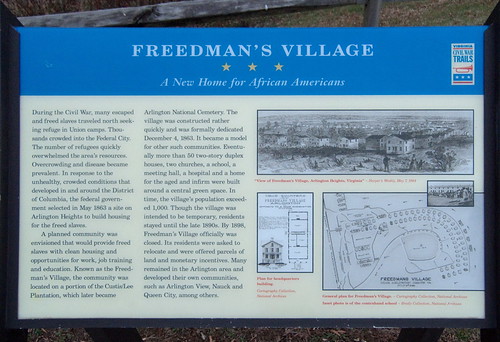
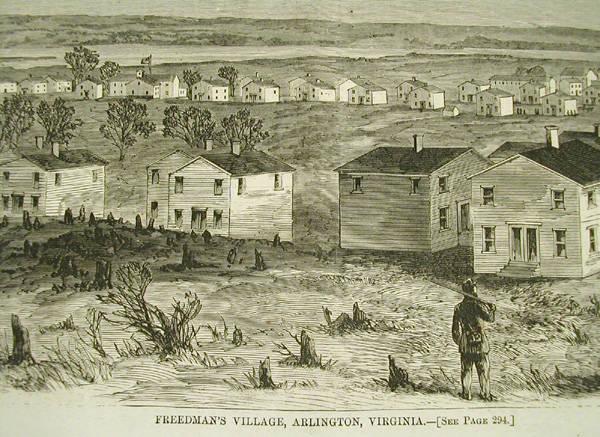
The Civil War leaders of the Union buried dead soldiers on the property in hopes that Lee would never want to return, and Parks' ancestor dug the very first grave near the Freedman's Village burial site. The federal government turned some land about half a mile north of Lee's mansion into a town specifically for freed slaves, referred to as contraband, who had nowhere to go. Freedman's Village was no ramshackle camp. At its height, more than 1,100 former slaves lived in a collection of 50 one-and-a-half story duplexes surrounding a central pond.

Although the town was supposed to be temporary, the freed slaves put up churches, stores, a hospital, mess hall, a school, an "old people's home" and a laundry -- to make a life for themselves. "I think it would have very much resembled a town anywhere in America today with that population. They had the same needs as anywhere, and they sustained themselves by working," said Thomas Sherlock, historian at Arlington National Cemetery.

Living in Freedman's Village wasn't free. Workers with government jobs on nearby farms or those doing construction were paid $10 a week, but half their salary was turned over to the federal government to pay for running the town. Everyone else who lived on site was charged between $1 and $3 rent. Dignitaries from around the nation came to see -- and sometimes stay -- with residents. The most famous was Sojourner Truth, the fiery black abolitionist and preacher, who spent about a year at Freedman's Village as a counselor and teacher.

Truth taught courage and urged residents to stand up to nearby white landowners who had taken to raiding the village to kidnap children for slave labor. Freedman's Village parents who had reported the kidnappings earlier had been thrown in jail. But when authorities came to jail Truth for encouraging parents to keep complaining, she swore to "make this nation rock like a cradle" if they tried to silence her. They backed down, and the raids soon ended. Life was difficult. Virginia residents resented the villagers, and threats were made against their lives. Freedman's Bureau record show that on July 27, 1865, an Army assistant commander ordered "the arrest of W. J. Miner (white man) near Freedman's Village for threatening the lives of colored people, collection of unjust claims" and other crimes. There's no indication an arrest was ever made.

Eventually, the village site, with a spectacular view of the nation's capital and the Potomac River, became more and more desirable for development. Despite impassioned protests from the freed slaves, the federal government paid the residents $75,000 for the buildings and property, and tore down the town in 1900. "Unfortunately our government didn't see the historic value of some of those things," Sherlock said.

Saving the city would have been a "gift to the American people to remember the struggles which seem like was a long time ago, but 150 years is not that long ago," Mr. Sherlock said. When the villagers dispersed into nearby cities and towns, many brought along bits and pieces of Freedman's Village. To this day, the 84-year-old Mr. Rowe and his family attend a nearby church, Lomax AME Zion Church, that got its start in Freedman's Village in 1863.

Several villagers later held prominent positions around the former town's site. William Syphax was elected to the Virginia General Assembly. After Mr. Rowe's great-grandfather, blacksmith William A. Rowe, left Freedman's Village, he became the first black policeman in Arlington County, Va., and later held other county posts, Mr. Rowe said. "They were very instrumental in setting up Arlington County when they moved out," he said.

Arlington National Cemetery holds little to tell people that Freedman's Village ever existed. There's a model of the town inside Arlington House, Lee's former home, but no markers or plaques on the town's site. The only trace of Freedman's Village left on the grounds are the lonely graves in Section 27 near the Iwo Jima Memorial. Walking among the gravestones, Mr. Parks points to the word "citizen" on some, and "civilian" on others -- a recent addition. Originally, Freedman's Village residents were buried with the word contraband on their gravestones. "As time went on and the headstones started to deteriorate and they were being replaced, the historian saw fit to give them the honor they were due and affirmed their status as civilians," Mr. Parks said.

More people should know about the struggles of the villagers, Mr. Parks said. We hope people will "continue to tell their stories, to bring their stories to light, in part really to give them back their dignity that the institution of slavery robbed from them but also to let the current generation know the sacrifices they made and the triumphs they had over extremely adverse circumstances," Mr. Parks said.

CWL: Was Freedman's Town ever 'LOST'? Was it ever a city? It appears not. Below is the city of Arlington's information on the village.

Freedman’s Village survived long after the Civil War, thriving for 37 years and sowing the seeds of Arlington’s African American community. Arlington’s Mount Zion and Mount Olive Baptist churches both descended from the village’s Old Bell Church. Residents of Freedman’s Village gained political influence in the 1870s, enabling villagers to elect officials who went on to become some of Arlington’s most prominent leaders. After 25 years of existence, the village was closed in 1888, and the land returned to military control. Former Freedman Village residents who remained in the area established such continuing neighborhoods as Arlington View, Butler-Holmes, Halls’s Hill and Nauck.

Text Source: Pittsburgh Post-Gazette.com

Top Image: Freedmans' Village Roadside Marker

Second Image: Flickr

Third Image: Library of Virginia

Bottom Image: Arlington Cemetery

Wednesday, July 15, 2009

New and Forthcoming: Intriguing Titles From McFarland Publishing

Rebel at Large:The Diary of Confederate Deserter Philip Van Buskirk, Philip Van Buskirk Edited and with an Introduction by B.R. Burg, McFarland Publishing, notes, bibliography, index, 208 pp. softcover, 2009, $35.00

This diary is one of the most unusual produced during the Civil War because it contains very little about military life. Early in the war Van Buskirk abandoned his regiment, working as a schoolmaster, farm hand, and casual laborer. He wrote of the suffering civilians endured at the hands of contending armies. But he also found time to chronicle his fascination with handsome young lads he encountered during his life as a deserter—unwittingly providing modern readers an illuminating glimpse of class differences and sexual mores. Naval, social and sexual historians, in particular, will find much valuable source material.

To Petersburg with the Army of the Potomac: The Civil War Letters of Levi Bird Duff, 105th Pennsylvania Volunteers, Levi Bird Duff Edited by Jonathan E. Helmreich, McFarland Publishing, ,33 photos, maps, appendices, notes, bibliography, index, 240pp. softcover (7 x 10) 2009, $45.00.

The letters of Levi Bird Duff present a perceptive picture of life in the Army of the Potomac from 1861 to 1864. They are unusual for their literacy, descriptions and continuity, the strength of opinions expressed, and their source: a private who rose to the rank of lieutenant colonel, thus a witness of the army at several levels. Leadership, organizational, weather, and morale problems that plagued Union troops are made clear. Written only for the eyes of Duff’s love, the messages reflect the tension experienced by many soldiers between the conflicting calls of duty and affection.

Tinclads in the Civil War: Union Light-Draught Gunboat Operations on Western Waters, 1862–1865, Myron J. Smith, Jr., McFarland Publishing, 90 photos, maps, appendices, notes, bibliography, index
softcover (7 x 10), 2009, $55.00.

Once the Union Army gained control of the upper rivers of the Mississippi Valley during the first half of 1862, slow and heavy ironclads proved ineffective in patrolling the waters. Hastily outfitted steamboats were covered with thin armor and pressed into duty. These “tinclads” fought Confederate forces attacking from the riverbanks, provided convoy for merchant steamers, enforced revenue measures, and offered tow, dispatch, and other fleet support services. This history documents the service records and duties of these little-known vessels of the Union fleet.

Text and Image Source: McFarland Publishing

Monday, April 28, 2008

New---The War and The Hearth in Dixieland

Weary of War: Life on the Confederate Home Front, Joe Mobley, Prager/Greenwood Publishing, illustrations, bibliography, index, 200 pp., $49.95.

Providing a fresh look at a crucial aspect of the American Civil War, this new study explores the day-to-day life of people in the Confederate States of America as they struggled to cope with a crisis that spared no one, military or civilian. Mobley touches on the experiences of everyone on the home front-white and black, male and female, rich and poor, young and old, native and foreign born.

He looks at health, agriculture, industry, transportation, refugees city life, religion, education, culture families, personal relationships, and public welfare. In so doing, he offers his perspective on how much the "will of the people" contributed to the final defeat of the Southern cause. Although no single experience was common to all Southerners, a great many suffered poverty, dislocation, and heartbreak.

For African Americans, however, the war brought liberation from slavery and the promise of a new life. White women, too, saw their lives transformed as wartime challenges gave them new responsibilities and experiences. Mobley explains how the Confederate military draft, heavy taxes, and restrictions on personal freedoms led to widespread dissatisfaction and cries for peace among Southern folk. He describes the Confederacy as a region of divided loyalties, where pro-Union and pro-Confederate neighbors sometimes clashed violently. This readable, one-volume account of life "behind the lines" will prove particularly useful for students of the conflict.

Table of Contents:
Introduction
1. Death, Sickness, and Despair
2. Agriculture, Industry, and Transportation
3. Destitution, Poor Relief, and Ersatz
4. Conscription, Desertion, and Internal Conflict
5. Slaves, Free Blacks, and Foreigners
6. Refugees, Cities, and Towns
7. Religion, Education, and Cultural Life
8. Courtship, Marriage, and Family Life
Epilogue

Source: text from publisher

CWL: Weary of War: Life on the Confederate Home Front by Joe A. Mobley is the third in the series 'Reflections on the Civil War Era' and released in March. True Sons of the Republic: European Immigrants in the Union Army by Martin W. Öfele is the second in the series and was released in February. Decision in the Heartland: The Civil War in the West, the first in the series, was released in January.

Wednesday, November 28, 2007

CWL---Just Published: Medicine, Family and Homefront

Images of Civil War Medicine: A Photographic History, Gordon E. Dammann and Alfred Jay Bollet, Paperback, heavily illustrated with b/w photogrpahs, 192 pages, Demos Medical Publishing, $34.95.

From the Publisher: Dr. Alfred Bollet’s Civil War Medicine: Challenges and Triumphs won wide acclaim as an expert study. Now, in collaboration with Dr. Gordon Dammann, Dr. Bollet has taken his expertise one step further and pictorially illuminated this fascinating chapter in medical history. Featuring 250 rare archival photographs, Images of Civil War Medicine is a comprehensive visual encyclopedia of medical care during a seminal event in American history. The book showcases the uniforms, equipment, and members of a large group of individual Civil War doctors — “Cartes de Visites” — along with resonant images of existing pre-war structures used to heal the sick. Also here are prominent medical educators, hospitals, stewards, and ambulances,as well as images of surgery, dentistry, nursing, and embalming. Ideal for Civil War buffs, historians, and medical history enthusiasts, Images of Civil War Medicine gives a complete overview of this era's medical realities.

Why the Confederates Fought: Family and Nation in Civil War Virginia, Aaron Sheehan-Dean hardcover, 312 pages, The University of North Carolina Press, $34.95.

From the publisher
In the first comprehensive study of the experience of Virginia soldiers and their families in the Civil War, Aaron Sheehan-Dean captures the inner world of the rank-and-file. He challenges earlier arguments that middle- and lower-class southerners gradually withdrew their support for the Confederacy because their class interests were not being met. Instead he argues that Virginia soldiers continued to be motivated by the profound emotional connection between military service and the protection of home and family, even as the war dragged on. Aaron Sheehan-Dean is assistant professor of history at the University of North Florida. He is editor of Struggle for a Vast Future: The American Civil War and The View from the Ground: The Experience of Civil War Soldiers.

The Civil War and the Limits of DestructionMark E., Jr. Neely, Harvard University Press, 288 pp., hardcover, $27.95.

From the Publisher
In a perceptive and rigorously argued call to resist the temptation to describe the Civil War as an unusually destructive or brutal war, Mark Neely finds new ways to examine old questions and to challenge prevailing interpretations. This is another first-rate work from one of the best and most imaginative scholars working in the field of Civil War history. --Gary W. Gallagher, author of The Confederate War

Neely tackles a fascinating and important topic: were terror and brutality a key part of the Civil War? He makes a compelling case that the combat was more controlled than we now often accept. His account is original­-in some cases clearly pathbreaking­-and his tone passionate and gripping. This is a major contribution that will capture a wide readership. --Ari Kelman, author of A River and Its City

The Civil War is often portrayed as the most brutal war in America's history, a premonition of twentieth-century slaughter and carnage. In challenging this view, Mark E. Neely, Jr., considers the war's destructiveness in a comparative context, revealing the sense of limits that guided the conduct of American soldiers and statesmen.

Neely begins by contrasting Civil War behavior with U.S. soldiers' experiences in the Mexican War of 1846. He examines Price's Raid in Missouri for evidence of deterioration in the restraints imposed by the customs of war; and in a brilliant analysis of Philip Sheridan's Shenandoah Valley campaign, he shows that the actions of U.S. cavalrymen were selective and controlled. The Mexican war of the 1860s between French imperial forces and republicans provided a new yardstick for brutality: Emperor Maximilian's infamous Black Decree threatened captured enemies with execution. Civil War battles, however, paled in comparison with the unrestrained warfare waged against the Plains Indians. Racial beliefs, Neely shows, were a major determinant of wartime behavior.

Destructive rhetoric was rampant in the congressional debate over the resolution to avenge the treatment of Union captives at Andersonville by deliberately starving and freezing to death Confederate prisoners of war. Nevertheless, to gauge the events of the war by the ferocity of its language of political hatred is a mistake, Neely argues. The modern overemphasis on violence in Civil War literature has led many scholars to go too far in drawing close analogies with the twentieth century's "total war" and the grim guerrilla struggles of Vietnam.

Monday, July 16, 2007

New for Fall: Live Free, Die Hard


Diehard Rebels: The Confederate Culture of Invincibility, Jason Phillips, University of Georgia Press, 272 pages, b/w historic cartoons and illustrations, notes, bibliography, index release date November 15, 2007 $34.95

Well into the final months of the Civil War, countless Confederate soldiers earnestly believed that victory lay just around the corner. How could this be? Jason Phillips reveals the deeply ingrained attitudes that shaped the reality of these diehards not only during the war but in the subsequent era, when the myth of the Lost Cause was born.

Much is known about what Confederate soldiers fought for; far less is understood about why they fought on despite long odds and terrible costs. Drawing on soldiers’ letters and diary entries from 1863 to 1865, Diehard Rebels explains how religious dogma and perceptions of Union barbarity and ineptitude affirmed in many soldiers a view of an indomitable South. Within the soldiers’ closely circumscribed world, other elements reinforced convictions that the South was holding its own against great but surmountable odds. Close comradeship and disorienting combat conditions were factors, says Phillips, as well as conclusions drawn from images and experiences contradicting the larger reality, such as battlefields littered with enemy corpses and parade-ground spectacles of Confederate military splendor.

Troops also tended to perceive the course of the war in far-off theaters, the North, and overseas in positive ways. In addition, diehards were both consumers and conduits of rumors, misinformation, and propaganda that allowed them to envision a war that was rosier than the truth but still believable. Instead of crippling diehards after defeat, old notions of southern superiority helped them uphold southern honor. The central elements of Confederate invincibility fueled white southern defiance after surrender and evolved into the Lost Cause.

Table of Contents:
Acknowledgments
Introduction. Southern Invincibility and Confederate Defeat
Chapter One. The Smile of Providence: Confederate Religion and Invincibility
Chapter Two. The Mask of Cain: Enemy Images in Rebel Minds
Chapter Three. Without a Murmur: Confederate Endurance and the Immediate War
Chapter Four. Gray Grapevines: Rumors and the Distant War
Chapter Five. The Face of Surrender: Diehard Rebels in 1865
Conclusion. The Aftermath of Invincibility

Jason Phillips is an assistant professor of history at Mississippi State University. He has also taught at Texas A&M University.

James B. McPherson, whose 2007 book is 'This Mighty Scourge: Perspectives on the Civil War' likes it--
"Diehard Rebels is a major contribution to the history of the Confederacy and the history of Southern culture. It offers an important corrective to the hindsight perspective that portrays an irreversible slide down the slippery slope of demoralization and defeat after the twin defeats at Gettysburg and Vicksburg."
—James McPherson,

Bertram Wyatt-Brown, author of 'The Shaping of Southern Culture', likes it too--
“Phillips persuasively answers a Civil War mystery. Why did so many Confederates doggedly keep fighting when any rational observer would have recognized looming defeat? Examining a most impressive array of sources, he finds that religious faith, cheerleading propaganda, admiration of the officer class, hatred of Yankees, military discipline, bonding in the ranks, stubborn denial of the obvious were all factors. Phillips eloquently and poignantly recounts the deprivations and sacrifices that were endured in vain hope of eventual victory. Every Civil War student, both the professional and lay reader, will find Diehard Rebels highly moving and tragic.”

Text Supplied by The University of Georgia Press with edits by The Civil War Librarian

Thursday, July 12, 2007

New for the Fall: Virginia's Families and Soldiers At War


Why Confederates Fought: Family and Nation in Civil War Virginia (Civil War America), Aaron Sheehan-Dean, The University of North Carolina Press, Hardcover, 272 pages. $34.95, release date October 31, 2007

In the first comprehensive study of the experience of Virginia soldiers and their families in the Civil War, Aaron Sheehan-Dean captures the inner world of the rank-and-file by utilizing new statistical evidence and first-person narratives. Aaron Sheehan-Dean is assistant professor of history at the University of North Florida. He is editor of 'The View from the Ground: The Experience of Civil War Soldiers' which The Civil War Librarian thoroughly enjoyed and discussed the individual essays in May, June and July.

Friday, June 22, 2007

CWL --- Commitment: Battlefront vs. Homefront


The Army Is Not Near So Much Demoralized as the Country Is: Soldiers in the Army of Northern Virginia and the Confederate Home Front, Lisa Laskin, in The View From the Ground: Experiences of Civil War Soldiers, A. Sheehan-Dean, editor, Kentucky UP, pp. 91-121, notes.

“Commitment to Confederate war aims, a common feeling of superiority over the enemy, and pride in their army, and its leadership contributed to the ANV soldiers’ unity and high morale . . . until the last days of the war,” and the single greatest persuasive argument for desertion came from the home front. Laskin’s review of “of soldiers contemporary writings about their relationships with Southern civilians illuminates” a paradox. “The people to whom soldiers looked for emotional support, also proved to be the group most capable of sabotaging soldier morale.” (pp. 91-92)

Women’s patriotism served the Confederacy. Early in the war, civilian animosity towards those who had not quickly enlisted intimidated young men. This goading provided reinforcement to the Southern war effort. In the patriarchal worldview of Dixie women embodied home and sacrifice. Their vulnerability motivated soldiers forward on the march to victory. Southern notions of honor included the protection of families from both the invading Northern barbarians and rebellious and revengeful slaves.

The author of this essay has found a discrepancy between soldiers’ idealization of women’s patriotism and their obvious hostility to the southern soldier. She cites incidents in Virginia, Tennessee, North and South Carolina from Southern soldiers’ papers that reveal that civilians did not welcome their presence. Also, the spring of 1863 food riots in the urban South drew the attention and comments of Rebel soldiers who “uniformly disparaged the rioters as a lawless, marauding mob incited by foreigners.” (p. 101)

In soldiers' writings, three types of homefront attitudes were particularly disturbing: the avoidance of military duty, wartime profiteering, and rising tide of despair coming from homefront letters. By the war’s end, soldiers of the Army of Northern Virginia concluded that they alone were the final repository of honor in the Confederacy. The author notes that the thousands of ANV deserters have not been heard.

In the middle of reading the essay, this reader wondered what Gary Gallagher thought about Laskin’s notions. The final page of the essay takes into consideration Gallagher’s work on the Army of Northern Virginia and the Confederate homefront. Laskin states that “the ANV’s impressive battle record helped boost the spirits of the folks at home, but it could never entirely overcome the inherent friction in soldier-civilian relations.” Laskin concludes that “soldiers’ commitment to the war—or at least to seeing the job through—was in stark contrast to the wavering commitment of those at home.” (p.111)

Help Note: This chapter can be obtained by using your local library's inter-library loan services or by contacting me.