Showing posts with label Mississippi. Show all posts

Friday, June 24, 2016

News---The Free State of Jones Film: How Much Of That Is True?

 News---The Free State of Jones Film: How Much Of That Is True?  15 Questions Answered

Free State of Jones is a  inspired by the life of  Newton Knight and the anti-Confederacy rebellion in Jones County, Mississippi. Victoria E. Bynum's The Free State of Jones [2001] served as the basis of the film and the historian served as a script consultant.


1.  Why did Newton Knight initially join the Confederate Army?When the state of Mississippi seceded from the Union in January 1861, many Mississippians were opposed to the decision. Mississippi's Declaration of Secession did not reflect the views of many of the small family-owned farms and cattle herders living in Jones County. It was a decision that primarily reflected the planters' interests. When the American Civil War began in April 1861, anyone who opposed the state's new Confederate government was deemed a traitor and a coward. Immediate death was often the penalty for those who refused to join the Confederate Army. The Free State of Jones true story reveals that Newton Knight enlisted in the army in the early fall of 1861. The Free State of Jones book author Victoria E. Bynum believes that Knight did not necessarily enlist out of fear of conscription but rather because he just wanted to be a soldier. -Mississippi History Now

14 More Questions Answered at Text Source: History Versus Hollywood


Also, Smithsonian Magazine [March 2016] has a superb article on a recent visit to Jones County, the current residents' understanding of Newton Knight and the successful rebellion.  His descendants and those who believe that he is not a hero are interviewed.

Smithsonian Magazine: The True Story of the Free State of Jones

Wednesday, March 02, 2016

Forthcoming---The Free State of Jones County, Mississippi: Its History and Its Hollywood Treatment

“The Free State of Jones” on Film: A Q&A with Victoria Bynum, Megan Kate Nelson, Society of Civil War Historians homepage website, March 2, 2016. 
 
This May, STX Entertainment will release the film Free State of Jones, which tells the story of the Knight Company and the Jones County rebellion, a Civil War history first told by Victoria Bynum in her 2001 book The Free State of Jones. A few weeks ago, Bynum and I discussed her experiences working as a consultant on the film, and seeing her book come alive on the screen.

MKN: Did you know at the time you were writing “The Free State of Jones” that it had cinematic potential? And what is it about this story that makes it compelling for filmmakers?

VB: As I researched and wrote The Free State of Jones, I grew increasingly aware of its historical importance as an insurrection that combined elements of class, race, gender, and kinship that, for this story, had long been underestimated, misunderstood, distorted, or simply ignored.

Although I did not write the book with a movie in mind, the story’s vivid real-life characters, its oral and written first-hand accounts of fierce confrontations between Confederates and deserters, the interracial romance between the band’s leader, Newt Knight, and his slave accomplice, Rachel Knight, and the Unionist core of the band itself, convinced me of the story’s cinematic potential.
On the standard author’s questionnaire that I completed for the University of North Ca
rolina Press, I advised the press to consider presenting the book “to television and film companies as a potential docudrama or miniseries.” At that point, however, I did not anticipate Hollywood’s interest in the story.

MKN: As the process of transforming the book into the film got underway, what was it like to experience the subjects and arguments in your book morphing into a visual format?


imagesVB: When I visited the movie set in Louisiana, I watched actor Matthew McConaughey recreate Newt Knight’s pivotal experiences at the battle of Corinth. I was pleased at the manner in which Gary Ross, director and author of the movie’s screenplay, targeted the beginning stage of Newt’s evolution into a class-conscious opponent of the Confederacy, and I was impressed by McConaughey’s ability to immerse himself in the role, both physically and psychologically.

UnknownI’ve since viewed the movie’s trailer, and was likewise impressed with the way in which class issues, front-line participation by women, and collaboration between deserters and slaves in this home front insurrection came to life on the screen.

I’ve not yet seen the entire movie, so can’t comment on the completed product. Based on what I have seen, I’m hopeful that the movie captures the essential elements of defiance and struggle that drew me to the story.

state-of-jones-12jan16-11MKN: Was there anything that worried you, or surprised you about that process?


VB: Like most historians, I worried about the movie’s factual accuracy. Over time, my thinking has evolved on the creative differences between an academic work of history and a historically-based movie. Both rely on imagination, but in very different ways. Historians don’t merely assemble facts, apropos the cliché, “let the facts speak for themselves.” We must use imagination as well as intellect to assign the elusive truth of meaning to our work, or we risk producing little more than a footnoted list of facts.

In contrast to historians, Hollywood moviemakers use imagination to recreate a historic event that can be viewed within the space of 2-3 hours. The larger truth of an event is typically delivered without perfect adherence to facts—but rather with invented dialogue, composite characters and compressed events—to tell a true story that informs, inspires and entertains. My expectation is that the movie and my book will mutually reinforce the larger truth of about the Free State of Jones.

MKN: You published “The Free State of Jones” in 2001; why do think that the time is finally right — in 2014-5 — to make it into a film?

VB: Actually, I first learned in 2005 that plans for a movie based on the history of the Free State of Jones were underway. As is often the case in Hollywood, the journey to production was a slow one.

That said, Hollywood’s current interest in portraying Civil War dissenters is well-timed to highlight issues being debated with particular force in this national election year. Federal vs. state power, stark economic inequality, and fierce confrontations over racial, class, and gender rights all divide Americans.

Amid these battles, the popularity of the Lost Cause defense of the Confederate flag as a symbol of “white heritage” has spiked, particularly on social media. The Free State of Jones reminds us that there was neither a Solid (white) South during the Civil War era, nor a monolithic white heritage embodied by the Confederate flag.


MKN: How do you hope the film will shape Americans’ understanding of Civil War history?

VB: Most Americans know little to nothing about landowning, nonslaveholding white Southerners of the antebellum and Civil War South, which in turn prevents them from fully understanding the average Southerner’s experience of the Civil War. In bringing the story of the Free State of Jones to the masses, not only is the image of a white Solid South negated, so also is the agency of Southern dissenters during the era of the Civil War and Reconstruction asserted. This represents an important shift in the general manner in which Hollywood has presented the Civil War.

MKN: What advice do you have for historians writing with an eye toward film adaptation, or working as consultants on films about history?

VB: Since I did not write The Free State of Jones with such an eye, my remarks are speculative. I’ve heard it said that authors who intend to pitch their work to film companies should retain the intellectual rights to their manuscripts (which, in academia, are generally held by the press). I suppose one would consider hiring a literary agent, as well.

In the aftermath of having the rights to my book purchased by a Hollywood studio, however, I have benefited from the University of North Carolina Press’s commitment to publishing a new edition of the book and marketing it internationally.

I have no specific advice in regard to finding work as a film consultant. I was asked to be a consultant for The Free State of Jones movie on the basis of my book of the same name. Several other historians were hired as consultants based on their works on related historical topics.

Victoria Bynum is Distinguished Professor Emeritus of History at Texas State University, San Marcos. A graduate of the University of California, San Diego, an award-winning author and NEH Fellow, she has produced cutting-edge scholarship on gender, race, and class relations in the Civil War Era South for more than thirty years. Her blog,  Renegade South, features unruly women, mixed-race families, anti-Confederate guerrillas, and political dissenters.

 Full Text Source: Society of Civil War Historians

Tuesday, April 05, 2011

New and Noteworthy: Battles and Campaigns in Mississippi

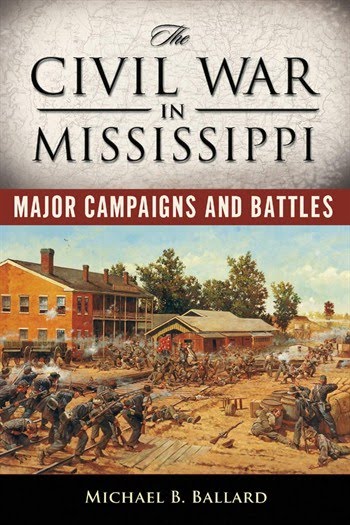
The Civil War in Mississippi: Major Campaigns and Battles, Michael B. Ballard, University Press of Mississippi, hardback, $40.00

The Civil War in Mississippi : Major Campaigns and Battles from the University Press of Mississippi is the first volume ever published that is dedicated exclusively to the story of major Civil War campaigns and battles in Mississippi. Author Michael Ballard takes readers on a chronological journey through Mississippi ’s Civil War. From the first Union attack on Vicksburg in the spring of 1862 through Benjamin Grierson’s second and last raid through Mississippi in late 1864 and on through early 1865, this book traces the campaigns, fighting, and causes and effects of Mississippi ’s Civil War.

The Civil War in Mississippi begins with a prologue covering military and other events in the state leading up to the first military action within the state’s borders. The book then covers in detail all of the major military operations that took place in Mississippi , including the campaign for and siege of Vicksburg , and battles at Iuka and Corinth , Meridian , Brice’s Crossroads, and Tupelo .

The colorful cast of characters present here includes such household names as Sherman, Grant, Pemberton, and Forrest, as well as a host of other commanders and soldiers. Minority troops and others generally forgotten in studies of the Mississippi military during the war are also discussed at length.

The Civil War in Mississippi will delight any Mississippian or Civil War buff who wants the complete story of the military history of the Civil War in Mississippi. Michael B. Ballard is author of Civil War Mississippi: A Guide and many other books. He is a professor and University Archivist and Coordinator of the Congressional and Political Research Center at Mississippi State University Libraries. He is also associate editor of the Grant Papers from the Ulysses S. Grant Association. He lives in Ackerman, Mississippi.

Text Source: book's webpage University of Mississippi Press

Monday, August 02, 2010

New and Noteworthy: Mississippi's Wartime Homefront

Mississippi in the Civil War: The Home FrontTimoth B. Smith, niversity of Mississippi Press, illustrations, bibliography, index, $40.00.

In Mississippi in the Civil War: The Home Front, Timothy B. Smith examines Mississippi’s Civil War defeat by both outside and inside forces.

The Union army dismantled the state’s political system, infrastructure, economy, and fighting capability. The state saw extensive military operations, destruction, and bloodshed within her borders. One of the most frightful and extended sieges of the war ended in a crucial Confederate defeat at Vicksburg, the capstone to a tremendous Union campaign.

As Confederate forces in Mississippi became overwhelmed militarily, the white populace’s morale began to crumble. Realizing that the enemy could roll unchecked over the state, civilians, Smith argues, began to lose the will to continue the struggle. Many white Confederates chose to return to the Union rather than see continued destruction in the name of a victory that seemed ever more improbable. When the tide turned, Unionists and African Americans boldly stepped up their endeavors. The result, Smith finds, was a state vanquished and destined to endure suffering far into its future.

The first examination of the state’s Civil War home front in seventy years, this book focuses new light on previously neglected groups such as women and African Americans and it is the fourth book in the Heritage of Mississippi Series.

Tim Smith teaches history at the University of Tennessee at Martin. He is the author of several books, including The Untold Story of Shiloh: The Battle and Battlefield and Champion Hill: Decisive Battle for Vicksburg.

Text Source: Mississippi Department of Archives and History

Wednesday, October 15, 2008

News---Grant's Canal and Connecticut Remembered at Vicksburg

Connecticut Gets A 'Fitting Memorial', Pamela Hitchins, The Vicksburg Post, October 15, 2008

With songs from a troubadour, flags fluttering in the breeze and smiles for “a fine day,” officials, guests and Vicksburg National Military Park staffers celebrated the official dedication of the Connecticut state monument Tuesday — newest in the inventory of the 109-year-old park. It is in a noncontiguous section of park land, just west of the river bridges.

Many of them sported shamrock stickers in honor of the 9th Regiment Connecticut Volunteers, the “Irish Regiment” that labored in June and July 1862, attempting to dig a canal across DeSoto Point near Delta, La. The monument is near the only visible remnant of the attempt commissioned by Union Gen. U.S. Grant to entice the Mississippi River to bypass Vicksburg. Had the canal succeeded, a battle to conquer Vicksburg would have been less crucial, as Confederate cannon would not have been able to fire on passing Union boats.

“This is a fine day for the park to add a state monument to the otherwise grand collection of monuments that we already have,” said Monika Mayr, VNMP superintendent. “It really enhances the site and adds to our ability to tell the story of the canal here.” A six-man Knights of Columbus honorary color guard, decked out in white, green, purple and red, stood at attention — three on one side of the monument, three on the other — during the ceremony. The first Supreme Knight, James T. Mullen, was a sergeant in Company C of the 9th Regiment at Vicksburg.

As Connecticut state troubadour emeritus Tom Callinan stood with his guitar, a breeze caught the Connecticut and regimental flags, and they waved broadly behind him as he sang “of Connecticut’s 9th, me boys,...young men fighting for freedom in a land where they hadn’t been born.” Master of ceremonies for the dedication was Robert Larkin of Cheshire, Conn. “Some 16 years ago my youngest daughter and sister visited this park where our ancestor, Pvt. John Marlow of Company C, died on July 24th during the first assault on Vicksburg in 1862,” he told the crowd of about 75 people. “They found no mention of him or the 9th and no monument to the state of Connecticut.”

Larkin worked for nearly 10 years to change that, becoming chairman of the Connecticut monument committee, fundraising, contacting descendants of the 9th and helping with historical and design efforts. “Our heartfelt thanks go out to all who supported us,” Larkin said. “We are honored to present this monument and give Connecticut a fitting memorial here at the Vicksburg National Military Park.” Karen Senich, executive director of the Connecticut Commission on Culture and Tourism, presented the monument to the park on behalf of the state. “This is a monument that is a work of art,” Senich said. “We are very proud that a Connecticut artist, Stacy Mathieu, did the work you see here today.” Mathieu in turn thanked composite artist and designer Kerry Sheldon. “She did an amazing amount of work on the portraits, and worked with Bob (Larkin) to put the proper uniforms on the men, enhance the resolution of their faces, improve the composition and make sure they were historically accurate. She spent countless hours on the project.” Mathieu’s work hand etching all images on the center panel extended over five months. “This is the first time I’ve seen it upright,” she said. “It’s such a great culmination of all the efforts people have put into it over the years. Just seeing it assembled on the concrete pad, with the benches — it’s a nice unified whole.”

The black and green granite monument stands about 10 feet high and 10 feet long, and consists of a base, two side panels, the etched centerpiece and two benches. The pieces weigh 13,597 pounds. In his remarks, VNMP historian Terrence Winschel thanked Larkin for his vision and persistence in spearheading the effort to see the memorial realized. “Looking back on it, it has been a remarkable achievement,” Winschel said. Carol Brown, of Branford, Conn., made the trip to honor two of her ancestors, both of whom survived the canal effort and are memorialized with portraits on the monument — her great-grandfather, Lt. William O’Keefe and Capt. Lawrence O’Brien, whose sister married O’Keefe after the war. Brown was there with her two daughters, Alison Brown and Kristin Fary, both of Atlanta, and Fary’s three children, Grace, 15, Paige, 14 and Jack, 6.

“We heard lots of stories from our grandmother about her Uncle Larry,” Alison Brown said. “Even in the heat they had to wear their full woolen uniforms. They had to march in dress parade, wearing their packs and carrying their arms at the end of the day. They weren’t even allowed to bury the men after they collapsed and died.” Winschel remarked after the ceremony that the monument can only add to the park’s reputation as the “art park of the world,” a moniker given to it by a Civil War veteran. “It adds to the significance of the site,” he said, nodding toward what remains of the canal nearby.

The Irish Regiment, 845-men strong when mustered-in in New Haven, Conn. in the fall of 1861, saw action in Pass Christian and occupied New Orleans before venturing up the river to Vicksburg in June 1862. Though the site memorializing their efforts is called Grant’s Canal, the work of the ninth was known as Williams Canal, as Union Gen. Thomas Williams commanded the effort. The canal across the neck of a peninsula was to be long and deep enough to accommodate Union boats, Winschel said. In the high heat and humidity, “with only the muddy water of the Mississippi to drink,” 153 men of the 9th died in the effort, from heat stroke, malaria, dysentery and other diseases — “ a ghastly toll in human life,” Winschel said.

In 1863, Union forces moved down the west side of the Mississippi, crossed the river at Bruinsburg and then moved up through Port Gibson, Raymond and Jackson before turning back toward the river. After direct assaults failed, a siege began and Vicksburg was surrendered on July 4. The park, created by Congress in 1899, preserves much of the terrain and battlements from the war on the city’s perimeter. In addition to the noncontiguous site in Louisiana, the National Park Service also owns two overlooks on Washington Street and the headquarters of Confederate commander Gen. John Pemberton on Crawford Street.

Text Source: Vicksburg Post

Photograph Source: Meredith Spencer, The Vicksburg Post

Sunday, April 06, 2008

CWL---Simple Story of a Soldier Intrigues and Awaits Further Research


Simple Story Of A Soldier: Life And Service in the 2d Mississippi Infantry, Samuel W. Hankins, John F. Marszalek (Introduction), Fire Ant Books, an imprint of the University of Alabama Press, index, 96 pp. 2004, $12.95

In 1905, Samuel W. Hankins wrote and serialized his memoir in Confederate Veteran magazine. Living in a home for Confederate Veterans located in Gulfport, Mississippi, the 65-year later published his story as a pamphlet in 1912. From northeastern Mississippi, Hankins joined the Confederate army in 1861 when he had just turned 16. His father, not a supporter of secession, joined the Confederate army and ordered is son to stay with his mother. Samuel refused and father accepted him as a comrade in arms in the 2nd Mississippi regiment.

Drill was impossible for some in the 2nd Mississippi; they did not know their right from their left. Hankins describes his train ride to Virginia while riding atop the cars and his encounters with tunnels. Ordered to Jackson's small army, the 2nd Mississippi occupied Harpers Ferry, drilled, bought pieces of rope that had been used to hang John Brown and engaged in gambling. Nothing is mentioned of moving the locomotives down the Valley Pike but the soldiers' narrow eye view of the battle of Manassas is given.

Hankins neglects telling events from July 1861 to April 1862, at which point the 'war begins in earnest.' The soldiers are very soggy. One has a premonition of death. An artillery piece fires at a balloon; the ropes are cut and the balloonist falls to his death. In 1902, while in Corinth finds a former Union soldier who also witnessed the balloonist's fall. The 2nd Mississipi' place at Malvern Hill is in support of the artillery.

The battle of Sharpsburg comes and passes quickly. Hankins describes the Suffolk campaign as it was lived by the privates. Soaked uniforms, lousy clothes, rotting shoes, despicable food. Hankins relates that he was a half an hour from freezing to death while on picket duty; two of his comrades sling him between themselves and force him to walk. He recovers slightly. Readers will painfully accept the conditions of the winter of 1862-1863 and wonder how the 17-year old ever made it through.

Gettysburg comes quickly in the memoir; Hankins is wounded in the foot at the Railroad Cut and to captured. For the reader, the details of this event are very descriptive. Shipped to NYC, then to Fortress Monroe, then to City Point, Virginia, Hankins is exchanged and sent to Mississippi to recuperate. He does and joins other wounded veterans in forming a partisan band of cavalry who roam Mississippi and Alabama in search of a Confederate army to join. They are skilled in staying out of Yankee hands and avoiding combat altogether. The trek nearly destroys their horses and fortunately, a doctor locates a still and reinvigorated the flagging bodies and spirits of the troop.

The Mississippi cavalry battalion takes part in a portion of the Atlanta campaign and then is ordered to Mississippi, back to Alabama, and then back to Mississippi. Learning of the news of Lee's surrender, the unit disbands.

Though meager in the amount of detailed descriptions Harkins offers, those episodes he covers are expressive and from the privates point of view. The captain is the most important man in the memoir. Hankins never meets a general. His personal experience is at the center of this book and rewards the reader. Yet, Marszalek only introduces the pamphlet; there are no notes or annotations in the book. Hankins' memoir awaits a graduate student's efforts. An explanation of the 2nd Mississippi's role and conduct at Manassas and Glendale would be helpful. Hankins' reporting of the death of the balloonist is minimal. Medical care and the lack thereof is important in the memoir and needs to be expanded. The partisan cavalry battalions of Mississippi need to be explained. CWL enjoyed reading Hankins' memoir but wishes to have a fuller picture the privates, corporals, sergeants and captains of the 2nd Mississippi. Long Live Bell Irwin Wiley!