Showing posts with label Film and Media. Show all posts

Thursday, June 30, 2016

News: A Hollywood Film With Footnotes and Viewers Guide--The Free State of Jones

Aiming For Accuracy: Free State of Jones, Contingency, and the Meaning of Freedom, Journal of The Civil War Era, June 29, 2016.                                                                                                        The following is an excerpt from the online website of the Journal of The Civil War Era:

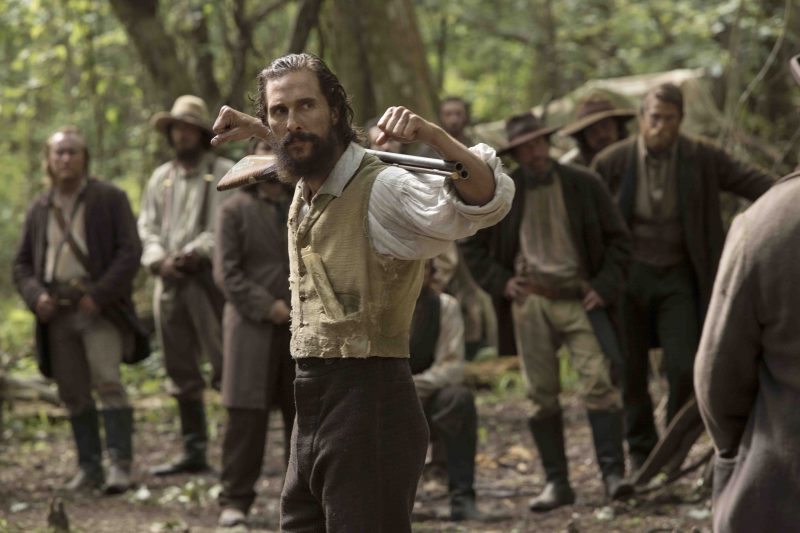
"Early in Free State of Jones a Confederate soldier proclaims he is not fighting for slavery but rather “for honor.” His comrades, including poor Mississippi farmer Newton Knight (Matthew McConaughey), needle him. Considering the “Twenty Negro Law,” Conscription Act, and tax-in-kind law, they point out that their blood only helps slaveholders get richer. After deserting, Knight leads poor farmers and former slaves against conscription, taxation, and re-enslavement. Against a shared enemy, the Confederacy, he brings black and white fugitives together. But when Knight and his black comrades-in-arms attempt to move from the bullet to the ballot box, white allies fade away and white supremacists rise up."


"Beginning at the Battle of Corinth in 1862, Free State of Jones is about a long Reconstruction. It uniquely explores African Americans’ struggle for political and economic rights in the face of white power. Here, emancipation has an asterisk. Slavery ends with the war, but freedom does not follow. After former Confederates return to power and reassert slavery’s white hierarchy, political organizer and ex-slave Moses (Mahershala Ali) captures the reality for black Americans: “We free and we ain’t free.” Unlike other films, Free State of Jones illuminates the contingency of black freedom in the South after the Civil War in the face of white supremacist violence, northern Republican abandonment, and insufficient federal troops. After the battle scenes, the Federal troops are entirely absent."
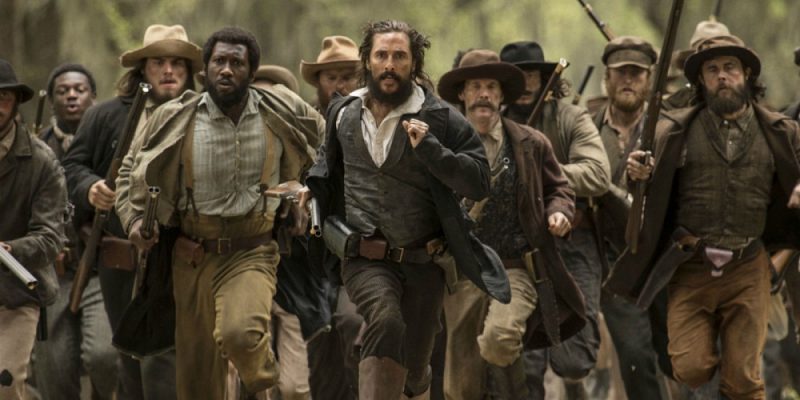
Jones4"Throughout the film, class, race, and gender overlap and challenge the assumptions of viewers and characters. Women and men, black and white, resist, fight, and survive together. When a white member of Knight’s company tries to deny Moses food because he is black and a fugitive, Moses responds, “How you ain’t?” How, if both are fugitives from compulsory service to slaveholders in a cotton field or on a battlefield, are they different? Through spirituality and experience, Knight considers this equality of the oppressed to be self-evident."

"McConaughey’s portrayal of Knight suggests Nathaniel Bacon and John Brown: a natural leader wild-eyed for solidarity and justice in the face of economic and racial oppression. Director Gary Ross highlights the many methods of resistance employed by fugitive slaves and enslaved people: fleeing to the wilderness, like Moses; remaining on plantations but assisting runaways, like Rachel (Gugu-Mbatha-Raw); remembering, like Moses’ wife (Kesha Bullard Lewis) and son Isaiah (LaJessie Smith). White characters resist Confederate authority similarly, but Ross also delineates the differences in experience. Rachel’s and Moses’s bodies bear witness to their physical and psychological torture, scars that mark the limits of white abilities to fathom black experiences."

Article continued at Aiming For Accuracy: Free State of Jones, Contingency, and the Meaning of Freedom, Journal of The Civil War Era, June 29, 2016:

Text Source:  Muster--Reflections on Popular Culture by the Journal of the Civil War Era

Director Gary Ross' Scene Guide With Footnotes

Gary Ross:  "We felt it was important in an historical movie, especially a movie about such a crucial time in history, for the audience to know what was true and what was fictionalized, even if it was based on underlying source material."

"In this site you will be able to navigate through the entire movie, click the areas that interest you, and see a brief explanation of the historical facts that informed the screenplay. If you are more curious about that part of the movie, we have footnoted the paragraph to see sources on which it is based. But footnotes themselves can be misleading, so if you want to see the entire primary source, you can click again and be transported to the original document. We hope this is helpful, maybe even fun. Some things need to be invented in a movie, but most things in Jones were not. I think it’s only right that you be able to tell which was which." states Gary Ross, Director
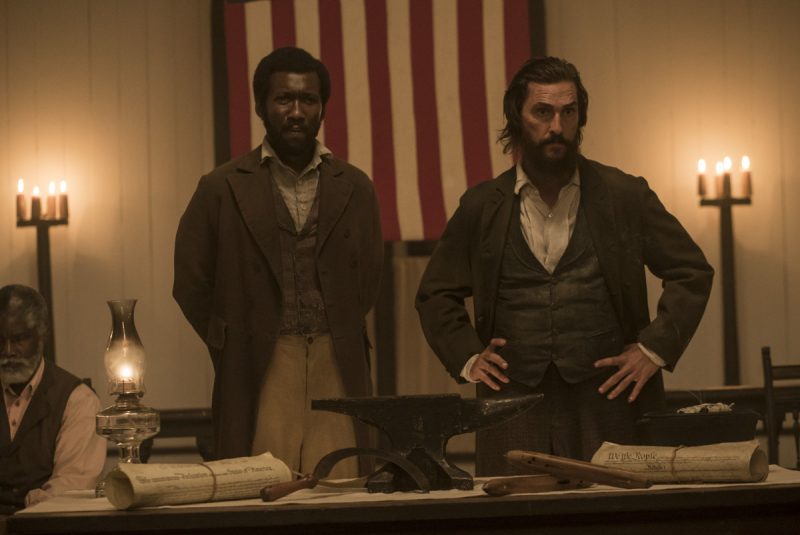
 
 At a meeting of the Union League, Moses (Mahershala Ali) and Newt (Matthew McConaughey) tell the Freedman that all citizens shall have the right to vote.

Wednesday, March 02, 2016

Forthcoming---The Free State of Jones County, Mississippi: Its History and Its Hollywood Treatment

“The Free State of Jones” on Film: A Q&A with Victoria Bynum, Megan Kate Nelson, Society of Civil War Historians homepage website, March 2, 2016. 
 
This May, STX Entertainment will release the film Free State of Jones, which tells the story of the Knight Company and the Jones County rebellion, a Civil War history first told by Victoria Bynum in her 2001 book The Free State of Jones. A few weeks ago, Bynum and I discussed her experiences working as a consultant on the film, and seeing her book come alive on the screen.

MKN: Did you know at the time you were writing “The Free State of Jones” that it had cinematic potential? And what is it about this story that makes it compelling for filmmakers?

VB: As I researched and wrote The Free State of Jones, I grew increasingly aware of its historical importance as an insurrection that combined elements of class, race, gender, and kinship that, for this story, had long been underestimated, misunderstood, distorted, or simply ignored.

Although I did not write the book with a movie in mind, the story’s vivid real-life characters, its oral and written first-hand accounts of fierce confrontations between Confederates and deserters, the interracial romance between the band’s leader, Newt Knight, and his slave accomplice, Rachel Knight, and the Unionist core of the band itself, convinced me of the story’s cinematic potential.
On the standard author’s questionnaire that I completed for the University of North Ca
rolina Press, I advised the press to consider presenting the book “to television and film companies as a potential docudrama or miniseries.” At that point, however, I did not anticipate Hollywood’s interest in the story.

MKN: As the process of transforming the book into the film got underway, what was it like to experience the subjects and arguments in your book morphing into a visual format?


imagesVB: When I visited the movie set in Louisiana, I watched actor Matthew McConaughey recreate Newt Knight’s pivotal experiences at the battle of Corinth. I was pleased at the manner in which Gary Ross, director and author of the movie’s screenplay, targeted the beginning stage of Newt’s evolution into a class-conscious opponent of the Confederacy, and I was impressed by McConaughey’s ability to immerse himself in the role, both physically and psychologically.

UnknownI’ve since viewed the movie’s trailer, and was likewise impressed with the way in which class issues, front-line participation by women, and collaboration between deserters and slaves in this home front insurrection came to life on the screen.

I’ve not yet seen the entire movie, so can’t comment on the completed product. Based on what I have seen, I’m hopeful that the movie captures the essential elements of defiance and struggle that drew me to the story.

state-of-jones-12jan16-11MKN: Was there anything that worried you, or surprised you about that process?


VB: Like most historians, I worried about the movie’s factual accuracy. Over time, my thinking has evolved on the creative differences between an academic work of history and a historically-based movie. Both rely on imagination, but in very different ways. Historians don’t merely assemble facts, apropos the cliché, “let the facts speak for themselves.” We must use imagination as well as intellect to assign the elusive truth of meaning to our work, or we risk producing little more than a footnoted list of facts.

In contrast to historians, Hollywood moviemakers use imagination to recreate a historic event that can be viewed within the space of 2-3 hours. The larger truth of an event is typically delivered without perfect adherence to facts—but rather with invented dialogue, composite characters and compressed events—to tell a true story that informs, inspires and entertains. My expectation is that the movie and my book will mutually reinforce the larger truth of about the Free State of Jones.

MKN: You published “The Free State of Jones” in 2001; why do think that the time is finally right — in 2014-5 — to make it into a film?

VB: Actually, I first learned in 2005 that plans for a movie based on the history of the Free State of Jones were underway. As is often the case in Hollywood, the journey to production was a slow one.

That said, Hollywood’s current interest in portraying Civil War dissenters is well-timed to highlight issues being debated with particular force in this national election year. Federal vs. state power, stark economic inequality, and fierce confrontations over racial, class, and gender rights all divide Americans.

Amid these battles, the popularity of the Lost Cause defense of the Confederate flag as a symbol of “white heritage” has spiked, particularly on social media. The Free State of Jones reminds us that there was neither a Solid (white) South during the Civil War era, nor a monolithic white heritage embodied by the Confederate flag.


MKN: How do you hope the film will shape Americans’ understanding of Civil War history?

VB: Most Americans know little to nothing about landowning, nonslaveholding white Southerners of the antebellum and Civil War South, which in turn prevents them from fully understanding the average Southerner’s experience of the Civil War. In bringing the story of the Free State of Jones to the masses, not only is the image of a white Solid South negated, so also is the agency of Southern dissenters during the era of the Civil War and Reconstruction asserted. This represents an important shift in the general manner in which Hollywood has presented the Civil War.

MKN: What advice do you have for historians writing with an eye toward film adaptation, or working as consultants on films about history?

VB: Since I did not write The Free State of Jones with such an eye, my remarks are speculative. I’ve heard it said that authors who intend to pitch their work to film companies should retain the intellectual rights to their manuscripts (which, in academia, are generally held by the press). I suppose one would consider hiring a literary agent, as well.

In the aftermath of having the rights to my book purchased by a Hollywood studio, however, I have benefited from the University of North Carolina Press’s commitment to publishing a new edition of the book and marketing it internationally.

I have no specific advice in regard to finding work as a film consultant. I was asked to be a consultant for The Free State of Jones movie on the basis of my book of the same name. Several other historians were hired as consultants based on their works on related historical topics.

Victoria Bynum is Distinguished Professor Emeritus of History at Texas State University, San Marcos. A graduate of the University of California, San Diego, an award-winning author and NEH Fellow, she has produced cutting-edge scholarship on gender, race, and class relations in the Civil War Era South for more than thirty years. Her blog,  Renegade South, features unruly women, mixed-race families, anti-Confederate guerrillas, and political dissenters.

 Full Text Source: Society of Civil War Historians

Wednesday, March 05, 2014

Historian Sue Eakin Thanked By 12 Years A Slave Director

Sue Eakin Thanked Onstage At Oscars For Work Verifying Story Of ‘12 Years A Slave’, Kyle Peveto, The Advocate, Baton Rouge, Louisiana, March 5, 2014.

A Louisiana historian who dedicated decades to researching the 1853 book “Twelve Years a Slave” received international attention Sunday when the film based on the book won the Academy Award for best picture.

During his acceptance speech, the film’s director thanked Sue Eakin, a Rapides Parish native and historian whose research for the 1968 LSU Press edition of the book helped prove the veracity of the story of Solomon Northup, a free man who was kidnapped and sold into slavery. “I’d like to thank this amazing historian, Sue Eakin, whose life, she gave her life’s work to preserving Solomon’s book,” director Steve McQueen said while accepting the Oscar.

“Twelve Years a Slave” tells the firsthand account of Northup, who was kidnapped, enslaved at plantations in central Louisiana and freed to return to his family. Eakin was 12 when she read an original edition of the book in the early 1930s. She found her own copy at a Baton Rouge bookstore when she entered LSU in 1936, according to an essay she wrote later in life, and dedicated her graduate studies in history at LSU and at the University of Southwestern Louisiana (now University of Louisiana at Lafayette) to researching the book. She died at 90 in 2009.

“I think it’s vital that everyone understands it’s a true story and there’s a lady from Louisiana who spent her lifetime dedicated to authenticating it,” said her son, Frank Eakin, of The Woodlands, Texas, who broke into tears when McQueen mentioned his mother from the stage.
“The very last thing I expected was that recognition,” he said. When the book was published in the 1850s, it became a popular best-seller, said Raphael Cassimere Jr., a retired professor at the University of New Orleans. “Timing was bad, because even though it sold 30,000 copies, which was a lot for a book, it came out a year after ‘Uncle Tom’s Cabin’ and it kind of was forgotten for some time, except by local people,” Cassimere The Advocate in October.

Some locals regarded Northup’s book as fiction when Sue Eakin first read the memoir.
Sue Eakin, who commuted to Baton Rouge from her home in Bunkie to complete her master’s degree in the 1950s and 1960s, researched the people and places mentioned in Northup’s memoir of enslavement at plantation in the Bayou Boeuf area. In the 1960s, she began working with Joseph Logsdon, a professor at LSU-New Orleans, now the University of New Orleans, to create a scholarly edition of the book.

Sue Eakin investigated all the Louisiana people and places mentioned in the work, while Logsdon focused on researching Northup’s home in Saratoga, N.Y., and other places of interest in the north. Their 1968 annotated edition reintroduced Northup’s story to college students across the country, who read it in history classes. “If that hadn’t happened, then none of the other things could have happened,” said MaryKatherine Callaway, director of LSU Press. “It took their work first to begin this whole journey toward this film.”

Filmed at south Louisiana plantations and in New Orleans, “12 Years a Slave” earned $50 million worldwide and won three awards Sunday. Lupita Nyong’o won best supporting actress for her role as Patsey. Screenwriter John Ridley, who said in media interviews he leaned heavily upon the LSU Press edition of the book, won best adapted screenplay.

Logsdon and Eakin continued researching Northup’s story after their 1968 edition rescued the book from obscurity. When Logsdon died at 61 in 1999, he was planning a trip to New York to investigate Northup’s mysterious disappearance, Cassimere said in October. Descendants of the slave owners and other characters in the book approached her with archives of family history while she taught history at LSU at Alexandria, Frank Eakin said. Sue Eakin published her final annotated version of “Twelve Years a Slave” in 2007 when she was 88.

Text Source:  The Advocate, March 5, 2012
Image Source: Barnes and Noble.com

Monday, May 06, 2013

News--- Stephen Lang's The Wheatfield: Gettysburg Foundation 's Centerpiece Of July 1 Commemoration

Salute To the States: Gettysburg Foundation's Signature Event, July 1, 2013

The Gettysburg Foundation invites you to join us for our special 150th Battle of Gettysburg commemorative event, Salute to the States, highlighted with a special performance by renown actor and playwright Stephen Lang.

Lang will perform his solo piece, The Wheatfield, in which he, in the character of Medal of Honor Recipient James Jackson Purman, relates the events that transpired at The Battle of Gettysburg on July 2nd and 3rd, 1863. The personal story that Purman tells is both stark and rich in detail; highly emotional and intensely dramatic. It is an 18 minute tour de force of theatrical expertise.

The performance will be followed by the world premiere of the short film The Wheatfield, written and acted by Lang; directed by Alexander and Adrian Smith; produced by Jake Boritt; original music by Robert Kessler; music performed by celebrated double-bassist Tim Cobb.  Following the film an onstage Q&A with Lang and the filmmakers will be hosted by the eminent Lincoln scholar and author Harold Holzer. Holzer will conduct the interview and invite questions and comments from the audience.

This ticketed event also includes a culinary tour of America featuring signature cuisine from various regions of the United States, Civil War-era ballroom dancing, living history performances by Confederate and Union Generals who share their experiences at Gettysburg, and a unique exhibit of reunion badges from each state that fought at Gettysburg (display courtesy of Gettysburg National Military Park.)

Held at the Gettysburg National Military Park Museum and Visitor Center, from 7:00 p.m. to midnight, the cost of tickets is $100 Individual Ticket and $150 Patron Ticket (additional $50 contribution supports 150th preservation, acquisition and education projects.)
Registration/RSVP deadline is June 1, 2013. To purchase tickets and for more information, please call 717-339-2148 or visit www.gettysburgfoundation.org.

Text Source: Gettysburg Foundation
Image Source: ALT Move Guide

Monday, March 25, 2013

New and Noteworthy---Ron Maxwell's Copperhead Opens June 28 2013

The official website for Copperhead contains a trailer; the Internet Movie Database contains a list of characters and actors.  The film's website lists the release date as June 28, 2013. The location of the filming was Kings Landing, New Brunswick, Canada.   Kings Landing includes over 70 historic buildings, complete with artifacts, furniture, tools and equipment” from the 1800s.  The film is based upon a short story, Copperhead, by Harold Frederic; he was was an New York state journalist, novelist and short story writer.  Frederic was born in 1856 and is considered as a realist author writing between 1887 through 1898.

The Hollywood Reporter offers this description of the film.:

"Copperhead, Ron Maxwell’s latest film now shooting in Atlantic Canada, is ostensibly about families on the homefront split by the bloodshed of the American Civil War.  But as much as the director of Gettysburg and Gods and Generals is keeping his focus on events in 1862 and telling a compelling story, Maxwell insists his latest Civil War costume drama will inevitably be seen by cinema-goers as an echo of America’s reaction to current events in Iraq and Afghanistan."

“I keep it (Copperhead) with as much integrity as I can in 1862, but people will watch this film and leave the theatre and say, ‘Wow, it was like a 150 years ago, and it’s like now,’” the director said from King’s Landing, New Brunswick, where he’s shooting the Jason Patric and Angus MacFadyen-starrer set in 19th century upstate New York.

“We’re living through similar times. There’s these great causes articulated -- we’re liberating and we’re freeing people, we’re changing the world, we’re defending liberty – and it’s the same rhetoric with the same consequences,” Maxwell insisted about the cost of war, then and now. Unlike his earlier Civil War-era epics set on bloody battle fields, Copperhead has a central focus on families back on the home front, burying their dead and feuding amid widespread fear and political panic.
“People die, and it’s mostly young people, it’s mostly the people who have no say in the politics, who have voice in it and who bravely, and with great courage and patriotism, put themselves in harm’s way and pay the price,” Maxwell added."

"Copperhead, based on the 19th-century novel of the same name by Harold Frederic, and adapted by Bill Kaufman, examines the price of dissent amid the hysteria of war, as a family is ripped apart by Civil War-era events. The film, which takes its name from a derisive term used during the Civil War to insult Northerners who opposed the historical conflict, sees Patric play the patriarch Abner Beech, while MacFadyen performs the role of Jee Hagadorn."

"At the same time, Maxwell sees political parallels between 1862 and today where few Americans and Canadians have been left untouched by a decade of brutal war and bloodshed in Iraq and Afghanistan, “By this time, you have to be living like Rip van Winkle not to understand the devastation that both these wars have wrought on our population,” he said. Copperhead, which has yet to secure U.S. distribution, will likely be between 95 and 115 minutes in length, Maxwell said. That’s far shorter in length, and more intimate, than his earlier Civil War epics, where Gettysburg, financed by Ted Turner, was four hours and 15 minutes, and Gods and Generals was three hours and 45 minutes."

Bottom Image Souce: Hollywood Reporter.

Thursday, November 08, 2012

Film---Engaged in a Great Civil War, Speilberg's Lincoln

A President Engaged in a Great Civil War: Lincoln by Steven Spielberg with Daniel Day-Lewis, reviewed by A. O. Scott, New York Times, November 8, 2012.


Excerpts:

"After a brutal, kinetic beginning — a scene of muddy, hand-to-hand combat that evokes the opening of Saving Private Ryan  “Lincoln” settles down into what looks like the familiar pageantry and speechifying of costume drama. A flock of first-rate character actors parades by in the heavy woolen plumage of the past".

"The script, by Tony Kushner is attentive to the idioms of the time without being too showy about it. Lincoln is eloquent in the manner of the self-taught provincial prodigy he was, his speech informed by voracious reading and also by the tall tales and dirty jokes he heard growing up in the frontier country of Kentucky and Illinois. He uses words like “shindee” and “flib-flub” and likes to regale (and exasperate) his cabinet with homespun parables, shaggy dog stories and bits of outhouse humor. His salty native wit is complemented by the clear and lofty lyricism that has come down to us in his great speeches."

"The main business of “Lincoln” is framed by two of those, the Gettysburg Address — quoted back to the president by awed Union soldiers on a January night in 1865 — and his Second Inaugural Address, which he delivered a little more than a month before the end of the Civil War and his own assassination. These are big, famous words and momentous events, and the task Mr. Spielberg and Mr. Kushner have set themselves is to make this well-known story fresh and surprising. Mr. Day-Lewis, for his part, must convey both the human particularity and the greatness of a man who is among the most familiar and the most enigmatic of American leaders. We carry him around in our pockets every day, and yet we still argue and wonder about who he was."

"This is, in other words, less a biopic than a political thriller, a civics lesson that is energetically staged and alive with moral energy. Lincoln, having just won re-election, faces a complex predicament. The war has turned in the Union’s favor, but the Capitol is in some turmoil. Lincoln must contend with a Democratic opposition that reviles him as a dictator (“Abraham Africanus,” they call him) and also with a deep, factional split within the Republican Party. "

"The question facing Lincoln is stark: Should he abolish slavery, once and for all, even if it means prolonging the war? The full weight and scale of this dilemma are the central lesson “Lincoln” asks us to grasp. The film places slavery at the center of the story, emphatically countering the revisionist tendency to see some other, more abstract thing — states’ rights, Southern culture, industrial capitalism — as the real cause of the Civil War."

" . . . this is finally a movie about how difficult and costly it has been for the United States to recognize the full and equal humanity of black people."

"There is no end to this story, which may be why Mr. Spielberg’s much-noted fondness for multiple denouements is in evidence here. There are at least five moments at which the narrative and the themes seem to have arrived at a place of rest. (The most moving for me is a quiet scene when the 13th Amendment is read aloud. I won’t give away by whom.) But the movie keeps going, building a symphony of tragedy and hope that celebrates Lincoln’s great triumph while acknowledging the terror, disappointment and other complications to come."

Full Text and Image Source:  New York Times, November 8, 2012


Friday, November 02, 2012

News---Lincoln Through The Eyes of Daniel Day Lewis


Abe Lincoln As You Have Nerver Heard Him: Daniel Day-Lewis On Playing Abraham Lincoln, Charles McGrath, New York Times, October 31, 2012.

A Portion of the Text from the New York Times Interview With Daniel Day-Lewis

" Mr. Day-Lewis prepared for the part not by splitting rails or doing sums on the back of a shovel but mostly by reading. He started with Ms. Goodwin’s book, pored over Lincoln’s own writing and finished up with the Carl Sandburg biography. He also spent a lot of time studying the photographs taken toward the end of Lincoln’s life by Alexander Gardner. “I looked at them the way you sometimes look at your own reflection in a mirror and wonder who that person is looking back at you,” he said.
“Everyone’s jaw was on the floor,” he said. “It was one of the great things I’ve ever seen. To do that, you have to be there, in that moment. It’s not psychosis; it’s sustained concentration. Is all that necessary, the staying in character? It makes sense to me.” He added: “I’ve never seen a great actor do a major role that didn’t cost a lot. They’re sacrificial animals of a sort.”
Mr. Day-Lewis said that he felt a “great sadness” when the movie was done and that he still feels connected to it. “I’m woefully one-track-minded,” he said. “Without sounding unhinged, I know I’m not Abraham Lincoln. I’m aware of that. But the truth is the entire game is about creating an illusion, and for whatever reason, and mad as it may sound, some part of me can allow myself to believe for a period for time without questioning, and that’s the trick.” He laughed. “Maybe it’s a terrible revelation about myself that one does feel able to do that.”  "
Text Source, Image Source and Full Text Link:   New York Times, October 31, 2012

Thursday, October 25, 2012

News---1960s-1990s Iconic Photographer Annie Liebovitz Is Captured by Gettysburg

securedownload.jpegPhotographer Annie Leibovitz, Celebrated For Her Portraits of Famous People, Turned To Historic Places For Her Latest Project, "Pilgrimage," Now On Display In Gettysburg, David Dunkle, The Patriot News, October 24, 2012

 Photographer Annie Leibovitz talks Wednesday morning about "Pilgrimages," her new photography exhibit at the Gettysburg National Military Park Museum and Visitor Center.   For Leibovitz, this meant visiting places in the United States, Canada and England that were iconic in their way, but were also spots that just drew her to them.
 
These ranged from Niagara Falls and folk singer Pete Seeger's workshop, both in upstate New York, and artist Georgia O'Keeffe's studio in New Mexico. She also visited photographer Ansel Adams' studio in Carmel, Calif., the home of poet Emily Dickinson in Massachusetts. and rock and roll king Elvis Presley's Graceland mansion in Tennessee. And of course, Gettysburg, where a tremendous battle between huge Union and Confederate armies fought in July 1863 helped to set the course of the United States up to the present day.

"This is truly not my normal work, but it's not so far from my normal work either," Leibovitz said Wednesday morning during a news conference to announce the opening of an exhibit of her "Pilgrimage" work at the Gettysburg National Military Park Museum and Visitor Center. "It's sort of the peripheral vision of my usual work."  The exhibit officially opens Thursday and continues through Jan. 20, 2013. Access is included as part of regular museum admission.

"Annie is without a doubt one of the most famous photographers in the world, and her photographs capture the culture of our time," said Joanne Hanley, president of the Gettysburg Foundation, which runs the museum and visitors center in concert with the National Park Service. "But today we are seeing a different side of Annie. The photographs in this exhibit were taken simply because she was moved by the subject."

"I wanted to see what was inside me," she said of her reaction to the battle against lawsuits seeking up to $24 million from her. "It was something that built slowly over a period of time. It was an extraordinary journey of soul-searching."  . . . .

Leibovitz said she backed into the project, which coincided with a period of time when she was facing severe financial problems that could have cost her control of her own photographs, which include famous portraits of John Lennon and Yoko Ono, taken earlier on the day the ex-Beatle was murdered in New York City, and a nude and very pregnant Demi Moore.  "I thought I would come to Gettysburg and take a simple photograph of the battlefield. Of course, nothing is ever that simple." - Annie Leibovitz, on what she called "a bad day," she took her daughters to Niagara Falls, and was fascinated by how fascinated they were by the natural wonder. That led her to develop a preliminary list of about a dozen places where a pilgrimage would be appropriate.
 
The 70 photos now on display in the museum and visitor center include two she took on the battlefield at Gettysburg. One is of the Jacob Lott farm, which was at the center of the Union lines on the final day of the battle and it still being farmed today. The other is a shot of Devil's Den, where a famous Civil War photo, "Home of a Rebel Sharpshooter," was taken just days after the battle by Alexander Gardner.  Her trip to Gettysburg, a place she had visited as a child, was sparked by visits to Lincoln exhibits at the Smithsonian Institutes in Washington, D.C., and the Abraham Lincoln Presidential Library and Museum in Springfield, Ill.

"I didn't know what I was getting myself into when I thought about the Lincoln Memorial and what that meant," Leibovitz said. "But it led me to Gettysburg. I thought I would come to Gettysburg and take a simple photograph of the battlefield. Of course, nothing is ever that simple."
She admitted that she shot the photo of the Lott farm, which shows wash hanging from a clothesline in the yard with battlefield memorials in the background, before asking permission of the current owners. "I was just praying they were going to say 'yes' when I did ask them for permission," she said. "Thankfully, they did."

Leibovitz, 63, has mostly overcome her financial problems, and is back to concentrating on the work that made her one of the world's most famous photographers. Her work has graced dozens of covers for Rolling Stone, Vanity Fair and Vogue magazines, and her "Pilgrimage" project has been published in hardcover with an introduction by noted historian Doris Kearns Goodwin.

Leibovitz said she hoped her work would inspire others to follow in her path, or make their own.  "Anyone can go to any of these places," she said. "Gettysburg is there for anyone. It's all there for anyone."
 
Text Source, Full Text Source, and Image Source: The Patriot News, October 24, 2012

Tuesday, October 09, 2012

News---First Look of Film 'Lincoln' Occurs in UK

Lincoln, First Look At The Film in UK,  Katey Rich, The Gaurdian,  October 8, 2012 

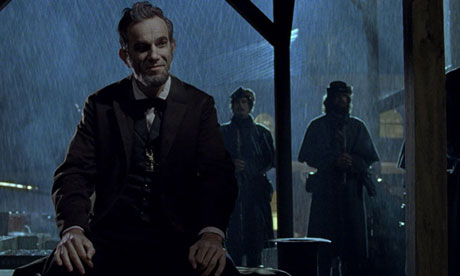
Playing politics … Daniel Day-Lewis as the president in Lincoln.Politics was a dirty business even in the 19th century, and even when changing history for the better, as the best moments of  Lincoln  wittily and elegantly prove. Steven Spielberg's  behemoth of a new film, which premiered in unfinished form at the New York film festival Monday night, has a title that suggests a sweeping portrait of the great 16th American president. But the film is largely too content depicting Abraham Lincoln as an all-knowing icon, and even with Daniel Day-Lewis's beautifully measured (and surprisingly soft-spoken) performance, Lincoln often recedes to the background of the very uneven movie that bears his name.
 
The screenplay from Pulitzer prize-winner Tony Kushner focuses on just the last four months of Lincoln's life, as he works in Washington to end the civil war raging just south of him, but not before passing an amendment to officially outlaw slavery. The backroom deals and legal hurdles to make that happen are immensely complicated, but after some bulky exposition this wheeling and dealing among lawmakers makes for the film's strongest scenes. Secretary of State William Seward (David Strathairn) hires a trio of hooligans (John Hawkes, Tim Blake Nelson and James Spader) to rustle up votes for the amendment through whatever means necessary, while on the floor of the House of Representatives, anti-slavery lawmaker Thaddeus Stevens  (a gloriously scene-stealing tommy Lee Jones) bellows at pro-slavery Fernando Wood (Lee Pace), with the roomful of men around them banging on their desks and shouting over each other. If only modern American politics were remotely as entertaining.

We visit the battlefield a few times, with General Ulysses S Grant (Jared Harris) preparing to negotiate peace with the Confederacy, but Lincoln is largely set in the cramped chambers of the White House and Congress; between that and the many speeches about constitutional law, it can start to feel a little airless. Glimpses into Lincoln's personal life, including strained relationships with both his wife (Sally Field) and eldest son (Joseph Gordon-Levitt), are intended to add a human dimension to the president, but they're never as effective as simply seeing the man at work; Gordon-Levitt has had a fantastic year in other films, but his character here is entirely superfluous, and Field brings tremendous overacting to a cast that's otherwise quite restrained.

Lincoln isn't as sentimental as you might expect from Spielberg, and though it never digs deep enough into Lincoln as a man, it's unafraid to show him as a canny politician willing to bend the law and make enormous compromises to accomplish a greater goal. With John Williams's gentle score, posh cinematography from Janusz Kaminski and a whole load of big costumes and facial hair for the cast, Lincoln veers too often toward becoming a somnolent period piece, but the strong cast and political texture always manage to perk things back up. Though it might have worked better as a tighter, purely political thriller with even less focus on the title character, Lincoln's smarty-pants pleasures manage to outweigh its stuffy drawbacks.

Text and Image Source:  The Gaurdian

CWL:  Lincoln will be released in the US on November 9, 2012

Lincoln


Friday, September 28, 2012

News---Where Have I Seen Him Before In the Movies?

 To Appomattox, an 8 part made for TV series premiering in 2013, has had a name change. It is now called Grant VS. Lee. Here is the summary of the first three episodes:

The Point At West Point and in Mexico, relationships between the best and brightest men of emerging American nation are formed-deep bonds made-then challenged with the outbreak of Civil War. American Macbeth Grant's triumphs in the West set rivals against him in Washington who use rumors of his earlier alcoholism to check his advancement. In the East, ambitious George McClellan is given supreme command over all U.S. forces and faces the indomitable Robert E. Lee in battle. Shooting Star Against the backdrop of Bloody Shiloh in the West, Grant and Sherman's friendship is cemented-the friendship that will win the war. In the East, Lee triumphs over McClellan, while Henry Halleck, fearing that Grant's continued success will usurp his own power and position removes Grant from command in order to make Grant's victories his own...

Of course, there must be an Abraham Lincoln. So who would you cast as the president? 

Here is the ballot: George Pickett, Stonewall Jackson, Colonel Miles Quaritch

You won if you voted for Stephen Lang.   Check the To Appomattox film website and the Internet Movie Database's entry for Stephen Lang.

Image Source: CinemaBlend. com


Friday, December 02, 2011

Film News---Spielberg Films Team of Rivals in Virginia; Release Date 2013

Daniel Day-Lewis Has a Great Honest Abe Beard Going for ‘Lincoln’, Tim Grierson, The Projector, December 2, 2011.

It was just over a year ago that it was announced that Daniel Day-Lewis would be the star of Steven Spielberg's Abraham Lincoln film. There's no question that the two-time Oscar-winner is an astonishingly gifted actor, but when you're playing a revered American president there will always be questions about whether you can do justice to a mythic figure in U.S. history -- especially when some people refuse to accept Day-Lewis in the role since he's English. But we think most folks will be willing to look past such minor issues after checking out this first photo of Day-Lewis sporting his beard for "Lincoln." You have to admit, the resemblance is pretty striking -- and rather presidential.

The photo (the first we've seen of the actor as Lincoln) was snapped by Michael Phillips (via Badass Digest), who took the picture presumably while Day-Lewis was enjoying a lunch break during the filming of "Lincoln" in Virginia. While a lot of unofficial on-set photos capture stars at their most unflattering, this casual shot actually gives Day-Lewis a regal, dignified air that's synonymous with most people's impressions of our 16th president. Even in repose, the guy just exudes rugged authenticity.

"Lincoln," which is based on Doris Kearns Goodwin's "Team of Rivals" is said to follow Lincoln during the final months of his life when the Civil War was coming to a close. The film won't open until December 2012, but it already has to be considered an Oscar front-runner simply because of the pedigree of the material, the director and the star -- and that it's not even mentioning the rest of the cast, which includes Sally Field, Tommy Lee Jones, Joseph Gordon-Levitt, Jackie Earle Haley, Michael Stuhlbarg, David Strathairn and Hal Holbrook. Spielberg has two movies coming next month -- "The Adventures of Tintin" and "War Horse" -- but after seeing this Day-Lewis photo it's hard not to focus on what the director has coming our way next year. We always knew Day-Lewis could play the part. Today, we learned he definitely looks the part, too.

Text Source: The Projector

Image Source: IFC.com

Actor/Character
Joseph Gordon-Levitt/Robert Todd Lincoln
Daniel Day-Lewis/Abraham Lincoln
Tommy Lee Jones/Thaddeus Stevens [Pennsylvania, US Congressman]
Lee Pace/Fernando Wood [Mayor NYC]
Sally Field/Mary Todd Lincoln
Jackie Earle Haley, Alexander Stephens [CSA, Vice President]
Jared Harris, Ulysses S. Grant
Joseph Cross, John Hay [Secretary to Lincoln
David Strathairn, Secretary of State William Seward
Bruce McGill, Edwin Stanton [Secretary of War]
Jeremy Strong, John Nicolay [Secretary to Lincoln]
Grainger Hines, Secretary of the Navy Gideon Welles
Reed Birney, James Speed [Kentucky friend of Lincoln]
Mike Shiflett, CSA Senator RMT Hunter
John Hutto, Senator Charles Sumner [Massachusetts, US Senator]
Lincoln (original screenplay) (filming)

John Logan is the development screenwriter; his works include: 2004 The Aviator, 2003 The Last Samurai, 2000 Gladiator, 1999 Any Given Sunday. Tony Kushner is the onset screenwriter; he also wrote the screenplay of Munich

Information Source: IMBD.com

Friday, November 11, 2011

Film Coming in 2012, 2013---12 Years a Slave: Kidnapped And Sold Into Slavery, An Autobiography

Director Steve McQueen is already getting plenty of attention for his sexually controversial film Shame starring Michael Fassbender and Carey Mulligan, and while his next film, Twelve Years a Slave already sounds promising featuring a reunion with the X-Men: First Class star and Chiwetel Ejiofor, the new is sure to get a considerable amount of exposure with a huge name now joining the cast. Screen Daily reports (and The Playlist confirms) that Brad Pitt, who is already producing the film through his Plan B production banner, will also have a role in the film written by McQueen along with Three Kings scribe John Ridley.

Based on Solomon Northup's 1853 autobiography, the film will tell the story of a free black man (Ejiofor) who found himself kidnapped and turned into a slave for twelve, long, grueling years under numerous owners. Northup was a happy, married, educated and free black man living in New York who was approached by two men with a job offer in Washington D.C. But upon his arrival in the capitol, he was kidnapped, put in a slave pen and passed around through various slave owners for twelve years. As an autobiography, the book is a detailed firsthand account of the slave markets in D.C. right down to the food served to the slaves. Spoiler alert for those who don't want to know too much, the real-life story has a happy ending with the man able to secure his freedom when a white carpenter from Canada, who didn't believe in slavery, smuggled out letters to Northup's wife, thus initiating a court case that set him free.

It's not clear what role Pitt will take in the film, but it's my bet that he'll play one of the various slave owners. Fassbender's role has yet to be confirmed either, but it's been speculated that he'll play the carpenter from Canada, though that role could just as easily end up going to Pitt. Either way, with a film like Shame putting McQueen in the spotlight for its NC-17 sexual drama, and a stellar cast, that includes a long deserved lead role for Ejiofor, this is already one of my more anticipated films in the coming years.

Text Source: First Showing
Top Image: Black Film
Bottom Image: Brad Pitt in film The Assassination of Jessee James

Monday, February 07, 2011

Review by Ron Briley--- Film: The Conspirator

"The Conspirator": Film and Historical Truth, Ron Briley, History News Network, February 7, 2011.

Mr. Briley is Assistant Headmaster, Sandia Preparatory School. He is the author of The Politics of Baseball: Essays on the Pastime and Power at Home and Abroad.

This is an abridgement of the review which is found in full at History News Network, February 7, 2011.

Although academic journals such as The American Historical Review and The Journal of American History have expanded their focus to consider cinema, most historians still seem to approach historical films with considerable suspicion. Thus, the American Historical Association’s (AHA) Executive Director James R. Grossman demonstrated both excitement and trepidation when he introduced a screening of The Conspirator on the last evening of the AHA’s 2011 annual meeting.

The 2011 film session, however, was somewhat different as, despite the disclaimer of Grossman, the AHA appeared to be endorsing a film project on which members of the historical organization served as consultants. The Conspirator is the first completed project of the American Film Company. CEO Joe Ricketts, founder of the online brokerage firm Ameritrade and a member of the family which owns the Chicago Cubs, explained to the assembled historians that his goal is to produce high quality and entertaining feature films which will attract adult audiences and be historically accurate. Ricketts asserted that with the rich variety of stories offered by American history there is no need for filmmakers to fabricate the nation’s past. The producer concluded that if The Conspirator is successful, the American Film Company is considering other projects such as a film on Paul Revere based upon the scholarship of David Hackett Fischer.

The production values of The Conspirator are certainly first rate. The film is directed by Oscar-winning filmmaker Robert Redford, and the cast includes such respected performers as Robin Wright, James McAvoy, Kevin Kline, Evan Rachel Wood, Tom Wilkinson, and Danny Huston. Budgeted for approximately $20 million, The Conspirator will be distributed for theatrical release in the spring by Lionsgate and Roadside Attractions.

The conclusion of the [AHA] panel was that the film deserved high marks for its historical detail regarding the case of Mary Surratt, who was executed for conspiracy in the assassination of President Abraham Lincoln. On the other hand, several members of the audience questioned whether it was really possible to make a motion picture about the Civil War without mentioning slavery. Thus, The Conspirator may be perceived as getting the details right, but missing what scholar Robert Rosenstone describes as the larger historical truths such as placing slavery at the center of our discussion on the Civil War.

Although the film focuses upon the trial of Mary Surratt (Robin Wright) by a military tribunal, the story is told from the viewpoint of her attorney Frederick Aiken (James McAvoy), who was a Union war hero before resuming his law career. Aiken is reluctant to accept the Surratt case, but he is assigned the case by Reverdy Johnson, a former attorney general currently serving as a United States senator from Maryland.

The historians on the AHA panel, however, assumed that Surratt was probably involved with the murder conspiracy, but they did acknowledge that the government employed the prosecution of Surratt to gain leverage against her son.

. . . Several members of the AHA audience suggested, it becomes easy to read the film as an allegorical commentary on the response of the Bush administration to the terrorist attacks of 9/11. Screenwriter Solomon, however, asserts that that the script for The Conspirator was written before 9/11. Nevertheless, it would certainly appear that doubts about the Patriot Act and concerns over violations of the civil liberties of those incarcerated in the global war on terror contributed to getting this script to the screen.

Yet, Solomon insists that his script is really rather ahistorical. He uses the stories of Mary Surratt and Frederick Aiken to examine the love of a mother for her son, alongside a surrogate son prepared to assume the role abandoned by John Surratt. This confession may explain why several women at the AHA screening expressed disappointment that a film ostensibly focusing upon a female protagonist becomes, in fact, a motion picture about the relationship between a mother and a son. The film belongs to Frederick Aiken and not Mary Surratt.

But this is not the most troubling issue regarding the film. As one AHA member observed, is it really possible to make a film about the Civil War era and not mention the word slavery? The Southern Surratt family had been slaveholders before falling into more difficult economic times, but this fact is not alluded to in the film. Thus, it is possible for viewers to provide alternative answers to this question which deny the centrality of the slavery issue to the origins of the Civil War.

Those who attended a secessionist ball in Charleston, South Carolina may assert that they are commemorating a commitment to states’ rights rather than celebrating an effort to preserve the institution of slavery. And The Conspirator fails to offer any cinematic challenge to such an assumption. One may view The Conspirator free from the disturbing questions of race and slavery. Perhaps this will make the film appealing to a larger audience, but it will do little to foster popular understanding of the Civil War as we observe the 150th anniversary of that conflict. The Conspirator is an entertaining film which includes more accurate historical detail than most Hollywood productions, but it misses some of the larger historical truths and issues which must be examined to understand America in the 1860s and the legacy of slavery and the Civil War.

CWL: The Internet Movie Database lists the release date as April 15.

Thursday, January 27, 2011

Media Invitation----Hear Yourself On The Radio Talking About The American Civil War

Catherine V. Moore, one of the producers of the public radio program BackStory, which is based at Charlottesville's Virginia Foundation for the Humanities and hosted by Ed Ayers, Peter Onuf, and Brian Balogh. She and the hosts are currently in the process of producing a three-part series on the Civil War, and reaching out to you because we could use a little help for the third show in that series, which will be composed entirely of listeners calling in and asking Civil War-related questions of our History Guys.

The other two shows are Secession Crisis! and Why Fight? . Normally the producers gather up callers from those who comment on our website and Facebook page, but we'd like to open this up to those who may not be aware of BackStory show but who have a curiosity about the Civil War.

The producers feel that readers of CivilWarLibrarian might be interested in participating. BackStory is having a call-in session this Sunday. BackStory (www.backstoryradio.org) is a nationally-aired public radio show that brings historical perspective to the events happening around us today. On each show, the U.S. historians Ed Ayers, Peter Onuf, and Brian Balogh tear a topic from the headlines and plumb its historical depths.

Being a caller is really simple and takes about 15 minutes; it's pre-taped, low-pressure, and a lot of fun! If you are interested in participating as a caller and posing a Civil War question to the History Guys, either email producer Catherine Moore or leave a comment on the Civil War Call-In Show's webpage: (http://backstoryradio.org/civil-war-call-in-show/). They look forward to hearing from readers of CivilWarLibrarian.
Any help you might be willing to lend the producers will be appreciated! Here is the contact information for Catherine V. Moore, assistant producer of BackStory With the American History Guys which is sponsored by the Virginia Foundation for the Humanities Radio. Phone: 304-574-6120. Email: cvmoore@virginia.edu

Text and Images Source: BackStory With the American History Guys

Thursday, December 23, 2010

Interviewed 2----Brian Mallon/Winfield Scott Hancock on a 6 Hour G&G and 5 Hour Gettyburg


GC: Now the one thing that everyone is asking about is the rumored Gods and Generals director’s cut. I know you alluded to it in your email but can you tell us anything at all about it?

BM: Yes, I was just talking to Ron Maxwell about twenty minutes ago and I was told at this point that it will be coming out in April. There will not only be one for Gods and Generals but one for Gettysburg as well. He said that I have new scenes coming into G & G because the whole Antietam section is coming in.

GC: I heard that part was about an hour long. I’ve read all different things about it.

BM: It’s a huge scene and I’m amazed that it didn’t make it into the film initially. It should be a very much enhanced version. They’re enhancing the color and everything else and he’s in Los Angeles working on it now.

GC: This is great information. Do you know how long it’s going to be?

BM: I think he said maybe an hour and a half longer than it was.

GC: So about five hours in total. I’ve read a bunch of things about it, someone said originally it was going to be six hours, then I read that he screened it once and it was five hours and ten minutes, and now James Robertson just said it was going to be four and a half. But yours is coming directly from Maxwell so it’s the most credible.

BM: It might not be the final word on it, cause they’re still working on it. That’s probably why there are so many different numbers.

GC: I’m just glad to see Antietam go back in it. I read online that originally the movie was going to be Rated R when Maxwell submitted it and then he made some edits to get it down to PG-13. Since it was such a bloody battle, maybe that’s what got the rating down.

BM: It could be, but I can’t imagine why anyone would make these movies R—they’re mad and totally crazy.

GC: Yeah, because Maxwell did such a good job in showing the horrors of war and a lot of violence while keeping it at the PG-13 level.

BM: As he said, if you wanted the actual reality on the blood, it would be overwhelming after a very short time. People would lose track of the rest of the story if you had soldiers wading through blood.
GC: Well, as someone who wants to be a history teacher, that movie is perfect to be shown in a classroom setting.

BM: Yeah I think so, and it tells about the actual decisions and how our history depends on people’s character in moments of crisis.

Read the entire interview at the Text and Image link.

Text and Image Source: Greg Caggiano

Interviewed 1---Brian Mallon/Winfield Scott Hancock Reflects on Gettysburg and G&G


Greg Caggiano [Revolutionary War Reenactor and Film Enthusiast] Interviews Brian Mallon/Winfield Scott Hancock.

Brian Mallon offers reflections and insights on Ron Maxwell and his two films along with Mallon's own distinguished career in the UK and the US. Caggiano's question are on the mark.

GC: Before we begin, I just want to say that it is an honor to talk to you because Gettysburg was a film I watched when I was little, and it turned me into the Civil War enthusiast I am today—your portrayal of General Hancock was a big part of that. And also, I thank you for reading the reviews on my site. Not many people I interview actually read through it.

BM: I thought they were good, very thoughtful reviews with reasonable criticisms. I really enjoyed playing Hancock because he ended up becoming one of my favorite characters out of all those generals, as it turned out. He was the least preachy…he was a democrat (laughs), and his story appealed to me. It’s too bad that [The Last Full Measure], the last of the trilogy, doesn’t seem to be forthcoming.

GC: That was actually another thing I was going to ask you about, but yes, Hancock seemed like a very straightforward, to-the-point guy, as you said, not very preachy.

BM: And he was so constantly overlooked due to political reasons. He really should have been given a higher rank because his decisions were always the good ones.

GC: Out of all the roles you’ve played, obviously to me, you will always be General Hancock, so what first attracted you to take his role for Gettysburg in 1993?

BM: I was delighted to be offered it. Ron Maxwell came to see me at Cafe Beckett in Hollywood at the time, and we were sitting there talking and he hadn’t told me yet what he wanted me to play, and there’s this friend of mine, an Apache, who was wearing a Civil War general’s hat which was navy blue. Ron laughed and said, “I like your hat.” This friend of mine just puts the hat on my head and Ron thought this was very funny because he was going to offer me the role of this Union general and I didn’t know it yet. My friend then said to me that he wouldn’t take the hat back because it looked so right on me. So Ron thought this was all very amazing because here he was, about to offer me the role of a Union general and I was already wearing the hat.

GC: Before we begin, I just want to say that it is an honor to talk to you because Gettysburg was a film I watched when I was little, and it turned me into the Civil War enthusiast I am today—your portrayal of General Hancock was a big part of that. And also, I thank you for reading the reviews on my site. Not many people I interview actually read through it.

BM: I thought they were good, very thoughtful reviews with reasonable criticisms. I really enjoyed playing Hancock because he ended up becoming one of my favorite characters out of all those generals, as it turned out. He was the least preachy…he was a democrat (laughs), and his story appealed to me. It’s too bad that [The Last Full Measure], the last of the trilogy, doesn’t seem to be forthcoming.

GC: That was actually another thing I was going to ask you about, but yes, Hancock seemed like a very straightforward, to-the-point guy, as you said, not very preachy.

BM: And he was so constantly overlooked due to political reasons. He really should have been given a higher rank because his decisions were always the good ones.

Read the entire interview at the Text and Image link.

Text and Image Source: Greg Caggiano

Saturday, October 23, 2010

CWL--- Wide Awake Production of Chickamauga Hits High Mark

Chickamauga! High Tide In The West, Wide Awake Films, 2006, 50 minutes, $19.95.

CWL decided to buy a couple of films for a Great Battles of the Civil War discussion group. Hmmmm? Wide Awake Films? Lionheart Films? Media Magic? Previous experience had shown that the latter two may have uneven production and inconsistent story editing. On the other hand, Wide Awake was unfamiliar. Chickamauga! High Tide In the West has the best reenactment footage, storyline, narrative style CWL has seen in a long time.

Positive Factors: 1.)No intrusive talking heads. The single narrator is a voice over. 2.) A smoothly written, clearly and concisely written script. 3) The essential maps are sharp and not simplistically crafted. 4.) The film footage is not repetitious and 12 guys in uniform are not passed off as a brigade. 5.) Whatever reenactment was captured on film . . . well . . . wish I had participated in it. It was huge and loud 6.) The combat sound was crisp and not intrusive on the narrative.

The film editing was well done and had variety to it. Live action and slow motion, black/white and color, steady cams and hand held cameras, still photography and archival photos. "The best Civil War footage gathered thus far," Ed Bearss, highly respected chief historian emeritus for the National Park Service on the film's case. Don Troiani, noted Civil War artist [CWL as several of his prints] and avid collector of authentic Civil War artifacts and uniforms, said the the film has a "standard in historical accuracy rarely met by film documentaries" and is very realistic. CWL agrees with both.

The film offers a brief review of the generals and the armies involved in the Chickamauga campaign and its place in 1863, a year of battles east and west.
Chickamauga is a battle by brigades and in Peter Cozzen's book on the battle, CWL counted 15 brigades mentioned in one long paragraph. The script writers understood this element. Neither a compendium of the battle or a eighth grade level discussion of the battle, Chickamauga! deftly presents the complexity of the battle without getting lost in its details. Primary sources and the soldiers' words are used to summarize movements and characterize battle action.
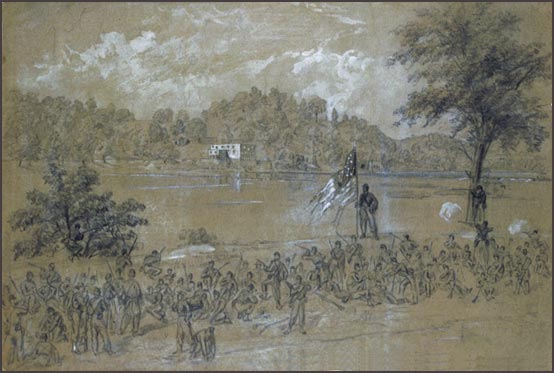
Overall, the film was well received in the discussion group and CWL gives Chickamauga! high marks and feels comfortable adding a few more Wide Awake films on the personal bookshelf.

Friday, August 06, 2010

News: Civil War Chaplains' Museum To Host Fredericksburg Film

The film The Angel of Marye's Heights, (2010, 29 minutes)will be shown Saturday September 18 at 7:30 in room 113 of the De Moss Learning Center on the campus of Liberty University, Lynchburg, Virgina. This half-hour dramatic Civil War documentary covering the life and legacy of Confederate Sgt. Richard Kirkland who climbed the stonewall at one of the bloodiest battle of the war to give water to his wounded enemies. The image of this young South Carolina soldier holding a canteen to the lips of a fallen foe has been memorialized in many mediums but never in film. In essence, the memory of Richard Kirkland as a 'Southern Samaritan' is even larger than the selfless act he performed. This moment of mercy has become a major symbol of light amidst the darkness of war. This film examines both Kirkland's act and the commemoration of it. Tickets are $5 and $3 with the proceeds going to the Civil War Chaplains Museum. This new endeavor can be found online at http://chaplainmuseum.org/

CWL: The film was funded by the Fredericksburg, Virginia based Foundation of Civil War Life. It can be found online.

Text Source: Internet Movie Database

Friday, September 25, 2009

New and Forthcoming Media---From Antietam Creek to the Pacific Theatre


New Dramatic Movie: Antietam Creek trailer. Set during the American Civil War, Antietam Creek tells the story of private Gabriel Buckley longing for home and the daughter he has never seen. A story of family, faith, and duty.


New Short Documentary: New York soldier's remains travel from the Cornfield in Antietam National Military Park to the National Cemetery in Saratoga, New York


HBO Film 'Pacific': Imperial Japan Trailer and God Created Japs Too . . . I Believe In Ammunition trailer

Top Image Source: Brothers' War

Middle Image Source:
Image Of Shepardstown Ford by Alfred Waud at 13th Massachusetts

Bottom Image Source: Review St. Louis