Showing posts with label Lincoln. Show all posts

Wednesday, March 03, 2021

Lincoln: A Life In The Natural Environment

Lincoln and the Natural EnvironmentLincoln and the Natural Environment, James Tackach, 150pp., 8 illustrations, bibliographic notes, bibliography, index, Southern Illinois University Press, 2019  $24.95 

Lincoln's life occurred during an era of transition from when most individuals were farmers who lived in relatively new states to a time when metropolitan regions and webs of commerce began to dominate the natural environment. During the early decades of Lincoln's life water powered then steam powered mills began to produce clothing, farm tools and machines, and domestic  goods. The first half of the 1800s most citizens lived on farms and in small communities. By mid-century, farmers and industrial workers had both come to dominate the interactions of the economy with the natural environment. 

On the eve of the Civil War, more than 70 percent of Americans lived on farms or in small farm towns, and agriculture was the nation's largest and fastest-growing business.

 Additional review at H-Net:https://www.h-net.org/reviews/showpdf.php?id=53544 

Monday, May 04, 2015

New and Noteworthy: Lincoln, His Anti-Semitic Friends and His Jewish Friends

Lincoln And The Jews: A History, Jonathan D. Sarna and Benjamin Shapell, St. Martins Press, 2015, 272 pp., bibliographic notes, index, profusely illustrated with color and b/w photographs, $40.00.

Having been a manuscript and letter collector for 35 years, Benjamin Shapell's interest has been absorbed by Lincoln more than anyone else. He has found among Lincoln's letters to be jewels 'having a poetic flair and marvelous turns of phrase.'  Portions of his collection has been have been exhibited by the Library of Congress, the Smithsonian Institution,  the New York Historical Society, and the Abraham Lincoln Presidential Library and Museum. In his collection of Lincoln documents he found Lincoln expressing humility, biblical imagery, compassion and respect for a people and a religion.

Jonathan Sarna, the author of When General Grant Expelled The Jews [2012] and notes that Lincoln  order expelling 'Jews as a class' from his encampments, Lincoln rescinded the order with the caveat "I do not like to hear a class or nationality condemned on account of a few sinners."  The authors have found correspondence between Lincoln and five close Jewish friends and 14 among his associates and supporters. Lincoln appointed or pardoned 48 Jews during the course of his administrations.  They also note that Lincoln also subtly changed his personal statements in response to Jewish sensitivities. As late at 1862 he described America as a Christian nation and a Christian people. By November 1863 he began to utter 'this nation under God.' Additionally, the authors examine anti-Semitism among Americans in general and abolitionists specifically.

Lincoln And The Jews: A History address in the first three chapters Lincoln's upbringing, what he learned about Judaism for his readings of the Bible and traces his earliest Jewish friends and acquaintances in Illinois.  In particular, the authors focus upon the relationship between Abraham Jonas and Lincoln during his campaigns for elective office. The middle chapters recount the role Jews played in the 1860 presidential campaign and during the presidency.  Lincoln's decision to appoint Jewish chaplains and Grant's Order 11 are thoroughly examined.  Issachar Zacharie, Lincoln's foot doctor, along with General Meade and his order to execute  a Jew, two Roman Catholics and and two Protestants at Beverly Ford, Virginia are recounted and explained. The last chapter and the epilogue recount the assassination, the Jewish response to Lincoln's funeral and later memorializing.  Also discussed is Mary Todd Lincoln's 1866 recounting that her husband remarked that he wished to Palestine and Jerusalem after his second term of was completed.

There is much to enjoy in Lincoln And The Jews: A History. The binding allows the thick pages to fall open, the illustrations are exceeding well reproduced, the narrative is accessible to a wide range of readers. There are approximately 150 hand written letters reproduced, numerous broadsides, ledger account books, and other assorted ephemera such as inauguration tickets and bank checks..  There are about 100 photographic portraits and carte d'visits.  Lincoln And The Jews: A History is an informative and handsome book which is reminiscent of the best work offered during the late 20th century by The American Heritage P
ress.

Sunday, November 02, 2014

New and Noteworthy--Lincoln, An Episcopal Priest, Bureaucratic Corruption And 300 Sentenced To Be Hanged

Lincoln's Bishop: A President, A Priest, Ant the Fate of 300 Dakota Sioux Warriors, Gustav Niebuhr, Harper One/Harper Collins Publishing, 210 pp., four b/w images, bibliographic notes, bibliography, index, $26.99.

The Dakota War of 1862 began on August 17 in southwest Minnesota and ended with the mass execution of 38 Dakota tribe warriors on December 26, 1862. Throughout the late 1850s, treaty violations, unfair annuity payments and bureaucratic corruption by Federal government agents caused destitution and starvation among the Dakota tribes.

In early December, my military court 303 Sioux prisoners were convicted of murder and rape sentenced to death. Some trials were conducted without defense attorneys; other trials lasted less than five minutes. Abraham Lincoln reviewed the court proceedings and commuted the death sentences of 264 prisoners and allowed the execution of 38. Lincoln received the counsel of Henry Benjamin Whipple, a native of New York, a missionary priest to Chicago, an elected first Episcopal bishop of Minnesota, did not meet a Native American until he was 37 years old.

Whipple met and respected the Dakota Sioux, watched and learned first had the corruption of the Federal Office of Indian Affairs. By letters and a visit to Washington D.C., he informed the President that the agency was corrupt, the agents were political hacks,, the vendors were greedy providers of illegal alcohol and abusive of Native American women. At stake for Whipple was not only an injustice but an offense to religious principles that demanded aggressive resistance. By 1860 he began a letter writing campaign that described the problems and proposed remedies.

The 15th President,James Buchanan did not respond; the 16th President did. After a face-to-face interview of Whipple, Lincoln mentioned to a friend that Whipple's testimony had 'shaken him down to his boots.'  Whipple organized other bishops, who by virtue of their habits, were reluctant to speak out on the issues of public issues, even those issues of slavery, secession or politics.

In Lincoln's Bishop, Gustav Niebuhr carefully offers evidence of Whipple's investigation and engagement with politicians regarding the Dakota Sioux.  Niebuhr is a professor of newspaper and online journalism, the founding director of the Carnegie Religion and Media Program, and winner of awards for the reporting of religion.  Lincoln's Bishop offers a clear and concise narrative supported by primary sources. It moves briskly does not stray away from the central features of the story. Currently 'telling truth to power' is often a slogan to justify personal self absorption, narcissism and self promotion.  Niebuhr's work offers the story of one man's  'telling truth to power' as selfless and motivated by the gospel.


Thursday, May 29, 2014

New and Noteworthy----The Sioux on the Gallows, Lincoln and An Episcopal Bishop

Lincoln's Bishop: A President, A Bishop and The Fate of 330 Sioux Warriors, Gustav Niebuhr, 244pp., HarperOne Publishing, $26.99.

From The Publisher: Gustav Niebuhr's compelling history of Abraham Lincoln's decision in 1862 to spare the lives of 265 condemned Sioux men, and the Episcopal bishop who was his moral compass, helping guide the president's conscience.

More than a century ago, during the formative years of the American nation, Protestant churches carried powerful moral authority, giving voice to values such as mercy and compassion, while boldly standing against injustice and immorality. Gustav Niebuhr travels back to this defining period, to explore Abraham Lincoln's decision to spare the lives of 265 Sioux men sentenced to die by a military tribunal in Minnesota for warfare against white settlers—while allowing the hanging of 38 others, the largest single execution on American soil. Popular opinion favored death or expulsion. Only one state leader championed the cause of the Native Americans, Episcopal bishop, Henry Benjamin Whipple.

Though he'd never met an Indian until he was 37 years old, Whipple befriended them before the massacre and understood their plight at the hands of corrupt government officials and businessmen. After their trial, he pleaded with Lincoln to extend mercy and implement true justice. Bringing to life this little known event and this extraordinary man, Niebuhr pays tribute to the once amazing moral force of mainline Protestant churches and the practitioners who guarded America's conscience.

It is hard to recall what powerful moral voices Protestant church leaders had in the formative years of the nation. Gustav Niebuhr travels back to the Minnesota frontier of 1862 when Dakota Sioux rose up against pioneering families and slaughtered hundreds. Citizens demanded mass executions and deportations. Into this turmoil stepped Henry Benjamin Whipple, the state's first Episcopal bishop.

Whipple had already loudly decried the crimes and corruption of those managing Indian affairs and warned of calamity. Now he made the case of mercy and a deeper justice, which eventually led to meeting with President Lincoln. Despite being preoccupied with the Civil War, Lincoln was moved to intervene, surprisingly taking the time to review all 303 cases and overturning the death sentence for most of the Indians. Nevertheless, the result was still the largest single execution on American soil.
If not for Whipple's vigorous campaigning, both in state and in Washington, DC, a greater tragedy might well have occurred. His success should haunt us: Where today do we hear these trumpet calls for justice like those given by figures such as Bishop Henry Benjamin Whipple?

Tuesday, October 09, 2012

News---First Look of Film 'Lincoln' Occurs in UK

Lincoln, First Look At The Film in UK,  Katey Rich, The Gaurdian,  October 8, 2012 

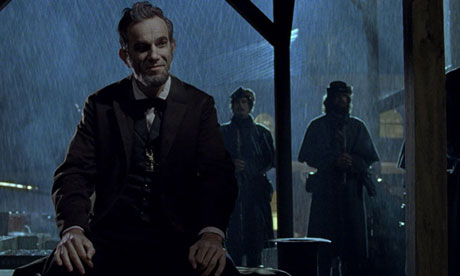
Playing politics … Daniel Day-Lewis as the president in Lincoln.Politics was a dirty business even in the 19th century, and even when changing history for the better, as the best moments of  Lincoln  wittily and elegantly prove. Steven Spielberg's  behemoth of a new film, which premiered in unfinished form at the New York film festival Monday night, has a title that suggests a sweeping portrait of the great 16th American president. But the film is largely too content depicting Abraham Lincoln as an all-knowing icon, and even with Daniel Day-Lewis's beautifully measured (and surprisingly soft-spoken) performance, Lincoln often recedes to the background of the very uneven movie that bears his name.
 
The screenplay from Pulitzer prize-winner Tony Kushner focuses on just the last four months of Lincoln's life, as he works in Washington to end the civil war raging just south of him, but not before passing an amendment to officially outlaw slavery. The backroom deals and legal hurdles to make that happen are immensely complicated, but after some bulky exposition this wheeling and dealing among lawmakers makes for the film's strongest scenes. Secretary of State William Seward (David Strathairn) hires a trio of hooligans (John Hawkes, Tim Blake Nelson and James Spader) to rustle up votes for the amendment through whatever means necessary, while on the floor of the House of Representatives, anti-slavery lawmaker Thaddeus Stevens  (a gloriously scene-stealing tommy Lee Jones) bellows at pro-slavery Fernando Wood (Lee Pace), with the roomful of men around them banging on their desks and shouting over each other. If only modern American politics were remotely as entertaining.

We visit the battlefield a few times, with General Ulysses S Grant (Jared Harris) preparing to negotiate peace with the Confederacy, but Lincoln is largely set in the cramped chambers of the White House and Congress; between that and the many speeches about constitutional law, it can start to feel a little airless. Glimpses into Lincoln's personal life, including strained relationships with both his wife (Sally Field) and eldest son (Joseph Gordon-Levitt), are intended to add a human dimension to the president, but they're never as effective as simply seeing the man at work; Gordon-Levitt has had a fantastic year in other films, but his character here is entirely superfluous, and Field brings tremendous overacting to a cast that's otherwise quite restrained.

Lincoln isn't as sentimental as you might expect from Spielberg, and though it never digs deep enough into Lincoln as a man, it's unafraid to show him as a canny politician willing to bend the law and make enormous compromises to accomplish a greater goal. With John Williams's gentle score, posh cinematography from Janusz Kaminski and a whole load of big costumes and facial hair for the cast, Lincoln veers too often toward becoming a somnolent period piece, but the strong cast and political texture always manage to perk things back up. Though it might have worked better as a tighter, purely political thriller with even less focus on the title character, Lincoln's smarty-pants pleasures manage to outweigh its stuffy drawbacks.

Text and Image Source:  The Gaurdian

CWL:  Lincoln will be released in the US on November 9, 2012

Lincoln


Tuesday, August 12, 2008

Forthcoming--- The Rifled Musket, The Commander-In-Chief, and The Submarine


The Rifle Musket in the Civil War Combat: Reality and Myth, Earl J. Hess, University of Kansas Press, 288 pp., $29.95, (September).


Tried By War: Abraham Lincoln as Commander-In-Chief, James M. McPherson, Penguin Press, 384 pp., $35.00, (October).


The H.L. Hunley: The Secret Hope of the Confederacy, Tom Chaffin, Hill and Wang Publisher, 352 pp., $26.00, (October).

Friday, July 18, 2008

New Arrival---Getting Right With the Declaration of Independence: Lincoln's Peoria Speech

Lincoln At Peoria: The Turning Point, Lewis E. Lehrman, Stackpole Books, 412 pp., index, illustrations, maps, notes, bibliography, chronology, 2008, $29.95.

CWL: Lincoln's Gettysburg Address, Second Inaugural, and Cooper Union Address have received new attention in the past several years. Harold Holzer recovered a close approximation of the actual words of the Lincoln-Douglas debates from the October 1858 newspapers in 1993. In 2008 two Lincoln/Douglas books have recently appeared: Lincoln and Douglas: The Debates that Defined America by Allen C. Guelzo and The Long Pursuit: Abraham Lincoln's Thirty-Year Struggle with Stephen Douglas For The Heart And Soul Of America by Roy Morris Jr. The battle between Stephen Douglas and Abraham Lincoln, as the current books remind us, was not limited to the seven famous debates. Lincoln's Peoria speech was delivered four years before, almost to the day of the last of the Lincoln-Douglas debates in October 1858. On first look, Lehrman's book has a crisp, sharp narrative style and is closely referenced. The author places the speech in the context of Lincoln's career and references it to other historians' considerations of Lincoln's life and work. Organized into nine chapters, each with four to seven sections, Lincoln At Peoria: The Turning Point encourages the reader to dip into the book then reflect on the argument. Lehrmans' book is accessible to readers ranging from Lincoln buffs to the those with advanced degrees; Stackpole Publishing has issued a nice edition in an enjoyable font style and size with a binding that is supple and easy to hold.

From the Publisher: Lincoln at Peoria: The Turning Point explains how Lincoln's speech at Peoria on October 16, 1854 was the turning point in the development of his antislavery campaign and his political career and thought. Here, Lincoln detailed his opposition to slavery's extension and his determination to defend America s Founding document from those who denied that the Declaration of Independence applied to black Americans.

Students of Abraham Lincoln know the canon of his major speeches from his Lyceum Speech of 1838 to his final remarks delivered from a White House window, days before he was murdered in 1865. Less well-known are the two extraordinary speeches given at Springfield and Peoria two weeks apart in 1854. They marked Mr. Lincolns reentry into the politics of Illinois and, as he could not know, his preparation for the Presidency in 1861. These Lincoln addresses catapulted him into the debates over slavery which dominated Illinois and national politics for the rest of the decade. Lincoln delivered the substance of these arguments several times certainly in Springfield on October 4, 1854, for which there are only press reports. A longer version came twelve days later in Peoria. To understand President Abraham Lincoln, one must understand the Peoria speech of October 16, 1854. It forms the foundation of his politics and principles, in the 1850s and in his Presidency.

The Kansas-Nebraska Act, one of the most explosive congressional statutes of American history, repealed the prohibition on slavery in that section of the Louisiana Territory, 36 degree and 30 minute parallel, a restriction on the spread of slavery agreed upon by North and South in the Missouri Compromise of 1820. The Kansas-Nebraska Act, sponsored by the famous Illinois Senator Stephen A. Douglas, inaugurated an incendiary chapter in the slavery debates of the early American Republic. In response to the Kansas-Nebraska Act, Lincoln launched his antislavery campaign. All of his moral and historical arguments opposed any further extension of slavery in the American republic, founded, as he argued, upon the Declaration of Independence. That all men are created equal, with the inalienable right to liberty, was, for Lincoln, a universal principle that Americans must not ignore.

The Endorsements: Doris Kearns Goodwin, James M. McPherson, David Brion Davis, Douglas L. White, James Oliver Horton, Samuel Freedman and Michael Burlingame.

Friday, May 11, 2007

Forthcoming: The Age of Lincoln


THE AGE OF LINCOLN, Orville Vernon Burton, Hill and Wang Publishers, 432 pp, $27.00, Summer 2007.

(text from the publisher) Stunning in its breadth and conclusions, The Age of Lincoln is a fiercely original history of the five decades that pivoted around the presidency of Abraham Lincoln. Abolishing slavery, though extraordinary, was not this age’s most profound accomplishment. The enduring legacy of the age was inscribing personal liberty into the nation’s millennial aspirations.

America has always perceived providence in its progress, but in the 1840s and 1850s, a pessimism accompanied a marked extremism. With all sides claiming God’s blessing, irreconcilable freedoms collided; despite historic political compromises, the middle ground collapsed. In a remarkable reappraisal of Lincoln, the distinguished historian Orville Vernon Burton shows how the President’s Southernness empowered him to conduct a civil war that redefined freedom as a personal right protected by the rule of law. In the violent decades that followed, the extent of that freedom would be contested by racism and unregulated capitalism, but not its central place in what defined the country. (text from the publisher) Amazon.com blurbs from McPherson, Donald, Foner, Wyatt-Brown.