Showing posts with label Jefferson Davis. Show all posts

Wednesday, December 03, 2014

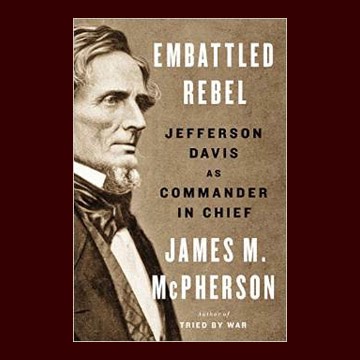
News--NYT's Review of Embattled Rebel Gives McPherson Good Marks For Putting Davis In Military Context

Embattled Rebel by James McPherson,  Steven Hahn, New York Times, November 20, 2014

Steve Hahn: "Yet, there is a larger and more unsettling issue. Treating Davis as commander in chief risks lending the Confederacy a legitimacy it never achieved at the time. No foreign country accorded the Confederacy diplomatic recognition, at least in part because of an unwillingness to openly support a slaveholders’ rebellion. Only after the war, as part of a reconciliation process, were Confederates spared serious punishment and then tendered respect as a cause and a state, enabling men like Davis and subsequent devotees of the “lost cause” to get a hearing for their version of events."

A full text ink is below.

Text and Image Source:  Sunday Book Review New York Times, November 20, 2014

Sunday, October 05, 2014

New and Noteworthy----Embattled Rebel: Jefferson Davis Beseiged on Several Fronts


EmbattledRebel: Jefferson Davis as Commander In Chief, James M. McPherson, Penguin Press, 302pp., 24 black and white illustrations, 15 maps, bibliographic notes, index, 2014, $32.95.

As president of the Confederacy, did Jefferson Davis prove to be a decisive factor in bringing about its defeat? Did his work as commander-in-chief contribute the defeat of the Confederacy? Is historian David M. Potter correct in stating that if  the Union and the Confederacy had exchanged presidents, the Confederacy might have won its independence?  In Embattled Rebel James M. McPherson, an academic scholar with over a dozen books and numerous articles to his credit, avoids comparing Davis to Lincoln. McPherson describes and analyzes Davis’ conception and execution of his duties as commander in chief as he understood them.

McPherson notes that negative depictions of Davis’ personality have been offered by his contemporaries in both the Confederate government and military.  These depictions of Davis are adequately noted by William C. Davis in Jefferson Davis: The Man and His Hour and An Honorable Defeat: The Last Days of the Confederate Government. McPherson acknowledges that there is substance to the claims that Jefferson Davis was impatient with others with whom he disagreed and did not take personal criticisms well.  More often than not, Davis could be humorless, argumentative and cold to others. 

The author does note that some found Davis to be attentive and polite to others, as well as cordial and a good listener.  McPherson believes that the Confederate president’s ill-health health was the likely cause of apparently abusive conduct.  Symptoms of previous bouts with malaria, severe neuralgia, and corneal ulcers left him at times in pain, nauseous, and partially blind.  Often sick, Davis worked frequently from a sick bed at home. Bronchial infections, insomnia and boils increased discomfort and pain.

McPherson notes that it was in April and May 1863, while Lee was suffering from symptoms of heart disease and Jackson was dying, that Davis could not come to the  presidential office for reasons of sickness.  Along with his ill-health, the stress of having meager resources at hand to meet the challenges of the presidency added to Davis’ irritability, impatience and short temper. 

With these caveats, McPherson judges Davis on five activities: 1. national policies regarding war aims, 2. national strategies regarding of the mobilization of political, economic, diplomatic, and military resources, 3. military strategy to address the war aims, 4. operations and management of the armies and their movements, and 5. the military tactics of specific armies in specific battles. 

He finds that Davis’ shaping and articulation of national polices to be clear and forceful regarding nationhood and slavery. McPherson makes the case that Davis’ military efforts were conditioned by economic and European situations beyond his control. Regarding the operations of the armies and military tactics, McPherson describes the difficulties and behavioral conflict inherent in Davis’ command style and those of several army commanders, who like Davis could be apparently thin skinned regarding criticism and closed minded to suggestions. 

In Embattled Rebel: Jefferson Davis as Commander In Chief,  McPherson clearly understands  that at the core of Davis’ difficulties lies not only his ill-health but also his ‘offensive-defensive’ military strategy and the strategies’ conflicts with the rights of the states to control their own manpower and resources. For McPherson, Jefferson Davis should not be charged with losing the war but that Lincoln won it by adeptly using resources, embracing over time a successful military strategy, and building a team of commanders that were not available to the Confederacy.  Embattled Rebel: Jefferson Davis as Commander In Chief is succinct and clearly written.  For those who have not read biographies of Davis published in the last 30 years, Embattled Rebel is a very fine place to start.

Wednesday, September 22, 2010

New and Noteworthy: The Manhunt for Jefferson Davis and The Parade of Lincoln's Corpse

Bloody Crimes;The Chase for Jefferson Davis and the Death Pageant for Lincoln's Corpse, James L. Swanson, William Morrow Publisher, 480 pages, $27.99.

The spring of 1865 was one of the most momentous chapters in an era filled with great drama. It was a season that saw not only the end of America’s bloodiest war and the beginning of the nation’s painful reconciliation, but also two dramatic spectacles that symbolized the emotional core of the conflict.

In April 1865, the future of the Confederacy was in grave peril. The capital, Richmond, could no longer be defended and could fall to Union armies within days. On the morning of April 2, Confederate president Jefferson Davis received the telegram from General Robert E. Lee: There is no more time—the Yankees are coming. That evening, shortly before midnight, Davis boarded a train from Richmond and fled. But in two weeks' time, John Wilkes Booth would assassinate the president, and the nation was convinced that Davis was the mastermind of the crime. In Bloody Crimes, James Swanson, the author of Manhunt: The 12-Day Chase for Lincoln’s Killer, recounts the events surrounding the stories of these two fallen leaders.

No longer merely a traitor, Davis became a murderer, a wanted man with a $100,000 bounty on his head. Over the course of several weeks, the Union cavalry led an intense and thrilling chase through the Carolinas and Georgia. Davis’ final journey into captivity, with its moments of great suffering and intense drama, transformed him into a martyr of the South’s Lost Cause—and, in the years after the war, his stock rose even higher in the former Confederacy.

At the same time, another man was also undergoing his last journey. Abraham Lincoln’s final sojourn began on April 19 after the White House funeral. From there a solemn procession escorted him to the Capitol rotunda, where tens of thousands of mourners viewed him in death. This was just the beginning. On April 21, one week after he was shot, 400 soldiers escorted him to the Baltimore and Ohio railroad depot and placed him aboard the special train that would carry him home on the nearly 1,700-mile trip to Springfield. By the time it was over, Lincoln’s corpse had been unloaded from the train 10 times and placed on public view in all the great cities of the North between Washington and Springfield, making it the largest, most elaborate, and most magnificent funeral pageant in American history.

Ultimately, Swanson uses Davis’ capture and Lincoln’s funeral as harbingers of the American future—and the ignominy with which the Confederacy is largely viewed today. As he writes, “The 20th century came to belong to Abraham Lincoln, not Jefferson Davis.”

At once suspenseful and poignant, Bloody Crimes tell the stories of two fallen leaders counterpoised, their final journeys shaping their legends among a wounded nation and throughout a scarred landscape.

Text Source: History Book Club

Image Source: Amazon.com

Thursday, December 31, 2009

Looking Forward---The Strategists: Lincoln vs. Davis, July 2010

The Grand Design: Strategy and the U.S. Civil War, Donald Stoker, Oxford University Press, 528 pages, July 2010.

Of the tens of thousands of books exploring virtually every aspect of the Civil War, surprisingly little has been said about what was in fact the determining factor in the outcome of the conflict: differences in Union and Southern strategy.
In The Grand Design, Donald Stoker provides a comprehensive and often surprising account of strategy as it evolved between Fort Sumter and Appomattox.

Reminding us that strategy is different from tactics (battlefield deployments) and operations (campaigns conducted in pursuit of a strategy), Stoker examines how Abraham Lincoln and Jefferson Davis identified their political goals and worked with their generals to craft the military means to achieve them--or how they often failed to do so. Stoker shows that Davis, despite a West Point education and experience as Secretary of War, failed as a strategist by losing control of the political side of the war. His invasion of Kentucky was a turning point that shifted the loyalties and vast resources of the border states to the Union. Lincoln, in contrast, evolved a clear strategic vision, but he failed for years to make his generals implement it.

At the level of generalship, Stoker notes that Robert E. Lee correctly determined the Union's center of gravity, but proved mistaken in his assessment of how to destroy it. Stoker also presents evidence that the Union could have won the war in 1862, had it followed the grand plan of the much-derided general, George B. McClellan. Historians have often argued that the North's advantages in population and industry ensured certain victory. In The Grand Design, Stoker reasserts the centrality of the overarching military ideas--the strategy--on each side, arguing convincingly that it was strategy that determined the war's outcome.

Donald Stoker is Professor of Strategy and Policy for the U.S. Naval War College's program at the Naval Postgraduate School in Monterey, California.

Text Source: Amazon.com

Friday, February 20, 2009

News--- Jeff Davis's White House Infiltrated By Union Intelligence Network

Slave in Jefferson Davis' Home Gave Union Key Secrets, Barbara Starr and Bill Mears, CNN, February 20, 2008

William Jackson was a slave in the home of Confederate president Jefferson Davis during the Civil War. It turns out he was also a spy for the Union Army, providing key secrets to the North about the Confederacy. Jackson was Davis' house servant and personal coachman. He learned high-level details about Confederate battle plans and movements because Davis saw him as a "piece of furniture" -- not a human, according to Ken Dagler, author of "Black Dispatches," which explores espionage by America's slaves. "Because of his role as a menial servant, he simply was ignored," Dagler said. "So Jefferson Davis would hold conversations with military and Confederate civilian officials in his presence."

Dagler has written extensively on the issue for the CIA's Center for the Study of Intelligence . In late 1861, Jackson fled across enemy lines and was immediately debriefed by Union soldiers. Dagler said Jackson provided information about supply routes and military strategy.

"In Jackson's case, what he did was ... present some of the current issues that were affecting the Confederacy that you could not read about in the local press that was being passed back and forth across local lines. He actually had some feel for the issues of supply problems," Dagler said. Jackson and other slaves' heroic efforts have been a forgotten legacy of the war -- lost amid the nation's racially charged past and the heaps of information about the war's historic battles. But historians over the last few decades have been taking an interest in the sacrifice of African-Americans during those war years.

Jackson's espionage is mentioned in a letter from a general to Secretary of War Edwin Stanton. Maj. Gen. Irvin McDowell refers to "Jeff Davis' coachman" as the source of information about Confederate deployments. Dagler said slaves who served as spies were able to collect incredibly detailed information, in large part because of their tradition of oral history. Because Southern laws prevented blacks from learning how to read and write, he said, the slave spies listened intently to minute details and memorized them.

"What the Union officers found very quickly with those who crossed the line ... was that if you talked to them, they remembered a great more in the way of details and specifics than the average person ... because again they relied totally on their memory as opposed to any written records," he said. Jackson wasn't the only spy. There were hundreds of them. In some cases, the slaves made it to the North, only to return to the South to risk being hanged. One Union general wrote that he counted on black spies in Tennessee because "no white man had the pluck to do it."

No one was better than Robert Smalls, a slave who guided vital supply ships in and out of Charleston Harbor in South Carolina. He eventually escaped and provided the Union with "a turning of the forces in Charleston Harbor," according to an annual report of the Navy secretary to President Lincoln. "A debriefing of him gave ... the Union force there the entire fortification scheme for the interior harbor," Dagler said.

One of the most iconic spies was Harriet Tubman, who ran the Underground Railroad, bringing slaves to the North. In 1863, she was asked by the Union to help with espionage in South Carolina. She picked former slaves from the region for an espionage ring and led many of the spy expeditions herself. "The height of her intelligence involvement occurred late in 1863 when she actually led a raid into South Carolina," Dagler said. "In addition to the destruction of millions of dollars of property, she brought out over 800 slaves back into freedom in the North."

As the nation marks Black History Month in February, Dagler said that history should include the sacrifices of the African-Americans who risked their lives for their nation. Many paid the ultimate sacrifice. "They were all over the place, and no one [in the South] considered them to be of any value. Consequently, they heard and saw virtually everything done by their masters, who were the decision-makers," Dagler said.

Whatever happened to William Jackson, the spy in Jefferson Davis's house?Unfortunately, that remains a great unknown. "He simply disappeared from history, as so many of them have."

CNN's Wayne Drash contributed to this report.

Text and Image Source: CNN, February 20, 2009

CNN Video on Black Spies

CWL: It seems likely that William Jackson's intelligence collection began and ended in 1861. More important Elizabeth Van Lew's intelligence network that began in late 1862 and early 1863. Van Lew was communication with several Richmond blacks close to the Davis' home.

Wednesday, July 23, 2008

News---Kentucky's Lincoln, Todd, And Davis Birthplaces See Surge In Visitors

Davis Sites Gain Visits Amid Lincoln 200th Fervor, Joe Biesk, Associated Press, July 20, 2008.

From Abraham Lincoln's boyhood residence to the Mary Todd Lincoln house, visitors this year are flocking to Kentucky sites dedicated to the 16th president. But, Lincoln's Confederate counterpart, Jefferson Davis, is experiencing a similar resurgence. Kentucky, which claims both men as native sons and has statues of both in its Capitol Rotunda, isn't the only place experiencing a Davis boost. "It'll be hard for anyone to approach the level of attention that Abraham Lincoln gets because he's always classified as one of our greatest presidents," said Paul Bradshaw, manager at a Davis site in Georgia. "But I think there's a trend to learn more about the other side."

Interest in both Civil War presidents seems on the rise, amid a two-year blitz surrounding Lincoln's 200th birthday next February. This June marked 200 years since the birth of Davis, who served as president of the Confederacy. Attendance at Kentucky's Lincoln sites has increased about 18.1 percent, officials say. Lincoln's boyhood home in Hodgenville, for example, had more than 105,000 visitors in the first six months this year, compared with about 89,000 during the same period last year. Kentucky has nine museums and historic sites dedicated to Lincoln, which have had more than 159,000 visitors this year. Mary Todd Lincoln's home in Lexington had more than 1,100 extra visitors this year while nearly 1,700 additional people went to the Lincoln Museum in Hodgenville, according to the Kentucky Historical Society.

Davis' memorial in Fairview, in southwestern Kentucky, meanwhile, has seen an increase in visitors by about 12 percent overall for the year, and a nearly 30 percent jump in June, the month he was born, said Mark Doss, the Davis memorial park manager. Doss said the park, which includes a 351-feet tall obelisk honoring Davis, had its "biggest month of June in the history of the park," tallying about 4,000 visitors. "It's to be expected," Doss said. "There's a lot of people that study Jefferson Davis and in the last few years there's been a lot more interest in his role not just in the war, but in his experience before the war." Bradshaw, who runs the Davis historic site in Irwinville, Ga., where Davis was captured by Union troops, said he expects about 20,000 people or more will visit this year, compared with the normal attendance of between 12,000 and 15,000 people annually. Increased interest in the Civil War, combined with the bicentennial events are likely behind the renewed interest, Bradshaw said. People seem to be looking for another perspective and to learn more about Southern history, he said.

"They know about Lincoln and everything he did," Bradshaw said. "I think there's a trend that there seems to be people who want to learn more about Jefferson Davis and what happened to him." Rick Forte, acting director of Beauvoir, the home in Biloxi Miss. where Davis last lived, said about 4,000 people visited the estate on June 3 for his birthday celebration and grand opening of the home there. Forte said the home, which is now owned by the Mississippi Sons of Confederate Veterans, has also seen more visitors. "We have seen just an outstanding growth of interest," Forte said. "Phone calls, e-mails, you name it." In Lexington, Ky., a town that also boasts ties to both men, the Lexington History Museum has an exhibit featuring both Lincoln and Davis. Jamie Millard, the museum president and CEO, says a record number of people - more than 8,000 - have viewed the museum's exhibit. Lisa Cleveland, a spokeswoman for the Kentucky Historical Society, said that people drawn to Lincoln also tend to show interest in Davis. A mid-June academic symposium on Davis drew about 150 people, and Kentucky's Lincoln sites have also seen more visitors, Cleveland said. "Clearly, for whatever reason, people are finding a reason to visit those Lincoln sites and looking at the Lincoln legacy in Kentucky," Cleveland said. "The interest is there, and I think it's fair to say that there has probably never been as much focus on Lincoln's Kentucky connection as there is now."

Source: Macon, Georgia

Pictures:
Top---Lincoln Birthplace

Middle---Mary Todd Lincoln
Birthplace


Bottom--- Jefferson Davis Postcard and Jefferson Birthplace Obelisk

Thursday, June 19, 2008

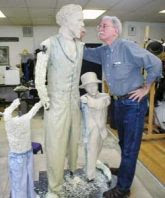
News---Jeff Davis And Children May Join Abe and Tad at Richmond Virginia Park

Statue Of Jefferson Davis Is Proposed--Confederate Group Seeks Spot Near Lincoln Statue At Tredegar In Richmond, Will Jones, Richmond Times Dispatch, June 10, 2002.

A life-size statue of Confederate President Jefferson Davis could stand with the one of Abraham Lincoln at Tredegar Iron Works in Richmond. The Sons of Confederate Veterans is offering to donate a bronze statue of Davis for placement at the National Historic Landmark site to mark this year as the bicentennial of his birth. The $100,000-plus statue by Lexington sculptor Gary Casteel would help educate the public about the Confederate president and how his family took in a mixed-race orphan and serve as a counter to the Lincoln statue that was dedicated in 2003, said Brag Bowling, a Richmond resident and a board member with the national Southern-heritage group. "There were two sides of the war," he said.

The Sons of Confederate Veterans fought the Lincoln statue, which depicts him with his son Tad on his visit to the burned-out Confederate capital in 1865. Bowling said the group isn't trying to cause an uproar but sees a need for historic balance at Tredegar. "The acceptance of that statue would soothe some feelings of Southerners from a few years ago," he said.

Representatives of the Sons of Confederate Veterans are expected to meet next Tuesday with officials from the American Civil War Center, which controls the Tredegar site through an agreement with its owner, NewMarket Corp. Museum President Christy S. Coleman said yesterday that it would be inappropriate to comment before the meeting. "With anything, it's all about content and intent," she said.

The statue of Davis depicts him standing with his son Joe and with Jim Limber, who was a mixed-race child taken in by the Davis family, according to John M. Coski, historian and library director for The Museum of the Confederacy. David Ruth, superintendent of the Richmond National Battlefield Park, said he expects the statue of Davis to be considered just as the Lincoln statue was when it was offered by the U.S. Historical Society.

Its placement would have to be approved by NewMarket, plus the board of directors for the American Civil War Center. The National Park Service could serve as a consultant in the process. The now-defunct Richmond Historic Riverfront Foundation controlled the Tredegar property when the Lincoln statue was approved. Ruth said whether the statue would be accepted at Tredegar could depend on such factors as its design; whether it's determined that another monument to Davis is needed in Richmond; and whether Tredegar would be the appropriate place. A monument to Davis was erected in 1907 at Monument and Davis avenues. "I would hope for more discussion than it simply being a counterpoint to Lincoln," he said.

Ruth said the story of Jim Limber's association with the Davis family could be worth telling, although some details of the relationship aren't clear. Bowling said the Sons of Confederate Veterans commissioned the statue with Casteel. The piece is expected to be finished this fall, and it could be placed to mark the 200th anniversary of Davis' birth or in the walkup to 2011 and the 150th anniversary of the start of the Civil War.

The Sons of Confederate Veterans is proposing the statue on a granite base with the title "Looking Forward -- Looking Back." A proposed inscription reads, "President of the Confederate States of America, Jefferson F. Davis, his son Joseph Evan Davis, and Jim Limber who was a black youth that the Davises rescued from maltreatment and raised as their own. Joseph, called 'Joe,' died during the War Between the States as the result of an accidental fall from a window of the Confederate Executive Mansion known today as the White House of the Confederacy. Jim Limber was captured with the Davis family after the collapse of the Confederacy and was cruelly separated from the Davises by Union soldiers. Mr. Davis tried the rest of his life to find out the fate of the boy, but he was never to be heard of again."

Text Source: http://www.inrich.com/cva/ric/entertainment/arts.apx.-content-articles-RTD-2008-06-10-0139.html
Contact
Will Jones at (804) 649-6911 or wjones@timesdispatch.com.

Photo:The Sons of Confederate Veterans commissioned the statue with sculptor Gary Casteel of Lexington at a cost of more than $100,000. It is expected to be finished this fall. Photo By: Sons of Confederate Veterans

CWL--Andrew Jackson adopted a Native American infant who survived the destruction of his Creek tribe. Jackson drew the Red Sticks into a trap at the Battle of Talladega in the fall 1813. It is estimated that over 400 Red Sticks died in the fight. Found among the dead was a male baby which was taken to Andrew Jackson. Jackson decided to adopt him. Though Jim Limber wasn't adopted by Jeff Davis, there is a tradition of children of the vanquished being adopted. The 'cruelly separated' phrase in the inscription appears conjectural and unsupported by evidence.

Saturday, May 31, 2008

News---Vicksburg Post Celebrates 200th Anniversary of Jefferson Davis' Birth; His Mansion/Presidential Library Reopens

Jefferson Davis Bicentennnial, Gordon Cotton, Vicksburg Mississippi Post, May 14-24, 2008.

This year is the 200th anniversary of the birth of Jefferson Davis, who was born in Fairview, Ky., on June 3, 1808, and at the age of 2 moved with his parents to Rosemont Plantation near Woodville, Miss. In 1835, Davis moved to Warren County where he spent the most productive years of his life. This is a series of 11 articles about Davis as a local Citizen.

May 14, 2008 Brother's home lured young couple to Warren County

May 15, 2008 Political career started with a one-day campaign, and a loss at the polls

May 16, 2008 Varina was met on an errand, and courtship followed

May 17, 2008 Washington and war with Mexico kept time at Brierfield brief

May 18, 2008 Brierfield lush and productive in years before the war

May 19, 2008 Locals first to cheer reluctant-yet-confident president

May 20, 2008 Union general's wife curious about husband's classmate

May 21, 2008 Mutual fondness clear on final visit

May 22, 2008 Last stop at Brierfield complicated by illness

May 23, 2008 Unexpected tributes were also unequivocal

May 24, 2008 Local friends, distant ediorialists offered tributes

Source of Articles: http://www.vicksburgpost.com/jefferson_davis/jeffersondavis.txt
Also Beauvoir Plantation, Jefferson Davis' retirement home was severly damaged by Hurricane Katrina.

The house is reopening in June. Go to the Beauvoir's wwwsite at
http://www.beauvoir.org/ and read the scanned newspaper story of the rebuilding of the house.