Showing posts with label July 3rd. Show all posts

Tuesday, October 30, 2012

New and Noteworthy---Fury At the July 2 Apex of Gettysburg: The Bliss Farm

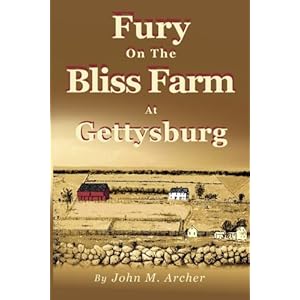
Fury On The Bliss Farm At Gettysburg, John M. Archer, Ten Roads Publishing, 80 pages, 24 photographs and maps, appendix, end notes, index, 2012,, $9.95.

Many debates have occurred regarding whether Gettysburg was a turning point of the Civil War. Other debates have risen with the question: What was the turning point of the Battle of Gettysburg. If July 2 is the bloodiest day of the battle and if Longstreet's assault was a main feature of that day, then what event marked the end of the assault? The assault ended or failed on the Bliss Farm, located on the west side of the Emmitsburg Road and opposite the Abraham Bryan farm.  John M. Archer, a licensed Gettysburg battlefield guide,  has written on the Bliss Farm in America's Civil War magazine and has been filmed, by the Pennsylvania Cable Network, guiding a tour of the location.  With Fury On The Bliss Farm At Gettysburg, he offers a clear and concise booklet of one his popular tours.

In 1857 William Bliss and his family moved from western New York to Adams County, Pennsylvania and purchased a 44 acre farm with its double log and frame house, a large banked barn, two water wells that featured pumps, and a large fruit orchard that held principally cherries and peaches. On July 2 his farm was fought over and on July 3 it the buildings were burned. Archer describes the multiple infantry charges with the capture and recapture of the farm buildings several times. During the July 3 Grand Assault, Confederates' left flank maneuvered around the smoking and smoldered embers of the buildings.

Archer's six stop tour begins on the east side of Emmitsburg Road at Ziegler's Grove, moves to the Brian Farm and then the 14th Connecticut monument. Stops 4, 5, and 6 are on the west side of Emmitsburg Road. The Confederates' important occupation of Long Lane, the multiple attempts to take and hold the farm buildings, and the role of the Bliss Farm in Wright's occupation of Cemetery Ridge are thoroughly explained. In three appendices, Archer describes the nature of skirmishing and Wright's breakthrough; also armies' the order of battle is offered. Fury On The Bliss Farm At Gettysburg is useful for the armchair reader and the battlefield visitor who desires an informed walk describing what might be the apex of Longstreet's July 2 assault.

Friday, April 27, 2007

CWL --- Walking Gettysburg's Battlefield: Culp's Hill


Gettysburg Battlewalks: Culp's Hill, Hartwig, Scott, Pennsylvania Cable Network, 1 hour 31 minutes, 2003.


This tour is a testament to Scott Hartwig's ability to hold a story together for 100+ walkers. For the armchair viewer, this particular dvd in the Gettysburg Battlewalk series, has no vistas, no panoramic views, and no closeups of monuments. Its trees, trees, trees and trees. Viewers would do well to just listen to parts of this battlewalk while consulting any combination of the following materials: the McElfresh watercolor map, Pfanz's 'Gettysburg: Culp's Hill and Cemetery Hill, the West Point Atlas of the Civil War, Hartwig's guide to battlefield monuments and Archer's tourbook, Culp's Hill at Gettysburg: The Mountain Trembled. Hartwig introduces the Culp's Hill battle as 'not a happy one.' He views it as one of defeat, tragedy, courage, mediocre generalship and the advantage of a hilltop position with breastworks.

Key elements of the story are Slocum's decision to leave one brigade on Culp's Hill after being ordered to remove the entire 12th Corps, Greene's decision to order his brigade to build breastworks, and the loss of command and control of troops by Confederate generals. Hartwig states that among the causes of this loss is the physical distance between Lee's headquarters and Ewell's headquarters with the town between them, the terrain over which CSA troops fought, and the lack of understanding of the topography of the Culp's Hill battlefield. Hartwig also sees Lee's orders to Longstreet on July 2nd and 3rd as they relate to Lee's orders to Ewell on July 2nd and 3rd as creating the loss of control by Lee of his army corps attack schedule. This particular loss by Lee puts Ewell at a disadvantage. While Ewell's corps is fighting, no other CSA troops are attacking.

Hartwig amply presents soldiers' words to describe the ferocity of the battle. The active listener will take notes on the chronology of the events because much of the ground is fought over twice. The tour goes halfway up to the summit, then down, up to the lower summit, then down, over to the edge of Pardee's field, then back to base of the the summit, then up to the top, then down to the bottom again. The actual tour took between 2.5 to 3 hours; the dvd contains 1.5 hours of lecture material. This battlewalk is recommended to those who have a well stocked library and have visited the Culp's Hill site at least once.