Showing posts with label Law. Show all posts

Wednesday, May 01, 2019

New and Notewworthy: Lawyers Fight A Civil War, Of By and For Lawyers; Was Secesssion a Crime?

Uncivil Warriors: The Lawyers' Civil War, Peter Charles Hoffer, Oxford University Press, 240 pages, bibliographic notes, index, 2018, $27.95.

Reviewed by Jeremy Weber (Air War College, Air University) for H-War (April, 2019)
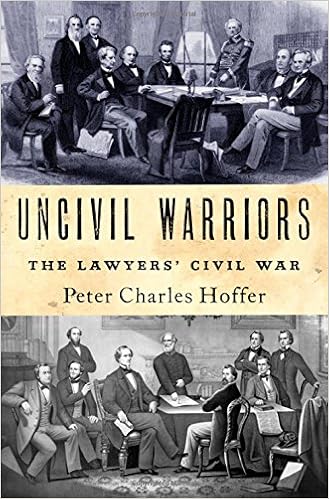
Image result for uncivil warriors bookJust when it seemed the Civil War could not possibly provide fresh material, along comes Peter Hoffer’s Uncivil Warriors; The Lawyers’ Civil War. In 184 pages, Hoffer, a legal historian, tells the story of the lawyers who used their skills to frame the issues presented by this unique war, resolve disputes, and generally maintain some form of order to the conflict. He portrays the war ultimately as not one of guns or honor, but “a Civil War by lawyers, of lawyers, and in the end, for lawyers” (p. 4). Along the way, Hoffer supplies a new appreciation of the role of law—and lawyers—in initiating, carrying out, and terminating warfare. 

Hoffer’s work is an introduction to the role of lawyers in the Civil War, not a treatise. He focuses on the two legal issues at the heart of the conflict: the status of slavery and the purported secession of seven states from the Union. Hoffer convincingly demonstrates that both issues were at least as much legal questions as political ones, and lawyer/politicians used the language of law to understand, analyze, and resolve these questions. As Hoffer notes, the work lawyers performed in placing the conflict in a legal framework made the Civil War, “unlike civil wars before and after, remarkably rule-bound” (p. 3).

However, lawyers did not play an equal role on both sides. The cabinets of both Abraham Lincoln and Jefferson Davis were replete with lawyers, Hoffer notes, but Lincoln (being a lawyer himself) was able to harness the talents of his lawyer/politicians. In Hoffer’s exploration of the advocacy and competition within the Lincoln cabinet, we see shades of the Team of Rivals narrative that has become familiar to many. Yet Hoffer goes beyond this story to explore the reason Lincoln was able to not only tolerate, but value the role his lawyer/politicians played in challenging his thinking. Davis, on the other hand, was not receptive to legal counsel, and suffered for it in the form of rash decisions and lack of congressional support.

Uncivil Warriors also adds value by exploring the constitutional mindset that Union lawyer/politicians struggled with, the idea of an “old Constitution” of limited federal powers and states’ rights. The book is fundamentally an exploration of how Lincoln and his team of lawyer/politicians—along with the Supreme Court—wrestled with, rubbed up against, and ultimately cast aside the old Constitution to which Lincoln had pledged himself in favor of a new Constitution marked by federal supremacy, human rights, and governmental obligations. 

Uncivil Warriors does not fully cover the role of lawyers in the war. Hoffer does not explore the many lawyers who accepted commissions to serve on the battlefield. He spends little time exploring the war’s legal development most known by military and international lawyers—the development of the Lieber Code, the document that gave rise many of international law’s foundational agreements. At other times, the book seems to struggle to maintain its focus, as in its extended discussion of the Supreme Court’s In Re Merryman decision (admittedly an important subject). The inclusion of both an epilogue and a conclusion in such a short work feels somewhat out of place, as does—to be nitpicky—the title. After all, Hoffer’s thrust is that lawyers made the war more civil, not less. 
These minor points aside, Uncivil Warriors remains a worthy contribution to the field, allowing the reader to see the war not as a primarily political, cultural, or military conflict, but a legal one. If war is truly a political entity, and if most politicians (especially during that era) are lawyers, it makes sense that war should have a strong legal element. Hoffer shows that the Civil War served as a fulcrum around which our view of the Constitution pivots. In this sense, Uncivil Warriors makes the Civil War seem like a fresh and underexplored topic—no small accomplishment. 

Full  Text Source:  H-Net

Table of Contents: 
Introduction: A Civil War Of, By, and For Lawyers?
Prologue: The Inseparability of Politics and Law: The First Lincoln-Douglas Debate
Chapter One: The Contested Legality of Secession
Chapter Two: A Tale of Two Cabinets and Two Congresses
Chapter Three: In Re Merryman and its Progeny
Chapter Four: Was Secession a Crime?
Chapter Five: An Emancipation Proclamation
Chapter Six: "A New Birth of Freedom"
Epilogue: The Lawyers' Reconstruction
Conclusion: The Lawyers' Civil War in Retrospect

Friday, April 26, 2019

New and Noteworthy: A Civil WarOf, By and For Lawyers? Uncivil Wariors: The Lawyers' Civil War

Peter Charles Hoffer. Uncivil Warriors: The Lawyers' Civil War. New York: Oxford University Press, 2018. 240 pp. $27.95 

Reviewed by Jeremy Weber (Air War College, Air University) Published on H-War (April, 2019)

Cover for 

Uncivil Warriors
Just when it seemed the Civil War could not possibly provide fresh material, along comes Peter Hoffer’s Uncivil Warriors; The Lawyers’ Civil War. In 184 pages, Hoffer, a legal historian, tells the story of the lawyers who used their skills to frame the issues presented by this unique war, resolve disputes, and generally maintain some form of order to the conflict. He portrays the war ultimately as not one of guns or honor, but “a Civil War by lawyers, of lawyers, and in the end, for lawyers” (p. 4). Along the way, Hoffer supplies a new appreciation of the role of law—and lawyers—in initiating, carrying out, and terminating warfare.

Hoffer’s work is an introduction to the role of lawyers in the Civil War, not a treatise. He focuses on the two legal issues at the heart of the conflict: the status of slavery and the purported secession of seven states from the Union. Hoffer convincingly demonstrates that both issues were at least as much legal questions as political ones, and lawyer/politicians used the language of law to understand, analyze, and resolve these questions. As Hoffer notes, the work lawyers performed in placing the conflict in a legal framework made the Civil War, “unlike civil wars before and after, remarkably rule-bound” (p. 3).

However, lawyers did not play an equal role on both sides. The cabinets of both Abraham Lincoln and Jefferson Davis were replete with lawyers, Hoffer notes, but Lincoln (being a lawyer himself) was able to harness the talents of his lawyer/politicians. In Hoffer’s exploration of the advocacy and competition within the Lincoln cabinet, we see shades of the Team of Rivals narrative that has become familiar to many. Yet Hoffer goes beyond this story to explore the reason Lincoln was able to not only tolerate, but value the role his lawyer/politicians played in challenging his thinking. Davis, on the other hand, was not receptive to legal counsel, and suffered for it in the form of rash decisions and lack of congressional support.

Uncivil Warriors also adds value by exploring the constitutional mindset that Union lawyer/politicians struggled with, the idea of an “old Constitution” of limited federal powers and states’ rights. The book is fundamentally an exploration of how Lincoln and his team of lawyer/politicians—along with the Supreme Court—wrestled with, rubbed up against, and ultimately cast aside the old Constitution to which Lincoln had pledged himself in favor of a new Constitution marked by federal supremacy, human rights, and governmental obligations.

Uncivil Warriors does not fully cover the role of lawyers in the war. Hoffer does not explore the many lawyers who accepted commissions to serve on the battlefield. He spends little time exploring the war’s legal development most known by military and international lawyers—the development of the Lieber Code, the document that gave rise many of international law’s foundational agreements. At other times, the book seems to struggle to maintain its focus, as in its extended discussion of the Supreme Court’s In Re Merryman decision (admittedly an important subject). The inclusion of both an epilogue and a conclusion in such a short work feels somewhat out of place, as does—to be nitpicky—the title. After all, Hoffer’s thrust is that lawyers made the war more civil, not less.

These minor points aside, Uncivil Warriors remains a worthy contribution to the field, allowing the reader to see the war not as a primarily political, cultural, or military conflict, but a legal one. If war is truly a political entity, and if most politicians (especially during that era) are lawyers, it makes sense that war should have a strong legal element. Hoffer shows that the Civil War served as a fulcrum around which our view of the Constitution pivots. In this sense, Uncivil Warriors makes the Civil War seem like a fresh and underexplored topic—no small accomplishment.

Full Text Link:  http://www.h-net.org/reviews/showrev.php?id=53490


Tuesday, October 04, 2011

New and Noteworthy----Lincoln's Kentucky Ally And Prosecutor of The Conspirators

Lincoln's Forgotten Ally: Judge Advocate General Jospeh Holt of Kentucky, Elizabeth Leonard, Univ. Of North Carolina Press, 448 pages, notes, bibliography, index, $40.00, Release Date: October 10, 2011.

Lincoln's Forgotten Ally, Review by William C. Davis, History Book Club.

First impressions are important, and for most people who first see his hard stare and cold features, impressions of Joseph Holt seldom improve upon familiarity. When he is recalled at all, it is as the implacable and merciless prosecutor of the conspirators involved in the kidnapping and assassination plots against Abraham Lincoln. Almost a century and a half after the trial of the criminals, Holt is still largely remembered for allegedly suborning perjury and paying for damning testimony to take the trial beyond just those immediately involved, seeking to implicate Confederate President Jefferson Davis and others in high position in the Lost Cause.

Elizabeth D. Leonard's new Lincoln's Forgotten Ally: Judge Advocate General Joseph Holt of Kentucky is a welcome tonic to long-held prejudices. If Holt was indeed relentless in his pursuit of Lincoln's killers, still he was also firmly opposed to slavery and a staunch supporter of the Union from the outset despite being a Democrat from slave-holding Kentucky.

He served in the lackluster cabinet of the equally lackluster President James Buchanan, first as postmaster general, and then as secretary of war after scandal rocked the administration. When war broke out Holt at first took a commission as colonel of a Union infantry regiment, but in 1862 Lincoln appointed him judge advocate general of the Union army. No one likes a prosecutor as a rule, and as judge advocate, prosecution was Holt's mandate. He pursued the case against General Fitz-John Porter, a popular and capable officer who ran afoul of internal army politics, and then became the guiding force behind the trials of the Lincoln conspirators. The convictions were perhaps his greatest success, though the manner in which they were obtained tarnished his image ever after, and effectively ended any hopes he may have had for a postwar political career.

Lincoln's Forgotten Ally is the first full biography we have had of Holt, and the author is more than equal to the task of taking a two-dimensional figure and putting flesh on his bones. Throughout Holt's life his devotion to the Union comes through, from his efforts to keep Kentucky from seceding, to his work in making the Emancipation Proclamation effective, and his postwar efforts to use his office to make sure that military forces occupying the South during Reconstruction effectively implemented the reforms implicit in the 13th, 14th and 15th amendments to the Constitution, while combating the rise of the Ku Klux Klan and other extremists. When he died in 1894, his body was wrapped in a battle flag that he had kept for that purpose for almost 30 years.

Combining in-depth research and able narrative with measured judgment, Elizabeth D. Leonard has given Holt that necessary third dimension at last, and in the process filled an important void in our understanding of the men and measures that turned Lincoln's vision into a reality.

Text and Image Source: History Book Club

Wednesday, May 25, 2011

New and Noteworthy: Fugitive Slaves, Their Rescuers and The Coming of the Civil War

Fugitive Justice: Runaways, Rescuers, and Slavery on Trial, Steven Lubet. Belknap Press of Harvard University Press, 367 pp., notes, index, hardcover, 2010, $29.95.

H-Net, H-Law review: Triumph of Law, Failure of Justice, Steve Peraza Published on H-Law, May, 2011.
Excerpt: The Fugitive Slave Act of 1850 affirmed the U.S. government’s support of slavery, catalyzing conflict in the process. The law required federal officials to aid in the search for and seizure of alleged runaways anywhere in the United States. It also criminalized efforts to stall or block the law’s enforcement. Therefore slave catchers and U.S. Marshals hunted fugitives with impunity, even in states and territories where positive laws had abolished slavery. Moreover black and white abolitionists who refused to help slave catchers, or who chose to rescue recaptured runaways, faced federal fines and imprisonment. The fugitive slave law thus protected southern slaveholders’ rights to their human chattel, but as one historian has noted, “To secure these rights the law seemed to ride roughshod over the prerogatives of the northern states.”

Excerpt: That the fugitive slave law overcame social, political, and legal challenges is one of the lessons of Fugitive Justice: Runaways, Rescuers, and Slavery on Trial, a well-researched and elegantly written monograph by Williams Memorial Professor of Law Steven Lubet. But the purpose of the study is not to measure the effectiveness of the law. Rather, Fugitive Justice explains how federal enforcement and prosecution of the law pushed abolitionist lawyers to advance radical legal theories in defense of the runaways and rescuers they represented. To do so, the monograph retells the stories of three high-profile fugitive slave trials in Pennsylvania, Massachusetts, and Ohio, respectively, focusing acutely on the legal arguments delivered for and against the fugitive slave law during each case. In this way readers experience both the palpable drama of antebellum trials in the United States as well as the ideological and rhetorical battles among prosecutors, defense attorneys, U.S. commissioners, and federal judges.

Excerpt: Professor Lubet’s Fugitive Justice convincingly argues that fugitive slave trials were a contributing factor to the coming of the Civil War. It also explains clearly how notions of “higher law” evolved from mere rhetoric to antislavery legal theory. In the final analysis Lubet’s study tells a compelling story about the fugitive slave law and its challengers from which both legal scholars and historians will benefit.

Full Text Review: H-Net, H-Law May 2011.

Wednesday, July 09, 2008

CWL---Slavery, Freedom And The Law In the Atlantic World

Slavery, Freedom, and the Law in the Atlantic World: A Brief History with Documents, Sue Peabody and Keila Grinberg, Bedford/St. Martin's, 224 pp., illustrations, bibliography, chronology, index, 2007, $15.95.

In an introductory essay of 28 pages, the authors set 46 documents (1685-1888) into the context of the unfolding history of slavery and emancipation in the Atlantic World of Europe, Africa and the Americas. Political traditions, economic pressures, religious settings and social environments are adequately described regarding the continents. Slavery and freedom in the French Atlantic and the Haitian Revolution, the British Atlantic and the United States, the Spanish and Portuguese Atlantic and the Latin American continent.

How did legal institutions of the nations generate and mediate freedom? In the dynamic centuries from the 1600s to the 1800s, freedom and revolution, Independence and slavery were concepts and conduct that conceived American slavery. The authors point out that in the era of North American colonization Britain had no laws regarding slavery because slavery on the island had died out as a legal category within English law. It was because of this that in the 1772 Somerset decision the English bar declared a slave free; no laws existed and the English tradition was that the English were a free people. Lord Chief Justice Mansfield ruled that a slave brought into Great Britain could not be held in bondage because there were no codes of law, oral or written, that created or supported slavery in Britain.

The authors outline the historiography of the question: Why did the world's biggest slave trader abolish an institution that was a major source of wealth for the empire. Quickly covering five major historians' views, the introductory essay establishes the Amistad decision as a provocation to the U.S. Supreme Court. In the Dred Scott decision, Chief Justice Taney's statement, that a black person has no rights which a white person is obligated to respect, contradicted the Amistad decision. The French, Spanish and Portuguese generated a variety of responses to the growth of slavery in there colonies.

Thirteen documents or document sets are offered on England, the British colonies and the United States. Included are Pennsylvania's 1780 legislative act to gradually abolish slavery in the commonwealth and the 1837 Pennsylvania Supreme Court decision on whether a free man of color has the right to vote.

This book is suitable for undergraduate and graduate students, as well as individuals seeking a brief but satisfying essay on the legal status of slaves and slavery in the Western hemisphere.