Showing posts with label Women. Show all posts

Thursday, June 20, 2019

Two Photographic Exhibitions: Notable Women of the Civil War Era, & Storied Women of the American Civil War EraWashington, D.C.

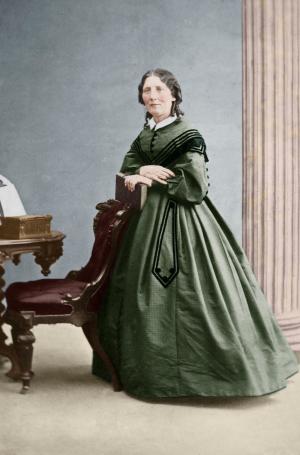
Image result for Harriet Beecher Stowe 
Two Exhibitions--Women of Progress: Early Camera Portraits,  &  Storied Women of The Civil War Era, National Portrait Gallery, Washington, D.C.  June 14, 2019 - May 31, 2020
 
In mid-nineteenth-century America, the growing presence of women in public life coincided with the rise of portrait photography. 

Two exhibition of daguerreotypes and ambrotypes from the 1840s and 1850s features portraits of early feminist icons, women’s rights advocates Margaret Fuller and Lucy Stone, abolitionist Lucretia Mott and best-selling author Harriet Beecher Stowe. 

Image result for Pauline CushmanAlso, during the Civil War era, numerous women rose to national prominence—from First Lady Mary Todd Lincoln to the actress and Union spy Pauline Cushman. This intimate exhibition includes portraits of these and other intriguing women who captivated the public while becoming sought-after subjects for Mathew Brady’s camera. Ann Shumard, the National Portrait Gallery’s senior curator of photographs, is the curator of both exhibitions.
 National Portrait Gallery, Washington, D.C


Friday, June 07, 2019

Women, Pianos and The American Civil War With a Video Clip, Some Humor and a Comment

Image result for woman playing the piano during the American Civil War image

How Musical “Battles” Connected Women to the Violence of Civil War, WQXR radio weblog

To paraphrase historian David McCullough, the Civil War was fought in 10,000 places, from Valverde, New Mexico, and Tullahoma Tennessee, to St. Alban’s, Vermont, and Fernandina on the Florida coast. The battle locations were many, but the conflict was alive beyond the battlefields, too – including parlors across the nation.  The American Civil War saw an explosion of popularity for battle pieces — compositions that invited those on the home front to imagine the events of the war through music, thanks to the power of sonic imagery. They became a regular component of life at the homefront for many (mainly northern), white women. 

In an article for the Summer 2016 volume of 19th Century Music,  Professor Elizabeth Morgan of St. John’s University examines the role these pieces played on the homefront. She traces the genre’s popularity back to 18th-century Czech composer Frantisek Kotzwara’s Battle of Prague.

  “Easily the best-known keyboard work in the genre during the late 18th and early 19th centuries, the Battle of Prague would inspire American works on the Revolutionary, Mexican-American, and Civil wars, often serving as a template for these later pieces, which mimicked its motives, form, and narrative trajectory,” she writes. 

Image result for woman playing the piano during the American Civil War imageAt the height of their popularity, battle pieces and their performance threw into relief several curious relationships and commentaries on gender. Society then, as it still does now, has a tendency to gender instruments.  While 19th-century Americans were theoretically fine with women playing the piano, battle pieces drew more complicated feelings. Morgan cites several satirical references to Kotzwara’s piece in contemporary popular fiction by authors including Edgar Allen Poe and Mark Twain. But mocking Prague wasn’t limited to Americans — Ellen Thorneycroft Fowler’s short story "Wanted, A Wife,"  which includes a protagonist who hates nothing more than a woman at the piano, all because his grandmother played Prague constantly in his youth, and “he had neither forgotten nor forgiven her.” 

Why was it such a focus of derision during a time when battle music was one of the most popular genres for American music publishers? Morgan thinks that, for some, it may have lain in a distaste of program music, where sound is used to represent hard concepts. 

Then there’s the physical embodiment of the performance. Quoting Twain, Morgan argues that it was the “mimetic relationship between battle music and wartime fighting that lent the genre to satire.” The American satirist wrote of the pianist's body, with all the contortions and movements that come with mapping the violence of war on a battlefield onto the violence of music at the piano.

Third, Morgan writes that there could have been discomfort in the way the genre merged public and private life. Battle pieces were considered compositions for women, and by their very nature required performers to imagine themselves in the grisliest of situations. But for many in the 19th-century, this was incomprehensible. “This identification was not always received warmly,” explains Morgan, “but instead that an audience might laugh at a young female performer, implying that she took herself too seriously.”

Image result for woman playing the piano during the American Civil War imageWartime has historically opened employment opportunities to members of society that would have normally been denied them. For example, it was increasingly acceptable for (white) women to be nurses on the front. (The same cannot be said for female doctors). And during the 1860s, there was a surge of women writing music. “Hundreds of female composers published works on topics related to the war,” Morgan writes, and while they weren’t all battle pieces, it was still a significant social shift. “Just as the war made it socially acceptable to be a nurse for soldiers at the front, it also expanded the bounds of propriety to include being a published woman composer.” 

Since it’s program music, Morgan argues that women composers brought a different perspective to the table. For example, Laura Hastings Hatch wrote Battle of the Wilderness in 1869, well after the war’s conclusion — which is significant because, at the time, battle pieces were often published shortly after the events depicted. Morgan also points out that while the genre often illustrated clear victories, the Battle of the Wilderness was a violent affair without a clear victor. The sheet music’s cover, too, lacks victorious imagery; it contains instead broken bodies and tools of destruction. There’s no glory in that music, and Morgan theorizes gender may have had a hand in shaping that perspective. 

It is difficult to imagine that anyone felt the casualties of the bloodiest war in American history more acutely than women at home, she argues, ”many of whom waited for soldiers who didn’t return or who came home permanently altered.” That it proves hard to find a recording of Wilderness, a battle piece that stands in stark contrast to so many others of its day, is maddening.

“War is hell.” That phrase (supposedly) first uttered by William Tecumseh Sherman tells us that the glories of the battlefield and the romance of war are an illusion, a sham. Trauma and violence don’t just stay on the front lines — it made its way back home too, affecting even the day’s entertainment. White women, through music, found themselves tethered to the theaters of war, with some taking advantage of the creative opportunities that arose during the chaos. If anything, these piano “battles” teach us that, whether home or away, it’s nearly impossible to escape the grip of a Republic of Suffering.

There is a reader's comment at the end of the post at WQXR. 

Text Source: WQXR

Tuesday, April 23, 2019

New And Noteworthy: They Were Her Property: White Women as Slave Owners in the American South


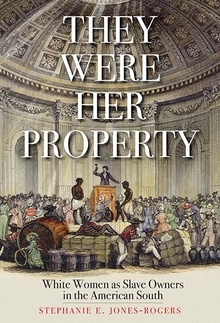
They Were Her PropertyThey Were Her Property: White Women as Slave Owners in the American South, Stephanie E. Jones-Rogers, Yale University Press, 320 pages, bibliographic notes, bibliography, illustrations, index, 2019, $30, hardcover.

From the Publisher: Bridging women’s history, the history of the South, and African American history, this book makes a bold argument about the role of white women in American slavery. Historian Stephanie E. Jones-Rogers draws on a variety of sources to show that slave-owning women were sophisticated economic actors who directly engaged in and benefited from the South’s slave market. Because women typically inherited more slaves than land, enslaved people were often their primary source of wealth. Not only did white women often refuse to cede ownership of their slaves to their husbands, they employed management techniques that were as effective and brutal as those used by slave-owning men. White women actively participated in the slave market, profited from it, and used it for economic and social empowerment. By examining the economically entangled lives of enslaved people and slave-owning women, Jones-Rogers presents a narrative that forces us to rethink the economics and social conventions of slaveholding America.
 
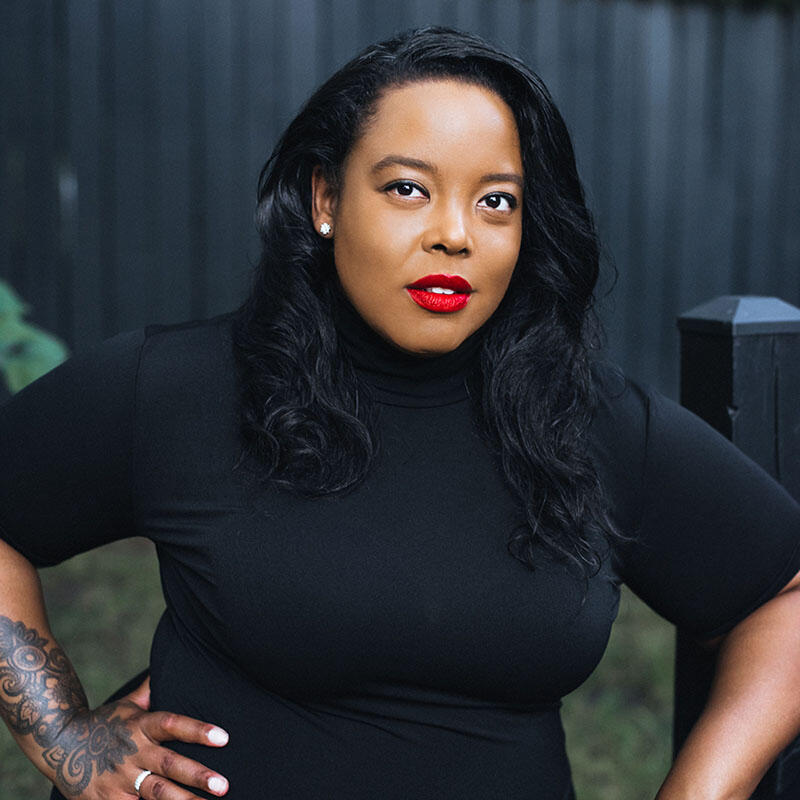
Stephanie E. Jones-Rogers is assistant professor of history at the University of California, Berkeley. She is the winner of the 2013 Lerner-Scott Prize for best doctoral dissertation in U.S. women’s history. She lives in El Cerrito, CA.
 
Christian Century Magazine review by Edward J. Blum (April 18, 2019):  
 
Eva Jones was devastated. The Civil War had left some friends and family members maimed and others dead. Because of economic inflation and stagnation, she could no longer afford some everyday goods. Perhaps most upsetting was emancipation. Before the war, Jones was a member of a prominent southern family and a slave owner. She fumed in a letter to her mother-in-law that the loss of her human property constituted “unprecedented robbery” that would render her “a heap of ruins and ashes.” She lamented the life she would lead when no longer a mistress: a “joyless future of probable ignominy, poverty, and want.”

Stephanie E. Jones-Rogers chronicles the financial realities and choices of slave-owning women like Jones, uncovering a world of women’s participation in the institution of slavery that is often undervalued by other scholars. With an array of evidence ranging from court records to newspaper advertisements, ruminations of slave traders to remembrances of former slaves, Jones-Rogers places slaveholding mistresses at the core of slavery’s economy. These women were perceptive players in the buying and selling of men and women. Rather than passive victims of patriarchy and the system of slavery, they were coconspirators in the economic exploitation of people.
Jones-Rogers shows how young mistresses were cultivated to manage and discipline slaves through childhood education. Some of the training came from parents directly. Girls learned other lessons by watching, even by reading a children’s newspaper. The day when a girl first received legal rights to slaves was a noteworthy occasion, as important as a birthday or other holiday.

Dissecting the way women worked within slavery’s financial world, Jones-Rogers finds no discernible differences between mistresses and masters in their treatment of slaves as property. Both women and men exploited enslaved people for their economic benefit. Curiously, however, Jones-Rogers largely omits discussion of the prevalence and economic consequences of sexual contact between masters and slaves—or between mistresses and slaves.

Professor Stephanie Jones-RogersSlave auctions were considered detestable by many, and a story emerged in the South that women would avoid the tawdry affair of separating families and friends. Jones-Rogers rips apart this fabrication. She shows how mistresses were active participants in the market at every step of the system. They discussed trades within their homes, brought slaves to traders for sale, circulated around the auctions to gather information, and purchased and sold slaves.

In perhaps her most interesting chapter, Jones-Rogers looks at the one arena of slave ownership where white women largely created and defined the market: wet nurses. There were many reasons a mistress might want a slave woman to provide nourishment for newborns. One was to free the mistress from the labor of nursing, especially if she was in poor health. Another was to offer sustenance to enslaved babies. Wet nurses became prized commodities, and they were often regarded as skilled laborers.

Jones-Rogers also investigates how mistresses (like Eva Jones) experienced the collapse of slavery. Many white women did everything in their power to maintain their investments. In New Orleans, for instance, one owner hid a slave in a dungeon. When Union soldiers rescued the young woman, they found that the iron yoke around her neck had rusted and fused onto her skin. Other mistresses went on the run to avoid Union soldiers and thereby keep their slaves. Even when they acknowledged that emancipation had carried the day, many white women continued to press for their financial interests, petitioning the federal government for compensation for their alleged fiscal losses.

Overall, the book makes two points clear. First, women acted in their own best interest financially and socially. They followed the prices and values of slaves; they sold and purchased men, women, and children; and they often kept their finances separate from those of their husbands. Second, women’s slave ownership caused considerable conflict between white people. Husbands frequently wanted to control the assets of their wives, and  parties often ended up in court over matters of slave control.

They Were Her Property will generate significant conversation among historians of the American South and slavery. While it includes ample qualitative evidence (petitions, court cases, recollections, and other textual documents), economic historians may complain that it lacks the quantitative data that would demonstrate mistresses’ monetary im­pact and their power to generate broader social change. Jones-Rogers presents legal and political history, but she rarely includes macro-statistics to place slave-owning women within broad trends and developments.

When she does use such data, her findings are fascinating. For instance, after Congress abolished slavery in the District of Columbia, the federal government offered slaveholders financial compensation. Of the 1,065 slave owners to submit petitions, more than 400 of them were women. One, Margaret C. Barber, owned 34 slaves and Congress paid her almost $10,000. When Congress then allowed African Ameri­cans to sue for their freedom in the district, 42 of the roughly 108 petitioners identified their owners as women. These numbers are probably not representative of the southern states overall, but they should pique the interest of historians. In the moment of emancipation, 40 percent of government involvements with slaveholders and slaves in the nation’s capital dealt with female slaveholders.

In the 1930s, workers for the Federal Writers Project—a New Deal organization dedicated to combating unemployment during the Great Depression—inter­viewed former slaves about their experiences. Jones-Rogers relies significantly upon these interviews, although some historians wonder if they are more useful for understanding race relations in the early 20th century than slavery in the 19th. Since slavery had ended 65 years earlier, many of the interviewees had been children at the time of emancipation. There are also concerns that the interviews are shaped by the influence of white interviewers. Whether the interviews are suitable for the study of slavery, Jones-Rogers puts them to excellent work. She shows that the interviewees understood white women to be part of, rather than subject to, the economic realities of enslavement.

Amid the vignettes of slave-owning women using their power and authority, Jones-Rogers frequently chastises other historians for failing to present southern white women as active players in slavery. The point is important, but it becomes tedious to read repeatedly. If readers simply skip those paragraphs, they will find a gripping story of female businesswomen using their property—in this case, human beings—to make money. These women were not pawns in the racialized nation we still inhabit; they were players.

Full text link to Christian Century review:  Christian Century April 18, 2019
Author's Photograph Source 
Yale University Press Source   They Were Her Property

Friday, March 08, 2013

New and Noteworthy----Maryland's Civil War Women

Maryland Women in the Civil War: Unionists, Rebels, Slaves and Spies, Claudia Floyd, History Press, 160 pp. $19.99

From The Publisher:  On July 9, 1864, young Mamie Tyler crouched in a cellar as Union sharpshooters above traded volleys with Confederate forces. After six excruciating hours, she emerged to nurse the wounded from the Battle of Monocacy. This was life in a border state and the terrifying reality for the women of Maryland. Western Maryland experienced some of the worst carnage of the war, and women turned their homes into hospitals for the wounded of Antietam, South Mountain and Gettysburg. In Baltimore, secessionists such as Hetty Carry fled arrest by Union troops. The Eastern Shore’s Anna Ella Carroll plotted military strategy for the Union, and Harriet Tubman led hundreds of slaves to freedom on the Underground Railroad.

Author Claudia Floyd draws on letters and memoirs to chronicle their stories and present a fascinating and nuanced portrait of Maryland women in the Civil War.

Text Source: History Press

Friday, July 08, 2011

News--Women Military Re-enactors: The Exceptions and The Rules

Women Re-Enact Civil War As Men, Quite Accurately, Associated Press, Citizens-Times, Asheville, NC,July 6, 2011.

Hoop skirts and washboards don't appeal much to Joyce Henry, so she found another way to relive the Civil War — as a man. With her breasts tightly bound, shoulder-length red hair tucked under a shaggy auburn wig and upper lip hidden by a drooping mustache, Henry impersonates Lt. Harry T. Buford, a real-life Confederate soldier.

The impression could hardly be more accurate since Buford, too, was a woman. He was invented by Loreta Janeta Velazquez, a Cuban-born woman from New Orleans who fought as a man in a series of Civil War battles including the First Battle of Bull Run, according to her autobiography.

Researchers have documented more than 200 such cases. And today, a small number of women follow suit by donning blue and gray uniforms as Civil War re-enactors. A century and a half ago, women weren't allowed into military service; masquerading as men was the only way in for those who weren't satisfied with supporting the war effort from home or following their husbands' military units around. As the country marks the 150th anniversary of the War Between the States, some female re-enactors still cling to secrecy — not just for historical accuracy but because uniformed women aren't always welcome in the male-dominated hobby.

Some of these women are easily spotted by their lack of attention to detail. Others go to great lengths and expense to avoid detection. Henry, of Williamsburg, Va.,said she even got an FBI expert to teach her to apply facial hair. "My goal has always been to be as authentic as possible," said Henry, a former Petersburg National Battlefield ranger who is now head coachman at Colonial Williamsburg. She said she has spent nearly $3,500 on her Civil War outfit and gear, including an $850, custom-tailored, gray wool frock coat.

Image Caption: Elizabeth Charlton, right, gets help with her backpack as she prepares to portray a Civil War soldier at a Memorial Day event at Bellevue Cemetery in Lawrence, Mass. [Photo by The Associated Press]

Text and Image Source: Citizens-Times, Asheville, NC,July 6, 2011

Monday, October 19, 2009

Author Speaks: Behind Every Civil War Husband Is . . . .

Why It's Time to Write Wives into the Story of the Civil War, Carol Berkin, History News Network, October 19, 2009.

Carol Berkin is the author of Civil War Wives: The Lives and Times of Angelina Grimke Weld, Varina Howell Davis, and Julia Dent Grant.

In telling the stories of Angelina Grimke Weld, Varina Howell Davis, and Julia Dent Grant I have chosen three women who left behind rich records of their experiences and their thoughts. There were many other wives of famous men whose lives might reveal answers to the questions posed above, but few of them left the letters, diaries, memoirs and public statements that allow us to reconstruct their stories in their own words, without their husbands or fathers as intermediaries. That there are strikingly few such women is in itself an important commentary on our past. .

Through her diary, we can follow Angelina Grimke Weld as she struggles with a slave system that insured her luxury in her native South Carolina; through her published essays and letters, we can see her radical views on gender equality and racial equality emerge; and through her private correspondence, we can share her growing intimacy with Theodore Weld, her complex and often debilitating relationship with her sister, and her struggle to retain her moral compass while others, inside as well as outside the anti-slavery movement, sought to silence her. From Angelina we learn the limits of the abolitionist vision, for few of the movement’s leaders shared her conviction that ending slavery was only a first step toward a greater goal of racial equality. In the post war years, she proved the strength and endurance of her convictions, recognizing as nephews the mulatto sons of her brother and financing their educations.

Varina Howell Davis’s letters to her family and friends show us the difficulties that faced a Southern woman whose brilliance could not be submerged and whose wit could not be contained. Neither her husband, Jefferson Davis, nor most of the Southern matrons of her social class appreciated Varina’s independent mind and outspoken commentary on the public and private circles she inhabited. Her memoirs give us striking insight into the personal foibles and failings as well as the unexpected acts of kindness of congressmen, presidents, and generals, and her recollections of her own suffering and the suffering of others during both the siege of Richmond vividly brings home to us the experience of defeat and dislocation in civil war. In her letters to prison doctors, former abolitionists, newspaper editors, philanthropists, generals, and political leaders, we can follow her dogged campaign to free her husband from prison after the war. Her husband’s approval of her aggressive – and thus, in his view, unfeminine—behavior in this instance provides an ironic commentary on when the rules that govern women’s lives could be broken. Only in widowhood and old age did Varina come into her own: she abandoned the South for New York City, became a writer for the Hearst papers, and reveled in the company of authors, playwrights, artists and academics, all of whom admired her intelligence and wit.
Every record left behind by Julia Dent Grant captures the contentment and self-confidence of a woman who never challenged the social norms that ruled a woman’s life in 19th century America. Her naivete and her lack of curiosity about the larger world around her come through in the memoirs she wrote in old age and in the recollections of all those who knew her well. Alone among these three women, Julia neither attempted to make history nor to understand it; she negotiated the war by reducing it meaning to its impact on her husband, Ulysses S. Grant, her children, and her friends. For Julia, the war was not a constitutional crisis, but a welcome opportunity for her husband to shine; the emancipation of the slaves was not a social revolution or an act of moral conscience but a domestic inconvenience that meant replacing the servants she owned with servants she must pay. Similarly, the scandals that plagued her husband’s presidential administrations were not threats to the nation’s stability but attacks upon her husband’s honor. Yet understanding Julia is important, for she was surely not alone in her response to the crises of her era; like millions of other Americans who did not control, and could not fully comprehend the cataclysmic events they were caught up in, she domesticated the history happening around her.

Angelina, Varina and Julia responded differently to their historical moment and to the norms and values of their race, class, and gender. Each, however, offers us a new perspective on a national narrative most often told in a masculine voice and from a masculine point of view. No matter how intimately their lives were intertwined with those of their husbands, these women narrate the events of their lifetime with a different cadence, and in a different tempo, from these men. And their stories, taken together, help us reconstruct the era of the Civil War with greater depth and complexity.

Complete text is at History News Network, October 19, 2009
Saturday, September 19, 2009

New in Paper---Women, Politics and The United States Sanitary Commission

Civil War Sisterhood: The U.S. Sanitary Commission and Women's Politics in Tranistion, Judith Ann Giesberg, Northeastern Press, bibliography, notes, 256 pp.,$26.00.

The Civil War-era U.S. Sanitary Commission (USSC) was the largest wartime benevolent institution. Judith Ann Giesberg demonstrates convincingly that that generation of women provided a crucial link between the local evangelical crusades of the early nineteenth century and the sweeping national reform and suffrage movements of the postwar period.

Drawing on Sanitary Commission documents and memoirs, the author details how northern elite and middle-class women's experiences in and influence over the USSC formed the impetus for later reform efforts. Giesberg explores the ways in which women honed organizational and administrative skills, developed new strategies that combined strong centralized leadership with regional grassroots autonomy, and created a sisterhood that reached across class lines. She begins her study with an examination of the Woman's Central Association of Relief, an organization that gave birth to the USSC. Giesberg then discusses the significant roles of Dr. Elizabeth Blackwell, Dorothea Lynde Dix, and Henry Whitney Bellows, and considers the rationale for bringing women and men together in a collaborative wartime relief program. She shows how Louisa Lee Schuyler, Abigail Williams May, and other young women maneuvered and challenged the male-run Commission as they built an effective national network for giving critical support to soldiers on the battlefield and their families on the home front. ---publisher's description.

"Although the significant involvement of American women in the reform movements that swept the nation prior to the Civil War and afterward has often been noted in historical studies, women's wartime activity has tended to be ignored. Giesberg (history, Northern Arizona Univ.), the author of several articles on women and the war, presents a study designed to correct this picture. By examining gender differences in the leadership of the U.S. Sanitary Commission, she shows that women thought and acted independently in this highly developed female-driven system of soldier supply and that this activity prepared them for postwar, women-led reform work. Libraries that own Jeanie Attie's Patriotic Toil (Cornell Univ., 1998) and other studies of women's work within this organization may still wish to acquire this book, which offers not only a comprehensive view of female wartime activity but also establishes a link between their prewar and postwar political action. Recommended for larger public and all academic libraries."
-Library Journal review by Theresa McDevitt, Indiana University of Pennsylvania.

Sunday, July 12, 2009

New and Notable---Northern Women, Factory Production, and Battlefield Victory

Army at Home: Women and the Civil War on the Northern Home Front , Judith Giesberg, 256 pages, The University of North Carolina Press, $35.00.

Introducing readers to women whose Civil War experiences have long been ignored, Judith Giesberg examines the lives of working-class women in the North, for whom home front was a battlefield of its own.

Black and white working-class women managed farms that had been left without a male head of household, worked in munitions factories, made uniforms, and located and cared for injured or dead soldiers. As they became more active in their new roles, they became visible as political actors, writing letters, signing petitions, moving (or refusing to move) from their homes, and confronting civilian and military officials.

At the heart of the book are stories of women who fought the draft in New York and Pennsylvania, protested segregated streetcars in San Francisco and Philadelphia, and demanded a living wage in the needle trades and safer conditions at the Federal arsenals where they labored. Giesberg challenges readers to think about women and children who were caught up in the military conflict but nonetheless refused to become its collateral damage. She offers a dramatic reinterpretation of how America’s Civil War reshaped the lived experience of race and gender and brought swift and lasting changes to working-class family life.

Giesberg examines the lives of working-class women in the North, where black and white working-class women managed farms that had been left without a male head of household, worked in munitions factories, made uniforms, and located and cared for injured or dead soldiers. As they became more active in their new roles, they became visible as political actors, writing letters, signing petitions, moving (or refusing to move) from their homes, and confronting civilian and military officials. Giesberg provides a dramatic reinterpretation of how America’s Civil War reshaped the lived experience of race and gender and brought swift and lasting changes to working-class family life.

Victoria Bynum, author of The Free State of Jones: Mississippi's Longest Civil War"In Giesberg's action-packed Civil War study, women risk body and soul to make a living and to protest segregation, conscription, and low wages. These are not teary-eyed maidens waiting out the war with hankies gripped to their throats; they embody home front struggles that paralleled battlefields in transforming U.S. society."

J. Matthew Gallman, author of America's Joan of Arc: The Life of Anna Elizabeth Dickinson "A highly original analysis of how the war affected working-class women and how those women affected the war effort in heretofore underrecognized ways, Army at Home is also a very valuable case study in how to apply larger theoretical insights to the Civil War era."

Text and Image Source: Amazon.com

Reviews Source: University of North Carolina Press

Friday, August 15, 2008

New---The North's Joan of Arc

America's Joan of Arc: The Life of Anna Elizabeth Dickinson, J. Matthew Gallman, 272 pages, 17 illustrations, July 2008, paperback, $16.95.

One of the most celebrated women of her time, a spellbinding speaker dubbed the Queen of the Lyceum and America's Joan of Arc, Anna Elizabeth Dickinson was a charismatic orator, writer, and actress, who rose to fame during the Civil War and remained in the public eye for the next three decades. J. Matthew Gallman offers the first full-length biography of Dickinson to appear in over half a century. Gallman describes how Dickinson's passionate patriotism and fiery style, coupled with her unabashed abolitionism and biting critiques of antiwar Democrats--known as Copperheads--struck a nerve with her audiences.
In barely two years, she rose from an unknown young Philadelphia radical, to a successful New England stump speaker, to a true national celebrity. At the height of her fame, Dickinson counted many of the nation's leading reformers, authors, politicians, and actors among her friends. Among the dozens of famous figures who populate the narrative are Susan B. Anthony, Whitelaw Reid, William Lloyd Garrison, Frederick Douglass, Elizabeth Cady Stanton, and Harriet Beecher Stowe. Gallman shows how Dickinson's life illuminates the possibilities and barriers faced by nineteenth-century women, revealing how their behavior could at once be seen as worthy, highly valued, shocking, and deviant.

"Gallman has made an outstanding contribution to our picture of nineteenth-century gender politics and culture and the pivotal place of Anna Dickinson in that world."--Nina Silber, Civil War History
Source: Text from publisher

Wednesday, June 04, 2008

Research----Worth a Dozen Men: Women, Nursing and Medical Care During the American Civil War; Dissertation In Search of a Publisher

Worth a Dozen Men: Women, Nursing and Medical Care During the American Civil War, Libra Rose Hilde, Harvard University, 2003.

CWL--- I am probably one of a small group who periodically search Dissertation Abstracts to find new scholarship on the Civil War. Also, I am one of a even smaller group who actually borrow dissertations through inter-library loan and read a few chapters of a dissertation just for fun; dissertations are not indexed, so I read chapters. Well, what can I say? I am like that. And yes, I do read the 30+ page bibliographies.

Jane E. Schultz's, Women at the Front: Hospital Workers In Civil War America (2004) looks broadly at women, such as laundresses, cooks, matrons and nurses in soldiers' hospitals during the war. Libra Rose Hilde's dissertation, Worth A Dozen Men, focuses on nursing during wartime. The nursing profession, its ideals and it practical applications provide the focus of the first 130 pages of the dissertation. The social changes which the profession of nursing passed through are presented in the next 400+ pages. The movement of females into the nursing profession, the conflicts male doctors and female nurses, and the emotional support of female nurses for male patients are thoroughly presented.

Hilde's tenth chapter stands as a nice complement to Drew Gilpin Faust's This Republic of Suffering (2008). 'Far From Home and Mother: Death in Civil War Hospitals' begins with Ada Babcock's diary entry. "There was another death . . . he was very much frightened, & I am told wept nearly all day yesterday. I am so sorry I did not know it, I would have gone to him & tryed [sic] to ease his last moments." Also, Chapter 7, Women's work in Civil War Hospitals, stands well by itself. "The traditional female roles shaped middle and upper class women's official duties in the South. Expectations regarding motherhood, domestic nursing, and female sympathy and piety determined a typical suite of unofficial duties that women . . . from ward nurses to chief matrons, added to their daily routine." (p. 315)

"Middle and upper class Southern women frequently lacked experience with the more basic labor involved in their positions. Suddenly place in charge of a kitchen and feeding hundreds of men, Phoebe Pember quickly adapted despite unfamiliarity handling certain types of food. "For the first time I cup up with averted eyes a raw bird . . . .' " (p. 323) The chapters I read frequently use anecdotes similar to Pembers' to illustrate the the point being made.

A small or large publisher, looking for a an item in the Civil War field, would do well to examine Hilde's dissertation for a book length or booklet length publication.

Photo: Nurses and Officers of the U.S. Christian Commission at Fredericksburg, Virginia. Library of Congress

Monday, May 07, 2007

Forthcoming: Women in the American Civil War


Women in the American Civil War, Volumes 1 & 2, Lisa Tendrich Frank, ed., ABC-CLIO Press, November, 2007, $195.00

These volumes provide 400 entries of individuals, organizations, issues and roles of women. Twelve essays address women in the North and South, slave and free, before, during and after the war. The books also include portions of documents, diaries and letters.