Showing posts with label Cotton Trade. Show all posts

Tuesday, May 28, 2019

New and Noteworthy: The Strange Journeys of the Cotton Gin, The Confederate Constitution, The Confederate Gold, The Stone Mountain Memorial, The Boll Weevil and The KKK Among Other Pieces of Georgia History

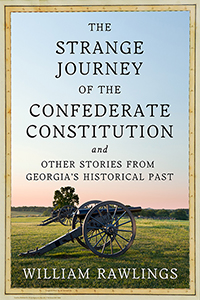
https://www.mupress.org/Assets/ProductImages/9780881466263.jpgThe Strange Journey of the Confederate Constitution and Other Stories from Georgia's Historical Past, William Rawlings, Mercer University Press, 288 pages, 2017, illustrations, maps, bibliographic notes, bibliography, appendix, index, $29.00.

William Rawlings offers a clear and concise collection of essays organized as themes in Georgia history: the cotton gin's actual history, land frauds in colonial and revolutionary era Georgia, the creation and post-war travels of the Confederate States' constitution, what exactly the Confederate gold was and how it was spent and not buried, the creation of the Stone Mountain Memorial [and what was supposed to be but is not on it], and the first, second and third Ku Klux Klans.Also murder trials, fraud trials, and a pastor who shoots a blue jay bird and a chicken.

Rawlings offers an extensive appendix entitled: Exploring Our Past: A Short Practical Guide to Historical Research for Writers which is suitable for aspiring writers, Advanced Placement History students, college graduates and journalists.  Overall, Rawling's The Strange Journey of the Confederate Constitution and Other Stories for Georgia's Historical Past is a superb example of well writing, interesting and insightful state and local history with applications to the nation's story.

From the Publisher: The Strange Journey of the Confederate Constitution and Other Stories f\rom Georgia's Historical Past  is a collection of seventeen articles and essays on topics in Georgia and Southern history. Individual chapters are arranged by era and cover subjects ranging from The Great Yazoo Fraud of the 1790s, to Jefferson Davis and the Confederate Treasure of the 1860s, to the Reign of Terror visited by the Ku Klux Klan in Macon of the 1920s. While academic, the book’s varying topics are aimed at readers with a general interest in the intriguing and often convoluted history of the South. Some articles focus on events, others on people (e.g. Gutzon Borglum or Eli Whitney), and still others on more controversial topics, such as the place of The Birth of a Nation and Gone With the Wind in modern society. The author’s writing style is one that promotes relaxed recreational reading, treating each topic as an unfolding story as the chapter progresses. As a bonus to those interested in research and writing about historical subjects, the Appendix contains advice in the form of “A Short Practical Guide to Historical Research for Writers.”

Monday, June 30, 2014

New and Noteworthy---Illegal Arms Trade With The Confederacy, Illegal Cotton Trade With the United States

Trading With The Enemy: The Covert Economy During The Civil War, Philip Leigh, Westhome Publications, 183 pp., illustrations, tables, bibliographic notes, bibliography, $26.00.

Using clear and concise language, Philip Leigh cogently explains how the world's cotton market on the eve of the Civil War provoked Northern fears of its own economic collapse.  In 1860, cotton textile manufacturing was the planet's largest industry and it was dependent on the South. Northern manufacturing and the U.S. export trade was dominated by the annual cotton crop.  If the South when it became the Confederacy did not trade with the North then textile mills would become idle and the balance of payments abroad would become unfavorable for North.

Yet, the South would also be diminished by a trade embargo with the North. Wheat, corn, pork and a wide variety of manufactured items would be denied the Confederacy. With gold flowing out of the U.S. treasury, cotton became essential because one in Northern hands it could be exported in exchange for credits in Europe. Both Lincoln and Davis realized that inter-sectional trade would exist and very little could be done to prevent it.  Davis turned a blind eye to it; Lincoln sought to develop a policy that would cultivate it.

The 1862 Port Royal South Carolina effort encouraged African-Americans raised cotton on deserted plantations. The Red River and Olustee military campaigns were conducted to seize cotton. When New Orleans and Memphis fell to the Union both cities became gateway cities for cotton coming out of Louisiana and Mississippi. Also, with the fall of New Orleans the cotton trade migrated to Galveston, Texas and Matamoros, Mexico. Then the French involvement in Mexican politics was moved to the front burner in Seward's State Department. When Norfolk, Virginia and Vicksburg, Mississippi fell into Federal hands, other routes of cotton coming out of  the South opened up. Licenses to trade for cotton were granted to Northern merchants who dealt with the commanders of captured cities.  It was not a coincidence that Benjamin Butler commanded both New Orleans and Norfolk while serving in the army.

The U.S. treasury granted the buyer permits and demanded that those shopping for cotton pay with newly printed greenbacks and not gold. Hopefully, greenbacks would be currency in the Confederacy and undermine Southern home front loyalty. Yet in practice, whichever buyer had gold was the first one in line to buy the cotton made available by military expeditions and planters bring their cotton to market in a Federally captured city.

The passage of cotton via blockade runner to the Bermuda and Bahama Islands, as well as Havana, Cuba is thoroughly presented by Leigh.  He notes that much of this cotton was taken to Halifax, Nova Scotia, repackaged/rebranded and sold to Boston and New York textile merchants.  Did the New England and Mid-Atlantic textile merchants pay in weapons and medicine or know that their payments would be used to buy military arms and medicines?  Leigh finds that, in fact, merchants did.  

Leigh well documents his findings and supports in conclusions. With a writing style that is marked by clarity and precision, he presents information that is unfamiliar to most general readers of Civil War literature.  Yet, without a doubt, what the author offers is an articulate and thoughtful re-examination of Northern merchants complicity in a necessary evil, that of trading with the enemy during a civil war.

Philip Leigh is a regular contributor to the New York Times Disunion Civil War series and the Civil War Monitor. A professional writer, he holds an engineering degree from the Florida Institute of Technology and an MBA from the Kellogg School at Northwestern University. He most recently edited a new edition of Co. Aytch, or a Side Show of the Big Show by Sam Watkins, also available from Westholme Publishing. Additionally, Leigh edited and added illustrations to Three Months in the Southern States, by Arthur J. L. Fremantle.