Showing posts with label Shenandoah Valley Farmers. Show all posts

Wednesday, May 12, 2010

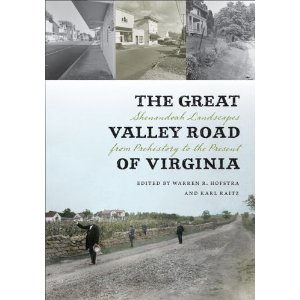
New & On The Library's Shelves---The Great Valley Road of Virginia In The Heart and Mind

The Great Valley Road of Virginia: Shenandoah Landscapes from Prehistory to the Present, Warren R. Hofstra et al., University of Virginia Press, 320 pages, extensive maps, photographs, charts and illustrations, notes, index, 2010, $50.00.

The Great Valley Road of Virginia contains historic landscapes from frontier to modern times. It is not a coffee table book but is an fine combination of academic history and popular culture. An accessible narrative with a foundation of solid research in local, state and regional documents contains much on the American Civil War and ranges from the Shenandoah Valley's prehistory to the presetn.

Native Americans had used this great Appalachian valley for kinship and commerce travelling before Europeans began their settlements. A segment of a path that began in southeastern Pennsylvania and ended in northern Georgia, the Valley Road was essential to Native American communities. Americans used the Valley Road as a route through the Cumberland Gap to Tennessee and Kentucky.

When the Valley Road became a turnpike and played a vital role in the economic and social life of Virginia and the South before the Civil War. During the war it was the focus of two great Confederate military campaigns: Jackson's in 1862 and Early's in 1864. After the war the Valley Road was essential to the recovery of western Virginia. US Route 11 and Interstate 81 now carry the traffic.

There are eight chapters in the book; the 30 page fifth chapter that covers 1836 to 1865 is entitled 'Strategy and Sublimity: A Gallery of Valley Pike Images during the Civil War'. There are 24 illustrations selected by an associate professor of art; the text is written by an associate professor of history. Both are on the faculty of at Shenandoah University in Winchester, Virginia. For anyone who reads and studies Civil War history, The Great Valley Road of Virginia: Shenandoah Landscapes from Prehistory to the Present offers much in every chapter. The mindset aand cultural heritage of Virginia troops from the Shenanhoah Valley is revealed on nearly every page. CWL recommends this book to those who wish to understand what Virgina's western soldiers brought to the war.

To Find Out More: Great Valley Road

Monday, August 11, 2008

New In August: Jackson and the Shenandoah

Shenandoah 1862: Stonewall Jackson's Valley Campaign, Peter Cozzens, University of North Carolina Press, 13 illustrations, 13 maps, 640 pp., notes, index, bibliography, $35.00

From Publishers Weekly:
Cozzens (The Darkest Days of the War) is an independent scholar and a master of Civil War military history at tactical and operational levels. He deploys a large body of unfamiliar primary material in this detailed analysis of a campaign less one-sided than the accepted view that it represented Union blundering and the triumph of Confederate planning and execution signaling the emergence of one of history's great generals, Stonewall Jackson. Without debunking Jackson, Cozzens describes a commander still learning his craft. Jackson's obsession with keeping his strategic intention to himself too often left his subordinates confused. As a tactician he tended to commit his forces piecemeal. The Union generals opposing him performed reasonably well in the context of divided command, inadequate logistics and constant micromanaging by Abraham Lincoln. In particular the president's concern for Washington's safety led him to withhold troops from McClellan's Peninsular Campaign—a decision Cozzens reasonably says enhanced McClellan's natural caution. Jackson's victories revitalized a Confederacy whose morale was at its lowest after a string of Union victories. The South now had a new hero, whose personal idiosyncrasies and overt religiosity only enhanced his appeal.

From Library Journal:
A compelling chronological and bilateral narrative of the entire campaign from March to June 1862. Using primary source materials from both sides, Cozzens offers new interpretations of the campaign and of Stonewall Jackson's legendary success, which was not nearly as brilliant as it appeared but was as much the result of Union failure as the triumph of Southern arms. . . . Jackson's errors are covered here, as are those of a succession of Union commanders, all really learning their trade in these early stages of the war. Sure to become the standard work on the campaign, this book is strongly recommended.

From The Publisher:
In the spring of 1862, Federal troops under the command of General George B. McClellan launched what was to be a coordinated, two-pronged attack on Richmond in the hope of taking the Confederate capital and bringing a quick end to the Civil War. The Confederate high command tasked Stonewall Jackson with diverting critical Union resources from this drive, a mission Jackson fulfilled by repeatedly defeating much larger enemy forces. His victories elevated him to near iconic status in both the North and the South and signaled a long war ahead. One of the most intriguing and storied episodes of the Civil War, the Valley Campaign has heretofore only been related from the Confederate point of view. With Shenandoah 1862, Peter Cozzens dramatically and conclusively corrects this shortcoming, giving equal attention to both Union and Confederate perspectives.

Based on a multitude of primary sources, Cozzens's groundbreaking work offers new interpretations of the campaign and the reasons for Jackson's success. Cozzens also demonstrates instances in which the mythology that has come to shroud the campaign has masked errors on Jackson's part. In addition, Shenandoah 1862 provides the first detailed appraisal of Union leadership in the Valley Campaign, with some surprising conclusions.

Moving seamlessly between tactical details and analysis of strategic significance, Cozzens presents the first balanced, comprehensive account of a campaign that has long been romanticized but never fully understood.

Peter Cozzens is an independent scholar and Foreign Service officer with the U.S. Department of State. He is author or editor of nine highly acclaimed Civil War books, including The Darkest Days of the War: The Battles of Iuka and Corinth.

CWL:
Cozzens, diligent researcher in federal, state, regional archives and personal collections, has produced many works on the western military campaigns of the Civil War. At times, he uses striking first person accounts of battle; at other times, Cozzens writing style can be dense. In his book on Chickamauga, there was one paragraph that was a page and a half long and included mention of 14 different brigades. For readers working through the western campaigns, Cozzens works are is essential. CWL recommends that previous to beginning one of Cozzens books, readers should be already familiar with the battle through a tour book, such as those published by the University of Nebraska Press.

Also, Stonewall in the Valley: Thomas J. Stonewall Jackson's Shenandoah Valley Campaign, Spring 1862 by Robert G. Tanner was issued in the 1976 and reissued with additional research in 1996. It is recognized as the current standard on the topic. A writer of Cozzens stature may raise the bar above Tanner's esteemed work.

Tuesday, November 06, 2007

CWL---The Confederacy's Self-Inflicted Wound: Cleaning Out the Shenandoah in 1861

The Shenandoah Valley of Virginia, Michael Mahon, in Virginia At War, 1861, William C. Davis and James I. Roberston, Jr., University of Kentucky, 2005, pp. 131-148.

With the Blue Ridge Mountains on the east and the Allegheny Mountains on the west the Shenandoah River runs from the southwest and towards the northeast. Lynchburg lies at the southwest end and Harper's Ferry lies at the northeast end. Long but narrow, the valley was and still is an agriculturally very productive region of Virginia.

During the secession crisis of December 1860 through April 1861, most Valley citizens opposed secession and sent like-minded representatives to the secession convention in Richmond during the February through April meeting. Only four secessionists were among the 19 representatives from the Valley's voting districts. Lincoln's election and the secession of the lower South did not have the impact in the Valley districts as the events had in the Tidewater districts. The Republicans refusal to compromise on the extension of slavery became the wedge issue employed by the pro-secession delegates to nudge the state towards secession and were confident that Virginians would not move away from support of the new Confederacy.

Two major factors were responsible for unionism being so wide spread in the northern counties of the valley. The Baltimore and Ohio Railroad was the largest employer in this part of the valley and the politicians of Martinsburg guarded its regional economic impact. In addition, Winchester had a significant minority of Unionists and did northeastern (lower valley) counties of Berkeley, Clarke, Frederick and Jefferson counties had Unionist slight majorities or strong minorities.

The ascendancy of the Confederacy in these counties is directly related to the presence of Confederate forces. Troops under the command of Jackson during April, May and June. During this time 6,500 Valley men were organized into the 2nd, 4th, 5th, 27th, and 33rd Virginia regiments which later were recognized as the Stonewall Brigade. Though all state politicians in Richmond believed that the lower (northeastern) valley should be held by the Confederacy, Johnson and other military leaders believed it was indefensible. Tactically, the Winchester area was the further point of practical military defense. The fear that Union occupation of the Valley propelled Richmond leaders, Samuel Cooper in particular, ordered Johnson to strip the Valley of foodstuffs in 1861.

Wells J. Hawks, lifelong resident of the region and former mayor of Charlestown, became the chief commissary officer of Jackson's troops. By May, Hawks and his staff denuded the Winchester region of corn, oats, wheat and flour, as well as beef, pork and vegetables. By the end of 1861, Hawks reported to his superiors that he had purchased 1,300 barrels of flour and could obtain another 5,000 barrels during the winter months. Also in December Adjutant General Cooper telegraphed Major John Harmon, Jackson's quartermaster, that the Virginia Central railroad would be unable to transfer troops from the Valley to Manassas because all its cars and engine were transferring supplies.

In addition to selling the agricultural produce of their community, Valley citizens generated income by offering clothing, medical care, and horses to the Confederacy. The economic prosperity of the region increased as prices increased. Businesses not related to military demands took downturns in their gross sales and net profits; furniture and cabinet makers, jewelers and clothing retail stores suffered. Local residents realized both economic advantages and disadvantages; any business relating to taking care of soldiers was profitable and any business unrelated to taking care of soldiers was prostrate. Ironically, the cost of farm labor increased in the summer of 1861 which in turn diminished net returns on agricultural goods. There were less than 200 adult slaves in Shenandoah County, and local residents complained to state representatives that soldiers must be sent home to harvest the July, August and September crops.

Farm families struggles became acute when not only labor was scarce but also the heavy livestock used in the harvest became rare. Military impressment of teams of horses and oxen caused resentment toward the military. Even teams that were needed to transports those Southerners fleeing from Harper's Ferry, Martinsburg, Shepardstown, Charlestown, and Berryville were hard to find and when available they were costly. As the war progressed, coffee, tea, sugar and salt were in shortage supply and their prices spiraled upward. The price of coffee doubled in August, rising from 25 cents to 50 cents a pound; the price of salt nearly quadrupled from 8 to 30 dollars a pound. "Our winter will, I fear, will be rather a hard one," wrote Julia Chase of Winchester. From the firing on Fort Sumter to the fall of 1861, economic prosperity and depression, and rising prices and rising costs, as well as the emotional shock of losing adult males on the battlefields and campgrounds, Southerners in the Valley were being afflicted by shortages of commodities and heartaches of losing kin. The empty cupboard and the vacant chair were becoming common in Valley households.