Monday, December 01, 2014

New And Noteworthy---Montana's Confederate Heritage

Confederates In Montana Territory: In The Shadow of Price's Army, Ken Robison, History Press, 192 pp.,49 illustrations, 4 maps, index, chapter bibliographies, $19.99. 

Montana was not an organized territory until the spring of 1864 and was over a thousand miles away from military operations in Kansas and New Mexico. During the first three years of the war the region that would become Montana was divided between the territories of Washington, Idaho and Dakota. During the war there were those Confederate soldiers that deserted or Confederate civilians who drifted into this region. In the southwest area one community wished to name itself Varina, in honor of Varina Davis, the wife of  the Confederate president. This was dismissed by a regional judge who was a native of Connecticut but did allow a substitute name, Virginia. In 1862, gold was discovered in the region and one strike was named Confederate Gulch. Such loyalty issues arose and caught the attention of Unionists in the region who brought it to the attention of the national government which remedied the situation by creating the Montana Territory.

Ken Robison, the author of Confederates In Montana Territory is a Montana native, historic preservationist, newspaper columnist, historian and retired captain of the U.S. navy's intelligence branch. He has authored four other books on Montana's early history and a frequent contributor to the Montana: The Magazine of Western History and other regional journals.

Confederates In Montana Territory: In The Shadow of Price's Army offers detailed and entertaining stories regarding Confederate veterans commanded by William Quantrill,  Bill Anderson, Nathan Bedford Forrest and John Mosby. Robison's focus includes particular cavalry regiments and the unique adventures that the Confederate veterans experienced during the war. The Moore brothers accompanied Jefferson Davis during his flight from Richmond, Virginia; others were veterans of the Confederate Marine Corps. Robison uniquely captures the lives of former slaves who migrated to Montana during and after the war. His work is a biography driven account of Confederate soldiers, civilians and contrabands living together on western frontier.   Confederates In Montana Territory: In The Shadow of Price's Army offers a clear and concise account which is a fine example of local and regional historical research done well.


Wednesday, November 26, 2014

News---The Sensory Experience of the Civil War: Battles, Sieges and The Bloated Bodies

 Experiencing War Envelops All The Human Senses, Even Taste, Renee Standera, WISTV,  Report from Columbia, SC.

The sensory experience of the Civil War is the subject of a new book written by University of South Carolina Distinguished Professor Mark Smith. It's titled The Smell of Battle, the Taste of Siege. "My aim here...is to add texture to the experience of war," he said. "What did it mean? How did it feel?"

From the first shots at Fort Sumter, to the Hunley submarine and the burning of Columbia, South Carolina is featured throughout the book.  "My thinking was to identify a very well-known event during the Civil War and then look at the sources. What do the sources say about the sensory experience of that event?" he said.

Each sense is related to an incident in the Civil War. It opens with the sense of sound related to the firing on Fort Sumter in 1861. "The war literally began with a bang in South Carolina...This was the first time that people had heard the sound of war, for many, many years at least. That's what they commented on."

The first battle of Bull Run represents the sense of sight. "First Bull Run was principally a conversation and an event about confusion. Visual confusion," he said. "Troops at this point in time had not adopted gray or blue, so there were Confederate troops wearing blue. There were Union forces wearing gray. This caused enormous confusion on the battlefield."

Smith used the battle of Gettysburg to represent the sense of smell. "More people died in those hills than any other battle. So many, in fact, that the technology of death outpaced the technology of burial," said Smith. "They couldn't bury the corpses fast enough. And, as a result, on those hot July days, those dead bodies started to reek."Death could be smelled for miles. Death could be smelled for weeks."

The Union siege of Vicksburg represents the sense of taste. "The siege was simply designed to starve people into submission and that's precisely what Grant did at Vicksburg," Smith said. "At the beginning of the siege Southerners -- white Southerners at least -- ate well. Ate plentifully. By the end of the siege, there had been in revolution in their palate. They ate anything they could find. Once proud, they were reduced to eating morsels, scraps fit only for animals."

The sense of touch was represented by the C.S.S. Hunley. "Poignantly, the eight men who died in that submarine died at their posts," he said. "They didn't try to clamber out of their seats and they died alone. They died without human touch and it took over a hundred years for them to be touched again by another human being."  

Smith wraps all the senses into the Union Army's occupation of Columbia and the city's subsequent burning. "Their presence changed the sensory landscape of Columbia. The noises were unprecedented. The smells of thousands of troops--their garbage. Their refuse. And then the smell of a burning city and civilization evaporating on a cloud. And then they left and the city didn't even look the same any longer."

Smith is a leading expert in Civil War History and the senses. The History Channel has requested an interview with him regarding the subject. "If you don't pay attention to the role of smell, the role of touch, the role of sound, taste, including visual, then you come away with a very antiseptic view of war,"Smith said. "Almost a...a view of war that suggest it wasn't painful. That somehow it was simply an honorable act."

Text Source:  WISTV.com

Monday, November 17, 2014

New and Noteworthy---Soldiering For Freedom: Clear, Concise, Cogent and Accessible

Soldiering For Freedom: How The Union Army Recruited, Trained and Deployed the U.S. Colored Troops, Bob Luke and John David Smith, Johns Hopkins University Press, 131 pp., 12 b/w images, bibliographic notes, bibliography, index, $19.95.

Soldiering For Freedom: How The Union Army Recruited, Trained and Deployed the U.S. Colored Troops is a superlative introduction to the USCT for advanced placement high school and undergraduate students. Basic information is providded on the raising of African American troops, the Bureau of Colored Troops, contrabands, discrimination, the 54th and 55th Massachusetts Volunteer Infantry, and Abraham Lincoln. Additionally, the narrative offers an addresses the issues of race, soldiering, emancipation, nationalism, citizenship.   Overall, Soldiering For Freedom is clear, concise, cogent and accessible to students and general readers.

Wednesday, November 05, 2014

New and Noteworthy---The Confederate Raid Into Vermont: The Setting, The Raid, The Trials

The St. Albans Raid: Confederate Attack on Vermont, Michelle Arnosky Sherburne, The History Press, 191 pages, appendix, bibliography, index, 37 illustrations, 3 maps, $19.99.

On the same day as the Battle of Cedar Creek, Virginia,  there occurred a controversial raid from Canada into Vermont by Confederate soldiers. The goal was to rob banks in retaliation for Sheridan's burning of the Shenandoah Valley and hopefully draw Federal forces from Virginia and defend the Canadian border.

Bennett Young, a Confederate cavalryman who had been captured during Morgan's 1863 Raid, imprisoned  then escaped, led the one day assault. His 1863 escape led him to Canada where he met Confederate sympathizers. His return to the Confederacy gave him the opportunity to request permission to return to Canada as a lieutenant and rob American banks. Shortly before 3 p.m. on October 19, Bennett and over twenty conspirators  initiated simultaneous robberies of St. Albans'  three banks. They identified themselves as Confederate soldiers and took a total of $208,000  which is a little over 3 million dollars in current value. During the robberies, eight or nine Confederates held the villagers at gun point on the village green, then stole their horses to prevent pursuit. Those Vermonters who chose resistance were killed or wounded. Young ordered his men to burn the city, but the four ounce bottles of sulfur, naphtha and quick lime they attempted to use did not ignite.

Michelle Sherburne's The St. Albans Raid: Confederate Attack on Vermont presents a clear and concise introduction to U.S.-Canadian relations during 1863 and 1864, the Confederate Secret Service in Canada, and the goals of the raid. The robberies and treatment of the civilians are well described as is the rescue of the town by discharged Vermont veterans and others. The Confederate invaders were captured, tried and found guilty but Canada, being neutral, did not extradite the criminals. Sherburne cogent description of the proceedings take into account of the impact of the trials on the relations between the two countries. She acknowledges gaps in the story due to the lack of documents and does not over-dramatize events.

One of The St. Albans Raid: Confederate Attack on Vermont several strengths is the inclusion of the photographs of many artifacts, portraits, weapons, bottles of Greek fire and buildings such as court houses and prisons.Sherburne's work is a fine example of local history well researched and well written.


Sunday, November 02, 2014

New and Noteworthy--Lincoln, An Episcopal Priest, Bureaucratic Corruption And 300 Sentenced To Be Hanged

Lincoln's Bishop: A President, A Priest, Ant the Fate of 300 Dakota Sioux Warriors, Gustav Niebuhr, Harper One/Harper Collins Publishing, 210 pp., four b/w images, bibliographic notes, bibliography, index, $26.99.

The Dakota War of 1862 began on August 17 in southwest Minnesota and ended with the mass execution of 38 Dakota tribe warriors on December 26, 1862. Throughout the late 1850s, treaty violations, unfair annuity payments and bureaucratic corruption by Federal government agents caused destitution and starvation among the Dakota tribes.

In early December, my military court 303 Sioux prisoners were convicted of murder and rape sentenced to death. Some trials were conducted without defense attorneys; other trials lasted less than five minutes. Abraham Lincoln reviewed the court proceedings and commuted the death sentences of 264 prisoners and allowed the execution of 38. Lincoln received the counsel of Henry Benjamin Whipple, a native of New York, a missionary priest to Chicago, an elected first Episcopal bishop of Minnesota, did not meet a Native American until he was 37 years old.

Whipple met and respected the Dakota Sioux, watched and learned first had the corruption of the Federal Office of Indian Affairs. By letters and a visit to Washington D.C., he informed the President that the agency was corrupt, the agents were political hacks,, the vendors were greedy providers of illegal alcohol and abusive of Native American women. At stake for Whipple was not only an injustice but an offense to religious principles that demanded aggressive resistance. By 1860 he began a letter writing campaign that described the problems and proposed remedies.

The 15th President,James Buchanan did not respond; the 16th President did. After a face-to-face interview of Whipple, Lincoln mentioned to a friend that Whipple's testimony had 'shaken him down to his boots.'  Whipple organized other bishops, who by virtue of their habits, were reluctant to speak out on the issues of public issues, even those issues of slavery, secession or politics.

In Lincoln's Bishop, Gustav Niebuhr carefully offers evidence of Whipple's investigation and engagement with politicians regarding the Dakota Sioux.  Niebuhr is a professor of newspaper and online journalism, the founding director of the Carnegie Religion and Media Program, and winner of awards for the reporting of religion.  Lincoln's Bishop offers a clear and concise narrative supported by primary sources. It moves briskly does not stray away from the central features of the story. Currently 'telling truth to power' is often a slogan to justify personal self absorption, narcissism and self promotion.  Niebuhr's work offers the story of one man's  'telling truth to power' as selfless and motivated by the gospel.


New And Noteworthy---Gettysburg: The Origins and Changing Meanings Of Preservation Efforts


Product Cover

On A Great Battlefield: The Making, Management, and Memory of Gettysburg National Military Park, 1933–2012

by Murray, Jennifer
Publisher: University of Tennessee Press
Retail Price: $49.00
Issue: Fall 2014
ISBN: 1621900533

On what is likely the most consecrated 6,000 acres of the United States landscape, is the Gettysburg National Military Park. Timothy B. Smith in The Golden Age of Battlefield Preservation: The Decade of the 1890's and the Establishment of America's First Five Military Parks [2008] addressed the creation of Gettysburg, Chickamauga and Chattanooga, Shiloh, Antietam, and Vicksburg parks during a particular decade. By the 1890s, the regional bitterness engendered by political combat created by Reconstruction had subsided. The decade was ripe for veterans from both sides, in a spirit of brotherhood, to reconcile and remember the war. The battlefield sites were for the most part unmarred by urban or industrial development. Smith examines the process of battlefield preservation and focuses on the preservation and interpretation of each of these sites.

Generally, historians have paid limited attention to Gettysburg battlefield’s history though thousands upon thousands of efforts have been made to describe and explain the battle and campaign. In both This Is Holy Ground: A History of the Gettysburg Battlefield by Barbara L. Platt [2001] and Gettysburg: Memory, Market, and American Shrine by Jim Weeks [2003], the authors addressed the extent by which preservation and interpretation were challenged by periodic bouts of tourism and commercialization. Additionally during these decades, the glacial eroding of the founding premise of the national military parks occurred. Since the centennial commemoration, the climate of opinion regarding the validity of the Lost Cause interpretation and the rise of understanding the battle in the context of American race relations has prompted the National Park Service to accept changes to its preservation and interpretation of the sites.

On A Great Battlefield: The Making, Management, and Memory of Gettysburg National Military Park, 1933-2013, Jennifer Murray offers a unique, and some may say an insider understanding of the changes that have occurred at the park. She worked for nine seasons at Gettysburg as an interpretive ranger while completing college and graduate school. She understands that the battlefield, its preservation and its interpretation has been in a continual state of transformation over 150 years.
Neither the battlefield landscape nor its interpretation has remained static. Events, such as the passing of Civil War veterans, the invention of the automobile, the Great Depression, the Second World War, the rising of the civil rights and environmental movements have had significant impacts. The battlefield’s initial preservation and memorialization [1863-1895], as well as its development by both the War Department [1895-1933] and the Department of the Interior [1933 to present], has played significant roles in making Gettysburg what it is today. The current $105 million visitor center with the restored cyclorama painting is nestled in a landscape which is being sculpted to be more and more like it was in July 1863.

Murray has organized the story chronologically. The first chapter, ‘We Are Met On A Great Battlefield’ begins with the internment of the dead immediately after the battle on 12 acres adjacent to the 5 year old Evergreen Cemetery. The founding of the Gettysburg Battlefield Memorial Association, along with the private purchases by veterans of land on which their unit fought, set in motion the preservation of the site for the purpose of remembering the valor of the soldiers. Frequent mapping of the battlefield by military staff and historians and the enabling legislation encouraged landholders to turn over their private property to the government in 1895.

The second chapter ‘We Cannot Hallow This Ground’ introduces the impact of tourism by automobile, the creation in 1916 by Congress of the National Park Service, New Deal politics, and the 1938 seventy-fifth anniversary commemoration. Each of these moved the park toward the “. . . promotion of the battlefield’s scenic features, landscape beautification efforts and a tendency to view Gettysburg not exclusively as a memorial battlefield , but as a park . . . (40).”

The next nine chapters describe the issues surrounding the development of the park between 1941 and the current day. During the Second World War the National Parks were requested to give up extra cannon, iron wayside plaques and iron fences to the war effort. Post war tourism, patriotism and commercialization changed the public perceptions of what Gettysburg was and what it should become. In the mid-1950s significant impacts came through the 1956 Federal Highway Act which funded the construction of 41,000 miles of highways and the Mission 66 initiative that evolved as a manifestation of the National Park’s “long-standing tradition to promote recreational tourism (80).” The Mission 66 initiative begat a visitors’ center that would later become the focus of interpretive issues and conflict of philosophies. Would the park be a battlefield, a memorial garden, or a tourist destination? “The site and design for the visitor center demonstrated the Park Services’ efforts to modernize the battlefield and provide visitor access” and “place convenience over preservation (85).”
As the centennial of the battle approached, the Cold War was well underway and molded domestic issues. Additionally, the nascent modern civil rights movement contrasted dramatically with the Lost Cause movement while the battle was commemorated. Murray sets forth the case that the battle, which had been described as the High Water Mark of the war, may have also provided a centennial that could be considered the high water mark of the Lost Cause explanation of the war.

She understands that the centennial observances of the Civil War “aptly demonstrate the dominance of the ‘heritage syndrome’ and a tendency to remember and glorify the soldiers, commanders and battles without engaging in a meaningful discussion of the war’s causes or consequences (113).” The centennial commemoration during the 1960s generated friction within the interpretations of the 1863 military campaign, the battlefield and the civilian lives in Gettysburg and Adams County.

Discord occurred over the building during 1958-1962 of a visitors center designed by Richard Neutra and located in an area that was the destination of the Grand Assault of July 3. Negative public comments were uttered frequently in the mid-1970s as the National Tower, 307 foot high elevated observation deck was being constructed upon land deemed by many to be sacred and very close to George Meade’s headquarters. The land swap between Gettysburg College and the National Park Service added heat to the simmering issues related to landscape preservation, visitor access and community desires. Between 1989 and 1991 history as a means of telling a story became extremely politicized. The demise of the Soviet Union, the Enola Gay exhibit at the Smithsonian Institution, the attempt of the Disney Corporation to create and history themed commercial park produced newspaper headlines. The film Glory and Ken Burn’s The Civil War generated an uncommon amount of public discussion regarding American history.

In 1998 the National Park Service released a draft of a general management plan for the park. At this time the Memorial-Commemorative Landscape philosophy of the 1950s-1980s came into conflict with a Battle-1863 Landscape philosophy of the 1990s. The General Management Plan provided a framework for decisions regarding the battlefield landscape [1863], the memorial landscape [1880s-early1900s] and visitor access [post Second World War].

Throughout the book, Murray sets forth generalizations concerning who is visiting the battlefield and their expectations when they get there. Her access to Gettysburg National Military Park’s [GNMP] archives is one of the chief strengths of the book. Notable is the author's attention to significant details from the wealth of data within the GNMP archives. At times institutional histories may be very difficult and less than exciting to read, but On A Great Battlefield never is. Murray offers a lucid and concise history of 150 years of preservation, interpretation, and commemoration at Gettysburg. Her writing style is precise, not wordy, and excludes stories and anecdotes that are non-pertinent to the clearly offered themes of each chapter. Murray’s work is a significant addition to both the history of the Gettysburg battlefield and the field of public history.

CWL: This book review originally appeared in Louisiana State University's Civil War Book Review, Fall, 2014.

Monday, October 20, 2014

New and Noteworthy---What Today's West Point Students Should Know About The Civil War


The West Point History of the Civil War Hardcover, The United States Military Academy, Colonel Ty Seidule and Clifford Rogers,  Simon and Schuster Publishers, 448 pp., bibliographic notes, images, index, $55.00

Publisher's Blurb:  The definitive military history of the Civil War, featuring the same exclusive images, tactical maps, and expert analysis commissioned by The United States Military Academy to teach the history of the art of war to West Point cadets.

The United States Military Academy at West Point is the gold standard for military history and the operational art of war. West Point has created military history texts for its cadets since 1836. For the first time in over forty years, the United States Military Academy has authorized a new military history series that will bear the name West Point. That text has been updated repeatedly, but now it has been completely rewritten and The West Point History of the Civil War is the first volume to result in a new series of military histories authorized by West Point.

The West Point History of the Civil War combines the expertise of preeminent historians commissioned by West Point, hundreds of maps uniquely created by cartographers under West Point’s direction, and hundreds of images, many created for this volume or selected from West Point archives. Offering careful analysis of the political context of military decisions, The West Point History of the Civil War is singularly brilliant at introducing the generals and officer corps of both Union and Confederacy, while explaining the tactics, decisions, and consequences of individual battles and the ebb and flow of the war. For two years it has been beta-tested, vetted, and polished by cadets, West Point faculty, and West Point graduates and the results are clear: This is the best military history of its kind available anywhere.

Table of Contents: 

Introduction: The West Point History Of The Civil War, Ty  Seidule

1. The Origins Of The Civil War And The Contest For The Borderlands, Mark E. Neely Jr. 

2. The War In The East: July 1861-September 1862, Joseph T. Glatthaar

3. Lee's War In The East, Joseph T. Glatthaar

4. Grant's War In The West, Steven E. Woodworth 

5. Coordinated Strategy and Hard War, Earl J. Hess

6. The End Of The Civil War And Reconstruction, James K. Hogue

Wednesday, October 15, 2014

News--- Found On Ebay: Photograph of R. E. Lee's Slaves Found At Arlington House

Slave Photo From Robert E. Lee's Home Discovered On Ebay, Fox News.coma and the Associated Press, October 12, 2014.

National Park Service curator Kim Robinson holds the photo of Selina Gray, right, who was in charge to care for Arlington House where Gen. Robert E. Lee had lived in for 30 years, Thursday, Oct. 9, 2014, at Arlington National Cemetery in Arlington, Va. The National Park Service has acquired a rare Civil War-era photograph of an enslaved woman at Confederate Gen. Robert E. Lee's home in Virginia. The previously unknown photograph depicts Selina Gray, the head housekeeper to Lee and his family. The photograph was unveiled Thursday at Lee's Arlington House plantation overlooking the nation's capital.

An “extremely rare” Civil War-era photograph of the enslaved woman who helped save Confederate Gen. Robert E. Lee's Virginia home has been obtained by the National Park Service after a volunteer spotted the image on eBay.  The previously unknown photograph depicts Selina Gray, the head housekeeper to Lee and his family, along with two girls thought to be her daughters. The photograph was unveiled Thursday at the Arlington House plantation overlooking the nation's capital that was home to Lee and dozens of slaves before the Civil War. An inscription on the back of the image reads "Gen Lees Slaves Arlington Va."

 Park officials said this is only the second known photograph taken of slaves at Arlington.  "It's extremely rare to have an identified photo of an enslaved person," said National Park Service spokeswoman Jenny Anzelmo-Sarles. "Since slaves were considered property, it's very rare to have a photo where you can identify the people in the photo."

WJLA eported Thursday that National Park Service volunteer Dean DeRosa spotted the photograph for sale on eBay for just $20. DeRosa told WJLA he recognized Gray “immediately.”  “What I find so fascinating is how well dressed Selina and her daughters are in this photo,” he told the station.

The nonprofit Save Arlington House Inc. donated $700 to acquire the image. The seller was based in England and found the photo in a box of unwanted images.  Gray is noted in history books for helping to save Arlington House after Lee's family left and the plantation was captured by Union troops during the Civil War.

Arlington House was originally built as a monument to George Washington. Lee's wife, Mary Custis Lee, entrusted the home to Gray, and she later confronted a Union general about soldiers pilfering Washington family heirlooms from the house. She was able to have the items safeguarded.  The photograph was unveiled to the public Saturday, and it will be used in future exhibits after Arlington House and its slave quarters are restored.

CWL:  Still in question is the date of the photograph and the lives of Selina Gray and her daughters. 

Text Source:  Slave Photo Discovered From Lee's Home and Slave Photo Discovered From Robert E. Lee's Home Discovered on Ebay

Image Source: AP Photo/Jose Luis Magana

Monday, October 06, 2014

New and Noteworthy---Music Along The Rapidan River: The War, The Soldiers and Their Music December 1863-April 1864

Music Along The Rapidan: Civil War Soldiers, Music and Community During Winter Quarters, Virginia, James A. Davis, University of Nebraska Press, 347 pp., 31 b/w illustration, bibliographic notes, bibliography, index, $45.00.

From The Publisher:  In December 1863, Civil War soldiers took refuge from the dismal conditions of war and weather. They made their winter quarters in the Piedmont region of central Virginia: the Union’s Army of the Potomac in Culpeper County and the Confederacy’s Army of Northern Virginia in neighboring Orange County. For the next six months the opposing soldiers eyed each other warily across the Rapidan River.

In Music Along the Rapidan James A. Davis examines the role of music in defining the social communities that emerged during this winter encampment. Music was an essential part of each soldier’s personal identity, and Davis considers how music became a means of controlling the acoustic and social cacophony of war that surrounded every soldier nearby.

Music also became a touchstone for colliding communities during the encampment—the communities of enlisted men and officers or Northerners and Southerners on the one hand and the shared communities occupied by both soldier and civilian on the other. The music enabled them to define their relationships and their environment, emotionally, socially, and audibly.


James A. Davis is a professor of musicology at the School of Music at the State University of New York at Fredonia. He is the author of Bully for the Band! The Civil War Letters and Diary of Four Brothers in the 10th Vermont Infantry Band and his articles have been published in numerous journals including Journal of Military History, American Music, and Nineteenth Century Studies.

Blurb: “Delightfully readable. A complete study of the Civil War where it meets music and national life.”—Randal Allred, professor of English at Brigham Young University–Hawaii

CWL:  Davis introduces the book with material on music and communities during the Civil War era. Chapter One: Winter Quarters in Virginia, 1863-1864; Chapter 2: Music and the Community of Soldiers; Chapter 3: Music and the Military Community: Chapter 4 Military Balls and the Officer's Community; Chapter 5: Music and the Religious Community; Chapter 6: Brass Bands and the Intersection of Musical Communities. He concludes the book with a discussion of the impact of 1863-1863winter quarters on these communities of soldiers and the war itself.

The illustrations are somewhat unique; they consist of soldiers with their instruments and the building and tents were the music was performed.  The index reveals that the most frequently discussed topics are:  brass bands, civilians, communities and audiences, military camps as homes, the various types of music and lyrics performed and the relationships that are revealed; and women. The troops of Pennsylvania, New York, Massachusetts and Virginia are frequently used as examples.

At the price of $45, readers may wish to request the book through a local library, either for its addition to the collection or borrowing it through inter-library loan.  Of course, libraries accept donations to purchase particular items and donors are often the first borrowers.

Sunday, October 05, 2014

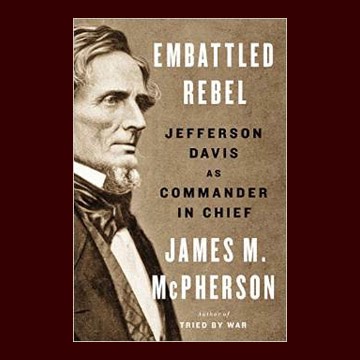
New and Noteworthy----Embattled Rebel: Jefferson Davis Beseiged on Several Fronts


EmbattledRebel: Jefferson Davis as Commander In Chief, James M. McPherson, Penguin Press, 302pp., 24 black and white illustrations, 15 maps, bibliographic notes, index, 2014, $32.95.

As president of the Confederacy, did Jefferson Davis prove to be a decisive factor in bringing about its defeat? Did his work as commander-in-chief contribute the defeat of the Confederacy? Is historian David M. Potter correct in stating that if  the Union and the Confederacy had exchanged presidents, the Confederacy might have won its independence?  In Embattled Rebel James M. McPherson, an academic scholar with over a dozen books and numerous articles to his credit, avoids comparing Davis to Lincoln. McPherson describes and analyzes Davis’ conception and execution of his duties as commander in chief as he understood them.

McPherson notes that negative depictions of Davis’ personality have been offered by his contemporaries in both the Confederate government and military.  These depictions of Davis are adequately noted by William C. Davis in Jefferson Davis: The Man and His Hour and An Honorable Defeat: The Last Days of the Confederate Government. McPherson acknowledges that there is substance to the claims that Jefferson Davis was impatient with others with whom he disagreed and did not take personal criticisms well.  More often than not, Davis could be humorless, argumentative and cold to others. 

The author does note that some found Davis to be attentive and polite to others, as well as cordial and a good listener.  McPherson believes that the Confederate president’s ill-health health was the likely cause of apparently abusive conduct.  Symptoms of previous bouts with malaria, severe neuralgia, and corneal ulcers left him at times in pain, nauseous, and partially blind.  Often sick, Davis worked frequently from a sick bed at home. Bronchial infections, insomnia and boils increased discomfort and pain.

McPherson notes that it was in April and May 1863, while Lee was suffering from symptoms of heart disease and Jackson was dying, that Davis could not come to the  presidential office for reasons of sickness.  Along with his ill-health, the stress of having meager resources at hand to meet the challenges of the presidency added to Davis’ irritability, impatience and short temper. 

With these caveats, McPherson judges Davis on five activities: 1. national policies regarding war aims, 2. national strategies regarding of the mobilization of political, economic, diplomatic, and military resources, 3. military strategy to address the war aims, 4. operations and management of the armies and their movements, and 5. the military tactics of specific armies in specific battles. 

He finds that Davis’ shaping and articulation of national polices to be clear and forceful regarding nationhood and slavery. McPherson makes the case that Davis’ military efforts were conditioned by economic and European situations beyond his control. Regarding the operations of the armies and military tactics, McPherson describes the difficulties and behavioral conflict inherent in Davis’ command style and those of several army commanders, who like Davis could be apparently thin skinned regarding criticism and closed minded to suggestions. 

In Embattled Rebel: Jefferson Davis as Commander In Chief,  McPherson clearly understands  that at the core of Davis’ difficulties lies not only his ill-health but also his ‘offensive-defensive’ military strategy and the strategies’ conflicts with the rights of the states to control their own manpower and resources. For McPherson, Jefferson Davis should not be charged with losing the war but that Lincoln won it by adeptly using resources, embracing over time a successful military strategy, and building a team of commanders that were not available to the Confederacy.  Embattled Rebel: Jefferson Davis as Commander In Chief is succinct and clearly written.  For those who have not read biographies of Davis published in the last 30 years, Embattled Rebel is a very fine place to start.

Tuesday, September 30, 2014

Forthcoming---The Early Morning of the War: Bull Run, 1861

The Early Morning of the War: Bull Run, 1861, Edward Longacre, University of Oklahoma Press, 12 maps, 30 b/w illustrations, notes, bibliography, index, 648 pages, $29.95.

From The Publisher: When Union and Confederate forces squared off along Bull Run on July 21, 1861, the Federals expected this first major military campaign would bring an early end to the Civil War. But when Confederate troops launched a strong counterattack, both sides realized the war would be longer and costlier than anticipated. First Bull Run, or First Manassas, set the stage for four years of bloody conflict that forever changed the political, social, and economic fabric of the nation. It also introduced the commanders, tactics, and weaponry that would define the American way of war through the turn of the twentieth century.

This crucial campaign receives its most complete and comprehensive treatment in Edward G. Longacre’s The Early Morning of War. A magisterial work by a veteran historian, The Early Morning of War blends narrative and analysis to convey the full scope of the campaign of First Bull Run—its drama and suspense as well as its practical and tactical underpinnings and ramifications. Also woven throughout are biographical sketches detailing the backgrounds and personalities of the leading commanders and other actors in the unfolding conflict.

Longacre has combed previously unpublished primary sources, including correspondence, diaries, and memoirs of more than four hundred participants and observers, from ranking commanders to common soldiers and civilians affected by the fighting. In weighing all the evidence, Longacre finds correctives to long-held theories about campaign strategy and battle tactics and questions sacrosanct beliefs—such as whether the Manassas Gap Railroad was essential to the Confederate victory. Longacre shears away the myths and persuasively examines the long-term repercussions of the Union’s defeat at Bull Run, while analyzing whether the Confederates really had a chance of ending the war in July 1861 by seizing Washington, D.C.

Brilliant moves, avoidable blunders, accidents, historical forces, personal foibles: all are within Longacre’s compass in this deftly written work that is sure to become the standard history of the first, critical campaign of the Civil War.

Edward G. Longacre is a retired U.S. Department of Defense Historian and the author of numerous articles and books on the Civil War and U.S. military history, including The Cavalry at Gettysburg, winner of the Fletcher Pratt Award, and Gentleman and Soldier: A Biography of Wade Hampton III, recipient of the Douglas Southall Freeman History Award.
Blurbs: “In this book, Edward Longacre has applied his considerable skills as a biographer to a vivid piece of American history, injecting humanity and fresh insight to the story of the Civil War’s first major battle. Practicing the lost art of personification and characterization with both flourish and wisdom, Longacre makes the players in this immense drama live anew.”—John Hennessy, author of Return to Bull Run: The Campaign and Battle of Second Manassas

"Extensively researched and full of fresh insights and information, Edward G. Longacre's finely crafted Early Morning of War offers a remarkably thorough, highly readable account of the men and events that shaped the course of the first great campaign of the American Civil War."—Ethan S. Rafuse, author of McClellan's War: The Failure of Moderation in the Struggle for the Union and Manassas: A Battlefield Guide


Wednesday, September 24, 2014

News---Gettysburg Monuments Return To Former Cyclorama Landscape

Gettysburg National Military Park staff returned the granite Battery F, 5th US Artillery monument to its original location, within the footprint of the old Cyclorama building in Ziegler's Grove, today, September 24. The monument was moved from its original location in the early 1960s to make way for the construction of the Cyclorama building. Now that the demolition of the cyclorama building is complete, funded by the Gettysburg Foundation, the monument has been returned to its original location.  

 Since 2009 Gettysburg National Military Park and the Gettysburg Foundation have been returning key portions of the center of the Union battle line on North Cemetery Ridge to their appearance at the time of the Battle of Gettysburg, 1863. Completed phases include the demolition of the old visitor center in 2009; the planting 41 apple trees to reestablish the Frey orchard (North) in 2010; the removal of the former Visitor Center parking lot in 2013 and the demolition of the Cyclorama building in 2013.
 
The Gettysburg Foundation is now raising funds for changes to the National Cemetery parking lot which would allow the replanting of missing portions of Ziegler's Grove, and rehabilitation of the historic terrain of Cemetery Ridge and Ziegler's Ravine.

Joanne M. Hanley, Gettysburg Foundation President, states, "The Cemetery Hill and Cemetery Ridge areas are central in Gettysburg National Military Park's and the Gettysburg Foundation's efforts to educate millions of visitors about the battle of Gettysburg, the causes and consequences of the American Civil War, and the lasting significance of this critical time in our nation's history. Preservation of this site will forever enhance the interpretive value of this critical portion of the Gettysburg battlefield."

Since 2009 Gettysburg National Military Park and the Gettysburg Foundation have been returning key portions of the center of the Union battle line on North Cemetery Ridge to their appearance at the time of the Battle of Gettysburg, 1863. Completed phases include the demolition of the old visitor center in 2009; the planting 41 apple trees to reestablish the Frey orchard (North) in 2010; the removal of the former Visitor Center parking lot in 2013 and the demolition of the Cyclorama building in 2013.

"These actions continue to help us meet our goals of improving the integrity of the battlefield landscapes and improving our visitors' understanding of what happened at Gettysburg and why it's so important," said Rick Kendall, Gettysburg National Military Park.

Text and Image Source:   Gettysburg Foundation

Friday, September 12, 2014

Off Topic--1,000 Year Old Viking Ring Fortress Site Discovered in Denmark

 Trelleborg in western Zealand. Photo: Thue C. Leibrandt/Wikimedia: Viking 'ring fortress' discovered in Denmark Commons

Viking 'Ring Fortress' Discovered in Denmark, The Telegraph, September 12, 2014

Historians believe distinctive geometric fortresses may have been built by Sweyn Forkbeard as a military training camp from which to launch his invasion of England.Archaeologists in Denmark  have discovered a distinctive ring-shaped Viking fortress which historians believe may have been used to launch an invasion of England.  The fortress found on the Danish island of Zealand, around 30 miles south of Copenhagen, is the fifth circular fortress to be unearthed, and the first in over 60 years. “This is great news,” said Lasse Sonne, a Viking historian from the Saxon Institute at the University of Copenhagen.

“Although there were Vikings in other countries, these circular fortresses are unique to Denmark. Many have given up hope that there were many of them left.” Like previously discovered ring fortresses, the Vallø Borgring is thought to date back to the late tenth century and the reign of Harald Bluetooth, the king who Christianised Denmark and Norway.

However, some historians contend the fortresses were constructed by his son Sweyn Forkbeard, the first Danish King of England, as a military training camp or barracks from which to launch his invasions of England. Sweyn Forkbeard seized London in 1013 and was declared King of England on Christmas Day of that year.

The newly discovered fortress has a diameter of 475 feet, making it the third-largest of its type, and consists of a 35-foot wide circular rampart surrounded by a palisade of wooden spikes.
Although only small portions of the new fortress have been uncovered, it appears to match the design of Denmark’s other ring fortresses, sticking to a strict geometric pattern.
The fortresses have four gates facing outward in different compass directions, and an interior courtyard symmetrically divided into four quarters. It is thought that Viking “longhouses” would have been constructed within the fortress.

Historians believe the geometric design may have been inspired by old Roman army camps found by Vikings during their raids on England.Denmark’s ring fortresses are also known as Trelleborgs, after the location of the first to be discovered in western Zealand.  The other three are located in Aggersborg and Fyrkat in northern Jutland, and Nonnebakken near Odense.

 viking fortress excavation

 Text Source: The Telegraph
Another News Story and Images at Archaeology and Huffington Post
Top Image: The Telegraph
Bottom Image: Huffington Post