Monday, October 20, 2014
New and Noteworthy---What Today's West Point Students Should Know About The Civil War
Publisher's Blurb: The definitive military history of the Civil War, featuring the same
exclusive images, tactical maps, and expert analysis commissioned by The
United States Military Academy to teach the history of the art of war
to West Point cadets.


Wednesday, October 15, 2014
News--- Found On Ebay: Photograph of R. E. Lee's Slaves Found At Arlington House
 Slave Photo From Robert E. Lee's Home Discovered On Ebay, Fox News.coma and the Associated Press, October 12, 2014.
National Park Service curator Kim Robinson holds the photo of Selina Gray, right, who was in charge to care for Arlington House where Gen. Robert E. Lee had lived in for 30 years, Thursday, Oct. 9, 2014, at Arlington National Cemetery in Arlington, Va. The National Park Service has acquired a rare Civil War-era photograph of an enslaved woman at Confederate Gen. Robert E. Lee's home in Virginia. The previously unknown photograph depicts Selina Gray, the head housekeeper to Lee and his family. The photograph was unveiled Thursday at Lee's Arlington House plantation overlooking the nation's capital.
An “extremely rare” Civil War-era photograph of the enslaved woman who helped save Confederate Gen. Robert E. Lee's Virginia home has been obtained by the National Park Service after a volunteer spotted the image on eBay. The previously unknown photograph depicts Selina Gray, the head housekeeper to Lee and his family, along with two girls thought to be her daughters. The photograph was unveiled Thursday at the Arlington House plantation overlooking the nation's capital that was home to Lee and dozens of slaves before the Civil War. An inscription on the back of the image reads "Gen Lees Slaves Arlington Va."
Park officials said this is only the second known photograph taken of slaves at Arlington. "It's extremely rare to have an identified photo of an enslaved person," said National Park Service spokeswoman Jenny Anzelmo-Sarles. "Since slaves were considered property, it's very rare to have a photo where you can identify the people in the photo."
WJLA eported Thursday that National Park Service volunteer Dean DeRosa spotted the photograph for sale on eBay for just $20. DeRosa told WJLA he recognized Gray “immediately.” “What I find so fascinating is how well dressed Selina and her daughters are in this photo,” he told the station.
 The nonprofit Save Arlington House Inc. donated $700 to acquire the
image. The seller was based in England and found the photo in a box of
unwanted images. Gray is noted in history books for helping to save Arlington House
after Lee's family left and the plantation was captured by Union troops
during the Civil War.
The nonprofit Save Arlington House Inc. donated $700 to acquire the
image. The seller was based in England and found the photo in a box of
unwanted images. Gray is noted in history books for helping to save Arlington House
after Lee's family left and the plantation was captured by Union troops
during the Civil War.Arlington House was originally built as a monument to George Washington. Lee's wife, Mary Custis Lee, entrusted the home to Gray, and she later confronted a Union general about soldiers pilfering Washington family heirlooms from the house. She was able to have the items safeguarded. The photograph was unveiled to the public Saturday, and it will be used in future exhibits after Arlington House and its slave quarters are restored.
CWL: Still in question is the date of the photograph and the lives of Selina Gray and her daughters.
Text Source: Slave Photo Discovered From Lee's Home and Slave Photo Discovered From Robert E. Lee's Home Discovered on Ebay
Image Source: AP Photo/Jose Luis Magana
Monday, October 06, 2014
New and Noteworthy---Music Along The Rapidan River: The War, The Soldiers and Their Music December 1863-April 1864
 Music Along The Rapidan: Civil War Soldiers, Music and Community During Winter Quarters, Virginia, James A. Davis, University of Nebraska Press, 347 pp., 31 b/w illustration, bibliographic notes, bibliography, index, $45.00.
From The Publisher: In December 1863, Civil War soldiers took refuge from the dismal conditions of war and weather. They made their winter quarters in the Piedmont region of central Virginia: the Union’s Army of the Potomac in Culpeper County and the Confederacy’s Army of Northern Virginia in neighboring Orange County. For the next six months the opposing soldiers eyed each other warily across the Rapidan River.
In Music Along the Rapidan James A. Davis examines the role of music in defining the social communities that emerged during this winter encampment. Music was an essential part of each soldier’s personal identity, and Davis considers how music became a means of controlling the acoustic and social cacophony of war that surrounded every soldier nearby.
Music also became a touchstone for colliding communities during the encampment—the communities of enlisted men and officers or Northerners and Southerners on the one hand and the shared communities occupied by both soldier and civilian on the other. The music enabled them to define their relationships and their environment, emotionally, socially, and audibly.
James A. Davis is a professor of musicology at the
School of Music at the State University of New York at Fredonia. He is
the author of Bully for the Band! The Civil War Letters and Diary of Four Brothers in the 10th Vermont Infantry Band and his articles have been published in numerous journals including Journal of Military History, American Music, and Nineteenth Century Studies.
CWL: Davis introduces the book with material on music and communities during the Civil War era. Chapter One: Winter Quarters in Virginia, 1863-1864; Chapter 2: Music and the Community of Soldiers; Chapter 3: Music and the Military Community: Chapter 4 Military Balls and the Officer's Community; Chapter 5: Music and the Religious Community; Chapter 6: Brass Bands and the Intersection of Musical Communities. He concludes the book with a discussion of the impact of 1863-1863winter quarters on these communities of soldiers and the war itself.
The illustrations are somewhat unique; they consist of soldiers with their instruments and the building and tents were the music was performed. The index reveals that the most frequently discussed topics are: brass bands, civilians, communities and audiences, military camps as homes, the various types of music and lyrics performed and the relationships that are revealed; and women. The troops of Pennsylvania, New York, Massachusetts and Virginia are frequently used as examples.
At the price of $45, readers may wish to request the book through a local library, either for its addition to the collection or borrowing it through inter-library loan. Of course, libraries accept donations to purchase particular items and donors are often the first borrowers.
Sunday, October 05, 2014
New and Noteworthy----Embattled Rebel: Jefferson Davis Beseiged on Several Fronts
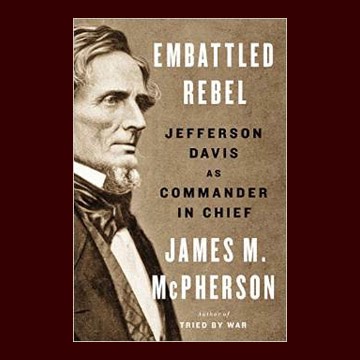
EmbattledRebel: Jefferson Davis as Commander In Chief, James M. McPherson,
Penguin Press, 302pp., 24 black and white illustrations, 15 maps, bibliographic
notes, index, 2014, $32.95.
As president of the Confederacy, did Jefferson Davis prove
to be a decisive factor in bringing about its defeat? Did his work as
commander-in-chief contribute the defeat of the Confederacy? Is historian David
M. Potter correct in stating that if the
Union and the Confederacy had exchanged presidents, the Confederacy might have
won its independence? In Embattled Rebel James M. McPherson, an
academic scholar with over a dozen books and numerous articles to his credit,
avoids comparing Davis to Lincoln. McPherson describes and analyzes Davis’
conception and execution of his duties as commander in chief as he understood
them.
McPherson notes that negative depictions of Davis’
personality have been offered by his contemporaries in both the Confederate
government and military. These
depictions of Davis are adequately noted by William C. Davis in Jefferson Davis: The Man and His Hour
and An Honorable Defeat: The Last Days of
the Confederate Government. McPherson acknowledges that there is substance
to the claims that Jefferson Davis was impatient with others with whom he
disagreed and did not take personal criticisms well. More often than not, Davis could be humorless,
argumentative and cold to others.
The author does note that some found Davis to be attentive
and polite to others, as well as cordial and a good listener. McPherson believes that the Confederate
president’s ill-health health was the likely cause of apparently abusive
conduct. Symptoms of previous bouts with
malaria, severe neuralgia, and corneal ulcers left him at times in pain,
nauseous, and partially blind. Often
sick, Davis worked frequently from a sick bed at home. Bronchial infections,
insomnia and boils increased discomfort and pain.
McPherson notes that it was in April and May 1863, while
Lee
was suffering from symptoms of heart disease and Jackson was dying, that Davis
could not come to the presidential
office for reasons of sickness. Along with
his ill-health, the stress of having meager resources at hand to meet the
challenges of the presidency added to Davis’ irritability, impatience and short
temper.
With these caveats,
McPherson judges Davis on five activities: 1. national policies regarding war
aims, 2. national strategies regarding of the mobilization of political,
economic, diplomatic, and military resources, 3. military strategy to address
the war aims, 4. operations and management of the armies and their movements,
and 5. the military tactics of specific armies in specific battles.
 He finds that Davis’ shaping and articulation of national
polices to be clear and forceful regarding nationhood and slavery. McPherson makes
the case that Davis’ military efforts were conditioned by economic and European
situations beyond his control. Regarding the operations of the armies and
military tactics, McPherson describes the difficulties and behavioral conflict inherent
in Davis’ command style and those of several army commanders, who like Davis
could be apparently thin skinned regarding criticism and closed minded to
suggestions.
He finds that Davis’ shaping and articulation of national
polices to be clear and forceful regarding nationhood and slavery. McPherson makes
the case that Davis’ military efforts were conditioned by economic and European
situations beyond his control. Regarding the operations of the armies and
military tactics, McPherson describes the difficulties and behavioral conflict inherent
in Davis’ command style and those of several army commanders, who like Davis
could be apparently thin skinned regarding criticism and closed minded to
suggestions.
In Embattled Rebel:
Jefferson Davis as Commander In Chief, McPherson clearly understands that at the core of Davis’ difficulties lies not
only his ill-health but also his ‘offensive-defensive’ military strategy and
the strategies’ conflicts with the rights of the states to control their own
manpower and resources. For McPherson, Jefferson Davis should not be charged
with losing the war but that Lincoln won it by adeptly using resources,
embracing over time a successful military strategy, and building a team of
commanders that were not available to the Confederacy. Embattled
Rebel: Jefferson Davis as Commander In Chief is succinct and clearly
written. For those who have not read
biographies of Davis published in the last 30 years, Embattled Rebel is a very fine place to start.
Tuesday, September 30, 2014
Forthcoming---The Early Morning of the War: Bull Run, 1861
 The Early Morning of the War: Bull Run, 1861, Edward Longacre, University of Oklahoma Press, 12 maps, 30 b/w illustrations, notes, bibliography, index, 648 pages, $29.95.
From The Publisher: When Union and Confederate forces squared off along Bull Run on July 21, 1861, the Federals expected this first major military campaign would bring an early end to the Civil War. But when Confederate troops launched a strong counterattack, both sides realized the war would be longer and costlier than anticipated. First Bull Run, or First Manassas, set the stage for four years of bloody conflict that forever changed the political, social, and economic fabric of the nation. It also introduced the commanders, tactics, and weaponry that would define the American way of war through the turn of the twentieth century.
This crucial campaign receives its most complete and comprehensive treatment in Edward G. Longacre’s The Early Morning of War. A magisterial work by a veteran historian, The Early Morning of War blends narrative and analysis to convey the full scope of the campaign of First Bull Run—its drama and suspense as well as its practical and tactical underpinnings and ramifications. Also woven throughout are biographical sketches detailing the backgrounds and personalities of the leading commanders and other actors in the unfolding conflict.
Longacre has combed previously unpublished primary sources, including correspondence, diaries, and memoirs of more than four hundred participants and observers, from ranking commanders to common soldiers and civilians affected by the fighting. In weighing all the evidence, Longacre finds correctives to long-held theories about campaign strategy and battle tactics and questions sacrosanct beliefs—such as whether the Manassas Gap Railroad was essential to the Confederate victory. Longacre shears away the myths and persuasively examines the long-term repercussions of the Union’s defeat at Bull Run, while analyzing whether the Confederates really had a chance of ending the war in July 1861 by seizing Washington, D.C.
Brilliant moves, avoidable blunders, accidents, historical forces, personal foibles: all are within Longacre’s compass in this deftly written work that is sure to become the standard history of the first, critical campaign of the Civil War.
Edward G. Longacre is a retired U.S. Department of
Defense Historian and the author of numerous articles and books on the
Civil War and U.S. military history, including The Cavalry at Gettysburg, winner of the Fletcher Pratt Award, and Gentleman and Soldier: A Biography of Wade Hampton III, recipient of the Douglas Southall Freeman History Award.
Blurbs: “In this book, Edward Longacre has applied his considerable
skills as a biographer to a vivid piece of American history, injecting
humanity and fresh insight to the story of the Civil War’s first major
battle. Practicing the lost art of personification and characterization
with both flourish and wisdom, Longacre makes the players in this
immense drama live anew.”—John Hennessy, author of Return to Bull Run: The Campaign and Battle of Second Manassas
"Extensively researched and full of fresh insights and information, Edward G. Longacre's finely crafted Early Morning of War
offers a remarkably thorough, highly readable account of the men and
events that shaped the course of the first great campaign of the
American Civil War."—Ethan S. Rafuse, author of McClellan's War: The Failure of Moderation in the Struggle for the Union and Manassas: A Battlefield Guide
Wednesday, September 24, 2014
News---Gettysburg Monuments Return To Former Cyclorama Landscape
 Gettysburg
National Military Park staff returned the granite Battery F, 5th US
Artillery monument to its original location, within the footprint of the
old Cyclorama building in Ziegler's Grove, today, September 24. The
monument was moved from its original location in the early 1960s to make
way for the construction of the Cyclorama building. Now that the
demolition of the cyclorama building is complete, funded by the
Gettysburg Foundation, the monument has been returned to its original
location.
Gettysburg
National Military Park staff returned the granite Battery F, 5th US
Artillery monument to its original location, within the footprint of the
old Cyclorama building in Ziegler's Grove, today, September 24. The
monument was moved from its original location in the early 1960s to make
way for the construction of the Cyclorama building. Now that the
demolition of the cyclorama building is complete, funded by the
Gettysburg Foundation, the monument has been returned to its original
location.
Since
2009 Gettysburg National Military Park and the Gettysburg Foundation
have been returning key portions of the center of the Union battle line
on North Cemetery Ridge to their appearance at the time of the Battle of
Gettysburg, 1863. Completed phases include the demolition of the old
visitor center in 2009; the planting 41 apple trees to reestablish the
Frey orchard (North) in 2010; the removal of the former Visitor Center
parking lot in 2013 and the demolition of the Cyclorama building in
2013.
The
Gettysburg Foundation is now raising funds for changes to the National
Cemetery parking lot which would allow the replanting of missing
portions of Ziegler's Grove, and rehabilitation of the historic terrain
of Cemetery Ridge and Ziegler's Ravine.
Joanne
M. Hanley, Gettysburg Foundation President, states, "The Cemetery Hill
and Cemetery Ridge areas are central in Gettysburg National Military
Park's and the Gettysburg Foundation's efforts to educate millions of
visitors about the battle of Gettysburg, the causes and consequences of
the American Civil War, and the lasting significance of this critical
time in our nation's history. Preservation of this site will forever
enhance the interpretive value of this critical portion of the
Gettysburg battlefield."
Since
2009 Gettysburg National Military Park and the Gettysburg Foundation
have been returning key portions of the center of the Union battle line
on North Cemetery Ridge to their appearance at the time of the Battle of
Gettysburg, 1863. Completed phases include the demolition of the old
visitor center in 2009; the planting 41 apple trees to reestablish the
Frey orchard (North) in 2010; the removal of the former Visitor Center
parking lot in 2013 and the demolition of the Cyclorama building in
2013.
"These
actions continue to help us meet our goals of improving the integrity
of the battlefield landscapes and improving our visitors' understanding
of what happened at Gettysburg and why it's so important," said Rick
Kendall, Gettysburg National Military Park.
Text and Image Source: Gettysburg Foundation
Friday, September 12, 2014
Off Topic--1,000 Year Old Viking Ring Fortress Site Discovered in Denmark

Viking 'Ring Fortress' Discovered in Denmark, The Telegraph, September 12, 2014
Historians believe distinctive geometric fortresses may have been built by Sweyn Forkbeard as a military training camp from which to launch his invasion of England.Archaeologists in Denmark have discovered a distinctive ring-shaped Viking fortress which historians believe may have been used to launch an invasion of England. The fortress found on the Danish island of Zealand, around 30 miles south of Copenhagen, is the fifth circular fortress to be unearthed, and the first in over 60 years. “This is great news,” said Lasse Sonne, a Viking historian from the Saxon Institute at the University of Copenhagen.
Historians believe distinctive geometric fortresses may have been built by Sweyn Forkbeard as a military training camp from which to launch his invasion of England.Archaeologists in Denmark have discovered a distinctive ring-shaped Viking fortress which historians believe may have been used to launch an invasion of England. The fortress found on the Danish island of Zealand, around 30 miles south of Copenhagen, is the fifth circular fortress to be unearthed, and the first in over 60 years. “This is great news,” said Lasse Sonne, a Viking historian from the Saxon Institute at the University of Copenhagen.
“Although there were Vikings in other countries, these circular fortresses are unique to Denmark. Many have given up hope that there were many of them left.” Like previously discovered ring fortresses, the Vallø Borgring is thought to date back to the late tenth century and the reign of Harald Bluetooth, the king who Christianised Denmark and Norway.
However, some historians contend the fortresses were constructed by his son Sweyn Forkbeard, the first Danish King of England, as a military training camp or barracks from which to launch his invasions of England. Sweyn Forkbeard seized London in 1013 and was declared King of England on Christmas Day of that year.
The newly discovered fortress has a diameter of 475 feet, making it the third-largest of its type, and consists of a 35-foot wide circular rampart surrounded by a palisade of wooden spikes.
Although only small portions of the new fortress have been uncovered, it appears to match the design of Denmark’s other ring fortresses, sticking to a strict geometric pattern.
The fortresses have four gates facing outward in different compass directions, and an interior courtyard symmetrically divided into four quarters. It is thought that Viking “longhouses” would have been constructed within the fortress.
Historians believe the geometric design may have been inspired by old Roman army camps found by Vikings during their raids on England.Denmark’s ring fortresses are also known as Trelleborgs, after the location of the first to be discovered in western Zealand. The other three are located in Aggersborg and Fyrkat in northern Jutland, and Nonnebakken near Odense.

Text Source: The Telegraph
Another News Story and Images at Archaeology and Huffington Post
Top Image: The Telegraph
Bottom Image: Huffington Post
Wednesday, August 13, 2014
News--Did A CSA Agent Target Northern Cities in 1864 For A Yellow Fever Epidemic?
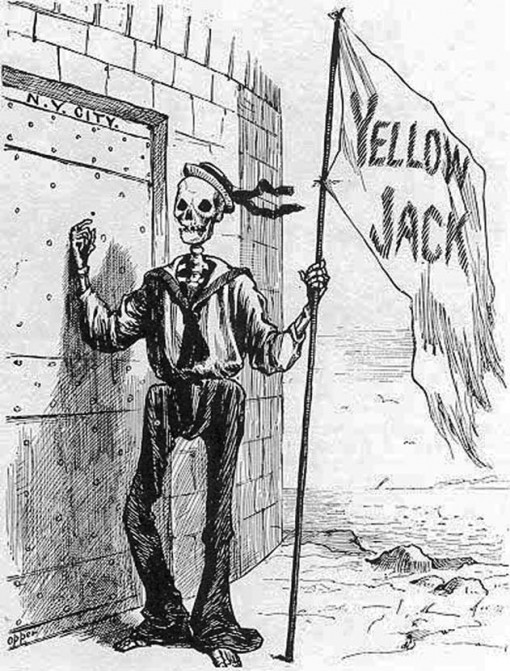 Yellow Fever Plot of 1864 Targeted Lincoln, U.S. Cities, Mathew W. Lively, Civil War Profiles Weblog, July 13, 2014.
Today we know that Yellow Fever is a virus that is spread through the bite of infected mosquitoes. But during the Civil War, which occurred prior to the discovery of germs being the source of disease, medical science and the lay population believed Yellow Fever could be contracted from direct exposure to those who were infected, primarily through contact with “black vomit.” It was this belief that led Blackburn to “contaminate” clothing for distribution.
The island of Bermuda was a major base of blockade running for the Confederacy and when a Yellow Fever epidemic occurred there in the summer of 1864, Dr. Blackburn, who had extensive experience treating the disease in the Deep South, traveled from Canada to Bermuda to lend his expertise in controlling the outbreak. While on the island, Blackburn took the soiled bedding and clothing of infected patients and packed them into trunks with new shirts and coats in an effort to “infect” the unused garments with Yellow Fever particles.
Blackburn then traveled to Halifax, Nova Scotia, in June 1864 with five trunks and one valise of infected clothing. Once there, he offered a man named Godfey Hyams the sum of $100,000 to smuggle the trunks into “Washington City, to Norfolk, and as far South” as he could go “where the Federal Government held possession and had the most troops.” He instructed Hyams to dispose of the new clothing by auction with the exception of the valise, which was to be delivered by express to President Lincoln as a gift. Blackburn also specified the contents of the largest trunk were to be sold in Washington, D.C., callously remarking: “It will kill them at sixty yards.”
Mathew W. Liverly's online article is continued at Civil War Profiles July 13, 2014
Image Source: Frank Leslie's Illustrated Newspaper, provided by Matthew Lively.
Tuesday, August 12, 2014
Author Interview: Uzal W. Ent And The Pennsylvania Reserves In The Civil War
 The Pennsylvania Reserves In The Civil War: A Comprehensive History, Uzal W. Ent, McFarland Publishing, 2014, 401pp., appendices, bibliography, index, chapter notes, $75.00.
Uzal W. Ent, a brigadier general retired from a 34 military career, has authored three books and has been published in 19 magazines and five encyclopedias and the of The Pennsylvania Reserves In The Civil War: A Comprehensive History which was published in July. Ent is the author of Fighting on the Brink: The Defense of the Pusan Perimeter [1998] and The First Century: A History of the 28th Division [1979].
Because Josiah R. Sypher published his History of the Pennsylvania Reserves in 1865 and Samuel P. Bates his History of the Pennsylvania Volunteers in 1869, the accounts of many of the individual regiments of the Pennsylvania Reserve division have never been adequately researched and studied with two exceptions being: Bouquets From The Cannon's Mouth: Soldiering With The Eighth Regiment Of The Pennsylvania Reserves [2005], Three Years in the Bloody Eleventh: The Campaigns of a Pennsylvania Reserve Regiment [2002]. Notable is the extensive work done by August and Angela Marchetti and colleagues at the online Pennsylvania Reserve Historical Society [http://www.pareserves.com/] whose Pennsylvania Reserve Volunteer Corps online research center develops and offers new resources.
CWL: The Pennsylvania Reserves In The Civil War: A Comprehensive History is certainly comprehensive. When did you begin your research for your work?
UWE: About 16 years ago after I completed a book on the Korean War's Pusan Perimeter in 1996-1997. McFarland Publishing edited it over several years. I began with my great, great grandfather' copy of Joseph Sypher's History of the Pennsylvania Reserve Corps first published in 1864 and then updated in 1865. Sypher's work is somewhat faulty regarding casualties because is was written at the end of the war. Yet Sypher kept in contact with Pennsylvania Reserve soldiers and received immediate feedback regarding his work, which he later updated in the next editions. By 1869 the casualty figures were released by the federal government. Broadfoot Press' work in regimental rosters is accurate and significant.
CWL: When did your interest first develop in the Pennsylvania Reserve Corps?
UWE: After completing Fighting on the Brink: The Defense of the Pusan Perimeter in 1997. I was familiar with the Pennsylvania Reserves because I am related to two Pennsylvania Reserve veterans: one in the 6th Pennsylvania and one in Rickett's Battery.
CWL: During your research, what were the most illusive pieces of information?
UWE: None especially yet I was always looking .
CWL: What difficulties did you have acquiring maps and photographs for the book?
UWE: Since I am not a cartographer, every map I drew was rejected by the publisher. McFarland Publishing acquired maps from Louisiana State University Press, Savas Beatie Publishing, Hal Jesperson and the National Park Service. The photographs are from the collection of the Library of Congress and those found in Battles and Leaders of the Civil War, which are in the public domain.
CWL: For such a large book, how did you construct the index?
UWE: A librarian and friend at the United States Army Military History Institute in Carlisle [Pennsylvania] constructed about 90% of the index and nearly all my research was done at the institutes' library.
CWL: You quote extensively for newspaper of the era. Tell us of your experience with newspaper morgue books and the online and digitized archives you used.
UWE: Regarding newspapers, most of what I needed was on microfilm and what is online and digitized was found for me by librarians.
CWL: What material did you use to which possibly Sypher did not have access?
UWE: At the USAMH library there is a large collection of letters, memoirs, newspapers. In neighboring Harrisburg at the Pennsylvania Museum's library there is another trove.
CWL: In what ways does The Pennsylvania Reserves in the Civil War: A Comprehensive History move beyond Sypher's and Bates' work?
UWE: It relies on those regimental histories published after Bates' work was published. Also the diaries, letters, memoirs and narratives available in the USAMHI archives and at the Pennsylvania State Museum library. Scholarly and popular articles published in the last 100 years and of course, The Official Records of the War of the Rebellion published in 128 volumes between 1880 and 1901. In the appendices are biographical sketches of the principal Reserve Corps officers along with the initial organization, including the 14th Reserves which is an artillery unit and the 15th Reserves which is a cavalry unit.
CWL: Thank you for your work on behalf of the Pennsylvania Reserves division.
UWE: And thank your for the interview.
Wednesday, July 30, 2014
News--Gettysburg Magazine Issue 50 and University of Nebraska Press
 Notes on Gettysburg Magazine, Issue 50, Cover Date: January 2014 arrived in the U.S. mail on Monday July 28.
1. Now glue bound instead of staple bound
2. Thicker paper used for cover; more glossy
3. Articles: 3 in number focusing on sesquicentennial remembrance
4. New Section: Documents. Includes Henry E. Jacob's recollections of November 19, 1863; John Hay's description of the Address; Ward Hill Lamon's recollections of the Address; Woodrow Wilson's 1913 address, FDR's 1938 speech at Peace Light Memorial
5. Two advertisements: inside front cover--Adams County Historical Society; last pag--University of Nebraska Press' series This Hallowed Ground which consists of seven guides to the Civil War battlefields
6. Cover, back cover and inside back cover are contemporary color photographs
7. Total page count: 74
Over all, Issue 50 is not a military issue but is an historic character and contemporary author reflection issue.
The University of Nebraska Press' website notes:
"The University of Nebraska Press is proud to announce that Professor James S. Pula of Purdue University will be the new editor beginning with Issue 50. He is currently accepting submissions for future issues."
Text Source: University of Nebraska Press
Image Source: CWL scan of Issue 50 cover
Tuesday, July 29, 2014
New and Noteworthy--Making, Managing and Creating Memories of Gettysburg National Military Park
 On A Great Battlefield: The Making, Management, and Memory of Gettysburg National Military Park, 1933-2013, Jennifer M. Murray, University of Tennessee Press, 2014, 312pp, notes, bibliography, index, 3 maps, 34 b/w photographs.$49.00.
Certainly with 82 pages of notes and 14 pages of bibliography, Jennifer M. Murray was provided one of the very best studies of the history of Gettysburg National Military Park [NM]. The first chapter covers the first 70 years of the park. The next ten chapters details the 80 year span between 1993 to 2013. Murray, currently an assistant professor of history at University of Virginia's College at Wise is formerly a seasonal interpretative ranger during nine summer at at Gettysburg NMP.
Of contemporary interest is the coverage Murray provides for the planning, the fundraising and the bitter controversies regarding expansive changes at Gettysburg. The public/private partnership to build the $103 million visitor center, the landscape rehabilitation, and the inclusion of exhibits presenting slavery, abolition, secession, Reconstruction and the Civil Rights Movement of the 1950s and 1960s in the visitor center may well be studied and redirect the mission, tasks and future of the National Parks Service and its historical parks.
The final years of the 20th century and the first decade of the 21st century is viewed as a watershed era in the story of the park. Excepting the years between 1933 and 1940, when the park had available funds from the New Deal, no other era contained the degree of expansion and improvement to the battlefield. Eight of the 11 chapters focus upon the era of 1946-2013. Though initially a Phd. dissertation, Murray's narrative in On A Great Battlefield is clear, concise, cogent and accessible to the general reader.
Monday, July 21, 2014
News---Lee's Arlington House Receives $12.35 Million for Restoration and Improvements From Billionaire
 National Park Service Press Release, July 15, 2014: David Rubenstein Donates Lead Centennial Gift of $12.35 Million To The National Park Foundation to Restore Arlington House
located within the grounds of Arlington National Cemetery.
“Arlington House, originally constructed to memorialize George
Washington, tells America’s story from its founding, to the shame of
slavery and a nation divided, to a nation again made whole,” Jarvis
said. “We are honored by Mr. Rubenstein’s patriotism, his generous gift,
and his dedication to the future of America’s treasures. We are eager
to start the transformation that his ‘patriotic philanthropy’ will make
possible.”
When the projects are completed, visitors will see Arlington House
as it was in 1860, with every room restored to its historical
appearance. An important aspect of this project is to restore the slave
quarters to better represent and tell the stories of the enslaved.
Visitors will learn from park rangers and volunteers, or via new mobile
and web assets, in addition to audio tours and changing exhibitions. As
visitors move between the mansion and the new museum and bookstore, they
will pass along accessible paths that stretch through the restored
grounds, including heirloom gardens and new trails. People who cannot
visit in person will enjoy a more robust experience through virtual
tours, complete with detailed displays of the rooms and museum objects.
Rubenstein said, “I am honored to support the National Park
Service’s renovation of historic Arlington House built in honor of
George Washington and located on hallowed ground atop Arlington National
Cemetery. I hope that upon its restoration, Arlington House will
appropriately remind visitors of America’s rich history and our
country’s good fortune to have such a unique site to honor our veterans,
especially those who gave the last full measure of devotion on behalf
of this nation.”
The National Park Foundation, as the official charity of America’s
national parks and nonprofit partner of the NPS received the gift that
will make the critical projects at the memorial possible.
Mr. Rubenstein has set the tone for a new era of investment in
America’s national parks. For 100 years, generous philanthropists have
stepped forward to keep the national parks beautiful, vital and
accessible. Rubenstein’s donation is the largest gift associated with
the NPF’s Centennial Campaign. In preparation for the milestone
anniversary, NPS Director Jarvis has asked the NPF to spearhead and
implement the Centennial Public Engagement and National Fundraising
Campaigns. Through these efforts, NPS and NPF will celebrate the NPS’s
centennial and reintroduce the NPS’s work and opportunities to a new
generation of Americans, inviting them to protect America’s special
places, working together to connect all people to their parks, and
inspiring the next generation of park stewards to visit and get involved
with their national parks.
“Mr. Rubenstein’s transformative philanthropic support will not
only restore and rejuvenate Arlington House, enlivening it for new
audiences, but it also provides an inspiring example of how
public-private partnership is vital to ensure these special places
thrive,” Neil Mulholland, president and CEO of the National Park
Foundation said. “America’s national parks belong to each and every one
of us, and, as such, we share the responsibility to protect and preserve
them now and for the next generation.”
The residence of Robert E. Lee and his family before the Civil War,
the story of Arlington House connects to many important figures, issues
and events in American history. Built by George Washington Parke Custis
and his slaves between 1802 and 1818, the house and grounds have served
many purposes over the last 200 years: a family home for the Lees and
Custises, a plantation estate and home to 63 slaves, a monument honoring
George Washington, a military headquarters for Union troops, a
community for emancipated slaves and a national cemetery. With 650,000
visitors per year, Arlington House is the most visited historic house
museum in the national park system.
CWL, Explanatory Note: Arlington House, The Robert E. Lee Memorial is managed by the George Washington Memorial Parkway. It also manages the Clara Barton National Historic Site, the Clause Moor Colonial Farm, Glen Echo Park, Great Falls Park, Lyndon Baines Johns Memorial and the Theodore Roosevelt Island.
Text Source: National Park Service
Friday, July 18, 2014
News----- 36 Pounds of Coffee A Year; Grounds For War; Ohio Barrista Becomes President

How Coffee
Fueled the Civil War, Jon Grinspan, New York Times, July
9, 2014
It was the
greatest coffee run in American history. The Ohio boys had been fighting since
morning, trapped in the raging battle of Antietam, in September 1862. Suddenly,
a 19-year-old William McKinley appeared, under heavy fire, hauling vats of hot
coffee. The men held out tin cups, gulped the brew and started firing again.
“It was like putting a new regiment in the fight,” their officer recalled.
Three decades later, McKinley ran for president in part on this singular act of
caffeinated heroism.
At the time, no
one found McKinley’s act all that strange. For Union soldiers, and the lucky
Confederates who could scrounge some, coffee fueled the war. Soldiers drank it
before marches, after marches, on patrol, during combat. In their diaries, “coffee”
appears more frequently than the words “rifle,” “cannon” or “bullet.” Ragged
veterans and tired nurses agreed with one diarist: “Nobody can ‘soldier’
without coffee.”
Union troops
made their coffee everywhere, and with everything: with water from canteens and
puddles, brackish bays and Mississippi mud, liquid their horses would not
drink. They cooked it over fires of plundered fence rails, or heated mugs in
scalding steam-vents on naval gunboats. When times were good, coffee
accompanied beefsteaks and oysters; when they were bad it washed down raw
salt-pork and maggoty hardtack. Coffee was often the last comfort troops
enjoyed before entering battle, and the first sign of safety for those who
survived.
The Union Army
encouraged this love, issuing soldiers roughly 36 pounds of coffee each year.
Men ground the beans themselves (some carbines even had built-in grinders) and
brewed it in little pots called muckets. They spent much of their downtime
discussing the quality of that morning’s brew. Reading their diaries, one can
sense the delight (and addiction) as troops gushed about a “delicious cup of
black,” or fumed about “wishy-washy coffee.” Escaped slaves who joined Union
Army camps could always find work as cooks if they were good at “settling” the
coffee – getting the grounds to sink to the bottom of the unfiltered muckets.
For much of the
war, the massive Union Army of the Potomac made up the second-largest
population center in the Confederacy, and each morning this sprawling city
became a coffee factory. First, as another diarist noted, “little campfires,
rapidly increasing to hundreds in number, would shoot up along the hills and
plains.” Then the encampment buzzed with the sound of thousands of grinders
simultaneously crushing beans. Soon tens of thousands of muckets gurgled with
fresh brew.
Confederates were
not so lucky. The Union blockade kept most coffee out of seceded territory. One
British observer noted that the loss of coffee “afflicts the Confederates even
more than the loss of spirits,” while an Alabama nurse joked that the fierce
craving for caffeine would, somehow, be the Union’s “means of subjugating us.”
When coffee was available, captured or smuggled or traded with Union troops
during casual cease-fires, Confederates wrote rhapsodically about their first
sip.
The problem
spilled over to the Union invaders. When Gen. William T. Sherman’s Union troops
decided to live off plunder and forage as they cut their way through Georgia
and South Carolina, soldiers complained that while food was plentiful, there
were no beans to be found. “Coffee is only got from Uncle Sam,” an Ohio officer
grumbled, and his men “could scarce get along without it.”
Confederate
soldiers and civilians would not go without. Many cooked up coffee substitutes,
roasting corn or rye or chopped beets, grinding them finely and brewing up
something warm and brown. It contained no caffeine, but desperate soldiers
claimed to love it. Gen. George Pickett, famous for that failed charge at
Gettysburg, thanked his wife for the delicious “coffee” she had sent, gushing:
“No Mocha or Java ever tasted half so good as this rye-sweet-potato blend!”
Did the fact
that Union troops were near jittery from coffee, while rebels survived on
impotent brown water, have an impact on the outcome of the conflict? Union
soldiers certainly thought so. Though they rarely used the word “caffeine,” in
their letters and diaries they raved about that “wonderful stimulant in a cup
of coffee,” considering it a “nerve tonic.” One depressed soldier wrote home
that he was surprised that he was still living, and reasoned: “what keeps me
alive must be the coffee.”
Others went
further, considering coffee a weapon of war. Gen. Benjamin Butler ordered his
men to carry coffee in their canteens, and planned attacks based on when his
men would be most caffeinated. He assured another general, before a fight in
October 1864, that “if your men get their coffee early in the morning you can
hold.”
Coffee did not
win the war – Union material resources and manpower played a much, much bigger
role than the quality of its Java – but it might say something about the
victors. From one perspective, coffee was emblematic of the new Northern order
of fast-paced wage labor, a hurried, business-minded, industrializing nation of
strivers. For years, Northern bosses had urged their workers to switch from
liquor to coffee, dreaming of sober, caffeinated, untiring employees.
Southerners drank coffee too – in New Orleans especially – but the way Union
soldiers gulped the stuff at every meal pointed ahead toward the world the war
made, a civilization that lives on today in every office breakroom.
But more than
that, coffee was simply delicious, soothing – “the soldier’s chiefest bodily
consolation” – for men and women pushed beyond their limits. Caffeine was
secondary. Soldiers often brewed coffee at the end of long marches, deep in the
night while other men assembled tents. These grunts were too tired for caffeine
to make a difference; they just wanted to share a warm cup – of Brazilian beans
or scorched rye – before passing out.
This explains
their fierce love. When one captured Union soldier was finally freed from a
prison camp, he meditated on his experiences. Over his first cup of coffee in
more than a year, he wondered if he could ever forgive “those Confederate
thieves for robbing me of so many precious doses.” Getting worked up, he fumed,
“Just think of it, in three hundred days there was lost to me, forever, so many
hundred pots of good old Government Java.”
So when William
McKinley braved enemy fire to bring his comrades a warm cup – an act
memorialized in a stone monument at Antietam today – he knew what it meant to
them.
Text Source: New York Times, July 9, 2014
Subscribe to:
Posts (Atom)