Showing posts with label Public History. Show all posts

Tuesday, August 20, 2019

News: Amriecan Civil War In The Parks: The Future Is Not As Dire As Some Would Have It

Are Tourists Falling Out of Love with Civil War Battlefields? Public Historians Respond, Nick Sacco, Muster Online Newsletter of the Society of Civil War Historians, August 20, 2019

Last year I published a post on this website about visitation trends to Civil War historic sites within the National Park Service (NPS) during the Civil War Sesquicentennial from 2011 to 2015. After looking at the numbers I concluded that visitation to these sites remained relatively strong, but not everyone feels the same way. Two recent articles in the Wall Street Journal and Politico argue historic sites throughout the United States are losing both visitors and their general relevance as tourist attractions. The Wall Street Journal article focused specifically on Civil War battlefields and painted a bleak picture of the future; no more battle reenactments or living history performances, gift shops going out of business, and a generation of young people who lack “respect” for history.[1]

While it is fair to discuss the future of Civil War battlefields and historic sites more broadly, these articles fall short in one crucial way: they leave out the perspectives of the public historians who make their living interpreting history at these sites. Curious to learn more myself, I put a call out on social media asking for comments in response to three of my own questions about visitation to Civil War sites. A few public historians who work at these sites responded and their comments are summarized below.[2]

1. What do think about visitation trends to Civil War battlefields today?

Almost everyone who responded warned that visitation numbers needed to be placed into context. Eric Leonard pointed out that NPS historic sites experienced a forty-year decline in visitation from roughly 1976 until the mid-2000s. “The Civil War Sesquicentennial and ‘Find Your Park’ campaigns have helped buck that trend,” argues Leonard. Jake Wynn pointed out that non-military historical sites have something new to offer visitors. He cited the National Museum of Civil War Medicine as an example of a site that has experienced tremendous growth over the past ten years.

Stephanie Arduini gave a thoughtful answer, stating that “All history sites are trying to understand the larger decline in numbers, but [I] suspect it’s a combination of competition for limited time/funds, disconnect with older narratives not relevant to contemporary audiences or are too nostalgic at the expense of accuracy, and even aspects of design/platform for how visitors want to engage.” And Chris Barr reminded me that people visit historic sites for a range of reasons not necessarily connected to history education. “A lot of our parks that are near relatively large urban areas have growing visitation. Runners, hikers, joggers, etc…. Those people are every bit as much visitors as anybody.”  It seems that the bigger question, as Leonard suggested in his comments, is how to make all historic sites more relevant in the future.

2. Do children have a lack of respect for history? 

A common talking point I’ve seen online suggests that young people are glued to their cell phones and not interested in visiting historic sites. At the same time, I have also seen articles contending that nature sites such as the Grand Canyon and Yellowstone are “being loved to death” because of record visitation and young people who will stop at nothing to get the perfect image for Instagram.[3]

In both cases alleged visitation trends are unfairly blamed on young people. In reality, the primary drivers of historic site visitation are currently older Americans (Generation X and Baby Boomers, for example) who have more time and disposable income to travel. Ultimately young people are shaped by the environment around them, and they are more likely to be interested in history if they are exposed to it early in life. The comments I received from others echoed my own sentiments.
 
Barr suggested that young people respect history as much as previous generations and that “one day [in the future] today’s young people will grumble about kids not respecting or caring.” He also pointed out that the history curriculum in K-12 education has evolved and the Civil War simply isn’t given much emphasis as it used to. “If you’re 70 years old right now the Civil War Centennial hit when you were in middle or high school,” said Barr. “The conflict loomed large and took up a huge part of the curriculum you studied. Your grandparents may have been alive in the 1800s and there’s a chance you may have even met an elderly Civil War vet when you were a little kid. You definitely knew children of Civil War soldiers and the conflict was still in living memory.”

But today “somebody in an 11th grade US History course right now was born in 2003, the same year the US invaded Iraq. Your curriculum has to run all the way up through probably 9/11.” It isn’t so much that students don’t respect history, Barr argued, but that they might “feel a stronger connection to eras other than the Civil War.”

Several commenters spoke to the need of finding new ways to hook students into Civil War history using more primary source documents and interactive activities. Arduini spoke to the larger challenge of building an environment—both at historic sites and elsewhere—in which “learning is built based on their curiosity and inquiry instead of rote memorization, and also where the adults in their lives feel both comfortable and confident supporting their learning.” That challenge partly means finding ways to deal with decreased field trips for students amid increased time for standardized tests in the classroom. Leonard asserted that blaming young people for visitation declines is “lazy and stupid” and cited the National Park Service’s Junior Ranger program as an effective example of providing students the chance to learn and “speak to their experiences.”

Finally, Andrew Druart offered an optimistic take on the future. Druart, who leads the “Civil War Kids” initiative for the American Battlefield Trust, cited Pamplin Park in Petersburg, Virginia, as an example of a site that emphasizes youth education by “finding personal connections and reading diaries from those who lived it help kids better understand the human perspective.”

3. What new, dynamic ideas can sites implement to achieve relevance? 

All commenters stressed the importance of finding new strategies for meeting young people where they are. Several emphasized the importance of audience-centered education and facilitated dialogue techniques in educational programming. Barr explained the challenge to me in a straightforward way: “Many of us who choose to work in these sites are ‘buffs’ to varying degrees. Where we fail is when we try to come up with something to force our interests on somebody else.”

Understanding what visitors bring to the table (and why other people choose not to visit at all) is a crucial aspect moving forward. “We all have this idea that building relevance or connection is still going to be a ranger-centered or historian-centered endeavor. [But] relevance and audience building won’t come from a cool new topic to talk about, or a new subject to emphasize on a tour. It’s going to come from us being facilitators for the public to make their own connections and experiences,” said Barr.

Arudini and Wynn both highlighted the importance of using historical artifacts and documents in education programming. Arudini suggested that part of the challenge is using “contemporary design that helps people feel like the stories are contemporary and relevant.” She cited the new American Civil War Museum’s efforts to use colorized photos in their permanent exhibits and a larger effort to build partnerships with organizations not previously associated with Civil War history sites as two different ways to create a culture of honesty, accuracy, and inclusion in the museum’s historical interpretations. And Leonard differed slightly from Barr’s arguments by stressing the importance of more explicitly interpreting the Reconstruction era as a relevant and crucial historical moment in U.S. history.

“All [Civil War sites] have Reconstruction stories,” he asserted. Leonard would also like to see a reevaluation of living history programs, both in content and methods. “Are we doing living history because visitors have come to expect it, or because it’s the most effective means for communicating a subject?”

Should Civil War battlefields and related sites be worried about future visitation trends? I believe that the Wall Street Journal article painted too gloomy a picture that almost implies a crisis is at hand. I also reject the notion that young people are to blame. Nevertheless I fully agree with the various commenters that new ideas for innovative outreach, programming, and interpretation are crucial moving forward. There are no easy answers, but we need to keep placing the perspective of public historians working at Civil War historic sites front and center as this conversation continues.
Disclaimer: The views expressed in this essay reflect the personal views of those who were willing to be interviewed. They do not reflect the views of their previous or current employers.

Full Text Source: The Muster

Bibliographic Citations

[1] Cameron McWhirter, “Civil War Battlefields Lose Ground as Tourist Draws,” Wall Street Journal, May 25, 2019, accessed May 30, 2019, https://www.wsj.com/articles/civil-war-battlefields-lose-ground-as-tourist-draws-11558776600; M. Scott Mahaskey and Peter Canellos, “Are Americans Falling Out of Love with their Landmarks?,” Politico, July 4, 2019, accessed July 7, 2019, https://www.politico.com/magazine/story/2019/07/04/are-americans-falling-out-of-love-with-their-landmarks-227258.

[2] Most of these conversations took place on Twitter through Direct Messaging on July 7 and July 8, 2019, between Jake Wynn (@JayQuinn1993), Chris Barr (@cwbarr), Stephanie Arduini (@ACWMuseum), Andrew Druart (@AndrewDruart), and myself (@NickSacco55). The conversation between Eric Leonard and myself took place on July 7, 2019, through Facebook Messenger.

[3] John Coski, “Whither Public History?,” The Civil War Monitor, June 25, 2018, accessed June 26, 2019, https://www.civilwarmonitor.com/blog/whither-public-history; I responded to Coski on my personal website. See Nick Sacco, “The Times Are A Changin’,” Exploring the Past, July 9, 2019, accessed July 9, 2019, https://pastexplore.wordpress.com/2019/07/09/the-times-are-a-changin/; See also National Public Radio, “Instagramming Crowds Pack National Parks,” National Public Radio, May 28, 2019, accessed May 28, 2019, https://www.npr.org/2019/05/28/726658317/instagramming-crowds-pack-national-parks.

Friday, April 26, 2019

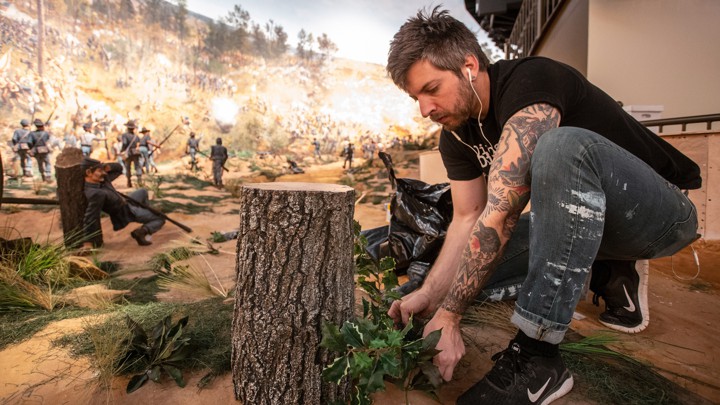
News: Atlanta's Civil War Cyclorama---Artifact, Memorial, or Lesson Plan?

 Atlanta’s Civil War Monument, Minus the Pro-Confederate Bunkum: A new exhibition of a gigantic painting uses historical fact to dispel Lost Cause mythology.  By Daniel Judt, The Atlantic Magazine, March 17, 2019

Every city in the South, it seems, is trying to figure out what to do with its monuments. Richmond has kept its grand “Monument Avenue” lined with statues of Confederate luminaries. New Orleans took Robert E. Lee and Jefferson Davis down from their pedestals.   In the city of Atlanta, whose leading Civil War monument is the enormous Atlanta Cyclorama, the strategy is novel: Use history itself to strip a divisive object of its symbolic power.

Cycloramas are panorama paintings designed for exhibition in rotundas. The viewer stands in the middle, cocooned by a canvas that becomes the world. The Atlanta Cyclorama shows the 1864 Battle of Atlanta, a crucial turning point in the Civil War that launched General William Tecumseh Sherman on his infamous march and sealed the South’s fate. Now the center of a major new exhibition at the Atlanta History Center, the Cyclorama measures 49 feet high by 382 feet long and weighs more than 9,000 pounds, making it one of the largest paintings in the United States.

 Ever since it premiered in 1886, the Cyclorama has itself been a battleground—a key theater in America’s 150-year fight over how to remember its Civil War. Some exhibitions have cast it as a Union victory; others as a Confederate one. At various moments, Union and Confederate veterans, white and black politicians, civil-rights leaders and segregationists have all tried to claim and control the Cyclorama. Some literally repainted it to promote their memory of the war. For much of the 20th century, the Lost Cause won out, and the Cyclorama served as Atlanta’s Confederate monument. It became part of an effort to uphold white supremacy under the guise of merely commemorating history.

The Cyclorama underscores why we care so much about monuments: not for the past they portray, but for the values they project into the present. “Southern white communities used monuments to preserve their version of the Civil War,” Sheffield Hale, the Atlanta History Center’s director, told me. “A statue of a Confederate general … is not about loss or grief. It is about power.”

When I spoke with Hale and his team of curators at the opening weekend late last month, they were very clear about the goal of the exhibition. They hope to end the Cyclorama’s career as a vessel for Civil War myths—to take away its power without erasing its history.

 They have succeeded. The new exhibition transforms the Cyclorama from, as Hale puts it, “attraction to artifact”—from monument to museum piece. It shifts the focus almost entirely from the history depicted in the painting to the history of the painting itself; from the battle that the Cyclorama depicts to the battle over that battle. And in doing so, it shows how we might resolve the long debate over Civil War monuments. Instead of letting the monuments tell our history, we can tell theirs.

Over its 133-year existence, the Cyclorama has proved uniquely pliable as a Civil War memento, perhaps because it was designed that way.
In their 19th-century heyday, cycloramas traveled from city to city, just as fairs or circuses did. They needed to appeal to a wide audience. When the Milwaukee-based American Panorama Company created the Atlanta Cyclorama, it instructed its team (all German immigrants who spoke no English) to paint an ambiguous juncture in the Battle of Atlanta: 4:45 p.m. on July 22, a moment when four Confederate brigades had just broken the Union line and taken control of Union artillery. Minutes later, Union reinforcements led by General John Logan would beat back the Confederates and end the threat. The Cyclorama depicts Logan on horseback, gallantly charging toward the battle. But he wasn’t there yet. The scene is tense, the outcome unresolved. The painters in Wisconsin crafted the Cyclorama to depict an impending Union victory. From another angle, though, the scene could also be interpreted as a Confederate opportunity. This was a moment when the war could have gone the other way.

The report continues at The Atlantic

Tuesday, July 29, 2014

New and Noteworthy--Making, Managing and Creating Memories of Gettysburg National Military Park

On A Great Battlefield: The Making, Management, and Memory of Gettysburg National Military Park, 1933-2013, Jennifer M. Murray, University of Tennessee Press, 2014, 312pp, notes, bibliography, index, 3 maps, 34 b/w photographs.$49.00.

Certainly with 82 pages of notes and 14 pages of bibliography, Jennifer M. Murray was provided one of the very best studies of the history of Gettysburg National Military Park [NM]. The first chapter covers the first 70 years of the park. The next ten chapters details the 80 year span between 1993 to 2013. Murray, currently an assistant professor of history at University of Virginia's College at Wise is formerly a seasonal interpretative ranger during nine summer at at Gettysburg NMP.

Of contemporary interest is the coverage Murray provides for the planning, the fundraising and the bitter controversies regarding expansive changes at Gettysburg. The public/private partnership to build the $103 million visitor center, the landscape rehabilitation, and the inclusion of exhibits presenting slavery, abolition, secession, Reconstruction and the Civil Rights Movement of the 1950s and 1960s in the visitor center may well be studied and redirect the mission, tasks and future of the National Parks Service and its historical parks.

The final years of the 20th century and the first decade of the 21st century is viewed as a watershed era in the story of the park. Excepting the years between 1933 and 1940, when the park had available funds from the New Deal, no other era contained the degree of expansion and improvement to the battlefield. Eight of the 11 chapters focus upon the era of 1946-2013. Though initially a Phd. dissertation, Murray's narrative in On A Great Battlefield is clear, concise, cogent and accessible to the general reader.


Monday, March 14, 2011

News---That Was Then, This Is Now: South Carolina's Plantations Talk About Slavery

Emancipating History, Edward Rothsetin, New York Times, March 13, 2011,

Charleston, S.C. Here, in this lovely town, once one of the most prosperous in the American colonies, there is no escape. In the Old Slave Mart Museum that opened in 2007, you read: “You’re standing in the actual showroom, the place where traders sold — and buyers bought — American blacks who were born into slavery.”

Or go to Drayton Hall, a local plantation hewn out of the Low Country landscape by hundreds of slaves, who also made its rice fields so profitable. At a clearing in the woods near the entrance, you see an information panel and a memorial arch: this was a “burying ground,” used at least as early as the 1790s, where the plantation’s slaves buried their dead.

Or drive to Boone Hall, another local plantation, which you approach through an avenue of moss-draped ancient oaks that leads visitors to the main house: you see a row of rare brick slave dwellings, placed so no visitor could have missed the immense wealth in human chattel. At one time, these one-room homes were joined by others on each side of the road, creating corridors of the enslaved, ushering guests to the master’s domain.

Or walk into the almost Italianate backyard of the Aiken-Rhett House in town, in which William Aiken Jr., who served as South Carolina’s governor, lived in the mid-19th century. Listen to the audio tour explaining that this was a work yard, and that such yards “were part of every town house in Charleston in the first half of the 19th century and were the domain of slaves.”

The house, together with the yards, we learn, “is referred to as an urban plantation.” And though Aiken was, by all accounts, an enlightened master (and an opponent of South Carolina’s secession), he was also the third-largest slaveholder in South Carolina.

Slavery and its heritage are everywhere here. Charleston was one of the main colonial ports of the 18th century, dealing in rice, indigo and slaves. In 1860 South Carolina held as many slaves as Georgia and Virginia, which were at least twice its size. The genteel grace and European travels of its wealthy citizens were made possible by the enslavement of about half the population.

So on a recent visit, I searched for a public display of an understanding of that American past and its legacy. After all, is there any more vexed aspect of this country’s history than its embrace and tolerance of slavery? And is there any aspect of its past that has been less well served in museums, exhibitions and memorials?

The sesquicentennial of the Civil War that is about to be commemorated means that it has been nearly 150 years since American slavery was brought to an end. But even in the North, the subject is still approached with caution, delicacy and worry. It inspires profound shame, guilt, anger, recrimination and remorse, aimed in many directions for many reasons on both sides of a racial divide. . . . .

At one plantation, Middleton Place, where restored 18th-century formal gardens and an exquisitely contoured landscape have won landmark status, descendants of slaves and of the plantation family have had a tradition of recalling their Middleton connections in separate gatherings. But at such gatherings, Charles Duell, the president of the nonprofit Middleton Place Foundation, which owns the plantation, has written: “Slavery was never mentioned. The subject was uncomfortable, very uncomfortable — not forgotten, but deeply sublimated.”

Slavery, he adds, was “simply not discussed within the family, or by employees, or with visitors to the Gardens.” Then, in 1991, a wood-frame house in which freed slaves had lived from the 1870s was restored as Eliza’s House, to show the living quarters that served generations of workers. In 2005 half of Eliza’s House was used to mount an exhibition still on display that tells the history of slavery and free black labor on the plantation, complete with the names and cost of each slave — some 2,600 people in all.

The dedication of the black burial ground at Drayton Hall last October also suited a broader plan developed by the hall’s executive director, George W. McDaniel. The plantation, now owned by the National Trust for Historic Preservation, does not only display its stunning Palladio-style house (which is meticulously unrestored), but also interprets the plantation with special attention to its slaveholding past.

A similar approach has been taken by the Historical Charleston Foundation, which owns the Aiken-Rhett House. The place has been so well preserved that its slaveholding records and the intact buildings provide what it describes as “one of the most complete records of an urban slave community in Charleston, and also the South.”

So out of a long tradition of silence has come a belated acknowledgment of slavery’s centrality and an attempt to explore it. But something more systematic is needed. The subject is far from neglected in the Charleston Museum, but neither is it fully addressed. The Avery Research Center for African American History and Culture at the College of Charleston plays an important role, but the difficulties are considerable, and not just because until recently the subject itself was not thought of as worthy of this kind of attention.

Historians of slavery must track census data and demographic information, commercial records and archaeological finds. There are few surviving objects or dwellings, and aside from important oral histories, there is scant documentation from slaves themselves. At the beginning of the 20th century, in fact, the field was dominated by Southern historians who gave the institution of slavery a paternalistic veneer. It was only in the 1930s that the historian Frederic Bancroft began piecing together the evidence showing just how important the domestic slave trade was. And that meant, to put it mildly, that slave families and owner loyalties were far less secure than previously portrayed.

The history has evolved since then, but it is still fitting that one of the most informative sites about slavery in Charleston is, despite its modest size and resources, a museum that focuses specifically on the slave trade and is housed in a building that during slavery’s last established years was one of the South’s primary slave markets: The Old Slave Mart Museum. Under the direction of Nichole Green, and with Elaine Nichols as curator, the museum, owned by the City of Charleston, is not a repository for objects, but a place where a narrative history is adroitly and soberly told, mostly on mounted wall panels. Part of that history is reflected in the building itself.

The trans-Atlantic slave trade had been forbidden by Congress in 1807, but that meant that the domestic trade became all the more important. Between 1789 and 1865, we learn, more than a million American-born slaves were sold in the South. In Charleston, they were mainly sold outdoors, near the Old Exchange Building . But eventually there were complaints about crowds obstructing traffic, and, more important, perhaps, as tensions with the North increased, sales of human beings were attracting critical attention. The city banned outdoor slave sales near the Exchange after July 1, 1856. That was the very day that “Ryan’s Mart” opened indoors, becoming the most important showroom in Charleston.

The museum doesn’t pretend to present a history of slavery, or an account of its abolition (though on the second floor, a traveling exhibition purchased from the Schomburg Center for Research in Black Culture, in New York, does address the subject). It simply chronicles the domestic trade. There is nothing here still redolent of such barter —the backyard prison, kitchen and outbuildings are long gone — but it doesn’t matter. The transformation of a slave showroom into a slave-trade museum gives a poignant edge to the account, in which an auction of slaves could resemble a sale of used cars.

The most valuable workers sold for nearly $40,000 in 2007 dollars (a chart of costs is shown). Hundreds of slaves, it is evident, could be worth more than the plantation they worked on. We read, too, that most white Southerners didn’t even own slaves. But slavery’s presence was widely accepted as natural.

Spend an hour here, and it starts to seem all the more remarkable that a museum has not undertaken a more ambitious examination of the subject. That will be one of the challenges for the National Museum of African American History and Culture in Washington, which is scheduled to open in 2015. In the meantime, remnants of slavery’s presence are so prevalent here that it becomes poignantly evident just how major an achievement is reflected by slavery’s enduring absence.

Text Source: The elipses [. . . . ] denotes two paragraphs removed from the complete text of article for space reason . New York Times, March 13 2011

Images' Source: McLeod Plantation, South Carolina