Showing posts with label Confederate History. Show all posts

Friday, April 26, 2019

News: Atlanta's Civil War Cyclorama---Artifact, Memorial, or Lesson Plan?

 Atlanta’s Civil War Monument, Minus the Pro-Confederate Bunkum: A new exhibition of a gigantic painting uses historical fact to dispel Lost Cause mythology.  By Daniel Judt, The Atlantic Magazine, March 17, 2019

Every city in the South, it seems, is trying to figure out what to do with its monuments. Richmond has kept its grand “Monument Avenue” lined with statues of Confederate luminaries. New Orleans took Robert E. Lee and Jefferson Davis down from their pedestals.   In the city of Atlanta, whose leading Civil War monument is the enormous Atlanta Cyclorama, the strategy is novel: Use history itself to strip a divisive object of its symbolic power.
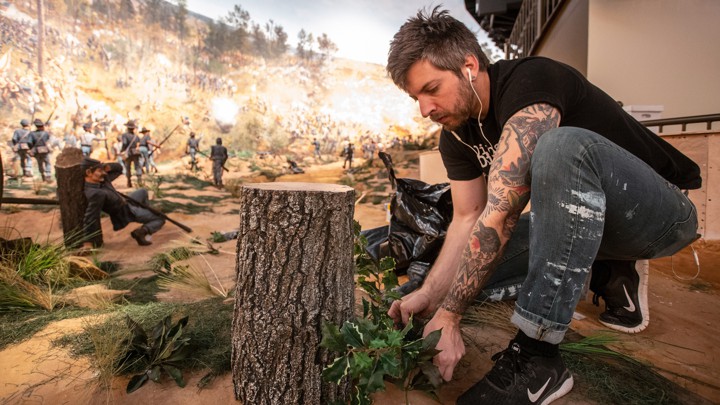
Cycloramas are panorama paintings designed for exhibition in rotundas. The viewer stands in the middle, cocooned by a canvas that becomes the world. The Atlanta Cyclorama shows the 1864 Battle of Atlanta, a crucial turning point in the Civil War that launched General William Tecumseh Sherman on his infamous march and sealed the South’s fate. Now the center of a major new exhibition at the Atlanta History Center, the Cyclorama measures 49 feet high by 382 feet long and weighs more than 9,000 pounds, making it one of the largest paintings in the United States.

 Ever since it premiered in 1886, the Cyclorama has itself been a battleground—a key theater in America’s 150-year fight over how to remember its Civil War. Some exhibitions have cast it as a Union victory; others as a Confederate one. At various moments, Union and Confederate veterans, white and black politicians, civil-rights leaders and segregationists have all tried to claim and control the Cyclorama. Some literally repainted it to promote their memory of the war. For much of the 20th century, the Lost Cause won out, and the Cyclorama served as Atlanta’s Confederate monument. It became part of an effort to uphold white supremacy under the guise of merely commemorating history.

The Cyclorama underscores why we care so much about monuments: not for the past they portray, but for the values they project into the present. “Southern white communities used monuments to preserve their version of the Civil War,” Sheffield Hale, the Atlanta History Center’s director, told me. “A statue of a Confederate general … is not about loss or grief. It is about power.”

When I spoke with Hale and his team of curators at the opening weekend late last month, they were very clear about the goal of the exhibition. They hope to end the Cyclorama’s career as a vessel for Civil War myths—to take away its power without erasing its history.

 They have succeeded. The new exhibition transforms the Cyclorama from, as Hale puts it, “attraction to artifact”—from monument to museum piece. It shifts the focus almost entirely from the history depicted in the painting to the history of the painting itself; from the battle that the Cyclorama depicts to the battle over that battle. And in doing so, it shows how we might resolve the long debate over Civil War monuments. Instead of letting the monuments tell our history, we can tell theirs.

Over its 133-year existence, the Cyclorama has proved uniquely pliable as a Civil War memento, perhaps because it was designed that way.
In their 19th-century heyday, cycloramas traveled from city to city, just as fairs or circuses did. They needed to appeal to a wide audience. When the Milwaukee-based American Panorama Company created the Atlanta Cyclorama, it instructed its team (all German immigrants who spoke no English) to paint an ambiguous juncture in the Battle of Atlanta: 4:45 p.m. on July 22, a moment when four Confederate brigades had just broken the Union line and taken control of Union artillery. Minutes later, Union reinforcements led by General John Logan would beat back the Confederates and end the threat. The Cyclorama depicts Logan on horseback, gallantly charging toward the battle. But he wasn’t there yet. The scene is tense, the outcome unresolved. The painters in Wisconsin crafted the Cyclorama to depict an impending Union victory. From another angle, though, the scene could also be interpreted as a Confederate opportunity. This was a moment when the war could have gone the other way.

The report continues at The Atlantic

Tuesday, April 17, 2018

News--Confederate Battle Flags Captured by US Colored Troops Exhibited in Richmond, Virginia

An African American leader brings a provocative take to expanded Civil War museum, Gregory Schneider, Washington Post, April 15, 2018


Caption:   Christy Coleman, CEO of the American Civil War Museum, which is headquartered at the site of the Tredegar Iron Works in Richmond. 
 
  Christy Coleman spends a lot of time among artifacts of the Civil War, and two that touch her deeply are a pair of tattered Confederate battle flags. This seems odd for an African American woman, until she explains.
One banner has a single word stitched on it: Home. The white material of the flag, it turns out, was cut from a wedding dress. The other flag is a traditional Stars and Bars, like you’d see on a T-shirt or shot glass. But this one was captured at the Battle of the Crater in Petersburg by United States Colored Troops.
Both relics hint at deeper human stories, and that’s where Coleman finds meaning in her job as chief executive of the American Civil War Museum, an institution created from the ruins of this city’s Confederate ironworks.

As the nation wrestles with its heritage of racial discrimination, and as the symbols of the Civil War show fresh power to divide, no place has a deeper stake than Richmond — a majority-black city where Robert E. Lee and Stonewall Jackson still cast long shadows. And no one is more on the spot to figure it all out than Coleman.“To have someone, a woman, who’s African American, at one of the most important museums in the former capital of the Confederacy — you can’t underestimate how important that is,” said Kevin Levin, a Civil War historian. “She really stands out.”

Coleman is using that position to look for a new way to tell the story of the Civil War, a conflict so easy to render in stereotypes. With a major expansion of the museum underway, her goal is to show the conflict from multiple points of view — not just North and South, but through the eyes of women, Native Americans, enslaved blacks, immigrants. If you can change perspectives, the thinking goes, issues begin to look different. Assumptions waver. 

That premise will be put to the test long before the expanded museum opens later this year. Coleman is helping lead a commission appointed by Richmond’s mayor to recommend what to do with five enormous statues of Confederate leaders along the city’s grandest residential boulevard, Monument Avenue.
Those statues are as fundamental to Richmond’s identity as Thomas Jefferson’s Capitol building. Coleman is conscious of the violence that has ripped other communities, such as nearby Charlottesville, over the same issue. But it’s not the first time she has confronted the nation’s most troubling legacy in a controversial and public way.“America’s reckoning with her sin and her trauma,” Coleman said, “is really what we’ve got to get to.” 

Coleman, 53, grew up in Williamsburg, in the workaday city behind Ye Olde Colonial Facade. Her neighborhood and church were filled with the tradespeople who groomed the gardens, sheared the sheep or ran the printing press in the historic area.  Most of the costumed interpreters didn’t look like Coleman, despite the fact that in Colonial times more than half the residents of Williamsburg were of African descent.
But she was captivated by them and won an audition for a reenactor role when she was only 17. The other historic interpreters worried about her. “They were preserving trades,” she said. “I was portraying an enslaved person.”

She saw something horrible overcome visitors who encountered her in that role. The modern veneer slipped aside and out came racial epithets or crude sexual comments. As a young woman, she struggled to process those situations. But she stuck with it, the thrill of giving voice to the voiceless more powerful than the revulsion. By the mid 1990s, after starting at William & Mary and graduating from Hampton University, Coleman became Colonial Williamsburg’s director for public history. She oversaw all of the historical interpreters.

One of her first big events was an annual market day, reenacting the way Colonial Virginians auctioned cattle and land. A staffer pointed out the obvious: The real market would have sold slaves, too.Coleman decided it was time to do something radical. She took a plan to upper management to stage a live slave auction. And she would be one of those on the sale block.The idea touched off a national debate. “Black and white folks thought that . . . it was going to stir up stuff that didn’t need to be stirred up in America,” Coleman said.
A massive crowd and international media showed up. Plainclothes police stood among the onlookers, just in case. And Coleman and three other African Americans let themselves be sold to the highest bidders.

Today, that event is viewed as a landmark success in the modern retelling of American history. After generations of avoiding the topic, other major institutions — such as Thomas Jefferson’s Monticello and James Madison’s Montpelier — now confront enslavement as a major component of their interpretation.
But it exacted a heavy price on Coleman. The emotional stress brought on panic attacks that stuck with her through years of therapy.

She never repeated the auction. A few years later, she was wooed to Detroit to run the Charles H. Wright Museum of African American History. Nearly a decade into that job, Coleman was married and had two small children and wanted to slow things down a bit. She got word of a small museum back home in Virginia that was looking for a shake-up. Richmond long portrayed its past in a one-sided way. After the Civil War, widows and wives of Confederate veterans gathered memorabilia and displayed it in the old Confederate White House. From that collection, arguably the most extensive of its kind anywhere, grew the Museum of the Confederacy.

The full text of the story is continued at----Full Text: Washington Post