Showing posts with label Battlefield Dead. Show all posts

Monday, May 20, 2019

News---12,000 Burials of Names Unknown Soldiers and Identification Without DNA Clues


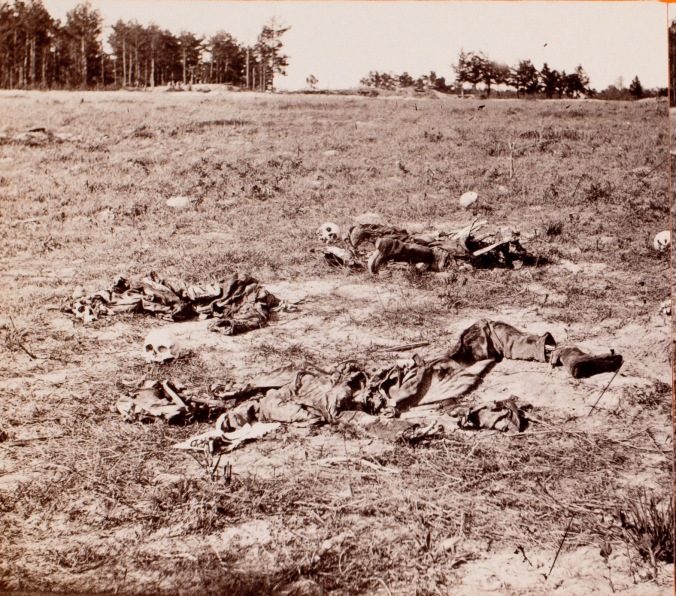
Wilderness dead in open fieldUnknown Until Now–The Ongoing Effort to Identify the Dead in the Fredericksburg National Cemetery, Peter Maugle, Mysteries and Conundrums weblog, May 18, 2019.

The officer stood over the freshly exhumed grave with a pencil and ledger in his hands. He told others to search the remains as he struggled to decipher the crude etching on a weathered piece of wood. The lettering was faded and worn, but seemed to read, “W.A.W.” A worker called the officer’s attention to a hat badge that indicated the deceased was from New Hampshire. The other workers shook their heads to signify there was no additional identifiable information to be found. The officer then recorded in the ledger book, “Grave # 1221, W.A.W., NH, removed from O’Bannon’s Farm.” A pile of bones and decayed clothing was then placed into a rough wooden coffin for transport to the newly established Fredericksburg National Cemetery.

The aforementioned scene was repeated over 15,000 times in Fredericksburg and Stafford and Spotsylvania counties from 1866 to 1868. During this period, United States Army reburial details scoured the region cataloging and reinterring the remains of Union soldiers. Sadly, over 12,000 of the graves were simply marked, “Unknown.” It was the result of no standard issue identification for the soldiers, no protocol for properly identifying or marking graves, and the sheer magnitude of casualties incurred on a landscape that witnessed four of the costliest battles of the Civil War.

However, in some instances, surviving soldiers took it upon themselves to identify and mark the graves of their comrades. This would likely be a difficult process in the aftermath of battle. Locating remains among the detritus of war surely complicated things, not to mention the armies were still in the midst of active campaigns. If a deceased soldier’s body was actually found, the next challenge was how to effectively mark the gravesite. Usually it was a shallow, hastily dug grave, and the marker would consist of writing or etching on various materials such as wood, metal, or even pieces of leather equipment. Not knowing who (if anyone), would ever tend to these graves, the soldiers did the best they could considering the circumstances.

carpenter-farm-graves-327-smallerDepending on when the death occurred, these graves, and their improvised markers, could remain untended for several years. During that time, the elements, animals, or unsympathetic locals could damage, remove, or destroy makeshift markers. Thus, the noble efforts of the living were for naught, as any indication of the grave’s occupant was compromised or simply disappeared.


Upon the war’s culmination, the Federal government established national cemeteries throughout the south, to better administer and honor the multitude of Union dead there. United States Army officers were assigned to supervise parties of contracted workers, some of them former enslaved men, to reinter the remains of Union soldiers to the national cemeteries. They were to establish identification to the best of their ability, despite the inherent difficulties. It appears they took this responsibility quite seriously, which might be expected due to their vocation.

Unfortunately, many found it near impossible to discern any semblance of identity from decomposing corpses that had been buried in a haphazard manner several years prior. But, there were exceptions. Some rudimentary grave markers actually survived relatively unscathed, and made the identification process fairly straightforward, although it was certainly not common. There were many graves with only a partially discernable marker; a soldier who had their last name or initials stenciled on their equipment or uniform; an officer whose rank and unit could be determined from their insignia, but their name was not there. Instead of simply denoting these partially identified men as “unknown,” the officers supervising the reburial details made a point to record any tidbits of information. As a result, the Fredericksburg National Cemetery includes gravestones engraved with only initials, just a last name, or merely a first name. The rank or state may also be noted, and the original site of the grave was documented. Why would this be important? How did the officers think these fragments of information could possibly be utilized?

Fast forward 152 years later, as Steve Morin, a volunteer at Fredericksburg and Spotsylvania National Military Park, pores through the yellowed pages of an antique book, cross-referencing it with his iPad. Morin, a retired FBI research specialist and student of the Civil War, is attempting to determine the identity of an unknown soldier. He is not using DNA to perform this task, which makes it possible to ascertain the names of many World War II, Korean and Vietnam War soldiers whose remains had been anonymous. Instead, Morin is using a combination of rosters, books, and online resources to reveal the identities of these otherwise indistinguishable men.
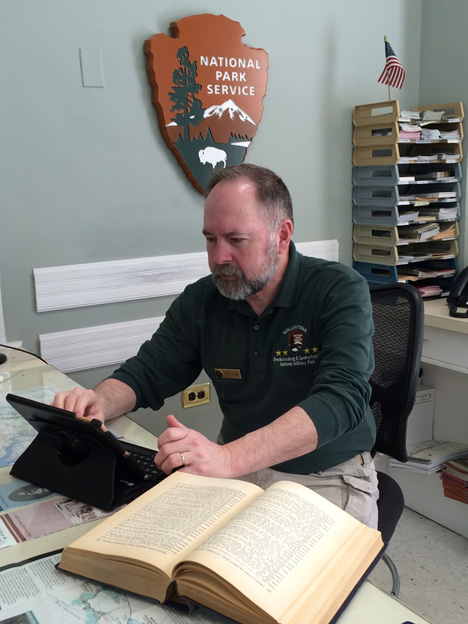

Steve MorinThe process can be tedious and frustrating at times, but Morin has the right mindset and background. Experience with the FBI instilled in him a conviction to get the facts straight. No stone is left unturned as Morin strives to make the most accurate identification possible. He scrutinizes enlistment and payroll records, unit rosters, pension applications, and a multitude of other sources. Morin must also take into account misspellings or misinterpretations of writing from over 150 years ago. He might consider if the letter “A” was perhaps misconstrued as an “H” on a crude grave marker, or if a soldier’s state of origin is supposed to be MA, ME, or MG? Sometimes the clues come together like a puzzle, and lead to a distinct probable identity. When a solid deduction is made based upon all available evidence, the outcome is denoted in the Fredericksburg National Cemetery records. The entries are never definitive, however, and always reflect a degree of uncertainty. And if there is insufficient evidence, the best course of action is to leave the status as “Unknown.”

Another researcher assisting with the identification project is Michael Taylor, a midshipman at the United States Naval Academy. Taylor was inspired to take on the task (in addition to his course load and other duties at the USNA), after he attended a tour of the Fredericksburg battlefield with his fellow midshipmen. The visit ended in the Fredericksburg National Cemetery, where Michael was struck by the over 12,000 unknown graves. He asked park staff if there was any way to go about identifying these soldiers. The arduous and complicated process necessary to establish any semblance of positive identification was explained to Taylor, but it did not deter the midshipman. Within a week, Michael delved into digital resources provided by the National Park Service and came up with promising leads. Now, over a year later, Taylor’s work has resulted in almost one hundred corrections and probable identifications for these previously unknown Civil War soldiers. Taylor, the son of a Vietnam War veteran, feels, “All those who served this country deserve to be remembered.”
When the Army reburial parties went about their grim task over 150 years ago, it is remarkable to consider they made every possible effort to somehow identify the fallen. Even if it only entailed part of a name, or their state of origin, there was an expectation that the task would someday be completed. Despite not knowing if there would be enhanced recordkeeping or organizations established to administer these places, the conviction was there. Otherwise, why bother inscribing “W.A.W.” on a gravestone? Now, with vast archives and multitudes of records available at a few keystrokes, the seemingly impossible is viable. Persistent research allows us the opportunity to fulfill the aspirations of our forebears by finally identifying these Civil War dead.
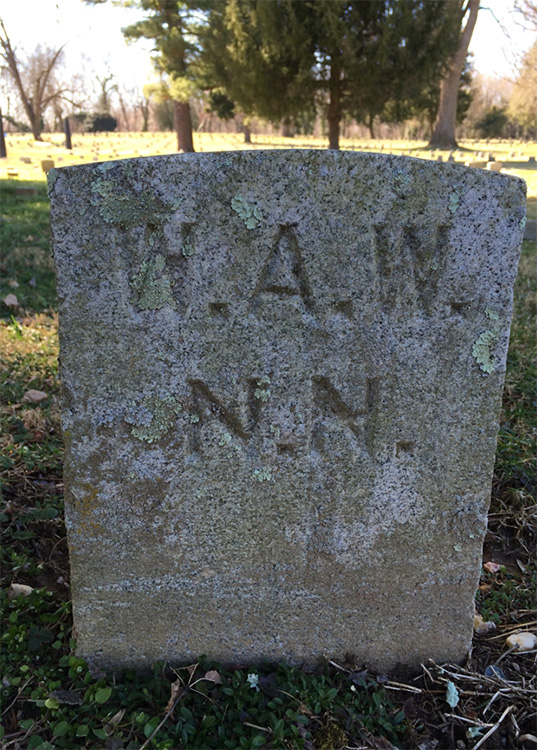
George Wheeler Grave NC Today, the gravestone in the Fredericksburg National Cemetery is still inscribed with the same ambiguous lettering, “W.A.W.” (National Park Service policy prohibits correcting gravestones for “errors of fact”). However, after extensive research by volunteer Steve Morin, the cemetery roster, maintained by the National Park Service and available to the public, reflects that this grave very likely belongs to Private George A. Wheeler of the 5th New Hampshire Infantry Regiment. Documentation indicates a soldier from New Hampshire named Wheeler was wounded at the Battle of Fredericksburg, removed to a field hospital, and died a few days later. An assistant surgeon recorded Wheeler’s death at the regimental hospital located near the O’Bannon farm in Stafford County. Perhaps his comrades crafted the rudimentary grave marker that a reburial detail found four years later. Their efforts, while diminished by the elements, later provided an army officer with some vague information associated with these remains. His copious notations eventually enabled an amateur historian to piece together the story of an otherwise unidentifiable casualty of our nation’s costliest conflict. Now, anyone searching for this soldier, whether a family descendant or a Civil War researcher, will be able to find him accordingly, whereas for 150 years prior, this soldier’s final resting place was essentially unknown.

The important work done by Steve Morin, Michael Taylor, and others will be highlighted this year at the Fredericksburg National Cemetery’s Luminaria, held on Saturday, May 25th. For the last twenty-three years, local scouts have lit over 15,000 candles on Memorial Day weekend, one for every soldier interred at the cemetery. However, this year’s program will be uniquely different, as attendees will be encouraged to visit the graves of several previously unknown soldiers and learn about the remarkable process it took to have their stories told for the first time in over 150 years.

Images:  

 Second from the top---- Union graves on the Carpenter Farm, 1866. Note the identification on the board nearest the camera–Richard Ross, today buried in the National Cemetery.

Third from the top---- Park volunteer Steve Morin, former FBI Research Specialist

Fourth from the top---- Grave # 1221 in the Fredericksburg National Cemetery, believed to be that of Private George A. Wheeler

Full Text and Image Source:     Mysteries and Conundrums weblog

Sunday, November 12, 2017

Forthcoming in early 2018: The Civil War Dead--What Their Photographs Did To Americans and Their Culture

  The Civil War Dead and American Modernity, Ian Finseth, Oxford University Press, 352 pages, February 2018, $65.00 hardcover

From The Publisher:   The Civil War Dead and American Modernity offers a fundamental rethinking of the cultural importance of the American Civil War dead. Tracing their representational afterlife across a massive array of historical, visual, and literary documents from 1861 to 1914, Ian Finseth maintains that the war dead played a central, complex, and paradoxical role in how Americans experienced and understood the modernization of the United States. From eyewitness accounts of battle to photographs and paintings, and from full-dress histories of the war to fictional narratives, Finseth shows that the dead circulated through American cultural life in ways that we have not fully appreciated, and that require an expanded range of interpretive strategies to understand.

While individuals grieved and relinquished their own loved ones, the collective Civil War dead, Finseth argues, came to form a kind of symbolic currency that informed Americans' melancholic relationship to their own past. Amid the turbulence of the postbellum era, as the United States embarked decisively upon its technological, geopolitical, and intellectual modernity, the dead provided an illusion of coherence, intelligibility, and continuity in the national self. At the same time, they seemed to represent a traumatic break in history and the loss of a simpler world, and their meanings could never be completely contained by the political discourse that surrounded them.

Reconstructing the formal, rhetorical, and ideological strategies by which postwar American society reimagined, and continues to reimagine, the Civil War dead, Finseth also shows that a strain of critical thought was alert to this dynamic from the very years of the war itself. The Civil War Dead and American Modernity is at once a study of the politics of mortality, the disintegration of American Victorianism, and the role of visual and literary art in both forming and undermining social consensus.
Table of Contents

Section I. The "Ghastly Spectacle": Witnessing Civil War Death Chapter 1: The problem of experience
Chapter 2: Sense, affect, representation
Chapter 3: Faces, names, types, families
Chapter 4: Melancholy reflections

Section II. Body Images: The Civil War Dead in Visual CultureChapter 1: Photography and the question of empathy
Chapter 2: The illustrated dead
Chapter 3: Lithography, history, allegory
Chapter 4: Painting and the enigma of visibility

Section III. Blood and Ink: Historicizing the Civil War Dead Chapter 1: Objectivity, partisanship, nationalism
Chapter 2: The early years: Northern determinism
Chapter 3: The early years: Southern alienation
Chapter 4: Later years: The convergence
Chapter 5: African American counterhistory

Section IV. Plotting Mortality: The Civil War Dead and the Narrative ImaginationChapter 1: Modernity, disenchantment, and the agons of realism
Chapter 2: "Grieve not so": Loss and the new woman
Chapter 3: Narratives ajar: Elizabeth Stuart Phelps and the refusal of closure
Chapter 4: Farewell, sacrificial hero
Chapter 5: The returning dead

About The Author: Ian Finseth is Associate Professor of American Literature at the University of North Texas. His scholarly work focuses on the literary history of transatlantic slavery, abolitionism, and the American Civil War. Dr. Finseth was born in Boston, grew up in California, and earned degrees from UC Berkeley (B.A.), the University of Virginia (M.A.), and UNC-Chapel Hill (Ph.D.)

Monday, June 17, 2013

New and Noteworthy---How Soldiers Die In Battle

The following is a portion of a book review written by Andrew Burtch, Canadian War Museum, published by Michigan War Studies, June 13, 2013.

The Last Full Measure: How Soldiers Die In Battle, Michael Stephenson, Crown Publishing, 464 pp., 2013, $28.00.

In The Last Full Measure, Michael Stephenson combines a compelling, encyclopedic analysis of the history of warfare with firsthand accounts of battlefield carnage. The finished product is accessible, informative, convincing, and moving. It forgoes any discussion of the geopolitical and strategic elements of warfare to get at what Stephenson defines as the core of military history—killing and dying. Whether inflicted by fire-hardened sharp sticks, swords, axes, arrows, musket balls, high velocity rounds, cruise missiles, or IEDs, violent death links soldiers across the centuries.

Stephenson states his central thesis in a discussion of combat in the Pacific during the Second World War: "The fighting ... reminds us that combat is a bloody gutter-slop: nasty, brutish and short—an abattoir that is only later cleaned up, perfumed, and decorated with the laurel crown of history" (262). He also dismantles the myth of the "Western Way of War," characterized by heroic man-to-man confrontations on the battlefield, by highlighting accounts from the sharp end, where "the last sound from the lips of the stricken is not so much the rousing call 'for the motherland' as the heartbreaking cry for mother" (xii–xiv).

. . . .

The book has no formal conclusion, perhaps because wars and their aftermaths are still ongoing in Iraq, Afghanistan, and elsewhere, and any attempt to assess definitively their outcome or meaning would quickly be outdated. But Stephenson misses an opportunity to use his considerable store of evidence to answer a question he raises at the close of his Civil War chapter. If war is such a devastating experience (in General Sherman's words, if "war is hell"), why does it continue to exist? Why is it that a man like Oliver Wendell Holmes Jr., wounded and thoroughly disillusioned, resigned his commission, yet less than twenty years later, "Like some American samurai, … discovered a fervent belief in the mystical importance of a warrior's unquestioning obedience unto death" (165).

Why, in short, do men so easily forget the atrocities of past wars just in time for the next one? Of course, many historians have fruitfully explored the meaning and memory of death and the heroic ideal after the battle, but we are left to wonder about Stephenson's thoughts on the subject.
This book is a thoughtful, respectful treatment of a difficult subject. Its author deftly balances personal, sometimes extremely graphic accounts of death and mutilation with enlightening historical analyses, steering clear of the purely anecdotal war stories or "pornography of violence" that John Keegan warned against. I recommend The Last Full Measure to both scholars and general readers with any interest in military history.

The full text of the review is found at Michigan War Studies, June 13, 2013

Thursday, July 26, 2012

Interactive Map: Where Were Gettysburg's Battlefield Dead Buried?

Zoom view
The Elliott Map is a map of the battlefield of Gettysburg made from an accurate survey of the ground by transit and chain by S. G. Elliott and Company.  Dated June 10, 1864, this map shows the locations of Union and Confederate burials, dead horses, breastworks, lunettes for artillery, and rifle pits, borough and farm buildings,  as well as topographical features.


Although the information appears impressive, a modern day research by historians and battlefield guides argues that the number of burials shown on the map [in particular in the Rose Farm area] are much less in number than what actually exists.   


The Library of Congress has an online and interactive Elliot Map. This link will bring you to the LOC map. Once you have the map on screen you can zoom in and out and scroll around the map by using the computer's  mouse wheel.  The Battle of Gettysburg Resource Center has a online compendium of historic and contemporary maps. Here is the link.