Thursday, January 09, 2014

Interview With Authors---Gettysburg: The Story of the Battle With Maps, Detweiler and Reisch [Part Two]


Interview with David Detweiler and David Reisch, of Gettysburg: The Story Of The Battle With Maps, Editors of Stackpole Press, [2013]

DD--David Detweiler, President and Chairman, Stackpole Publishing, author
DR—David Reisch, historian, researcher, cartographer, author

CWL—Civil War Librarian, Rea Andrew Redd, Director, Eberly Library, and adjunct instructor, U.S. history, Waynesburg University, Waynesburg, PA 15370; author of Gettysburg Campaign Study Guide, Volume One, [2012].

CWL: 6. Can you describe the process of preparing the atlas for publication?  What stumbling blocks were there? 

DD:  Stumbling blocks:   in a word, the ever difficult, torturous, essential decision, demanding to be made again and again and again, of what to leave out.  Also, to strive (didn’t often succeed, but tried) to make all clear.  Text.  Maps.  People are starving for clear expression.
DR:  It was an intense and intensive process of writing, mapmaking, discussing, revising, with research done, and done again, every step of the way.  It involved not only the two of us and stacks of books, reams of paper, but also a team of creative, hardworking folks who took the text and hand-drawn pencil maps and turned them into the eye-pleasing pages you see in the book.

CWL: 7. What did you discover that surprised and when you knew you were done?
DD:  That I wasn’t sad.

CWL: 8. On the left page "clips" of the map on the right page are presented.   This appears to be a novel approach.  How did this concept develop?
DD:  Good question.  Though we held the concept of never changing the “stage” of the base map, it does, in fact, illuminate and edify to blow up a sector, to show complicated action there, so we developed what we call “margin” art, or little clips, as you excellently describe it, to enlarge, even mark up a bit, and run in the margin of the base-map-facing text page, beside the relevant text.    Also, in the margin art you can graphically, i.e. nonverbally, “say” (show) what might have been, what was intended, what was prevented, so on.

CWL: 9.   Time on the battle clock is always debatable.  Noah Trudeau’s  A Testing Of Courage has clocks with hour and minute hands on each map. Gettysburg: The Story of the Battle With Maps uses terms such as ‘midday’ ,  ‘late afternoon’ and ‘twilight’ to designate time. 
DD:  Right . . . we worked hard to get the events described/portrayed in the order in which they happened.  To get (approximate) contiguity and contemporaneousness . . . but as to what 15-minute time field anything happened in, it’s far rarer to find agreement than diverse variation, among the many excellent texts and map books on the battle, as to just when an event occurred.  What its duration was.   I found three reputable accounts of the Battle that couldn’t agree on when the sun came up!
DR:  Almost unbelievably to our modern atomic-clocked minds, time was a rather subjective thing 150 years ago, outside but especially inside the world of battle.  Time was often guessed at by the position of the sun, those who had watches generally did not synchronize them, and combat distorted – stretched, compressed, twisted – time.  One example:  Most accounts agree that the artillery barrage before Pickett’s Charge began around 1 p.m. on July 3, but estimates of the barrage’s duration vary wildly, from approximately twenty minutes to five hours or more . . . which of course has implications for just when the Charge itself began.  But there are enough firsthand accounts, and enough historians have analyzed and dissected those accounts, that very reasonable estimates could be made, especially within the geographic and chronologic framework we were creating – once we nailed down a couple events, another handful would fall into place.

CWL: 10. The narrative is written in the present tense and future tense. How was this decision made?
DD:  There’s a tiny sprinkling of past tense.  But you’re right, 99% is present tense.   Guess I thought the past tense might become too ponderous . . . also, the book as I’ve struggled to describe (facets of) it above is, in its spirit, and letter, virtually always in the present moment.    Other (better) books must (nevertheless) flash back, use the pluperfect, and in their structure as well as tense stutter around, back, forward, in their sections, in time.
DR:  The present tense was a natural fit for a book like this, which describes and illustrates the battle as it unfolded – er, unfolds.  Hopefully it conveys a sense of immediacy and contingency – a sense that the battle is happening right here, right now, and could, at any number of decision points, have turned out somewhat differently.  The present tense isn’t appropriate for every work of history, and it has its limitations, but to my mind it’s not deployed as often as it might be, particularly in military history.  Castel’s Decision in the West is an outstanding example of the possibilities for the present tense in historical writing.

Interview With Authors---Gettysburg: The Story of the Battle With Maps, Detweiler and Reisch [Part One]


Interview with David Detweiler and David Reisch, of Gettysburg: The Story Of The Battle With Maps, Editors of Stackpole Press, [2013]

DD--David Detweiler, President and Chairman, Stackpole Publishing, author
DR—David Reisch, historian, researcher, cartographer, author

CWL—Civil War Librarian, Rea Andrew Redd, Director, Eberly Library, and adjunct instructor, U.S. history, Waynesburg University, Waynesburg, PA 15370; author of Gettysburg Campaign Study Guide, Volume One, [2012]. 

CWL: 1. Tell us a bit about yourself regarding and how you came to be editors for Stackpole Press?
DD:  STACKPOLE is a family-owned small business and I the fourth generation.  We do excellent books, I think.  Have been running it for 38 years;  if survival’s success, am succeeding.
DR:  It was my good fortune that Stackpole was hiring just as I left college with a degree in history and a love for the written word.  I’m still here more than ten years later.

CWL: 2. As editors, what tasks to you regularly do?
DD:  I am an editor at heart, despite title, and an editor finds superb authors and helps them develop a book better even than they could have imagined.
DR:  Editors, especially at a smaller publisher like Stackpole, perform a variety of tasks, from the acquisition and development of new books to the copyediting and proofreading of those books, as well as marketing and promotion work.  Turns out we can also be called upon, happily, to be historians as well.

CWL: 3. What got you interested in the study of history and the Civil War period?  Are other periods of history as important to you as the American Civil War?
DD:  My granddad, a citizen soldier, was gripped by and wrote about the Civil War.  I picked at a ravel, a couple of years ago:  Gettysburg, and have happily drowned in the infinite fascination of the infinite subject matter.  (More on mixed metaphors later.)
DR:  My interest in history began, when I was a boy of eight or nine, with an interest in the Civil War, which in turn began with books, such as the old classic kids’ novel Rifles for Watie.  Soon I moved on to Civil War Times magazine and adult history books.  Among the first of those I ever read was General Stackpole’s They Met at Gettysburg.  I was hooked, on Gettysburg, on the Civil War, on history.  It didn’t hurt that I grew up half an hour from the battlefield, had parents who encouraged my interests, and had some wonderful and inventive history teachers, not only in college, but also in middle and high school.  I often venture into other areas of history, World War II especially, but without fail I come back to the American Civil War.  Fortunately for publishers, not to mention historians, there seems always to be something new to learn, new to say, about this inspiring, appalling war of better angels and killer angels.

CWL: 4. Within the recent past, several Gettysburg Campaign atlases have been published. Why another atlas on Gettysburg?
DD:  I conceived of a treatment of the Battle of Gettysburg which would map, every other page, the progress of the battle without changing the grid, the size, the dimensions, the area, of the map.  Books previously – excellent ones – without fail took advantage of space to, when half the battlefield contains no event, leave it visually out.  Our GETTYSBURG shows the flow of the battle by keeping the stage – the base map – constant.  Other books zoom in, focus on an important area, fine.  But our original treatment shows something that a “moving camera” cannot:  the flow, the progress, of the facets of the battle as interrelated in time and space constant, over the 3 days.  Years ago when they made a film of the ballet Romeo and Juliet (Prokofiev’s I think), it drove me crazy when the movie camera moved – with Nureyev as he leaps -- or Fonteyn as she pirouettes along.  Ballet’s to been seen danced, its flow, on the unmoving base map of the stage.

CWL: 5. What makes your study stand out?  What does it contribute to the literature that has not already been contributed by others?
DR:  We’re lucky to have some very good maps of the battle.  But as useful as those other maps are, the picture they give can sometimes be disjointed or at least incomplete.  It’s essential to zoom in on, say, the Wheatfield in order to understand that bloodily tangled area of the battlefield.  But our book zooms out to show not only what was happening in the Wheatfield, but also what was happening elsewhere on the field at the same time – the fighting taking place in other sectors, the movement of reinforcements, and so on – so that the importance of the Wheatfield becomes clear (e.g., why it was the scene of such desperate fighting, what the Confederates could have done if they decisively seized it, how Union reinforcements of the Wheatfield sector weakened other parts of Meade’s line) and so that the tactical decisions of Lee, Meade, and their lieutenants can be more easily understood.  We’ve aimed to depict – shifting now from dance to music – not movements or isolated bars of melody, not cellos or trumpets alone, but the entire grand symphony that was the Battle of Gettysburg.


Thursday, January 02, 2014

News--40th Pennsylvania Reserves' Colonel Gallagher's Uniform and Gear Returns Home to Westmoreland County

Civil War Colonel's Uniform Returned Home To Westmoreland County, Len Barcousky, Pittsburgh Post-Gazette, December 27, 2013

Col. Thomas Foster Gallagher didn't know when to quit. "He was captured, sent to Libby Prison, freed, and returned to the army," Lisa Hays said of the Civil War officer from New Alexandria. "He was wounded in another battle. After he recovered, he returned to service. He kept going back to the war."

Ms. Hays, the executive director of the Westmoreland County Historical Society, said her organization has plans to let more people know about Gallagher's adventures. The historical society recently bought military clothing and equipment belonging to Gallagher when the items were sold at auction by his descendants. Now the society is in the midst of a fundraising effort to pay for conservation of the artifacts. Gallagher, born on Jan. 17, 1822, made his living as a merchant in New Alexandria. "Prior to the Rebellion he was a prominent figure in the Pennsylvania militia movement, and advanced from the office of lieutenant to major general," John Newton Boucher wrote in his two-volume "History of Westmoreland County." "His record during the great civil conflict of 1861 to 1865 was one of a marked success."

Gallagher and his wife Elizabeth had seven children. The items recently acquired by the historical society had stayed in the family until they were put up for sale through Massachusetts-based Skinner auction house on Nov. 2. Board member John Mickinak successfully bid for the collection via telephone. The items, which sold for $9,600, including a buyer's premium, included two military coats, two sashes, a sword belt, trunk and saddle. Also included were pieces of horse tack -- items such as bridles, reins and bits. "The tack is so ornate that we speculate it was given to him by his men or was some other kind of ceremonial gift," Ms. Hays said.

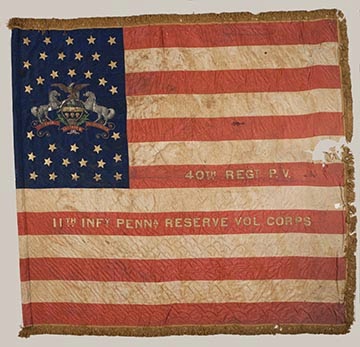
The society bid on the items after Mr. Mickinak investigated the provenance, or chain of ownership, of the artifacts. "We felt comfortable knowing that the items were coming from the family," Ms. Hays said. Gallagher enlisted on July 2, 1861, and was commissioned colonel of the 11th Pennsylvania Reserves, also known as the 40th Regiment in the Pennsylvania Line. He and much of his command were captured in June 1862 in Virginia at the Battle of Gaines Mills.

Following his release from Richmond's Libby Prison, he returned to the army and was promoted to commander of the Third Brigade of the Pennsylvania Reserves. He was badly wounded in Maryland during the Battle of South Mountain on Sept. 14, 1862.His last command was of the 54th Pennsylvania Militia, which helped in the capture of Confederate raider Gen. John Hunt Morgan and his men in 1863. He died in 1883 at 61 and is buried in New Alexandria Union Cemetery.

The society has received about 50 donations toward the costs of acquisition and conservation of the Gallagher artifacts. Gifts have ranged from $10 to a five-figure donation from the Katherine Mabis McKenna Foundation. Tax-deductible donations can be made to the Westmoreland County Historical Society, 362 Sand Hill Road, Suite 1, Greensburg, PA 15601, or by calling 724-532-1935.

In addition to collecting money for preservation of the Gallagher items, the society is about halfway through an effort to raise $4.3 million for the construction of a History Education Center at Hanna's Town county park in Hempfield and Salem. The proposed center would become home for the Gallagher artifacts as well as items related to all eras of Westmoreland history, Ms. Hays said. The county is home to about two dozen local history organizations. The center would offer permanent, long-term and temporary exhibits that could feature items from organizations that do not have display space for their collections.  Information about the proposed education center and donation information are online at westmorelandhistory.org/campaign.

Full Text and Gallagher Image Source: Pittsburgh Post Gazette.com 

Wednesday, December 18, 2013

News---North Carolina Sons of Confederate Veterans Fund Conservation of Battle Flag

Sons of Confederate Veterans Funds  Conservation of Another Battle Flag At Museum of History, Michael Hudson, Beach Carolina Magazine, December 16, 2013.    On November 21, 2013, members of the Sons of Confederate Veterans, Camp 379 in Marion, North Carolina, presented an $8,200 check to staff at the North Carolina Museum of History in Raleigh. The funds will be used for specialized conservation treatment of a battle flag carried by the 35th Regiment North Carolina Troops during the Civil War. The generous gift was the result of two years of fund-raising by Camp 379.

“It is an honor for Camp 379 to help preserve a part of North Carolina’s important history for future generations,” noted Jeff Cordell, Commander, North Carolina Division, Sons of Confederate Veterans, Camp 379. The historic banner is part of the museum’s Confederate flag collection, one of the largest in the nation. The standard wool-bunting state flag is missing its regimental numbers, possibly cut away as a souvenir during the war.

35th Regiment, North Carolina Infantry

35th Infantry Regiment completed its organization in November, 1861, at Camp Mangum, near Raleigh, North Carolina. Its members were raised in the counties of Mecklenburg, Onslow, McDowell, Moore, Chatham, Person, Union, Henderson, Wayne, and Catawba. After fighting at New Bern, the regiment was ordered to Virginia and assigned to General R. Ransom's and M.W. Ransom's Brigade. It participated in the difficult campaigns of the Army of Northern Virginia from the Seven Days' Battles to Fredericksburg. Ordered back to North Carolina, it fought at Boon's Mill and Plymouth , then returned to Virginia in May, 1864. The 35th saw action at Drewey's Bluff , endured the hardships of the Petersburg Campaign  siege south of the James River, and ended the war at Appomattox. This unit sustained 127 casualties at Malvern, 25 in the Maryland Campaign, 29 at Fredericksburg, and 103 at Plymouth. Many were disabled at Saylor's Creek, and on April 9, 1865, it surrendered 5 officers and 111 men. The field officers were Colonels James T. Johnson, John G. Jones, Matthew W. Ransom, and James Sinclair; Lieutenant Colonels M.D. Craton, Oliver C. Petway, and Simon B. Taylor; and Majors John M. Kelly and Robert E. Petty.

Text Source with slight edits:  Beach Carolina Magazine

Text Source of 35th NC Infantry: National Park Service


Thursday, December 05, 2013

News: Slave Cabins and Sherman's March Encampment Sites In Path of New Georgia Highway

Archaeologists Discover Slave Artifacts Were Georgia Highway Project Will Cross Georgia Plantation Site, Russ Bynum, Associated Press, December 1, 2013.

A Mexican coin punctured with a small hole, nails from long-decayed wooden dwellings, and broken bits of plates and bottles are among thousands of artifacts unearthed from what archaeologists suspect were once slave quarters at the site of a planned highway project in Savannah.

A team hired to survey the site by the Georgia Department of Transportation spent three months excavating 20 acres of undeveloped woods tucked between a convenience store and apartments off busy Abercorn Extension on Savannah's suburban south side. Archaeologist Rita Elliott said the project yielded a staggering 33,858 artifacts believed to date from about 1750 until after the Civil War.

Historical records show that a wealthy Savannah attorney named William Miller owned a large plantation at the site and at one time had 87 slaves, Elliott said. Archaeologists didn't find the main plantation house but believe many of the artifacts they found are consistent with slave dwellings.
"These people are pretty anonymous in the historical records," Elliott said. "The archaeology may not tell us much about their names, but it will tell us about their lives."

As for the sheer volume of items recovered at the site, Elliott said, "It's not unheard of. But this is a lot of artifacts." The plantation site had plenty of high ground that probably would have been used for growing row crops, while the lower-lying marshlands would have been suitable for growing rice. Records show that two planters owned the land until Miller bought it all in the mid-1850s.
Clusters of nails found in the ground indicate that buildings were made from wood instead of brick, Elliott said. Archaeologists uncovered small pits used to store items in the floors of dwellings and dug up no window glass, further evidence the site had crude structures occupied by slaves.

Archaeologists found a silver Mexican coin from 1831 with a hole punched near the edge, as if it had been worn as a pendant. An 1865 penny was recovered from a pit. Researchers also found fragments of brick, broken dishes and bottles, a cast iron pot and a small brass thimble.

A small part of the site also turned up clues that some Union troops of Gen. William T. Sherman camped out at the site around the time Savannah was seized in1864. Archaeologists found bullets from muskets and uniform buttons, as well as what appear to be spikes used to hold down tents.
Elliott said records show that some of Sherman's troops marched right through Miller's plantation en route to Savannah. She estimates that several hundred camped there.

The archaeological work was ordered as part of the pre-construction phase of a $30.3 million dollar project to elevate Ga. 204, which links Savannah's south side to Interstate 95, above a busy residential crossing. Archaeological research was required for the project because it uses federal transportation money. Construction is scheduled to begin next year. "It is rare, and it's an opportunity that we enjoy," Georgia DOT spokeswoman Jill Nagel said of the plantation discovery. "We're preserving Savannah's history."
 
Since field work at the site ended in May, archaeologists have kept busy in the laboratory cleaning and examining each artifact, looking for clues to piece together the stories of slaves who lived on Miller's plantation. Eventually the artifacts will be turned over to the University of West Georgia in Carrollton for safe keeping.

Text Source:  TribTown, December 1 2013
Image Source: Memphis Commerical Appeal, December 1, 2013

Wednesday, December 04, 2013

News: Fraud Claimed In Sale of U.S.Grant's Coat and Cup

Disputed Sale of Civil War General Ulysses S. Grant's Coat and Cup Prompts Legal Battle, Fraud Claims by Gettysburg Antiques Seller, Matt Miller, Patriot-News' Penn Live Web Site, November 29, 2013.

Nearly 150 years after it ended, the Civil War is still big business. And the sale of some property of one of its key figures is now fodder for a federal lawsuit. A legal battle just begun in U.S. Middle District Court centers on claims by the owners of a military antiques shop in Gettysburg that they are owed a share of a $1.6 million to $1.85 million sale of a coat and cup once owned by Union Gen. Ulysses S. Grant, one of the war's top commanders and a former U.S. president.There is a bit of North-South friction as well.

The owners of The Horse Soldier on Steinwehr Avenue contend that a Virginian, Donald Tharp, defrauded them out of their cut on the sale of the Grant artifacts. The Horse Soldier owners, Patricia, Sam and Wesley Small, fired their first shot in the fight by suing Tharp in Adams County Court in late October. Tharp is now seeking to have the dispute moved to the federal court in Harrisburg.
In their complaint, the Smalls claim that in 1995 they discovered several Grant artifacts were up for sale. The Smalls and another man approached Tharp with a proposition for a joint financing deal to come up with the money to buy Grant's coat and cup.

Under that oral agreement, Tharp was to receive 10 percent interest annually on his investment, but no more than $160,000, until the artifacts sold, according to the suit. Once they sold, Tharp was to get 55 percent of the profit, with the Smalls receiving 25 percent and 20 percent going to the other investor, the Smalls claim.

The Grant pieces were in the Smalls' store for about three weeks before Tharp asked to borrow the coat and cup to display at his home. The Smalls claim they agreed to turn them over because they'd had dealings with Tharp before and trusted him. However, the Smalls claim in their suit that, without telling them, Tharp sold the items for at least $1.6 million to more than $1.8 million, with Grant's coat going for around $1.5 million. The suit does not state when the sale took place, but the Smalls claim that they didn't learn that the artifacts had been sold until 2010.

They contend that Tharp has refused to pay them the money they are owed for the sale, and has ignored a June 2011 arbitration decision that found in their favor. They want the court to rule that their agreement with Tharp is binding and that he must pay up on claims of breach of contract and unjust enrichment.  Specifically, the Smalls are seeking $380,000, plus interest and legal fees.
Tharp's attorney, Ralph J. Kelly, and Steven E. Grubb, the lawyer representing the Smalls, weren't immediately available for comment Friday.

Text and Image Source: Patriot-News' Penn Live Web Site, November 29, 2013.

Tuesday, December 03, 2013

New And Noteworthy: Allegheny County, Pennsylvania Soldiers In the Gettysburg Campaign

Those Who Fought: Allegheny County, Pa., and the Gettysburg Campaign, Arthur B. Fox, Mechling Bindery, 202 pages, Softbound, $19.95.

From the Publisher: The first book that specifically recognizes the role of Allegheny County, Pa., in the Battle of Gettysburg and honors the local soldiers who fought there. The author presents the human side of the soldier, and adds vital facts of the regiments and current efforts to memorialize them.

From the Pittsburgh Post-Gazette: [excerpt] " The book is the third volume in a trilogy Mr. Fox has written about the region's military role at the time of the War Between the States. His earlier works are Pittsburgh During the American Civil War: 1860-186" and Our Honored Dead: Allegheny County, Pa., in the American Civil War. All three books are published by Mechling Bookbindery in Chicora, Butler County.
"Those Who Fought" was planned as a much longer work looking at the experiences at Gettysburg of soldiers from 10 counties in southwestern Pennsylvania. Its 50,000 words now concentrate on units recruited mostly from Allegheny County.

Text Sources: Mechling Bindery and Pittsburgh Post Gazette December 2, 2013

Saturday, October 26, 2013

New and Noteworthy---Surgeon in Blue, Jonathan Letterman: Triage, Ambulances and Battlefield Farms

Surgeon in Blue: Jonathan Letterman, The Civil War Doctor Who Pioneered Battlefield Care by Scott McGaugh, Publisher: Arcade, 368pp., notes, bibliography, b/w photographs, $25.95
Scott McGough’s Surgeon In Blue is the first full length biography of Letterman. The author’s narrative is accessible to a variety of readers. It is not a detailed account of military campaigns nor is it a densely written example of medical history. It offers minimal insight into Letterman’s character and motivation. Jonathan Letterman did not leave a trove of personal letters. A current edition of his Medical Recollections of the Army of the Potomac is 204 pages in a slim trade paperback edition. Letterman’s narrative is similar to an analytical treatise: clear, precise and dispassionate.McGough gives other medical reformers credit where credit is due. He notes that Letterman in early 1863 “could set aside the continuing refinement of battlefield care that he had organized. Fredericksburg validated the Letterman System. Though the system was Letterman’s achievement, it had been built in part on the work of Napoleon’s surgeons more than sixty years before and of Union army surgeons under Ulysses S. Grant earlier in 1862.” 
McGough’s work accomplishes several tasks.  It puts Letterman and his work in the context of the mid-19th century U.S. army. Surgeon in Blue offers a clear depiction of the personalities and political vendettas of the Army of the Potomac, the presidential cabinet, the U.S. Congress and the U.S. Sanitary Commission. McGough has researched the appropriate archival material and enhanced his efforts by consulting historians of the National Park Service and the U.S. Army, the Gettysburg Licensed Battlefield Guides, and the staff of the National Museum of Civil War Medicine. Surgeon in Blue offers the compelling story of American physician’s life lived during the sobering era of the American Civil War.

Friday, October 25, 2013

Off Topic---All Hallows' Eve and All Saints Day and Stories That Go Bump In The Night

Carrie (1974), Mile 81 and The Dune (2012), Joyland (2013), Stephen King; In The Tall Grass, Stephen King and Joe Hill (2012), A Face In The Crowd, Stephen King and Stewart O'Nan (2012).

Well, the leaves and turning and a fresh crop of zombies are rising from their graves. In the twilight, atop ivory candles are small white flames with amber and honey colored edges that honor and remember the saints who continue to intercede in behalf of humanity. All Hallows Eve and All Saints' Day are upon us.

Halloween is a contraction of All Hallows' Evening (October 31), a day in the liturgical annual calendar dedicated to remembering dead saints and martyrs, and all departed, faithful believers in the resurrection of the dead.  All Saints' Day [also known as All Hallows, Solemnity of All Saints, The Feast of All Saints] is celebrated on 1 November.  As for myself, I use the liturgical calendar and the Hagerstown Farmers' Almanac. My first 18 years included planting and harvesting crops, birthing and slaughtering cattle, and even, after one heavy but brief July rain storm, listening to two acres of corn grow. I respect the saints, mother nature, and those who have been committed to the earth and continue to await their resurrection.

Carrie is  Stephen King's first published novel; it was released on April 5, 1974   Set future year of 1979, the novel's focus is on Carietta White, a much bullied female who lives with her mother, a sociopath who uses small portions of The Bible to justify her abuse of Carrie. During a incident in high school, Carrie becomes aware of her latent telekinetic powers. By the end of the novel, the body count is above 500 and most of Chamberlain, Maine is ashes.

Carrie is an epistolary novel that offers a limited omniscient narrator and portions of documents that include fictional letters, commission reports, and imaginary non-fiction books. The novel's several main and secondary characters are compelling; the pace of the novel is neither too slow nor too fast.
If there is a problem, it is in the denouement. Carrie's path of destruction is too wide and the body count too large. It appears that King may wanted to use fictive documents to help him plot his first published novel and needed a castrophe to be investigated in order to justify their use.  Carrie appeared after the novels Rosemary's Baby (1967) and The Exorcist (1971) and the films (1968, 1973) respectively. Both novels and films broaded the territory which King could explore, such as a bullied child with delayed menstruation.

Mile 81 and The Dune (2012), Joyland (2013), In The Tall Grass, (2012), A Face In The Crowd, (2012) are better paced, more subdued and more creepy than Carrie.  The novella Mile 81 offers a malevolent, supernatural, shape shifting force stymied by a vulgar but clever adolescent. The short story The Dune is set, for the most part in a single with an older gentlemen reporting a prophecy of eminent death to his listener. Joyland is a short (for King) novel set in the early 1970s set in a North Carolina amusement park where a ghost prompts an investigation into the possibility of a serial killer travelling between amusement parks. In The Tall Grass and A Face In The Crowd are longer short stories which are reminiscent of Peter Mathieson's work and the television series The Twilight Zone. Mile 81, In The Tall Grass and A Face In The Crowd are offered only as audio and Kindle products.

With a twice a day 45 minute commute, audio books are nearly always sliding around my passenger seat. In autumn, on purpose I avoid the interstates and take two lane highways.  I pass small churches and their neighboring cemeteries, forests preparing for winter, pumpkin vendors and harvested fields. I slow down. I listen to stories and ponder mother nature, the departed, and the liturgy .

Monday, October 21, 2013

New and Noteworthy--- Did John Brown Get What He Wanted? An Emancipation Army With Armed African Americans?

To Raise Up a Nation: John Brown, Frederick Douglass, and the Making of a Free Country, William S. King, Westholme Publishing,  664 pages, 40 b/w illustrations and maps, $35.00.

From The Publisher:  Drawing on decades of research, and demonstrating remarkable command of a great range of primary sources, William S. King has written an important history of African Americans’ own contributions and points of crossracial cooperation to end slavery in America. Beginning with the civil war along the border of Kansas and Missouri, the author traces the remarkable life of John Brown and the personal support for his ideas from elite New England businessmen, intellectuals such as Emerson and Thoreau, and African Americans, including his confidant, Frederick Douglass, and Harriet Tubman.
Throughout, King links events that contributed to the growing antipathy in the North toward slavery and the South’s concerns for its future, including Nat Turner’s insurrection, the Amistad affair, the Fugitive Slave law, the Kansas-Nebraska Act, and the Dred Scott decision. The author also effectively describes the debate within the African American community as to whether the U.S. Constitution was colorblind or if emigration was the right course for the future of blacks in America.
Following Brown’s execution after the failed raid on Harper’s Ferry in 1859, King shows how Brown’s vision that only a clash of arms would eradicate slavery was set into motion after the election of Abraham Lincoln.

Once the Civil War erupted on the heels of Brown’s raid, the author relates how black leaders, white legislators, and military officers vigorously discussed the use of black manpower for the Union effort as well as plans for the liberation of the “veritable Africa” within the southern United States. Following the Emancipation Proclamation of January 1863, recruitment of black soldiers increased and by war’s end they made up nearly ten percent of the Union army, and contributed to many important victories.

To Raise Up a Nation: John Brown, Frederick Douglass, and the Making of a Free Country is a sweeping history that explains how the destruction of American slavery was not directed primarily from the counsels of local and national government and military men, but rather through the grassroots efforts of extraordinary men and women. As King notes, the Lincoln administration ultimately armed black Americans, as John Brown had attempted to do, and their role was a vital part in the defeat of slavery.

Blurb: “In his fast-paced and deeply researched To Raise Up a Nation, William S. King narrates the coming of the Civil War, the war itself, and the emancipation process, through the intertwined lives of John Brown and Frederick Douglass. King’s stimulating, well-written account draws upon telling anecdotes and pen portraits to document America’s dramatic story from Harper’s Ferry to Appomattox, a drama personified by the lives of Brown and Douglass."  John David Smith, Charles H. Stone Distinguished Professor of American History, University of North Carolina at Charlotte, and author of Lincoln and the U.S. Colored Troops.

CWL:  As the historiography grows and as schools of historical thought reveal the stereotypes used to misrepresent John Brown, King possibly completes the circle to what people in 1859 understood Brown to be and what Brown himself claimed to be: a captain without a company of soldiers, in an army that was yet to be raised, fighting for country that was still being formed. CWL is  looking forward to several days with To Raise Up a Nation: John Brown, Frederick Douglass, and the Making of a Free Country.

Wednesday, October 16, 2013

New and Noteworthy---Allegheny County, Pennsylvania at Gettysburg, Local History At Its Best

Those Who Fought: Allegheny County, Pa., and the Gettysburg Campaign, Arthur B. Fox, Mechling Bookbindery,  202 pages, softbound; $19.95.


From The Publisher: The first book that specifically recognizes the role of Allegheny County, Pennsylvania in the Battle of Gettysburg and honors the local soldiers who fought there. Although thousands of books and articles have been written about the Battle of Gettysburg, nothing specifically regarding the role of Allegheny County and the men who served has ever been published—until now. In his third book on western Pennsylvania’s involvement with the American Civil War, Pittsburgh historian Arthur B. Fox acknowledges the contributions of, and demonstrates his appreciation for, the local participants, past andpresent, in the many aspects the Gettysburg Campaign.  Those Who Fought: Allegheny County, Pa., and the Gettysburg Campaign is not simply another study or a re-interpretation of these battles. Instead, it is a commemoration of the courage, valor and sacrifice of Allegheny County soldiers who fought in the largest and deadliest battle of the Civil War.

Arthur Fox’s passion for Gettysburg history is evident in the details: lists, descriptions, monuments and vignettes, snippets of regimental records and battle reports—yet he brings it all to life through a wealth of little known, human interest stories. Allegheny County, represented by several thousand soldiers during the battle, makes up the majority of those stories. One of the most significant is that of Allegheny County’s only Medal of Honor recipient from the Battle of Gettysburg: Private Casper Carlisle (shown on the book’s cover).

In Those Who Fought, Fox delivers the most comprehensive narrative of this local hero. Among these compelling stories, the author documents the region’s impact on the battle with additional fascinating
information and images:

• Gettysburg reunions
• Care of the wounded at Camp Letterman; area physicians who volunteered to treat the Gettysburg wounded
• History, placement, and photos of area Civil War monuments
• Local contemporary groups and individuals dedicated to preserving the Allegheny County area’s
• Civil War legacy
• Numerous references and online sources; documentation from informants in letters and diaries
• Over 60 B&W and color photographs, several previously unpublished
• Images of paintings by Larry Smail, The Wheatfield: Whirlpool of Death, and by James Horton, of Casper Carlisle’s heroics near the Peach Orchard.

To begin all of this is the enlightening forward by Tom McMillan, Vice President of Communications for the Pittsburgh Penguins, and his interest and devotion to the battlefield, driven by the knowledge that several of his ancestors fought in the Gettysburg Wheatfield. Revealed later in the book is the surprise connection Fox discovered he had with McMillan’s ancestors.

About the Author:

Arthur Fox, a Dormont resident, received B.A.s in history and anthropology (specialty in archaeology) from the University of Pittsburgh and an M.A. in public history from Duquesne University in Pittsburgh. Fox has published more than 50 articles and is best known for his books
Pittsburgh During the American Civil War, 1860-1865 and Our Honored Dead: Allegheny County During the American Civil War. Fox formerly taught U.S. and Pittsburgh history at the University of Pittsburgh, Duquesne University and LaRoche College. For the last 14 years, he has been a permanent part-time assistant professor of world, U.S. and Canadian geography at Community College of Allegheny County, Allegheny Campus. He served in the U.S. Navy Seventh Fleet during the Vietnam War.

Contributor John Haltigan, an Allison Park resident, graduated from Northeastern University in Boston with a B.A. in history. After serving in the U.S. Air Force, Haltigan worked for more than 30 years as a personnel specialist with the Department of Veterans Affairs. Since his retirement, he has been an active volunteer at the Aspinwall Divison of the Pittsburgh VA Medical Center, where he has interviewed a number of World War II veterans for the Veterans History Project. Art and John began their collaboration after meeting several years ago at the VA Medical Center in Aspinwall, Pennsylvania.


Tuesday, October 15, 2013

New And Noteworthhy---Inside Your Museum; The Smithsonian's Civil War Collection

Smithsonian Civil War: Inside the National Collection, Neil Kagan and Stephen G. Hyslop, editors, Hugh Talman, photographer, Smithsonian Books, 368 pp., profusely illustrated, object list, index, $40.00.

In 150 slim chapters, beginning with the Smithsonian before the Civil War to the creation of the Lincoln penny, some very remarkable objects and their stories are revealed in Smithsonian Civil War: Inside the National Collection. The Institution was a creature of antebellum politics. Slave holding Congressmen resisted the passage of the 1846 Congressional bill to establish the Smithsonian Institution. Yet the future president of the Confederacy, Jefferson Davis, was the regent of the Smithsonian from 1847 to 1851; his circa 1855 photographic portrait graces an early page of the book. During the war years the Smithsonian Secretary was Joseph Henry who was a vocal advocate of slavery; he and his family lived the the building that included a museum, a library and other facilities. Henry refused to fly the U.S. flag over the building. He believed that the flag was an invitation for Confederates to fire on the building and its neighborhood.

Generally, the chapters consist of one page of  narrative and one to three pages of photographs of objects.  For example Chapter 10, John Brown, has one page of narrative divided into two columns; between the columns is a photo of one 950 pikes "that Brown acquired to arm slaves incited to rebel by his rat on Harper's Ferry." The second page is a photographic image of Brown [not bearded] taken in the mid-1850s by Augustus Washington, and African American. The third and fourth pages includes a small photographic image of Brown [bearded] taken in 1858, photos of weapons used by Brown in Kansas [44. caliber Sharps rifle, 52 caliber Sharps carbine, .31 caliber six -shot revolver] and August 10 1857 personal letter from John Brown to George Stearns regarding funds that bought the arms used in Kansas.

The150 chapter capture hundreds of unique items in the Smithsonian's collection. Chapters such as The Fire-Eaters' War, the Wartime Patent Office, the Telegraph at War, and Appomattox Paroles offer unique documents, devices and and military accouterments.  Indeed, there is something for everyone in Smithsonian Civil War: Inside the National Collection.  Currency and postage stamp printing plates, children toys, a soldier's photographic image in a hardtack frame, a variety of telegraph keys, two intact Minie balls that collided in flight, printing presses that accompanied armies, and a small wooden drum that held slips of paper which identified Union men eligible for the military draft  are just a few of the hundreds of objects that tell a stories in Smithsonian Civil War: Inside the National Collection. Some are amazingly unique. Federal soldier Solomon Conn of Company B, 87th Indiana purchase on May 1, 1863 in Nashville a violin to share with others because he never in his life learned to play the instrument but, its back he inscribed all the battles in he carried the fiddle. The entire back is full. in 1988 his heirs gave the instrument to the Smithsonian Institution. 

Readers of all ages will find delights, new information and unique images between the covers of  Smithsonian Civil War: Inside the National Collection.

Thursday, October 03, 2013

New and Noteworthy---How Arkansas,Missouri and Mississippi Were Won: Counter-Guerrilla Operations by 5th Illinois Cavalry

The Prairie Boys Go To War: The Fifth Illinois Cavalry, Rhonda M. Kohl, Southern Illinois University Press, 301 pages, 22 illustrations and maps, bibliographic notes, bibliography, index, 2013, $35.95.

The Trans-Mississippi Theatre probably does not receive the attention from scholars and buffs that it deserves.  Without fanfare and notoriety, essential work  was done by the Federal cavalry throughout the four years of war. The 5th Illinois Cavalry was organized and trained throughout the late summer and fall of 1861and by February 1862 they were serving in Missouri. The regiment became riven by internal dissent. The differences stemmed from religious, political and geographic diversities. Roughly 60% of the troopers were from northern and central Illinois and generally Republicans; about 40% hailed from southern Illinois and generally were Democrats. Those families from southern Illinois had migrated generations before from Tennessee, Kentucky, Virginia and the Carolinas.  In many instances politics, religion, family incomes, social values and education separated the officers from the enlisted men

Throughout 1862 they fought and chase guerrillas throughout southern Missouri and northern Arkansas. In the late fall the 5th Illinois left Helena, Arkansas to participate in Grant's late 1862 and first half of 1863 campaign to capture Vicksburg, Mississippi. Keeping Confederate guerrillas out of Grant's path and guarding the paths of supply to the Federal army were the regiment's primary tasks. During the latter half of 1863 and until the summer of 1862, the regiment raided central Mississippi and performed garrison duties.  Constantly the 5th Illinois Cavalry suffered from poor leadership, low morale, camp discipline and health issues including alcoholism, typhoid, malaria, and typhus.

Rhonda M. Kohl's work is unique in that it combines military and cultural history with a narrative that is both precise and enjoyable. She has balanced military adventures with explosive cultural issues. There are varieties of racism, religion, and politics contained in the soldiers' lives. Kohl sets aside stereotypes and offers a complex but accessible narrative of civilian soldiers in a civil war. Her training in anthropology is a strength. Her deeply researched The Prairie Boys Go To War: The Fifth Illinois Cavalry relies upon diaries, letters and memoirs to reveal the rubbed-raw emotions of the cavalrymen.