Tuesday, December 11, 2012

New and Noteworthy---The Civil War In Pennsylvania, An Amazing and Astounding Photographic History

The Civil War In Pennsylvania, A Photographic History, Michael G. Kraus, David M. Neville, and Kenneth C. Turner, Pennsylvania Heritage Foundation, 2012, 312 pp., profusely illustrated, bibliography, index, $35.00.

From the June 17, 1843 photograph of the shops at Numbers 46-52 Chestnut Street, Philadelphia to the July 1935 photograph of a veteran waving good-bye through a train window,  The Civil War In Pennsylvania, A Photographic History is an amazing and remarkable book. The breadth of the images' subjects presented and the details offered within each image is astounding.  The images are rare and their captions are informative. There is a wealth of material culture in this collection:  Civilians and soldiers, architecture and armaments, broadsheets and books, coins, currency and camp life, industry and insignia, and a depth of information that is often rare among sesquicentennial offerings.

In five chapters with 44 sections, the authors have left very few history stones unturned. Preceding from colonial Pennsylvania confronting slavery and concluding with the Keystone State commemorating the 75th anniversary of the Battle of Gettysburg, the authors provide a very detailed and very humane story of the the commonwealth and its people.

Every reader will have a list of their favorite and probably previous unseen images. From the antebellum period: the home of William Parker in Christiana, Lancaster County at which a slaveholder was killed and his son was wounded when they were attempting to capture their runaway slaves, and barefoot children at rest from working while skimming petroleum along the bank of Oil Creek .  From the Gettsyburg Campaign:  a very rare image of the Wrightsville bridge over the Susquehanna River before it was burned; the rebuilt Hanover Railroad Bridge that was destroyed by Confederate cavalry, and  an untrimmed printed of the very famous three Confederate prisoners of war at Gettysburg.  From 1863: John Hunt Morgan's raiders posing in a Western Penitentiary cell.

There is no page that readers will not linger over, reading every caption. The Ken Turner Collection, the Library of Philadelphia. the Library of Congress, the Historical Collections of the State of Pennsylvania, the Krause-Messick Collection, the Historical Society of Pennsylvania collections, the Westmoreland Museum of Art, the Pennsylvania State Archives, Pennsylvania county historical collections and many other corporate and private collections are represented in The Civil War In Pennsylvania, A Photographic History.  Thia immensity of images and the quality of the reproductions in other books would have a prohibitive retail price. Yet The Senator John Heinz History Center and the Pennsylvania Historical and Museum Commission have offered this astounding collection at a reasonable price.

Monday, December 10, 2012

News---Smithsonian Posts Civil War Diary Of Newspaper Correspondent and Artist on the Web

The Smithsonian's Archives of American Art has launched "Henry Mosler's Civil War Diary," a digital exhibition commemorating the sesquicentennial of Mosler's diary. Mosler (1841-1920) was a painter and illustrator who began his career during the Civil War when he served as an artist correspondent for *Harper's Weekly. *The website includes a digital reproduction and transcript of the diary as well as an interactive map that allows visitors to follow Mosler's activities as a war correspondent and artist.

Henry Mosler (1841 -1920) kept a diary in October 1862. In it, he recorded observations about his service as an illustrator for Harper’s Weekly and an aide-de-camp to General R. W. Johnson of the Ninth Indiana Volunteer Regiment. This was Mosler’s first professional position as an artist. During this period, he wrote about his time with the troops: their movements, encampments, and encounters.

This digital exhibition presents and interprets his Civil War diary. Visitors can read his writin, examine his illustration, follow the diary on a historic map of Kentucky, mark events of his life on the timeline, and explore selected diary entries in greater depth on the website.  Here is the link to the Henry Mosler diary. Beelow is an image created from a sketch made by Henry Moseler.  It is of "the departure of the First Zouave Regiment from Cincinnati for Western Virginia. "  It was published in the October 5, 1861 Harper's Weekly.


October 5, 1861 Harpers Weekly page 651

Wednesday, November 21, 2012

New Fiction---The Lincoln Letter: Two Plots and Four Characters Chase A National Treasure in Two Centuries

The Lincoln Letter, William Martin, Tom Doherty Associates Publishing, 450 pages, one map, $25.99.


In a novel that is both clever and precariously balanced, William Martin offers two plots which are separated by 150 years.  Archivist Peter Fallon and media consultant Evangeline Carrrington are modern treasure hunters who are on the trail of a pocket diary kept by Abraham Lincoln which he lost in the military telegraph office during 1862. Does it contain Lincoln's private thoughts as he contemplates the emancipation of those slaves held by Southerners in rebellion?

Fallon has found a letter written by Lincoln that hints that the diary existed.  Is waiting to be found?  Scholars from different academic camps and multi-millionaires with political agendas are on the diary's trail.  Some want the journal for political prestige, symbolic value, or in order to denigrate Lincoln and take him off his pedestal.  Some hope that the diary reveals  the dark truth about Lincoln's emancipation proclamation that may enhance or destroy certain scholars' and politicans' reputations.

In 1862 Lieutenant Halsey Hutchison, wounded veteran of an 1861 battle is a telegrapher and courier in the military telegraph office that Lincoln frequently visits. Upon finding Lincoln's pocket diary, he gaines new adversaries: Pinkerton detectives who may be involved in a coup d'etate with McClellan at its center, a brothel owner who has a lot of politicans in his pocket, and an abolitionist who seeks to keep the diary out of the hands of proslavery Democratic politicians.

The 1862 setting allows for a certain frequency in the use of guns and knives that the 2012 does not allow. Both the 1862 and the modern Washington D.C. are well described and the characters manners and behaviors reflect the eras.  African Americans are key characters in both eras. Civil War reenactors inhabit the modern era.   Martin handles the two plots well; neither gets too far behind or too far ahead of the other. Characters are unique to their era.  Overall, The Lincoln Letter page turner in which readers are offered fine descriptions of Washington D.C. in 1862 and 2012.

News--How Much History Is In The Film Lincoln? Four Questions and Four Suprising Answers

How True Is Lincoln?, David O. Stewart, History New Network, November 21, 2012.

"With history-minded Americans flocking to see Steven Spielberg’s Lincoln movie, many are beset with questions about the accuracy of some of the neglected facts and episodes featured in the film."

"Lincoln focuses closely on about five weeks in early 1865, when the House of Representatives was debating the 13th Amendment and Confederate peace commissioners explored a way to end the Civil War. Weaving the two stories together with an intimate view of President Lincoln, his official family and his real family, the movie presents a compelling portrait of a leader in a time of extraordinary strain and challenge. Daniel Day-Lewis’s portrayal of Lincoln distills the man’s humor, intelligence, sadness, and power. At least four fundamental questions will arise for any viewer who is not a Civil War junkie.", states David O. Stewart who is the  author of  Impeached: The Trial of President Andrew Johnson and the Fight for Lincoln’s Legacy. His novel about the John Wilkes Booth conspiracy, The Lincoln Deception, will issue in September 2013.

Here are the questions that Stewart addresses.

Were the House vote on the 13th Amendment and the Peace Conference with the Confederates really so closely intertwined?

Did Secretary of State Seward field a group of backstairs lobbyists to recruit Democratic votes for the 13th Amendment, even offering patronage jobs as inducements?

Did Pennsylvania Representative  Thaddeus Stevens really have a romantic liaison with his black housekeeper?

The movie attributes its story to Doris Kearns Goodwin's Team of Rivals but how much of the book is in the film? 

Full Text Available  History News Network, November 21, 2012.


History News Network, November 21, 2012

Monday, November 19, 2012

New and Noteworthy---NPS Rangers Offer Illustrated Walking Tour of Battle of Fredericksburg, 1862


Simply Murder: The Battle of Fredericksburg, December 13, 2012, Chris Mackowski and Kristopher White, 171 illustrations, 168 pp., $12.95.
 
"They melted like snow on the ground, one officer said—wave after wave of Federal soldiers charging uphill across an open muddy plain. Confederates, fortified behind a stone wall along a sunken road, poured a hail of lead into them as they charged . . . and faltered . . . and died. “I had never before seen fighting like that, nothing approaching it in terrible uproar and destruction,” said one eyewitness to the slaughter. “It is only murder now.”

The battle of Fredericksburg is usually remembered as the most lopsided Union defeat of the Civil War. It is sometimes called “Burnside’s folly,” after Union commander Maj. Gen. Ambrose Burnside who led the Army of the Potomac to ruin along the banks of the Rappahannock River. But the battle remains one of the most misunderstood and misremembered engagements of the war. Burnside started with a well-conceived plan and had every reason to expect victory. How did it go so terribly wrong?  Authors Chris Mackowski and Kristopher D. White have worked for years along Fredericksburg’s Sunken Road and Stone Wall, and they’ve escorted thousands of visitors across the battlefield.


Simply Murder not only recounts Fredericksburg’s tragic story of slaughter, but includes invaluable information about the battlefield itself and the insights they’ve learned from years of walking the ground. Simply Murder can be enjoyed in the comfort of one’s living room or as a guide on the battlefield itself. It is also the first release in the new “Emerging Civil War Series,” which offers compelling and easy-to-read overviews of some of the Civil War’s mostimportant battles and issues.

Release date is December 3, 2012.


About the Authors:

Chris Mackowski is a professor in the School of Journalism and Mass Communication at St. Bonaventure University in Allegany, New York, and also works with the National Park Service at Fredericksburg & Spotsylvania National Military Park, which includes


the Fredericksburg, Chancellorsville, Wilderness, and Spotsylvania battlefields.
 
Kristopher D. White is a historian for the Penn-Trafford Recreation Board and a continuing
education instructor for the Community College of Allegheny County near Pittsburgh,
Pennsylvania. He served for five years as a staff military historian at Fredericksburg &
Spotsylvania National Military Park, and is a former Licensed Battlefield Guide at Gettysburg. Longtime friends, Mackowski and White have co-authored several books and numerous articles for various Civil War magazines. They also co-founded the blog Emerging Civil War, which can be read at: www.emergingcivilwar.com.
 
Text Source:  Savas-Beatie Publishing


Wednesday, November 14, 2012

News---Lincoln's Voice In Spielberg's Lincoln

Daniel Day-Lewis Listened To His Inner Ear To Find Abe Lincoln’s Voice, Associated Press, Washington Post, November 13, 2012.

Excerpts:

“There are numerous accounts, contemporary accounts, of his speaking voice. They tend to imply that it was fairly high, in a high register, which I believe allowed him to reach greater numbers of people when he was speaking publicly,” Day-Lewis said in an interview. “Because the higher registers tend to reach farther than the lower tones, so that would have been useful to him.”

“I don’t separate vocal work, and I don’t dismember a character into its component parts and then kind of bolt it all together, and off you go,” Day-Lewis said. “I tend to try and allow things to happen slowly, over a long period of time. As I feel I’m growing into a sense of that life, if I’m lucky, I begin to hear a voice.

“And I don’t mean in a supernatural sense. I begin to hear the sound of a voice, and if I like the sound of that, I live with that for a while in my mind’s ear, whatever one might call it, my inner ear, and then I set about trying to reproduce that.”

“And I feel that he probably learned how to play with his voice in public and use it in certain ways in certain places and in certain other ways in other places. Especially in the manner in which he expressed himself. I think, I’ve no doubt that he was conscious enough of his image.”

Full Text Source Available: Washington Post, November 13, 2012.
Image SourceHollywood Reporter

Tuesday, November 13, 2012

Research Query and a Reply----Ten Union Spies Hung At Natchez?


Here is a post requesting aid in research.  Intriguing topic . . . .

The request was posted November 12 2012 on H-Net Civil War History listserv. 

From: Ellen Garvey [mailto:ellengarvey@earthlink.net]

Subject: Union Spies Hanged At Natchez?

An African American dealer in old newspapers, Robert M. Budd, who I have been writing about said in an interview with a reporter in the 1932 that his father was "one of ten Union spies sent SOuth to report on the Confederacy's preparations for war. He and several of his companions were discovered, their identity revealed, and they were hanged at Natchez." I don't know Budd's father's name, and don't know whether he was black or white. He seems to have been born in Washington
DC. Does anyone know how I might find more out about this?           Thanks,  Ellen            

[Reply to Ellen Garvey]

 
Image Is Of Civilians Hung For Burning Railroad Bridges En East Tennessee, 1862
Image Source: CivilWarDailyGazette
Reply to Ellen Garvey
 
A H-Net Civil War Response from Charles F. Ritter, Ph.D., Professor of History Emeritus, Notre Dame of Maryland University: 
" You may wish to consult Winthrop Jordon's Tumult and Silence at Second
Creek
which is a very good account of the Natchez Insurrection"

Friday, November 09, 2012

News---$2.5 Million 'The Soldier Experience Opens at Army Education Center, Carlisle PA

AHEC Prepares To launch Interactive Exhibit, Tammie Gitt, The Sentinel, November 8, 2012.
 
Explosions rattle the wooden benches as Chinese soldiers stream toward you.
 
Just as you’re being overrun, a voice yells, "We’re coming through!" The firefight quiets down and you have survived another night in Korea.
 
In 1950, you might have stepped out of the bunker into a cold, dangerous night. Today, you step out into the safety of the exhibit area telling the story of the soldiers who fought in Korea.
 
Experiences like this are just one aspect of a $2.5 million exhibit, "The Soldier Experience," opening today at the Army Heritage and Education Center in Middlesex Township. The grand opening of the exhibit will be held from 4 to 6 p.m., but the exhibit will be open throughout the weekend. Living veterans featured in the exhibit, as well as re-enactors representing earlier soldiers, will be at the opening ceremony.
 
Col. Matt Dawson, director of the Army Heritage and Education Center, said the exhibits combine documents with photographs and other artifacts to tell a story.
 
"What we hope is that as people walk through the museum, they will find something that they are interested in," he said.  He added that he hopes people will then take that interest further by using the center’s collections to research it. John Leighow, director of the Army Heritage Museum, said the experience, which took a little more than two years to come together, exhibits items in the center’s collection in a way that allows visitors to understand the Army through the eyes of a soldier on the ground.
 
Full Text Continues at The Sentinel.

Thursday, November 08, 2012

Film---Engaged in a Great Civil War, Speilberg's Lincoln

A President Engaged in a Great Civil War: Lincoln by Steven Spielberg with Daniel Day-Lewis, reviewed by A. O. Scott, New York Times, November 8, 2012.


Excerpts:

"After a brutal, kinetic beginning — a scene of muddy, hand-to-hand combat that evokes the opening of Saving Private Ryan  “Lincoln” settles down into what looks like the familiar pageantry and speechifying of costume drama. A flock of first-rate character actors parades by in the heavy woolen plumage of the past".

"The script, by Tony Kushner is attentive to the idioms of the time without being too showy about it. Lincoln is eloquent in the manner of the self-taught provincial prodigy he was, his speech informed by voracious reading and also by the tall tales and dirty jokes he heard growing up in the frontier country of Kentucky and Illinois. He uses words like “shindee” and “flib-flub” and likes to regale (and exasperate) his cabinet with homespun parables, shaggy dog stories and bits of outhouse humor. His salty native wit is complemented by the clear and lofty lyricism that has come down to us in his great speeches."

"The main business of “Lincoln” is framed by two of those, the Gettysburg Address — quoted back to the president by awed Union soldiers on a January night in 1865 — and his Second Inaugural Address, which he delivered a little more than a month before the end of the Civil War and his own assassination. These are big, famous words and momentous events, and the task Mr. Spielberg and Mr. Kushner have set themselves is to make this well-known story fresh and surprising. Mr. Day-Lewis, for his part, must convey both the human particularity and the greatness of a man who is among the most familiar and the most enigmatic of American leaders. We carry him around in our pockets every day, and yet we still argue and wonder about who he was."

"This is, in other words, less a biopic than a political thriller, a civics lesson that is energetically staged and alive with moral energy. Lincoln, having just won re-election, faces a complex predicament. The war has turned in the Union’s favor, but the Capitol is in some turmoil. Lincoln must contend with a Democratic opposition that reviles him as a dictator (“Abraham Africanus,” they call him) and also with a deep, factional split within the Republican Party. "

"The question facing Lincoln is stark: Should he abolish slavery, once and for all, even if it means prolonging the war? The full weight and scale of this dilemma are the central lesson “Lincoln” asks us to grasp. The film places slavery at the center of the story, emphatically countering the revisionist tendency to see some other, more abstract thing — states’ rights, Southern culture, industrial capitalism — as the real cause of the Civil War."

" . . . this is finally a movie about how difficult and costly it has been for the United States to recognize the full and equal humanity of black people."

"There is no end to this story, which may be why Mr. Spielberg’s much-noted fondness for multiple denouements is in evidence here. There are at least five moments at which the narrative and the themes seem to have arrived at a place of rest. (The most moving for me is a quiet scene when the 13th Amendment is read aloud. I won’t give away by whom.) But the movie keeps going, building a symphony of tragedy and hope that celebrates Lincoln’s great triumph while acknowledging the terror, disappointment and other complications to come."

Full Text and Image SourceNew York Times, November 8, 2012


Wednesday, November 07, 2012

News---Hurricane Katrina versus Colonial New Orleans' Slaves In Court Documents

Preservation Work Of Decaying Slave, Colonial Records From Louisiana Sheds New Light On US History, Associated Press, Washington Post, October 29, 2012.
 
The following are excerpts for an Associated Press article appearing in the Washington Post regarding the salvaging of the colonial New Orleans court records regarding free and enslaved African Americans:

"A marathon project is under way in New Orleans to digitize thousands of time-worn 18th-century French and Spanish legal papers that historians say give the first historical accounts of slaves and free blacks in North America."

" "Yellowed page by yellowed page, archivists are scanning the 220,000 manuscript pages from the French Superior Council and Spanish Judiciary between 1714 and 1803 in an effort to digitize, preserve, translate and index Louisiana’s colonial past and in the process help re-write American history."

" “No single historian could ever live long enough to write all the books that are to be written from all these documents,” said Emily Clark, a Tulane University historian who has worked in the papers." "

" “We don’t think of American society simply built from east to west, but we think of it as built from south to north,” said Ira Berlin, a University of Maryland historian. “As you begin to think of a different kind of history, you’re naturally looking for new kinds of sources to write that history." "

"This massive trove mostly describes domestic life as found in civil court papers, because the colony’s administrative records were taken back to Europe when the United States took possession of Louisiana in 1803.  So they tell of shipwrecks and pirates, of thieves and murderers, of gambling debts and slave sales, of real estate deals and wills. One finds pages signed by historical figures like Jean-Baptiste Le Moyne, better known as Bienville, the founder of New Orleans, and Louis XVI, the king of France. And the bizarre, as in the case of a man accused of selling dog meat to Charity Hospital. "

"Melissa Stein, the full-time staffer, looks for intriguing cases, like one about exhuming the body of an unbaptized 13-year-old slave girl, baptizing her and moving her body into the cemetery."

" “It blurs the boundary between freedom and slavery,” Clark said. “It’s not a two-dimensional picture: What do you make of it when you find an enslaved man who himself possesses two slaves and he does so when he is a teenager?” "

Full Text at Washington Post October 29, 2012
Image Source: Fox8Live

Monday, November 05, 2012

Noteworthy and Now In Paperback---The Encyclopedia of Civil War Medicine

The Encyclopedia of Civil War Medicine, Glenna R. Schroeder-Lein. M.E. Sharpe Publishing, 200812, 419 pp., 16 illustrations, chronology, bibliography, index, softcover, $34.95.

This history of Civil War medicine in encyclopedia form offers 200+ A to Z entries on people, medical terms, disease, wounds, treatments, hospitals and volunteer organizations. Both Battles of Manassas, Peninsula Campaign, Antietam, Chickamauga, Fredericksburg, Gettysburg, and Shiloh have entries listed in the table of contents. Other battles, such as Olustee, are found in the index. Clearly written, well annotated, and concisely organized, this one volume encyclopedia is reminiscent of Mark Boatner's Dictionary of the Civil War and Terry Jones' Historical Dictionary of the Civil War.

Schroeder-Lein's work encompasses the most recent scholarship on the medical aspects of the war. There are usually three or more bibliographic notes for each entry along with usually five or more 'See Also' links. The chronology runs twelve pages and the bibliography spans fourteen. The reading level is accessible to the high school student who has a desire to learn new medical terms such as hydrotherapy, allopath, varioloid, and quotidian.

From the table of contents there are entries such as  'medical historiography, 'The Medical and Surgical History of the War of the Rebellion', Hunter Holmes Maguire and Silas Weir Mitchell; from the index the terms libraries, nuns, nursing schools received attention are covered as topics

Glenna R. Schroeder-Lein received a PHD in history from the University of Georgia and is the author of Confederate Hospitals on the Move: Samuel H. Stout and the Army of Tennessee. She has assisted in the editing of the Andrew Johnson Papers and is currently the manuscripts librarian at the Abraham Lincoln Presidential Library in Springfield, Illinois.

Previously published in 2008 as a hardcover at $104.95, the book was beyond the means of most readers. Now $34.95for the softcover edition, American Civil War buffs and reenactors seeking the a greater depth and breadth of what historic characters knew should add a copy to their personal library.  For supporting members of the National Museum of Civil War Medicine and reenactors of Civil War medicine,  the book to be essential. Once you have it your hands, it is likely that you will be spending quite a bit of time in 'The Encyclopedia of Civil War Medicine.

Friday, November 02, 2012

News---Lincoln Through The Eyes of Daniel Day Lewis


Abe Lincoln As You Have Nerver Heard Him: Daniel Day-Lewis On Playing Abraham Lincoln, Charles McGrath, New York Times, October 31, 2012.

A Portion of the Text from the New York Times Interview With Daniel Day-Lewis

" Mr. Day-Lewis prepared for the part not by splitting rails or doing sums on the back of a shovel but mostly by reading. He started with Ms. Goodwin’s book, pored over Lincoln’s own writing and finished up with the Carl Sandburg biography. He also spent a lot of time studying the photographs taken toward the end of Lincoln’s life by Alexander Gardner. “I looked at them the way you sometimes look at your own reflection in a mirror and wonder who that person is looking back at you,” he said.
“Everyone’s jaw was on the floor,” he said. “It was one of the great things I’ve ever seen. To do that, you have to be there, in that moment. It’s not psychosis; it’s sustained concentration. Is all that necessary, the staying in character? It makes sense to me.” He added: “I’ve never seen a great actor do a major role that didn’t cost a lot. They’re sacrificial animals of a sort.”
Mr. Day-Lewis said that he felt a “great sadness” when the movie was done and that he still feels connected to it. “I’m woefully one-track-minded,” he said. “Without sounding unhinged, I know I’m not Abraham Lincoln. I’m aware of that. But the truth is the entire game is about creating an illusion, and for whatever reason, and mad as it may sound, some part of me can allow myself to believe for a period for time without questioning, and that’s the trick.” He laughed. “Maybe it’s a terrible revelation about myself that one does feel able to do that.”  "
Text Source, Image Source and Full Text Link:   New York Times, October 31, 2012

New and Noteworthy---The Very Remarkable Civil War Photographs of the Maryland Historical Society

Maryland's Civil War Photographs: The Sesquicentennial Collection, Ross J. Kelbaugh, Maryland Historical Society, 228 pages, 475+ photographs and images, black/white/color/colorized, appendices, index, 2012, softbound, $30.00.

In a very remarkable collection, the Maryland Historical offers 450+ photographs that are black and white, or colorized black and white.  Commemorating the sesquicentennial, this finely bound and printed book presents the work of skilled photographers who captured  soldiers and civilians, prisoners of war and working artisans while they were at the studio, on the battlefield, in the campsite, the hospital and the home front. These visual records have been preserved by institutions and private collectors and this edition presents the stories behind the subjects and the photographers. Editor and narrator, Ross J. Kelbaugh, founder and CEO of HistoricGraphics.com, is a veteran collector, interpreter, and educator. Over four decades, he has assembled the largest private collection of vintage Maryland photographs and related material in the state.

The first photograph is a wonderfully detailed image of William Weaver's photographic studio and gallery located at 147 Baltimore Street, Baltimore. Four stories tall, with a second story porch, a third story dormer and a fourth story mansard roof with a floor to ceiling window that likely shone light on to the third story studio, Weaver's store/gallery/studio appears majestic. The book's introduction is a clear and concise introduction to photographic processes, formats, sizes, papers and traveling studios of the era. In 16 chapters Kelbaugh presents and describes familiar and rarely scene photographs related to Maryland.

Among these non-Maryland subjects by non-Maryland photographers is Pennsylvanian and African America Nicholas Biddle, 'the first man wounded in the Great American Rebellion' who suffered his wound in Baltimore on April 18, 1861.  W.R. Mortimer of Pottsville, Pennsylvania is the photographer. Biddle is the credited with being the first African America to be pictured on a carte de visite that was mass-produced for sale.

In the book are rarely seen locations that are very important to Civil War history such as Baltimore's Front Street Theatre, the location of the second [Rump] 1860 Democratic Party presidential nominating convention, Baltimore's Pratt Street at which the 6th Massachusetts was attacked April 19th, 1861, and West Patrick Street in Frederick which the Army of Northern Virginia used during its two invasions of the North and which the Army of the Potomac used during its pursuit.

Included in the Antietam chapter is photograph that is a view that may have been included in Mathew Brady's October 1862 farmhouse exhibition of the Dead at Antietam. This image is in the author's private collection; this might be its first publication.  "In the rarest of the series and the only known period print, Gardner recorded Confederate dead near what is believed to be the Mumma family cemetery." On two board, a body may have been in the process of being moved to a grave. A hat has been laid over the corpse's groin.

Nineteenth century photograph enthusiasts, military and civil Civil War reenactors, historians of material and popular culture, architecture preservationists and historians of  African American history will find treasures throughout Maryland's Civil War Photographs: The Sesquicentennial Collection which is reasonalby priced considering the treasures it holds.

Tuesday, October 30, 2012

New and Noteworthy--- September Suspense: Military Defeat and Invasion, A National Election and Emancipation

September Suspense: Lincoln's Union in Peril, Dennis E. Frye, Antietam Rest Publishing, 292 pages,  notes, bibliography, appendices, 19 illustrations, index, 2012, $27.95.

Newspapers of the Civil War era are a fountain of information on the material aspects of life and political disputes. During the era there was no unbiased reporting of political news; there was lots of speculation. "Newspapers bring us closer to people and allow us to be there when they make their history" remarks Dennis Frye in his introduction to September Suspense: Lincoln's Union in Peril. During the first week of September of 1862 no one knew the outcome of the Confederate invasion of Maryland and Pennsylvania, the fall elections, and the revelation of an emancipation proclamation.

Frye relies heavily on southern and northern newspapers and diaries but not those written after the autumn of 1862.  Such reliance provides an immediacy which is usually not offered in most Civil War books.  Over 35 newspapers were consulted. Frye's narrative is sharp and concise. His pacing of the chapters creates an undercurrent of a  'you are there' suspense. This is reminiscent of of John Michael Priest's use of only diaries and letters of privates, corporals, sergeants, captains and lieutenants in Antietam: A Soldier's Battle and Before Antietam: The Battle of South Mountain.

In September Suspense: Lincoln's Union in Peril readers wrestle with American abolitionists and slaveholders, British politicians and American bankers, retail merchants and marauding soldiers, presidents and their cabinets, war governors and army generals, men and women on the street and soldiers in the ranks.  There is a suspense in Frye's work that moves readers forward through these American lives.

The appendices are not 'toss in the kitchen sink' material. The first appendix is the Confederate Terms of Peace published on September 11, 1862 in the Philadelphia Inquirer which was copied from and editorial appearing in the Richmond Enquirer and a Philadelphia Inquirer editorial response to it. The second appendix is General Lee's Proclamation to the People of Maryland that was made September 8, 1862 and a third appendix discusses the dilemma of attempting to ascertain how many Confederate troops crossed into Maryland the first days of September. Each is an essential document that readers in September 1862 held in their hands and read.  In September Suspense: Lincoln's Union in Peril  Frye achieves his goal of having the reader 'feel history', enter 'a time machine' and 'live the moment' with those who passed passed, day by day, through a suspenseful month when the Union was in peril.

Also,  September Suspense: Lincoln's Union in Peril is a good 'immersion' book for Civil War reenactors who enjoy a 'campaign style' story.

New and Noteworthy---Fury At the July 2 Apex of Gettysburg: The Bliss Farm

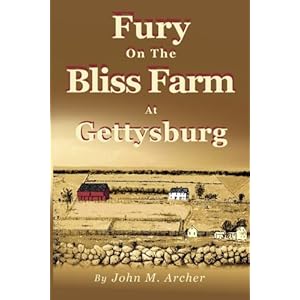
Fury On The Bliss Farm At Gettysburg, John M. Archer, Ten Roads Publishing, 80 pages, 24 photographs and maps, appendix, end notes, index, 2012,, $9.95.

Many debates have occurred regarding whether Gettysburg was a turning point of the Civil War. Other debates have risen with the question: What was the turning point of the Battle of Gettysburg. If July 2 is the bloodiest day of the battle and if Longstreet's assault was a main feature of that day, then what event marked the end of the assault? The assault ended or failed on the Bliss Farm, located on the west side of the Emmitsburg Road and opposite the Abraham Bryan farm.  John M. Archer, a licensed Gettysburg battlefield guide,  has written on the Bliss Farm in America's Civil War magazine and has been filmed, by the Pennsylvania Cable Network, guiding a tour of the location.  With Fury On The Bliss Farm At Gettysburg, he offers a clear and concise booklet of one his popular tours.

In 1857 William Bliss and his family moved from western New York to Adams County, Pennsylvania and purchased a 44 acre farm with its double log and frame house, a large banked barn, two water wells that featured pumps, and a large fruit orchard that held principally cherries and peaches. On July 2 his farm was fought over and on July 3 it the buildings were burned. Archer describes the multiple infantry charges with the capture and recapture of the farm buildings several times. During the July 3 Grand Assault, Confederates' left flank maneuvered around the smoking and smoldered embers of the buildings.

Archer's six stop tour begins on the east side of Emmitsburg Road at Ziegler's Grove, moves to the Brian Farm and then the 14th Connecticut monument. Stops 4, 5, and 6 are on the west side of Emmitsburg Road. The Confederates' important occupation of Long Lane, the multiple attempts to take and hold the farm buildings, and the role of the Bliss Farm in Wright's occupation of Cemetery Ridge are thoroughly explained. In three appendices, Archer describes the nature of skirmishing and Wright's breakthrough; also armies' the order of battle is offered. Fury On The Bliss Farm At Gettysburg is useful for the armchair reader and the battlefield visitor who desires an informed walk describing what might be the apex of Longstreet's July 2 assault.

Monday, October 29, 2012

New and Noteworthy---History and Guide to Civil War Shepherdstown: A Community of Suffering

A History and Guide to Civil War Shepherdstown: Victory and Defeat in West Virginia's Oldest Town, Nicholas Redding, Schroeder Publications, 144 pages, 56 illustrations, 6 maps, 2 appendices, order of battle, endnotes, index, 2012, $14.95.

 A History and Guide to Civil War Shepherdstown: Victory and Defeat in West Virginia's Oldest Town offers a intriguing description  of a village that began the war in Virginia and ended the war in West Virginia. Nicholas Redding finely balances aspects of Shepherdtown's citizens, it buildings and industries, and its proximity to Harpers Ferry, South Mountain, and the Battle of Sharpsburg. A third of the book presents Shepherdstown in the path of war. Wesley Culp, a recent immigrant from Adams County, Pennsylvania is typical of the town's  citizens who are divided in their allegiances. Reddington relies on eyewitness accounts of Shepherdtown's conflicted loyalities: Dr. Charles Wesley Andrew, Caroline Bedinger, and Henry Kyd Douglas and the Shepherdstown Register newspaper.

The middle third of the book is a guide to the Civil War sites in present-day Shepherdstown. The first third of the book is not retold; the discussion offers additional information that further clarifies the suffering and destruction of the town. The burning of the covered, two lane Potomac River bridge is well told and illustrated. Redding presents a black and white illustration of the bridge intact and a photograph of the remnants of the pilings.  Remarkably the illustration and the photograph were made from nearly the same location and reveals much about Shepherdstown. Ferry Hill in Maryland overlooks Shepherdstown and was the home of Henry Kyd Douglas, whose father practiced law across the river. Hotels, the town hall,  graffitti, homes that became hospitals, the residence of a Confederate spy, the site of the wagon shop where Wesley Culp was employed, churches and the cemetery are described and presented with personal primary source accounts of the structures' appearance and uses.

The final third of the book is a clear and concise history and guide to the September 1862 battle at Shepherdstown. Offered as a appendix, Mary Bedinger Mitchell's article in the 1886 Century Magazine recounts Shepherdstown citizens' experiences of the battles of South Mountain, Antietam and Shepherdstown. A second appendix is Henrietta Lee's lamentation addressed to Union general David Hunter; it presents the heartfelt anger of woman whose ancestral home was intentionally burned on the orders of the general.

History and Guide to Civil War Shepherdstown: Victory and Defeat in West Virginia's Oldest Town is both a satifying portrait of a border community overcome by the war and a guide book to the historic town. Redding's use of period photography, pen and ink sketches and primary sources is commendable. He introduces intriguing episodes that may compel readers to look further into Shepherdstown's history:  the Confederate spy network in the county, the printing of money that could be spent only in the town and the African Americans who remained in the town during the course of the war. 

Nicholas Redding's interview by the Civil War Trust

Friday, October 26, 2012

News--- Arkanasas Teenage Confederate Spy Remembered

 Long After Death, Confederate Spy Remembered, Jeannie Nuss, Asociated Press, October 15, 2012.

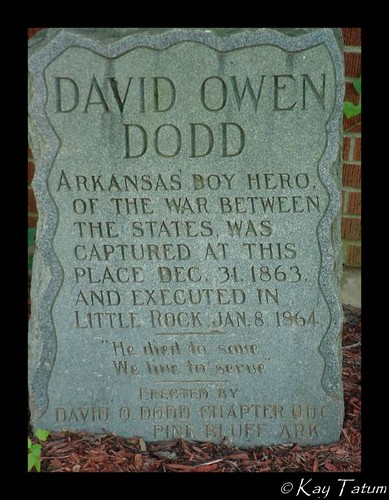
The story of David O. Dodd is relatively unknown outside of Arkansas, but the teenage spy who chose to hang rather than betray the Confederate cause is a folk hero to many in his home state.
Street signs and an elementary school in the state capital have long borne Dodd's name, and admirers gather at his grave each year to pay tribute to Dodd's life and death.  "Everyone wants to remember everything else about the Civil War that was bad," said one of them, W. Danny Honnoll. "We want to remember a man that stood for what he believed in and would not tell on his friends."

A state commission's decision, though, to grant approval for yet another tribute to Dodd has revived an age-old question: Should states still look for ways to commemorate historical figures who fought to defend unjust institutions? "(Dodd) already has a school. I don't know why anything else would have to be done to honor him," James Lucas Sr., a school bus driver, said near the state Capitol in downtown Little Rock. Arkansas' complicated history of race relations plays out on the Capitol grounds. A stone and metal monument that's stood for over a century pays tribute to the Arkansas men and boys who fought for the Confederacy and the right to own slaves. Not far away, nine bronze statues honor the black children who, in 1957, needed an Army escort to enter what had been an all-white school.

The newest nod to Dodd would mark a site across town where he was detained after Union soldiers found encoded notes on him about their troop locations. Dodd was convicted of spying and sentenced to death, and legend has it he refused an offer to walk free in exchange for the name of the person who gave him the information.  "He was barely 17 years old when the Yankees hung him" on Jan. 8, 1864, Honnoll said. "Yeah, he was spying, but there (were) other people that spied that they didn't hang."

Dodd is certainly not the only teenager to die in the war or even the lone young martyr, said Carl Moneyhon, a University of Arkansas at Little Rock history professor.  "If you start talking about the 16-, 17- and 18-year-olds who were killed in battle, the number is infinite," Moneyhon said. "There are tens of thousands of them. They become unremarkable."  So it seems all the more curious that some have come to portray Dodd as Arkansas' boy martyr.

Text Source and Full Text Continued at Associated Press
Image Source: Kay Tatum at Arkansas Sites

Thursday, October 25, 2012

News---1960s-1990s Iconic Photographer Annie Liebovitz Is Captured by Gettysburg

securedownload.jpegPhotographer Annie Leibovitz, Celebrated For Her Portraits of Famous People, Turned To Historic Places For Her Latest Project, "Pilgrimage," Now On Display In Gettysburg, David Dunkle, The Patriot News, October 24, 2012

 Photographer Annie Leibovitz talks Wednesday morning about "Pilgrimages," her new photography exhibit at the Gettysburg National Military Park Museum and Visitor Center.   For Leibovitz, this meant visiting places in the United States, Canada and England that were iconic in their way, but were also spots that just drew her to them.
 
These ranged from Niagara Falls and folk singer Pete Seeger's workshop, both in upstate New York, and artist Georgia O'Keeffe's studio in New Mexico. She also visited photographer Ansel Adams' studio in Carmel, Calif., the home of poet Emily Dickinson in Massachusetts. and rock and roll king Elvis Presley's Graceland mansion in Tennessee. And of course, Gettysburg, where a tremendous battle between huge Union and Confederate armies fought in July 1863 helped to set the course of the United States up to the present day.

"This is truly not my normal work, but it's not so far from my normal work either," Leibovitz said Wednesday morning during a news conference to announce the opening of an exhibit of her "Pilgrimage" work at the Gettysburg National Military Park Museum and Visitor Center. "It's sort of the peripheral vision of my usual work."  The exhibit officially opens Thursday and continues through Jan. 20, 2013. Access is included as part of regular museum admission.

"Annie is without a doubt one of the most famous photographers in the world, and her photographs capture the culture of our time," said Joanne Hanley, president of the Gettysburg Foundation, which runs the museum and visitors center in concert with the National Park Service. "But today we are seeing a different side of Annie. The photographs in this exhibit were taken simply because she was moved by the subject."

"I wanted to see what was inside me," she said of her reaction to the battle against lawsuits seeking up to $24 million from her. "It was something that built slowly over a period of time. It was an extraordinary journey of soul-searching."  . . . .

Leibovitz said she backed into the project, which coincided with a period of time when she was facing severe financial problems that could have cost her control of her own photographs, which include famous portraits of John Lennon and Yoko Ono, taken earlier on the day the ex-Beatle was murdered in New York City, and a nude and very pregnant Demi Moore.  "I thought I would come to Gettysburg and take a simple photograph of the battlefield. Of course, nothing is ever that simple." - Annie Leibovitz, on what she called "a bad day," she took her daughters to Niagara Falls, and was fascinated by how fascinated they were by the natural wonder. That led her to develop a preliminary list of about a dozen places where a pilgrimage would be appropriate.
 
The 70 photos now on display in the museum and visitor center include two she took on the battlefield at Gettysburg. One is of the Jacob Lott farm, which was at the center of the Union lines on the final day of the battle and it still being farmed today. The other is a shot of Devil's Den, where a famous Civil War photo, "Home of a Rebel Sharpshooter," was taken just days after the battle by Alexander Gardner.  Her trip to Gettysburg, a place she had visited as a child, was sparked by visits to Lincoln exhibits at the Smithsonian Institutes in Washington, D.C., and the Abraham Lincoln Presidential Library and Museum in Springfield, Ill.

"I didn't know what I was getting myself into when I thought about the Lincoln Memorial and what that meant," Leibovitz said. "But it led me to Gettysburg. I thought I would come to Gettysburg and take a simple photograph of the battlefield. Of course, nothing is ever that simple."
She admitted that she shot the photo of the Lott farm, which shows wash hanging from a clothesline in the yard with battlefield memorials in the background, before asking permission of the current owners. "I was just praying they were going to say 'yes' when I did ask them for permission," she said. "Thankfully, they did."

Leibovitz, 63, has mostly overcome her financial problems, and is back to concentrating on the work that made her one of the world's most famous photographers. Her work has graced dozens of covers for Rolling Stone, Vanity Fair and Vogue magazines, and her "Pilgrimage" project has been published in hardcover with an introduction by noted historian Doris Kearns Goodwin.

Leibovitz said she hoped her work would inspire others to follow in her path, or make their own.  "Anyone can go to any of these places," she said. "Gettysburg is there for anyone. It's all there for anyone."
 
Text Source, Full Text Source, and Image Source: The Patriot News, October 24, 2012

Monday, October 22, 2012

News: Spielberg Answers Questions--Why Lincoln? Why Are The Names of the Democratic Senators Changed?

Steven Spielberg Shares His Daddy Issues Talks Linocln on 60 Minutes, October 21, 2012.

Steven Spielberg’s career can be roughly divided into two distinct periods: the Mad at Dad phase, and the Reconciliation phase. The director admitted as much in a probing 60 Minutes interview last night. See, Spielberg’s parents, Arnold and Leah, got divorced when he was 19 — and for the following 15 years or so, Spielberg was furious with his father. He thought workaholic Arnold, an engineer, had instigated the split after years of ignoring his family in favor of his job.

What Steven didn’t know was that his beloved mother had actually fallen for another man — one of Arnold’s friends. As adorable 95-year-old Arnold explained to Lesley Stahl last night, he didn’t tell his son the truth for years because he was still in love with Leah… and Spielberg responded by littering movies like E.T. and Hook with absentee fathers or the void they left behind. Eventually, Steven’s wife, Kate Capshaw, prodded him to make peace with Dad — ultimately leading to films like War of the Worlds and Lincoln.

Not interested in Spielberg’s psychology? Press “play” on the first video and skip ahead 10 minutes. You’ll miss Spielberg discussing his daddy issues and his brushes with antisemitism — but you’ll get inside scoop on Lincoln, the director’s latest perfectly engineered Oscar-bait project. You could also just watch the second clip, which takes a more in-depth look behind the scenes of Lincoln — complete with a brief appearance by the famously taciturn Daniel Day-Lewis. It also features John Williams playing the theme from Jaws.

Link to Enterainment Weekly's webpag that contains the 60 Minutes segment that contains a 14 minute report with an interview and a link for Sixty Minutes Overtime that lasts 6:22 minutes with discussion of Daniel Day-Lewis' performance, why Spielberg changed the names of Democratic senators, and James Horner's creation of the soundtrack.

News: Major Structure on Ball's Bluff Battlefield Preserved

NVRPA, Civil War Trust, Close In On Purchase of Jackson House, October 19, 2012
Photo 1The Northern Virginia Regional Park Authority is close to acquiring the Jackson House property, which is adjacent to Ball’s Bluff Battlefield. The venture was made possible via a partnership with the Civil War Trust, who will help with the purchase and then donate the property to NVRPA to manage.
“We are so thrilled to be in partnership with the Civil War Trust in preserving a number of significant Civil War properties,” said NVRPA Executive Director Paul Gilbert. “Today, we are working on the acquisition of the Jackson House and the expansion of the Ball’s Bluff Battlefield. Recently, we celebrated another joint NVRPA/Civil War Trust project in preserving Mt. Defiance, a key site in the Battle of Middleburg.”
In addition to increasing the area of the Ball’s Bluff Battlefield property, the house also has a significant place in the battle’s history. James Morgan, author of “A Little Short of Boats: The Fights at Ball's Bluff and Edward's Ferry” notes that the house was a key landmark during the conflict.  Adjacent to the current battlefield park, the house was a key landmark around which the morning phases of the battle of Ball’s Bluff were fought,” Morgan said. “Union troops centered their initial line of battle around it. The widowed Mrs. Margaret Jackson, her seven children, and part of a neighboring family are known to have taken shelter in the basement as Union and Confederate troops fought around and through the house on the morning of October 21, 1861. A Union soldier later wrote of hearing the cries of the women and children below.”
According to Brian Knapp, Chairman of the NVRPA Board, the Jackson house would most likely exist as a simple rental property. However, NVRPA has much larger plans for the property down the road.  “In the long term, we plan to turn the Jackson house into a visitor center for Ball’s Bluff, and the public in Northern Virginia and elsewhere will be able to learn more about this battle and how the Civil War shaped and influenced our region,” Knapp said. “ We look forward to working with our many partners in the region – especially the Friends of Ball’s Bluff Battlefield - to make this vision a reality.”
Photo 3Morgan, who also chairs the Friends of Ball’s Bluff Battlefield, added “The Friends of Ball’s Bluff Battlefield would consider the acquisition of the Jackson house to be a dream come true. The property was the center of the morning skirmishing but, up to now, has not been part of the battlefield park. This purchase would allow us, for the first time, to properly interpret that phase of the battle on the actual site. We hope eventually to see the house become the Ball’s Bluff visitor center and museum.”
Ball’s Bluff Battlefield is located at the end of Ball’s Bluff Road in Leesburg. The park is open during daylight hours year round. The park was also one of the primary subjects in the recent documentary “Region Divided: Civil War in the Northern Virginia Regional Park,” created by NVRPA and Fairfax County Government Access Television, and narrated by Roger Mudd. The Balch Library in Leesburg will hold a public screening of the film on Sunday, October 21, 2012, from 2-4 p.m.
Text and Image Source:   Northern Virginia Regional Park Authority

Wednesday, October 17, 2012

New and Noteworthy: 1863, The Volunteer State, Longstreet and Burnside

The Knoxville Campaign: Burnside and Longstreet in East Tennessee, Earl J. Hess, University of Tennessee Press, 440 pp., notes, bibliography, maps, photographs, $39.95

From the Publisher: In the fall and winter of 1863, Union General Ambrose Burnside and Confederate General James Longstreet vied for control of the city of Knoxville and with it the railroad that linked the Confederacy east and west. The generals and their men competed, too, for the hearts and minds of the people of East Tennessee. Often overshadowed by the fighting at Chickamauga and Chattanooga, this important campaign has never received a full scholarly treatment. In this landmark book, award-winning historian Earl J. Hess fills a gap in Civil War scholarship—a timely contribution that coincides with and commemorates the sesquicentennial of the Civil War.

The East Tennessee campaign was an important part of the war in the West. It brought the conflict to Knoxville in a devastating way, forcing the Union defenders to endure two weeks of siege in worsening winter conditions. The besieging Confederates suffered equally from supply shortages, while the civilian population was caught in the middle and the town itself suffered widespread destruction. The campaign culminated in the famed attack on Fort Sanders early on the morning of November 29, 1863. The bloody repulse of Longstreet’s veterans that morning contributed significantly to the unraveling of Confederate hopes in the Western theater of operations.
Hess’s compelling account is filled with numerous maps and images that enhance the reader’s understanding of this vital campaign that tested the heart of East Tennessee. The author’s narrative and analysis will appeal to a broad audience, including general readers, seasoned scholars, and new students of Tennessee and Civil War history. The Knoxville Campaign will thoroughly reorient our view of the war as it played out in the mountains and valleys of East Tennessee.

“Hess’s account of the understudied Knoxville Campaign sheds new light on the generalship of James Longstreet and Ambrose Burnside, as well as such lesser players as Micah Jenkins and Orlando Poe. Both scholars and general readers should welcome it. The scholarship is sound, the research, superb, the writing, excellent.” —Steven E. Woodworth, author of Decision in the Heartland: The Civil War in the West

"Applying his discerning eye to yet another important but neglected aspect of the Civil War, Hess provides us now with the most though and professional examination of the Knoxville campaign we have, or are ever likely to have." —William J. Marvel, author of Tarnished Victory: Finishing Lincoln’s War
“Anyone who believes that everything significant that could be said about the Civil War has already been written must also be unfamiliar with Earl J. Hess, whose books tend to make historians studying the same subjects consider choosing other ones instead. The Knoxville Campaign, often overlooked or even dismissed as largely insignificant, can now be understood in its proper context at last. Operations in East Tennessee have never been so closely examined, so vividly described, and so convincingly explained as Hess does here in the first comprehensive study of this campaign and its impact on Union and Confederate strategy in the Western Theater.” —J. Tracy Power, author of Lee’s Miserables: Life in the Army of Northern Virginia from the Wilderness to Appomattox

EARL J. HESS is Stewart W. McClelland Distinguished Professor in Humanities and an associate professor of history at Lincoln Memorial University. He is the author of nearly twenty books, including The Civil War in the West—Victory and Defeat from the Appalachians to the Mississippi and Lincoln Memorial University and the Shaping of Appalachia.

Monday, October 15, 2012

Review---Lincoln's 100 Days Between September 22 1862 and January 1 1863

Jim Cullen's Review of Louis P. Masur's Lincoln's 100 Days: The Emancipation Proclamation and the War For the Union, [Oxford 1862]


Louis P. Masur's latest book stands at the intersection of two important long term trends in Civil War historiography (and, by extension, U.S. historiography generally). The first a post-1960s emphasis on foregrounding the racial dimension of the conflict, asserting slavery was the precipitating cause and abolition as the primary significance of its outcome. This would almost be so obvious among scholars to not bear mentioning if such emphasis was not primary before the late twentieth century, and if there didn't remain vocal segments in the culture at large that explicitly reject it. The other, more recent trend is a new emphasis on political history, in effect closing a circle that began with a move toward social history in the 1970s and '80s and cultural history in the 1990s and 2000s. In recent decades historians have tried to affirm their commitment to a democratic discourse by affirming the agency of individual actors at the ground level rather than the Words and Deeds of Great Men. Like all well-intentioned (or perhaps just intellectual marketplace-driven) trends, however, such tendencies have perhaps reached the point where they conceal more than they reveal. Who's running the government at any given time really may matter after all.

Given this context, there may well have been a spate of Emancipation Proclamation books even if its 150th anniversary was not at hand (President Lincoln issued the preliminary Proclamation on September 22, 1862, and the final one putting it into effect on January 1, 1863). In recent years, a string of heavyweight scholars -- among them Allen Guelzo, Harold Holzer, and, going back a bit further, John Hope Franklin -- have made it the subject of volume-length studies. This is interesting when one considers the traditional perception of the E.P., captured most vividly by Edmund Wilson, who in Patriotic Gore famously described it as having "all the moral grandeur of a bill of lading." But just as the center of gravity in the military history of the war has shifted from Gettysburg to Antietam, so too is the E.P. getting a second look as a document as carefully crafted, and eloquent in its own way, as the Gettysburg Address.


Full Text Continues at  History News Network, October 15, 2012

Tuesday, October 09, 2012

News---First Look of Film 'Lincoln' Occurs in UK

Lincoln, First Look At The Film in UK,  Katey Rich, The Gaurdian,  October 8, 2012 

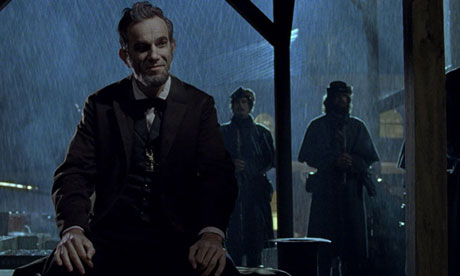
Playing politics … Daniel Day-Lewis as the president in Lincoln.Politics was a dirty business even in the 19th century, and even when changing history for the better, as the best moments of  Lincoln  wittily and elegantly prove. Steven Spielberg's  behemoth of a new film, which premiered in unfinished form at the New York film festival Monday night, has a title that suggests a sweeping portrait of the great 16th American president. But the film is largely too content depicting Abraham Lincoln as an all-knowing icon, and even with Daniel Day-Lewis's beautifully measured (and surprisingly soft-spoken) performance, Lincoln often recedes to the background of the very uneven movie that bears his name.
 
The screenplay from Pulitzer prize-winner Tony Kushner focuses on just the last four months of Lincoln's life, as he works in Washington to end the civil war raging just south of him, but not before passing an amendment to officially outlaw slavery. The backroom deals and legal hurdles to make that happen are immensely complicated, but after some bulky exposition this wheeling and dealing among lawmakers makes for the film's strongest scenes. Secretary of State William Seward (David Strathairn) hires a trio of hooligans (John Hawkes, Tim Blake Nelson and James Spader) to rustle up votes for the amendment through whatever means necessary, while on the floor of the House of Representatives, anti-slavery lawmaker Thaddeus Stevens  (a gloriously scene-stealing tommy Lee Jones) bellows at pro-slavery Fernando Wood (Lee Pace), with the roomful of men around them banging on their desks and shouting over each other. If only modern American politics were remotely as entertaining.

We visit the battlefield a few times, with General Ulysses S Grant (Jared Harris) preparing to negotiate peace with the Confederacy, but Lincoln is largely set in the cramped chambers of the White House and Congress; between that and the many speeches about constitutional law, it can start to feel a little airless. Glimpses into Lincoln's personal life, including strained relationships with both his wife (Sally Field) and eldest son (Joseph Gordon-Levitt), are intended to add a human dimension to the president, but they're never as effective as simply seeing the man at work; Gordon-Levitt has had a fantastic year in other films, but his character here is entirely superfluous, and Field brings tremendous overacting to a cast that's otherwise quite restrained.

Lincoln isn't as sentimental as you might expect from Spielberg, and though it never digs deep enough into Lincoln as a man, it's unafraid to show him as a canny politician willing to bend the law and make enormous compromises to accomplish a greater goal. With John Williams's gentle score, posh cinematography from Janusz Kaminski and a whole load of big costumes and facial hair for the cast, Lincoln veers too often toward becoming a somnolent period piece, but the strong cast and political texture always manage to perk things back up. Though it might have worked better as a tighter, purely political thriller with even less focus on the title character, Lincoln's smarty-pants pleasures manage to outweigh its stuffy drawbacks.

Text and Image SourceThe Gaurdian

CWL:  Lincoln will be released in the US on November 9, 2012

Lincoln


News---Drink Beer and Support Civil War Museums

Civil War Beer Crafted In Frederick, Ike Wilson, Frederick News Post, October 8, 2012.

The first of nine beers to commemorate the 150th Civil War anniversary -- Antietam Ale -- is now on tap. The concoction was derived from a number of beer recipes from the 1800s and researched by National Museum of Civil War Medicine researcher Terry Reimer. Monocacy Brewing Co. in Fredeerick  bottled the first batch Sept. 28 for distribution.

Antietam Ale is based on a recipe for an English-style ale once brewed by Brewer's Alley -- a style commonly referred to as an ordinary bitter, Brewer's Alley marketing manager Jim Bauckman said. The National Museum of Civil War Medicine provided brewmaster Tom Flores with a variety of historic recipes that likely resemble the flavor profile of Antietam Ale, Bauckman said.  The strength is relatively low compared with that of modern beer renditions, Flores said, but making the brew still involves a lot of complexity. "The harmony of all the flavors, and making all the delicate intensity work, was important," Flores said.   Antietam Ale has a slight hoppy presence that is quickly balanced by the flavor of specialty malts, Bauckman said.

Full Text Continued at Frederick News Post October 8, 2012 

CWL: On Saturday while eating a meal in the Pry House Barn on the Antietam Battlefield I bought a National Museum of Civil War Medicine glass tumbler and refilled it twice.  A good beer with good food at a good place.


Wednesday, October 03, 2012

Review: Russell Bond on the New Grant Biography

imageThe Man In Grant's Tomb: A Review of H.W. Brands' The Man Who Saved the Union, Wall Street Journal, September 29-30, 2012

'It's a bad business to fall in love with dead people," historian Brooks D. Simpson has sensibly warned—yet biographers often do just that, particularly when presenting the lives of American military heroes. The foremost example is Confederate Gen. Robert E. Lee, unquestionably a great commander but one whose mistakes and human failings were glossed over for generations. Lee's daring victories against the odds were romanticized by biographers who cast him as the ideal gentleman-soldier and the symbol of the Lost Cause. Meanwhile, tradition portrayed Lee's adversary, Ulysses S. Grant, as a besotted butcher who won the Civil War by unimaginative reliance on superior manpower and whose tenure as president was characterized by bumbling and corruption.

A backswing of the pendulum was inevitable. In recent decades, historians such as Thomas Connelly have questioned Lee's character and military acumen, mocking him as "the Marble Man"—a West Point nickname for Lee now used to signal an icon above criticism. Even as Lee's reputation has declined, Grant's has ascended—so much so that it is now Grant who arguably deserves the "marble" mantle.

Grant has come to rival Abraham Lincoln as the Civil War's most popular and revered biographical subject. William S. McFeely's Pulitzer Prize-winning "Grant: A Biography" (1981) ushered in the modern era of Grant scholarship, but its still-critical take on Grant's generalship sparked a flurry of responses trending toward hagiography. More than a dozen biographies, "dual biographies" and studies of Grant have been published in the past 15 years, their authors lauding Grant as a "genius" and a "savior"—all the while insisting that he has been "overlooked" and "underrated." (More balanced treatments, such as Mr. Simpson's excellent "Ulysses S. Grant: Triumph Over Adversity, 1822-1865," are the exception.) Recent historians have not so much drawn Grant's portrait as erected new monuments to him.

For full text of the review go to the Wall Street Jounal, September 2903, 2012